
On this page
Start here
Quick answer
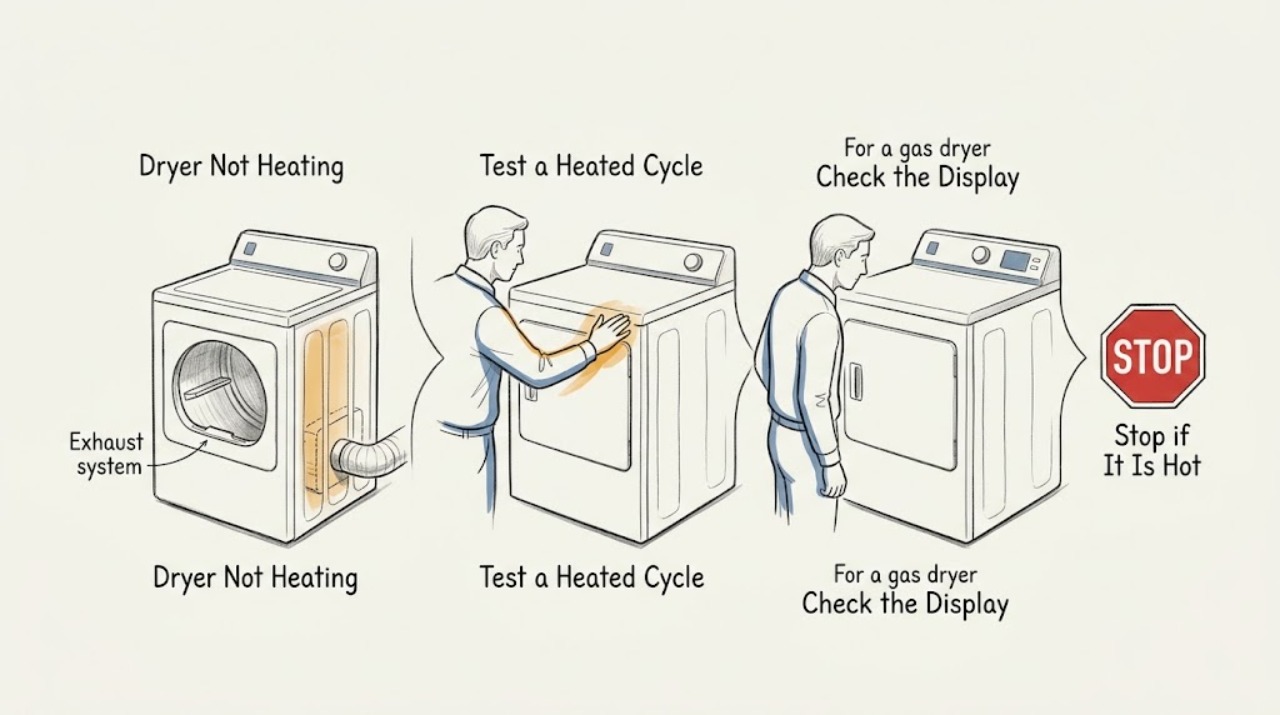
If a Crosley dryer tumbles but produces no heat, first confirm that the selected cycle and temperature are not Air Dry or No Heat. Then check the lint screen, accessible exhaust path, and outside airflow. For an electric dryer, a tripped breaker or fuse can leave the drum turning without heat; for a gas dryer, the external supply valve must be open, but do not investigate gas piping yourself. If the dryer has a burning odor, smoke, repeated breaker trips, no airflow, or still has no heat after these user checks, stop using it and arrange qualified appliance service.
Work through in order
Diagnostic checks
Use only checks that match the exact appliance or system and its official guide.
-
Check 1
Identify whether the Crosley dryer is electric or gas, then select a normal heated cycle and temperature for the fabric. Confirm that Air Dry, No Heat, or another heat-free option is not selected, and press Start as required by the model.
Expected result: A dryer on Air Dry or No Heat can tumble without producing warmth. If a normal heated cycle still tumbles with room-temperature air, continue with the power or gas-supply branch.
Next step: Run one supervised test with a suitable load. If the selected heated cycle still has no warmth, check power for an electric model or the external supply condition for a gas model.
Why this matters
Why: The cycle and temperature selection can reproduce a no-heat symptom without a failed component; correcting it is the lowest-risk first check.
-
Check 2
For an electric Crosley dryer, stop the cycle and check the household breaker or fuses that supply the appliance. Restore only a breaker that resets normally; do not open the electrical panel beyond ordinary user controls or perform electrical measurements.
Expected result: The drum can turn while an electrical supply problem leaves the heater without power. A breaker that trips again, a damaged cord, or a dryer that still has no heat after stable power indicates a service or electrical fault.
Next step: If the breaker resets and stays on, perform one brief heated test. If it trips again or no heat returns, stop and arrange qualified electrical or appliance service.
Why this matters
Why: Electric dryers use separate supply paths for motor and heat on some installations, so tumbling alone does not prove the heating supply is healthy.
-
Check 3
For a gas Crosley dryer, verify only that the external supply shutoff is in its normal open position if you know the installation and there is no gas odor. Do not disconnect the gas line, remove fittings, or attempt to adjust a regulator or burner.
Expected result: A closed supply valve can prevent a gas dryer from heating while other dryer functions may still operate. A valve that is already open with no heat, any gas odor, or uncertainty about the gas installation is not a user-repair condition.
Next step: If there is any gas odor, stop immediately and leave the area safely. Otherwise, with the external supply condition confirmed, move to the lint and airflow check; persistent no heat needs service.
Why this matters
Why: The fuel supply is a necessary branch for gas heating, but internal ignition and gas-flow diagnosis requires qualified service.
-
Check 4
Stop the dryer, clean the lint screen, reinstall it firmly, and inspect the accessible exhaust hose and outside hood for lint, crushing, kinks, or an obstruction. With no odor or other safety concern, run the dryer briefly and check whether air exits at the outside hood.
Expected result: A coated screen, crushed hose, blocked hood, or little outside airflow indicates an exhaust restriction. Normal airflow with no warmth makes a cycle, power, gas, or internal heating fault more likely.
Next step: Clear only user-accessible lint and restore the vent path. If the duct is inaccessible or needs cabinet disassembly, use a qualified technician.
Why this matters
Why: Restricted airflow can make clothes remain damp and can overheat the dryer, so it must be corrected before repeated heating tests.
-
Check 5
If the dryer still tumbles without heat after the cycle, supply, lint screen, and airflow checks, stop testing and record the model number, fuel type, selected cycle, and whether the drum was turning. Do not remove the cabinet to inspect the heater, thermal cutoff, igniter, motor, timer, or wiring.
Expected result: A persistent no-heat symptom with normal user settings and accessible airflow has not been resolved by an external check. Any internal part could require model-specific testing, and the symptom alone cannot identify which part failed.
Next step: Leave the dryer off and arrange qualified appliance service. Include any breaker behavior, gas-supply observation, airflow result, and unusual odor in the service description.
Why this matters
Why: Continuing to run a dryer with an unresolved heat or airflow fault can create a fire or equipment risk; guessing a replacement part is not a safe diagnosis.
Use your observations
Decision map
Find the observation that best matches what you see, then follow the next safe action.
-
PATH 01Next step
What you see
Air Dry, No Heat, or another heat-free setting is selected.
Do this next
Choose a normal heated cycle and temperature suitable for the load, then perform one supervised test.
-
PATH 02Next step
What you see
An electric dryer tumbles but the supply breaker or fuse has opened.
Do this next
Restore only a breaker that resets normally. If it trips again or heat remains absent, stop and arrange qualified electrical or appliance service.
-
PATH 03Next step
What you see
A gas dryer has a closed external supply valve and no gas odor.
Do this next
Have the external supply condition corrected according to the installation instructions; do not disconnect gas piping or service internal ignition parts.
-
PATH 04Next step
What you see
The lint screen or exhaust path is restricted, or little air exits the outside hood.
Do this next
Clean accessible lint and correct accessible vent restrictions. Use qualified help for inaccessible duct or cabinet work.
-
PATH 05Next step
What you see
The dryer still has no heat after external checks, or there is smoke, a burning odor, a gas odor, repeated breaker action, or visible damage.
Do this next
Stop using the dryer and arrange qualified appliance or electrical service. For a gas odor, leave the area and contact gas or emergency help from a safe location.
Helpful context
Understand the symptom
Start by separating heat loss from slow drying
A dryer that tumbles with room-temperature air has a different path from one that produces heat but takes too long. Check the air at the outside exhaust and the load after a brief, supervised test only when there is no odor or other safety concern. A clogged screen or vent can make drying slow and can create overheating risk, while a correct heat setting with no warm air points toward power, gas supply, or an internal heating fault.
Safety before heat troubleshooting
Do not run the dryer with a missing or damaged lint screen, and do not reach into a moving drum. Disconnect power before any cleaning that requires touching the appliance, and never open the cabinet to test a heater, thermal fuse, igniter, wiring, or live supply. For a gas odor, do not operate switches or use a flame; leave the area when safe and contact the gas utility or emergency help from a safe location.
When checks do not resolve it
Need a professional?
Qualified appliance service is appropriate for persistent no heat after cycle, supply, lint screen, and airflow checks, or for any internal heating, ignition, motor, thermal, or electrical diagnosis.
Common questions
FAQ
Why does my Crosley dryer tumble but not heat?
Check that a heated cycle is selected, then check the supply path for the electric or gas model and inspect the lint screen and outside airflow. If the drum still tumbles without heat, qualified service is needed.
Can a tripped breaker cause a Crosley dryer to have no heat?
Yes. Crosley notes that an electric dryer can continue turning while an opened fuse or breaker removes heat. Restore only a breaker that resets normally; repeated trips require qualified service.
What should I check on a gas Crosley dryer with no heat?
Verify only the external supply condition if you know the installation and there is no gas odor. Do not disconnect gas piping or open the dryer. If the valve is open and there is still no heat, arrange qualified service.
Can a clogged vent make a Crosley dryer stop heating?
A restricted lint screen or exhaust path can reduce airflow, lengthen drying, and create overheating risk. Clean accessible lint, check the outside hood, and use qualified help for inaccessible duct work.
Read the exact guide
Official sources
- Quick Start Guide Crosley DryerCrosley · Crosley guidance for selecting a cycle and temperature, Automatic Dry sensing, Timed Dry, and heat-free settings.
- Electric or Gas Dryer Use and Care GuideCrosley · Crosley guidance for no heat, cycle selection, electric supply, gas supply, lint screens, exhaust airflow, and service boundaries.
- Dryer Owner's ManualCrosley · Crosley owner guidance for safe dryer operation, power and fuel boundaries, lint care, and service escalation.
Community feedback
Share a repair observation
Share a plain-text repair observation. Accepted observations are published automatically; this page may take a moment to update.