
On this page
Start here
Quick answer
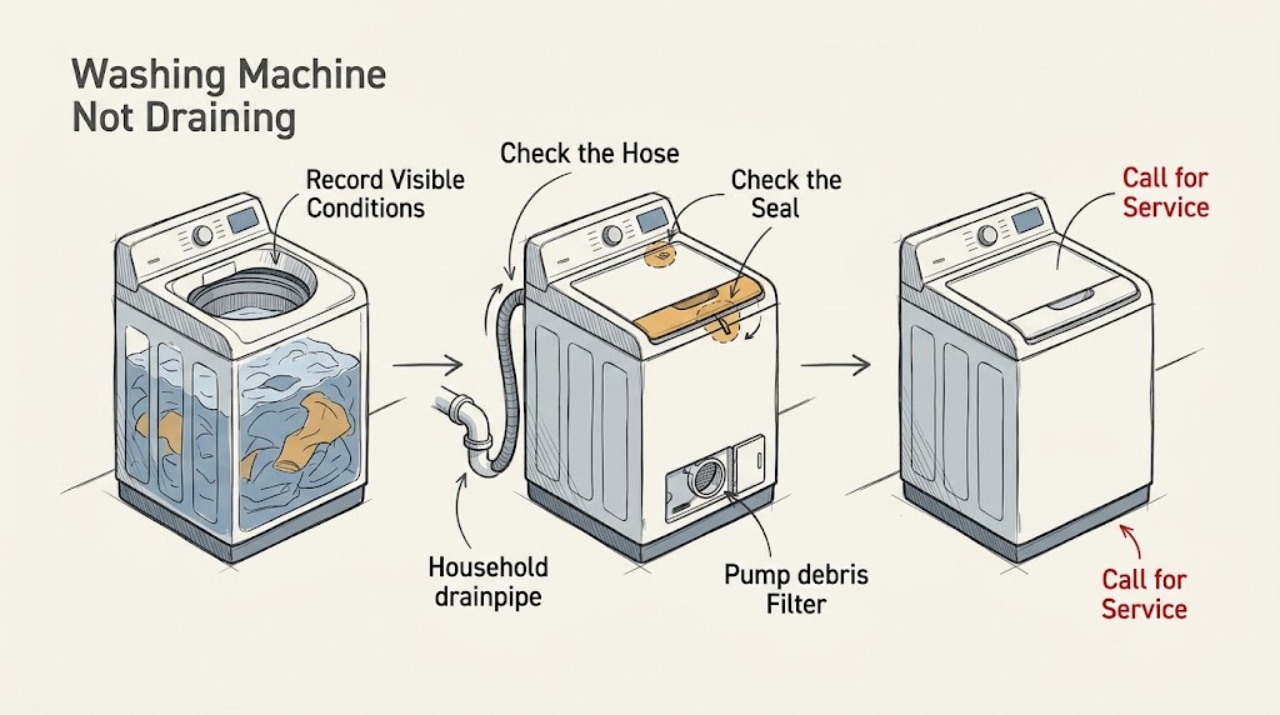
If a Crosley washer leaves water in the tub, first pause it and keep the lid or door closed until the basket has stopped. Check the external drain hose for kinks or a blockage, confirm the hose is installed with the model's required air gap and position, and inspect the household drain. If the model provides an accessible pump or debris filter, unplug the washer, wait for cool water, and follow the exact manual's controlled-drain procedure; do not open a filter with a full tub or force a locked door. Crosley guidance also identifies small objects in the pump, an overloaded or unbalanced load, and excess detergent suds as reasons a cycle may fail to drain or spin. Stop for a leak near electrical parts, smoke, burning odor, a hot cord, repeated breaker trips, or a pump that needs internal testing.
Work through in order
Diagnostic checks
Use only checks that match the exact appliance or system and its official guide.
-
Check 1
Pause the cycle and record whether water remains in the tub, whether the pump makes a humming or silent sound during a permitted drain command, whether the load is only wet, and whether a code or status light is present.
Expected result: The tub is full or partly full, the pump hums without moving water, the washer is silent, or the tub is empty but spin did not complete.
Next step: Follow the branch matching the observation. Keep the lid or door closed while water remains and arrange service if the machine cannot drain safely or the symptom returns after external checks.
Why this matters
Why: Retained water points to the drain hose, household drain, filter, pump, or suds path. A wet load with an empty tub can instead reflect low spin, an unbalanced load, or a programme choice. A silent pump or recurring code is not proof of a failed part without model-specific testing.
-
Check 2
Inspect the external drain hose from the washer to the standpipe, laundry tub, or household drain without disconnecting a pressurized water line. Straighten kinks, check that the washer is not sitting on the hose, and compare the hose depth, height, loose fit, and air gap with the exact installation instructions.
Expected result: The hose is kinked, crushed, pushed too far into the standpipe, sealed or taped in place, routed too high, or correctly positioned with an air gap.
Next step: Correct only the external hose routing, then run one supervised drain or drain-and-spin test. If the hose is clear and correctly installed but water remains, continue to the household drain and filter checks.
Why this matters
Why: A restricted hose can slow or stop pumping, while an incorrect standpipe arrangement can cause siphoning or prevent proper drainage. The model's installation instructions determine the permitted hose position; do not improvise a sealed connection.
-
Check 3
Check the receiving household drain, standpipe, or laundry tub for a blockage or backup using a safe external observation. Do not pour chemicals into the washer and do not tape or seal the washer hose into the drain.
Expected result: The household drain backs up, drains slowly, or accepts water normally while the Crosley washer still retains water.
Next step: Have a plumber clear a blocked household drain if needed. If the household drain is normal, unplug the washer and continue only with the exact model's permitted pump or debris-filter procedure.
Why this matters
Why: If the receiving plumbing cannot accept the discharge, the washer may appear not to drain even when its pump is operating. Normal household drainage shifts attention back to the washer's hose, debris filter, pump, or control path.
-
Check 4
If the exact model has an accessible pump or debris filter, unplug the washer, wait for the water to cool, and follow the manual to drain residual water into a controlled container before opening the filter. Inspect only for lint, coins, or other small objects that the manual says can be removed; do not put fingers into a running pump.
Expected result: The filter contains a removable obstruction, the filter is clear but the pump does not move water, or there is too much water to control safely.
Next step: Refit the filter and access cover exactly as instructed and retry once if no leak is present. If the water cannot be controlled, the filter will not reseat, the pump remains silent or only hums, or the issue returns, stop and arrange service.
Why this matters
Why: Crosley manuals describe small objects in the pump or a clogged debris or pump filter as causes of slow or failed drainage. A clear filter does not prove the pump, impeller, wiring, or control is functional, and uncontrolled water creates a flood and shock hazard.
-
Check 5
If the tub is empty but the clothes remain wet, redistribute the load and remove excess items. Avoid a tightly packed, single-heavy, or tangled load, use the model-approved spin or drain-and-spin cycle, and measure detergent according to its label.
Expected result: The load is overloaded or gathered to one side, there are excessive suds, or a balanced load still will not drain or spin.
Next step: Run one supervised suitable drain-and-spin or rinse-and-spin cycle without adding detergent. If it still stops or leaves water, return to the drain path and arrange service rather than repeatedly restarting.
Why this matters
Why: Crosley guidance says a tightly packed or unbalanced load can prevent correct spinning and leave clothes wetter, while excess detergent suds can slow or stop draining and spinning. A balanced load with an empty tub points away from a simple load correction.
-
Check 6
After external hose, plumbing, permitted filter, and load checks, run one short supervised drain or drain-and-spin test. Stop immediately if water leaks, reaches electrical parts, the cabinet moves abnormally, the cord becomes hot, smoke or burning odor appears, or the breaker trips.
Expected result: The washer drains and completes, drains only after repeated attempts, or still retains water with the external path clear.
Next step: Use the washer only when it drains normally without leaks or warnings. Otherwise leave it unplugged when safe, keep water contained, and provide the exact model, water level, filter and hose observations, programme, and any code to qualified service.
Why this matters
Why: A single successful cycle after clearing an accessible obstruction or correcting the hose supports that condition as the immediate cause. A recurring failure with a clear path can involve the pump, motor, wiring, sensor, lid or door lock, or control and needs model-specific diagnosis.
Use your observations
Decision map
Find the observation that best matches what you see, then follow the next safe action.
-
PATH 01Next step
What you see
The receiving household drain is blocked or backs up.
Do this next
Stop using the washer and have the household plumbing cleared. Do not seal the washer drain hose or add chemical drain cleaner to the appliance.
-
PATH 02Next step
What you see
The external drain hose is kinked, crushed, incorrectly positioned, or pushed too far into the standpipe.
Do this next
Correct the hose routing and air-gap arrangement using the exact Crosley installation instructions, then retry one supervised drain cycle.
-
PATH 03Next step
What you see
An accessible pump or debris filter contains a removable obstruction and water can be controlled safely.
Do this next
Unplug first, drain residual water exactly as the manual directs, remove only the permitted obstruction, refit the filter, and test once. Escalate if drainage does not return or the cover leaks.
-
PATH 04Next step
What you see
The tub is empty but the load is wet, tangled, overloaded, or heavily sudsed.
Do this next
Redistribute or reduce the load, use the model-approved drain-and-spin or rinse-and-spin cycle, and do not add detergent. Arrange service if a balanced load still fails.
-
PATH 05Next step
What you see
Water remains after the hose, household drain, permitted filter, and load checks, or an information code returns.
Do this next
Stop using the washer, keep the lid or door closed if water remains, and arrange qualified appliance service. Do not open panels or guess at a pump, lock, sensor, or control replacement.
-
PATH 06Next step
What you see
A leak near electrical parts, smoke, burning odor, a hot or damaged cord, sparks, abnormal movement, or repeated breaker trips occurs.
Do this next
Stop immediately, disconnect power only if safe, keep clear of water and damaged wiring, and seek qualified appliance, electrical, or plumbing service. Do not run another test.
Helpful context
Understand the symptom
Start with the water level and the stop stage
Note whether the tub is full, partly full, or empty but the load is wet, and whether the washer stopped during draining, final spin, or before the lid or door unlocked. Do not repeatedly restart a full tub. The same symptom can come from a blocked drain path, a pump filter, a load-balance decision, excess suds, or an interlock that is correctly keeping the lid or door closed. Record any displayed information code before changing settings.
Protect against flooding and electric shock
Keep the appliance off if water is near the plug, outlet, controls, or motor area. Unplug before moving the washer or working on an accessible filter, and use towels and a shallow container only if the manual's procedure can control the water. Never reach into a moving basket, force a locked lid or door, tip a full washer alone, remove panels, or run the pump with exposed wiring.
When checks do not resolve it
Need a professional?
Book service for recurring no-drain symptoms, a clear drain path with no pump response, uncontrolled residual water, a returning information code, or any repair beyond the exact Crosley user manual.
Common questions
FAQ
Why is my Crosley washer full of water?
Check the external drain hose, receiving household drain, and the exact model's permitted pump or debris-filter path. Small objects, siphoning, suds, or a pump fault can stop drainage; keep the lid or door closed and do not open a filter with uncontrolled water.
Can an unbalanced load make a Crosley washer seem not to drain?
Yes. A tightly packed or unbalanced load can prevent correct spin and leave clothes wet even when the tub is empty. Redistribute or reduce the load and run one suitable drain-and-spin or rinse-and-spin test.
Should I clean the Crosley washer pump filter?
Only if your exact model provides an accessible filter and its manual gives a safe procedure. Unplug first, wait for cool water, control the residual water, and never put hands into a running pump or force a filter cover.
When should I stop using a Crosley washer that will not drain?
Stop for uncontrolled water, a leak near electrical parts, smoke, burning odor, sparks, a hot or damaged cord, abnormal movement, repeated breaker trips, or a recurring code after safe checks. Disconnect power only if safe and arrange qualified service.
Read the exact guide
Official sources
- Crosley CWM41154DW Washer User ManualCrosley Home Products · Official Crosley top-load manual for the linked model family; exact model instructions take priority.
- Crosley Washer Use and Care GuideCrosley Home Products · Official Crosley washer guide; use the exact model's manual for controls, filter access, and hose dimensions.
- Crosley Washer Use and Care GuideCrosley Home Products · Official Crosley front-load washer guide; model-specific safe-drain and filter instructions take priority.
Community feedback
Share a repair observation
Share a plain-text repair observation. Accepted observations are published automatically; this page may take a moment to update.