
On this page
Start here
Quick answer
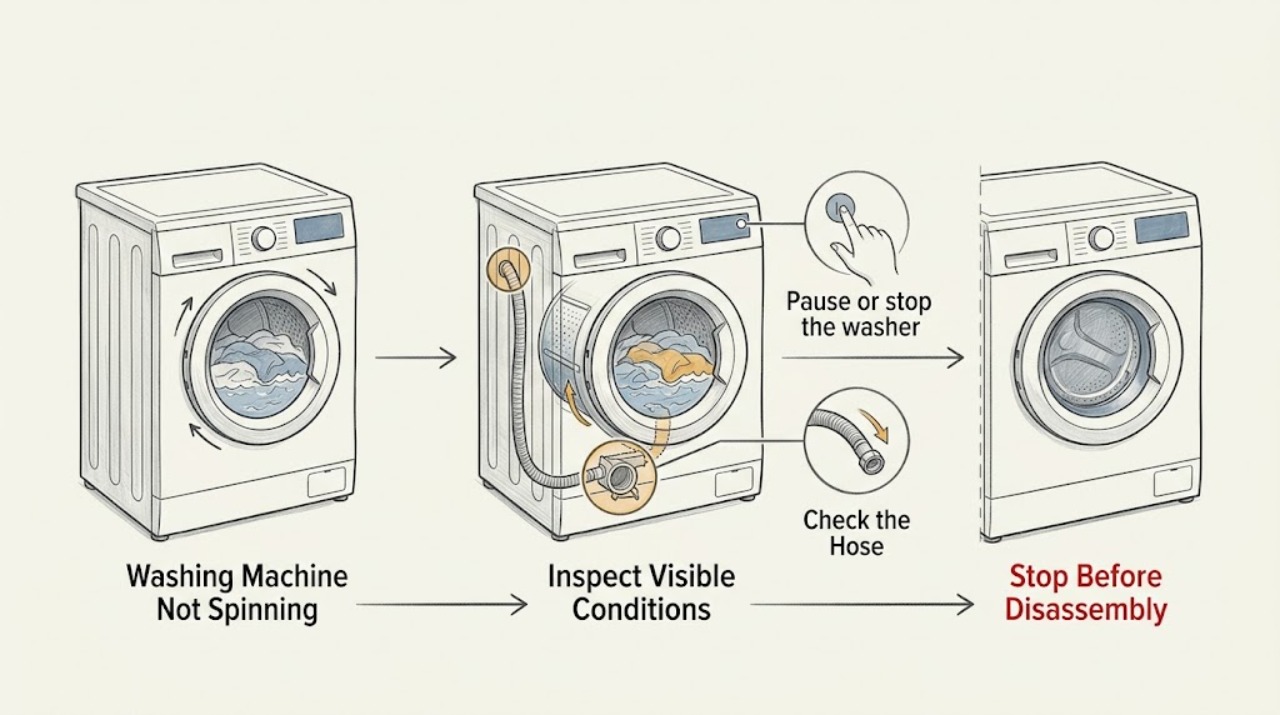
When a Crosley washing machine will not spin, first check whether it still contains water, whether the lid or door is fully closed, and whether the load is tightly packed or out of balance. Redistribute the wet clothes and use the model's Drain & Spin or Rinse & Spin option when available. Then inspect the drain hose for kinks or an installation problem and follow the exact Use and Care Guide for any user-accessible pump-filter check. If the washer remains full of water, will not lock the lid or door, makes a harsh mechanical noise, leaks, smells hot, trips power, or still will not spin after the safe checks, stop using it and arrange qualified service. Crosley publishes model-specific washer manuals, so cycle names and access points can differ.
Work through in order
Diagnostic checks
Use only checks that match the exact appliance or system and its official guide.
-
Check 1
Look at the washer's current state without reaching into it: note whether water remains in the tub, whether the cycle is paused, and whether the lid or door is fully closed and showing its normal lock indication. Stop if there is smoke, a burning smell, sparking, or a major leak.
Expected result: The tub is full or partly full, the lid or door is not confirmed closed, or the washer is paused; alternatively, the tub is empty and the lock indication is normal.
Next step: If water remains, follow the drain-path check. If the lid or door is not confirmed closed, close it normally and restart only as the manual permits. If the machine is empty and safely closed, continue with the load and cycle check.
Why this matters
Why: A drain, lid, door, or pause condition can prevent a spin command from proceeding; an empty tub with a confirmed lock moves the investigation toward load, settings, or a machine fault.
-
Check 2
Pause or stop the washer as the model guide directs, then redistribute the wet load so heavy items are not gathered on one side and the basket is not tightly packed. Do not put hands into a moving basket.
Expected result: The load was tightly packed or uneven, or it was already spread evenly with no obvious overload.
Next step: Run the model's Drain & Spin, Rinse & Spin, or equivalent spin cycle with the recommended load. If it spins after redistribution, use smaller, balanced loads; if it still will not spin, continue to the drain check.
Why this matters
Why: An unbalanced load can make the washer reduce or cancel spin to limit vibration; an evenly distributed load makes balance a less likely explanation.
-
Check 3
With the washer stopped and safely isolated, inspect the visible drain hose for kinks, crushing, an incorrectly positioned end, or a hose that the exact manual says is installed too far into the standpipe. Do not disconnect a hose while the tub could release water unexpectedly.
Expected result: The hose is kinked, crushed, poorly supported, or the household drain is slow; or the visible drain path is correctly installed and clear.
Next step: Correct only the accessible installation issue described by the model guide and remove a clearly accessible external blockage. If water remains or the hose and household drain are clear, stop repeated cycles and arrange service.
Why this matters
Why: Poor drainage leaves water in the washer and can prevent or shorten the spin; a clear visible path shifts attention to a concealed blockage, pump, control, or safety condition.
-
Check 4
Check the selected cycle and spin setting against the garment load, then use the model's documented Drain & Spin or Rinse & Spin option. Do not add detergent while trying to remove excess suds, and do not force a cycle if the controls show a fault or the door remains locked unexpectedly.
Expected result: No spin or a low-spin setting was selected, the load contains excess suds, or the correct spin-only cycle still will not start.
Next step: Use the recommended setting and the manual's suds-removal procedure when applicable. If the correct cycle will not spin with a balanced load and safe drain path, request qualified service.
Why this matters
Why: A selected setting or excessive suds can leave clothes wetter or slow draining without proving a mechanical failure; failure of the correct cycle is more significant.
-
Check 5
If the exact Crosley manual identifies a user-accessible pump filter or foreign-object check, follow only that procedure after isolating the washer and preparing for residual water. Record the model, remaining water, cycle, load condition, and any unusual sound; do not remove panels or inspect live components.
Expected result: The manual-directed accessible check finds an obstruction, or it is clear while the washer still will not spin.
Next step: Reassemble only what the manual identifies as user-serviceable and run the prescribed test. If the symptom remains, leave the washer out of service and give the technician the recorded observations.
Why this matters
Why: A documented accessible obstruction can restrict draining; a clear check with persistent no-spin points toward a lid or door lock, pump, drive, control, or wiring issue requiring model-specific diagnosis.
Use your observations
Decision map
Find the observation that best matches what you see, then follow the next safe action.
-
PATH 01Next step
What you see
The washer spins after the load is redistributed and the correct spin-only cycle is selected.
Do this next
Use balanced loads and the model-recommended spin setting; stop if the problem returns with ordinary loads or the washer begins to move violently.
Why this path and its safety boundary
Why it matters: Load balance or cycle selection was the leading cause.
-
PATH 02Next step
What you see
Water remains in the tub or the washer cannot complete its drain before spin.
Do this next
Check only the visible hose installation and the exact manual's user-accessible procedure. If water remains after that, stop using the washer and arrange service or plumbing help as appropriate.
Why this path and its safety boundary
Why it matters: The drain path, pump, or household plumbing must be resolved before spin can be evaluated.
-
PATH 03Next step
What you see
The lid or door will not confirm closed or locked, although the load and drain path appear normal.
Do this next
Close the lid or door normally and retry once according to the model guide. Do not bypass the interlock or open the cabinet; request service if the indication remains wrong.
Why this path and its safety boundary
Why it matters: The safety interlock or its control path may be preventing spin.
-
PATH 04Next step
What you see
The machine will not spin even when empty, balanced, correctly set, and able to drain.
Do this next
Stop repeated test cycles, record the model and symptom, and arrange qualified Crosley appliance service through the dealer or the Use and Care Guide.
Why this path and its safety boundary
Why it matters: A model-specific pump, drive, control, wiring, or safety fault is more likely than a simple load issue.
-
PATH 05Next step
What you see
There is smoke, a burning smell, sparking, a serious leak, repeated breaker tripping, severe shaking, or a basket that binds or strikes.
Do this next
Stop the appliance, isolate it only when safe, keep clear of water and electrical hazards, and seek qualified service. Do not bypass safety devices or work on live wiring.
Why this path and its safety boundary
Why it matters: This is a safety stop, not a routine no-spin check.
Helpful context
Understand the symptom
What not spinning usually means
A washer may refuse to reach spin speed because it is still trying to drain, has detected an unbalanced load, or cannot confirm the lid or door is closed. A low-spin selection can also leave clothes wetter without indicating a failed motor. Crosley manuals describe different top-load and front-load behavior, so use the controls and access instructions for the exact model rather than assuming that every Crosley washer has the same filter, latch, or cycle names.
Use the water level and load result to choose the next check
If water remains in the tub, resolve the drain path before judging the spin system. If the tub is empty but the load is wet, redistribute the clothes and run the appropriate spin-only cycle. A washer that spins an empty test but not a mixed, heavy load points toward balance, loading, or selected-cycle conditions; a washer that will not spin empty needs service-oriented diagnosis.
Stop before opening the machine
Stop the cycle and isolate the washer according to the model instructions before handling hoses or any user-accessible filter. Never reach into a moving basket, defeat the lid or door safety, remove cabinet panels, or work on live wiring. Escalate promptly for a burning smell, smoke, sparking, a serious leak, repeated breaker trips, or a basket that binds or strikes.
Only after diagnosis
Potential parts
- drain pump or pump filter component
Consider this category only if the washer retains water and a qualified diagnosis confirms a pump or drain restriction after the visible hose and manual-directed checks.
Confirm the complete Crosley model and manufacturer's fit information before ordering; a no-spin symptom alone does not identify a pump. - lid lock or door-lock assembly
Consider this category only if the exact model fails to confirm a closed lid or door while the load and drain conditions are normal.
Do not bypass the safety interlock. Verify model-specific compatibility through the manual or qualified service diagnosis. - drive or spin-control component
Consider this category only when the washer drains, confirms the lid or door, and still will not spin empty after a balanced-load test.
Internal diagnosis and fitment must be based on the complete model number; do not order a drive component from the symptom alone.
When checks do not resolve it
Need a professional?
Call qualified appliance service when a Crosley washer will not spin empty after the load, setting, lid or door, and visible drain checks; when water remains after the manual-directed safe checks; or when the lid lock, door lock, pump, drive, controls, or wiring may need internal diagnosis. Stop immediately for smoke, burning odor, sparking, a serious leak, repeated breaker trips, severe movement, or a binding basket.
Common questions
FAQ
Why is my Crosley washer full of water and not spinning?
A washer normally needs to drain before it can spin. Check the visible drain hose for a kink or installation problem and follow the exact model guide for any user-accessible filter check. If water remains, stop repeated cycles and arrange service.
Can an unbalanced load stop a Crosley washer from spinning?
Yes. Heavy items gathered on one side or a tightly packed basket can make the washer reduce or cancel spin. Redistribute the load and use the model's Drain & Spin or Rinse & Spin option.
Should I bypass the lid or door lock to make the washer spin?
No. The lid or door interlock is a safety feature. Close it normally and retry only as the manual directs; if the lock indication remains wrong, request qualified service rather than bypassing it.
Read the exact guide
Official sources
- LAVEUSE À FAIBLECrosley Home Products · Crosley washer not-draining, not-spinning, wet-load, balance, drain-hose, and control checks
- Troubleshooting Tips... Before you call for serviceCrosley Home Products · Crosley front-load no-spin, drain, balance, noise, leveling, and model-directed filter checks
- Troubleshooting Tips - WasherCrosley Home Products · Crosley washer lid safety, reset, spin pauses, out-of-balance indications, and wet-load checks
- CUSTOMER SERVICE - CROSLEY HOME PRODUCTSCrosley Home Products · Escalation path when a Crosley washer cannot be restored by model-directed safe checks
Community feedback
Share a repair observation
Share a plain-text repair observation. Accepted observations are published automatically; this page may take a moment to update.