
On this page
Start here
Quick answer
First record when the sound occurs and whether cooling remains normal. Danby manuals describe compressor running, fan airflow, refrigerant gurgling, clicks before compressor start, defrost sizzling, water entering the drain pan, and cabinet expansion or contraction as sounds that can be normal for particular models. A rattle or hum that changes when items on top are removed, the refrigerator is leveled, or wall contact is cleared is more consistent with external vibration. Inspect only from outside for loose objects, wall contact, an unstable cabinet, or visible debris near an accessible fan area; do not reach into a fan or remove a cover. If the noise is grinding, scraping, sparking, accompanied by a burning smell, leaking, loss of cooling, repeated protection trips, or persists after the safe external checks, stop using the refrigerator when safe and arrange qualified service. Compressor, fan, wiring, refrigerant circuit, and defrost-system work are not owner repairs.
Before you begin
Safety first
- The user may listen and document the pattern, remove loose external objects, clear visible wall contact, check stable placement, reseat accessible shelves or drawers, and inspect an externally accessible area only from a safe unpowered position. Fan guards, moving blades, compressor mounts, start devices, control boards, wiring, defrost components, refrigerant tubing, sealed-system charging, disassembly, and all energized tests are for qualified service personnel.
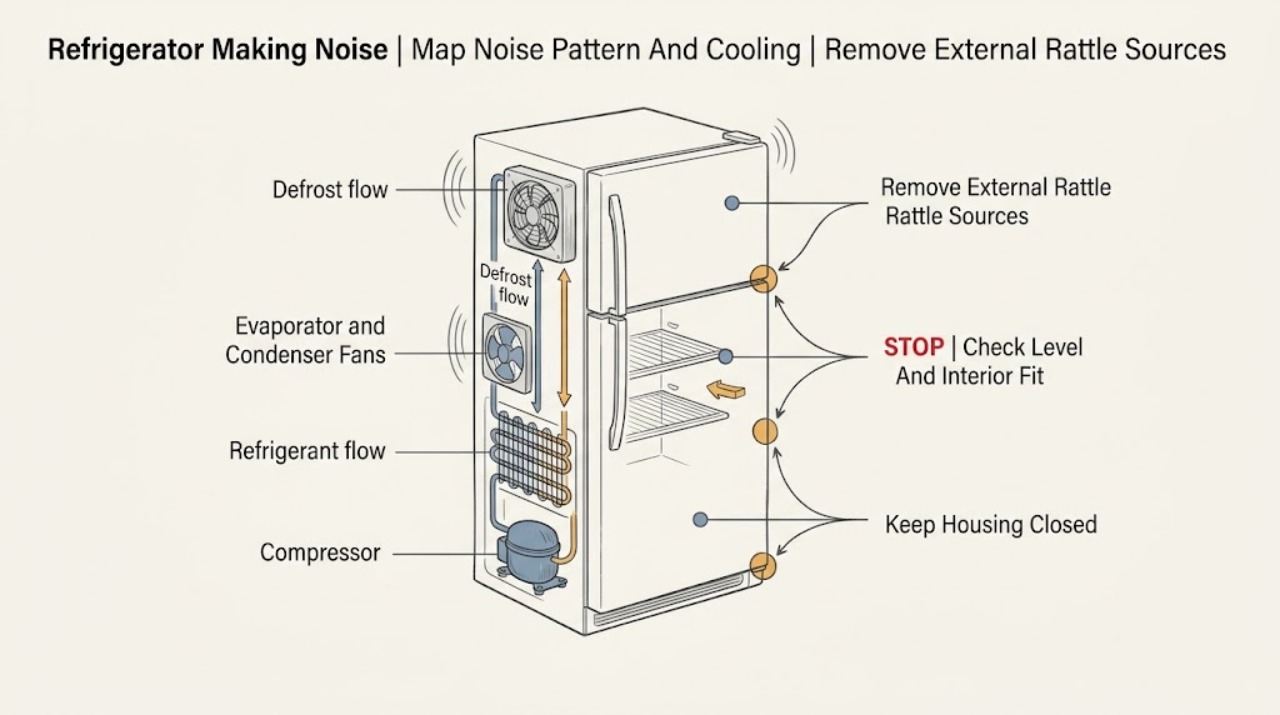
Work through in order
Diagnostic checks
Use only checks that match the exact appliance or system and its official guide.
-
Check 1
From a safe position, listen without touching the appliance and record whether the noise is a brief click, gurgle, hiss or sizzle, a steady hum, a repeating buzz, rattling, scraping, or grinding. Note whether it occurs when cooling starts, during a defrost period, when a door is opened, or continuously, and whether the refrigerator and freezer are still maintaining their normal temperatures.
Expected result: The sound is brief and cycle-related with stable cooling; it is continuous or getting louder; it changes with door movement; or cooling is worsening at the same time.
Next step: Continue only with the external vibration and obstruction checks when there is no hazard. If cooling is worsening or the sound is scraping, grinding, sparking, or accompanied by heat or odor, stop using the refrigerator when safe and arrange qualified service.
Stop if: Do not put hands into a fan area, remove a cover, or use energized instruments to identify the sound.
Why this matters
Why: A short cycle-related sound with stable temperature is more compatible with documented compressor, refrigerant, fan, or defrost operation. A persistent mechanical sound, a door-correlated fan symptom, or noise with worsening cooling makes an obstructed or failing fan, compressor, control, or sealed-system issue more likely.
-
Check 2
Remove bottles, magnets, pans, or other objects from the top and immediately around the refrigerator. Check that the cabinet is not visibly touching a wall or cabinet and that no loose external item is vibrating against it. Do not pull the refrigerator by its cord or disturb water or refrigerant tubing.
Expected result: The noise stops or changes when an object is removed; the cabinet is touching a surface; or no external object/contact explains the sound.
Next step: Keep the area clear and allow normal ventilation around the unit. If the noise persists without an external contact source, continue to the stability and shelf checks rather than opening the cabinet.
Stop if: Do not reach behind a running refrigerator, move heavy equipment alone, or pull on tubing, the cord, or the rear grille.
Why this matters
Why: A noise that changes with an external object or contact point is more likely transmitted vibration than a failed internal component. No change keeps the internal fan, compressor, refrigerant flow, or another mechanical source in consideration.
-
Check 3
With doors closed, observe whether the refrigerator rocks or sits unevenly. Check that visible shelves, bins, and drawers are fully seated and not touching the liner or each other. Make only the minor leveling adjustment described in the exact model manual and only if the adjustment point is plainly accessible; do not remove panels or tilt the appliance unsafely.
Expected result: The cabinet rocks or a shelf/bin is visibly mis-seated; the noise changes after a safe correction; or the unit is stable and correctly assembled but still noisy.
Next step: Correct only the visible seating or model-approved minor leveling issue and listen once during normal operation. If the noise remains, document its timing and location and proceed to the safe fan-area and hazard check.
Stop if: Do not dismantle shelves, loosen structural hardware, place hands near moving parts, or tip the refrigerator to reach an adjuster.
Why this matters
Why: An unlevel cabinet or incorrectly installed shelf/drawer can transmit a rattle or vibration. A stable, correctly assembled refrigerator with an unchanged internal sound needs a pattern-based service decision rather than repeated leveling.
-
Check 4
Only if there is no heat, odor, leak, damaged cord, or other hazard, disconnect power from a safe, dry position and inspect only the externally accessible area named by the exact model manual or Danby guidance. Look for visible dust, packaging, or debris near an accessible fan or compressor area; do not remove a grille, touch a blade, or clean inside a guarded assembly.
Expected result: An external obstruction or loose visible piece is present; the area is clear; or the sound continues after the appliance is restored and observed normally.
Next step: Remove only loose debris that is plainly accessible without disassembly, restore power only when the area is dry and safe, and make one normal observation. If the noise remains or cooling is affected, stop and arrange qualified service.
Stop if: Do not remove guards or panels, touch the compressor or fan, spray cleaner into an assembly, or perform an energized electrical or mechanical test.
Why this matters
Why: A visible external obstruction can account for rubbing or vibration, while a clear area and repeatable noise make a guarded fan, compressor mount, control, or sealed-system issue more likely. The part cannot be identified safely from sound alone.
-
Check 5
After the safe external checks, make one normal observation and record the model, sound description, timing, apparent location, cooling performance, any visible vibration source, and whether the sound changed after leveling or clearing contact. Stop immediately if smoke, arcing, burning odor, abnormal heat, a refrigerant or water leak, damaged cord, or repeated power protection appears.
Expected result: The sound is stable and matches a documented normal operating pattern; it resolves after an external correction; or it remains abnormal or is paired with a hazard or cooling loss.
Next step: Monitor only a stable refrigerator with normal cooling and no hazard. For a persistent or hazardous symptom, keep the unit out of service when safe, protect perishable food, and arrange qualified Danby or appliance service.
Stop if: Do not continue operation after smoke, sparks, burning odor, abnormal heat, a damaged cord, a leak, or repeated power interruptions; do not open the sealed system.
Why this matters
Why: Stable cycle-related sound or resolved external vibration is less concerning than a new persistent mechanical or electrical sound. A repeatable abnormal sound, especially with temperature loss or a hazard, requires diagnosis of components that are not user-serviceable.
Use your observations
Decision map
Find the observation that best matches what you see, then follow the next safe action.
-
PATH 01Safety boundary
What you see
The noise is a brief click, gurgle, airflow sound, defrost sizzle, drain-pan water sound, or cabinet pop, and cooling is normal with no hazard.
Do this next
Monitor the sound and keep the refrigerator level and clear of contact points. Arrange service if it becomes continuous, markedly louder, or is joined by cooling loss or a safety symptom.
Why this path and its safety boundary
Why it matters: The pattern is consistent with documented compressor, fan, refrigerant, defrost, or material-expansion operation for applicable Danby models.
Safety stop: Do not open the compressor or fan compartment to prove that a normal sound is harmless.
-
PATH 02Safety boundary
What you see
The rattle or hum changes or stops after removing items from the top, clearing wall contact, correcting a plainly visible instability, or reseating a shelf or drawer.
Do this next
Leave the cabinet stable, level according to the model manual, and clear around it. If the sound returns without a visible cause, arrange service rather than tightening hidden hardware.
Why this path and its safety boundary
Why it matters: External vibration transmission or an incorrectly seated removable interior part is more likely than a failed sealed-system component.
Safety stop: Do not tilt the appliance, loosen structural parts, or reach behind a running unit.
-
PATH 03Safety boundary
What you see
The refrigerator is stable and clear externally, but a scraping, grinding, repeated buzz, or loud vibration continues; the sound may change with door movement or coincide with cooling decline.
Do this next
Stop repeated listening tests, keep the appliance out of service if cooling or safety is affected, and arrange qualified diagnosis with the model and recorded pattern.
Why this path and its safety boundary
Why it matters: A guarded fan, compressor mount, control/start device, or another internal mechanical fault is more likely, and sound alone cannot identify which part has failed.
Safety stop: Do not remove fan guards, access the compressor, bridge a start device, or make live measurements.
-
PATH 04Safety boundary
What you see
Noise is accompanied by smoke, arcing, burning odor, abnormal heat, a damaged cord, a refrigerant or water leak, repeated protection trips, or significant loss of cooling.
Do this next
Isolate power only from a safe, dry position, protect food separately, and arrange qualified appliance service. Do not restore power until the cause has been assessed when a hazard is present.
Why this path and its safety boundary
Why it matters: This is a safety or sealed-system concern, not an external vibration adjustment. Electrical, compressor, defrost, or refrigerant work may be involved.
Safety stop: Do not touch leaking fluid, open refrigerant tubing, remove electrical covers, or continue operation after arcing, smoke, or repeated protection operation.
Helpful context
Understand the symptom
A refrigerator can make several normal sounds
Noise alone does not identify a failed part. Depending on the model and cycle, a Danby refrigerator may produce a compressor hum, air movement from a fan, refrigerant gurgling, a click as the compressor starts, a brief defrost sizzle, water flowing to the drain pan, or a pop as materials expand and contract. The useful first distinction is whether the sound follows a normal cooling or defrost event and whether the refrigerator still holds temperature.
Rule out vibration without opening the cabinet
Hard floors, walls, cabinets, and loose objects can amplify a modest operating sound. Remove items sitting on top, check that the unit does not rock, look for visible contact with a wall, and confirm that shelves or drawers are seated correctly. Danby’s own guidance points to loose components, the fan and compressor area, and leveling; keep the inspection external and stop if the sound suggests an electrical or mechanical hazard.
The noise pattern determines the service boundary
A brief gurgle or click with stable cooling is different from a new grinding sound, a fan that scrapes continuously, or a buzz followed by repeated restarts. A noise accompanied by warming food, a leak, smoke, an electrical smell, or repeated power protection is not a leveling exercise. Do not remove panels, touch moving parts, alter refrigerant tubing, or make energized measurements; record the pattern and use qualified service.
Safety boundary
Stop conditions
- Stop using the refrigerator for smoke, arcing, burning odor, abnormal heat, a damaged cord, a leak near electrical parts, or repeated protection operation; isolate power only from a safe, dry position.
- Do not remove rear, bottom, fan, compressor, control, or defrost covers; do not touch moving blades or energized parts.
- Do not open refrigerant tubing, alter a sealed system, add refrigerant, or attempt compressor or defrost repair.
- Do not tilt or move the refrigerator unsafely, pull on the cord or tubing, or reach behind a running appliance.
- Do not diagnose or order a component from sound alone; use the full model and qualified diagnosis.
Only after diagnosis
Potential parts
- evaporator or condenser fan assembly
Consider this only when the exact model is identified and qualified diagnosis links a repeatable scraping, grinding, or airflow-related noise to a fan assembly after external obstructions and vibration sources are excluded.
Verify the complete rating-label model and manufacturer fit information; fan construction and placement vary among Danby refrigerator families. - compressor start or mounting component
Consider this only after qualified service confirms that a persistent buzz, start-click pattern, or compressor vibration is not normal for the exact model and is not caused by leveling or external contact.
Do not infer compatibility from the Danby name or from a sound description; use the exact model and manufacturer fit information. - defrost or control component
Consider this only when the exact model manual and qualified diagnosis connect a repeated defrost-related noise with a control or defrost fault, especially if cooling or frost behavior also changes.
Confirm model-specific fit information before ordering; do not replace a control or defrost part based only on noise.
When checks do not resolve it
Need a professional?
Arrange qualified service when a grinding, scraping, or loud repeating buzz persists after safe external checks; when noise changes with cooling performance; or when the refrigerator shows smoke, arcing, burning odor, abnormal heat, a damaged cord, a leak, repeated protection trips, or significant loss of cooling. Keep the unit out of service when safe for hazardous symptoms.
Safety scope: The user may listen and document the pattern, remove loose external objects, clear visible wall contact, check stable placement, reseat accessible shelves or drawers, and inspect an externally accessible area only from a safe unpowered position. Fan guards, moving blades, compressor mounts, start devices, control boards, wiring, defrost components, refrigerant tubing, sealed-system charging, disassembly, and all energized tests are for qualified service personnel.
Common questions
FAQ
Is a gurgling sound from a Danby refrigerator normal?
It can be. Danby manuals describe refrigerant-flow gurgling as a normal sound for applicable models, especially when it is brief or cycle-related and cooling remains normal. A new loud sound with warming food, a leak, odor, or other hazard needs qualified service rather than a refrigerant-system inspection by the owner.
Why does my Danby refrigerator rattle or vibrate?
Check for objects on top, visible wall or cabinet contact, an unlevel or rocking cabinet, and shelves or drawers that are not seated correctly. Danby identifies these as possible vibration sources. If the sound does not change after safe external corrections, arrange qualified diagnosis instead of tightening hidden hardware.
What if the refrigerator makes a grinding or scraping noise?
A persistent grinding or scraping sound is not something to diagnose by opening the fan or compressor area. Note whether it changes with door movement or cooling, then stop using the unit when safe if cooling is declining or a hazard appears and arrange qualified service for the guarded fan, compressor, or control path.
Can I clean the fan or compressor area on a Danby refrigerator?
Danby’s FAQ mentions cleaning the fan and compressor area, but the safe boundary is external access only and the exact manual governs what is user-accessible. Disconnect power from a safe, dry position before any permitted external inspection, and do not remove guards, touch blades, open the compressor compartment, or spray into an assembly.
When should a noisy Danby refrigerator be taken out of service?
Stop using it for smoke, arcing, burning odor, abnormal heat, a damaged cord, a leak near electrical parts, repeated protection operation, or significant loss of cooling. Isolate power only when safe and arrange qualified appliance service; protect perishable food separately.
Read the exact guide
Official sources
- DCR049B1BSLDB Owner’s ManualDanby · The listed normal sounds and vibration troubleshooting apply to the DCR049B1BSLDB model; other Danby models may differ.
- Refrigeration FAQsDanby · General Danby refrigeration guidance, including model-family noise and stability advice; exact manuals control when instructions differ.
- WFF176SL, WFF176W, WFF176B Owner’s ManualDanby · The gurgling explanation applies to the listed model family; it is used here only to explain why some refrigerant-flow sounds can be normal.
- The fridge is making unusual noises. How can I fix this?Danby · General Danby guidance for unusual refrigerator noise; the exact owner’s manual controls model-specific access and adjustments.
- DFF1776W and D1866WE Refrigerator Owner’s ManualDanby · The sound descriptions apply to the listed models and illustrate model-specific operating noises, not a universal diagnosis for all Danby refrigerators.
Community feedback
Share a repair observation
Share a plain-text repair observation. Accepted observations are published automatically; this page may take a moment to update.