
On this page
Start here
Quick answer
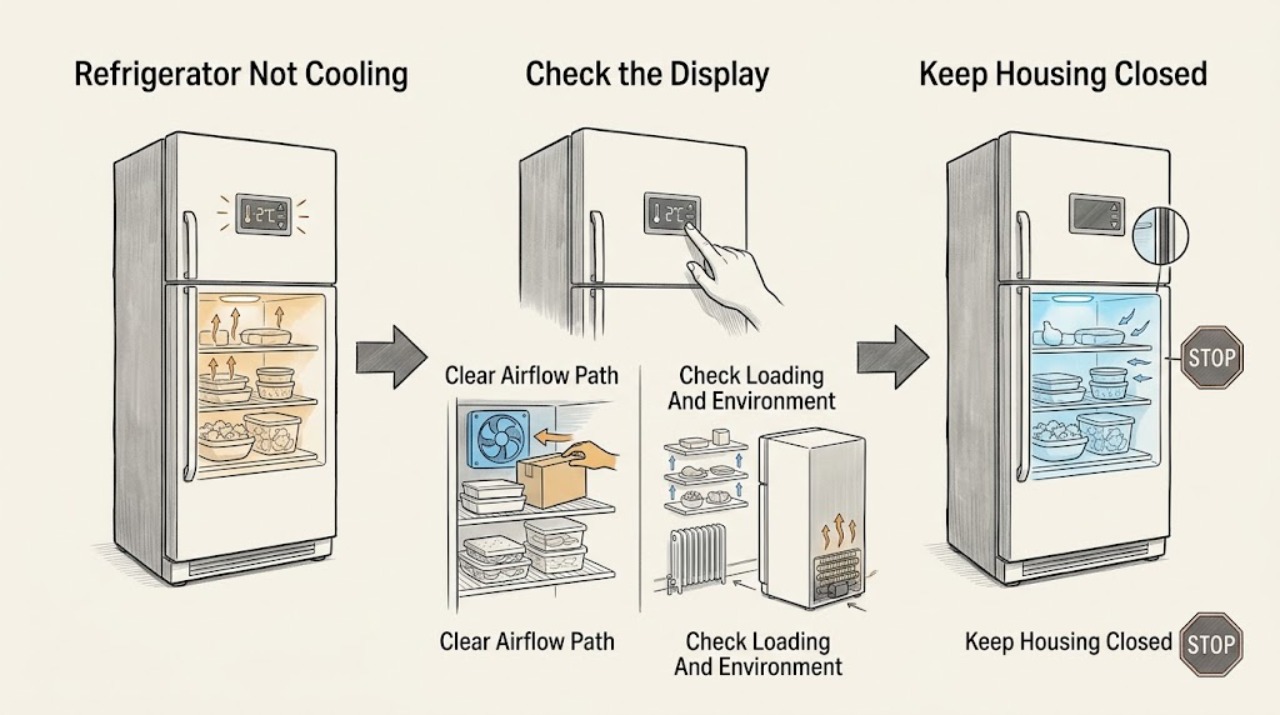
First confirm that the Danby refrigerator is plugged in, turned on, and not in a model-specific standby or compressor-off mode. Check the exact temperature controls rather than assuming a higher number is warmer or colder; Danby dial and electronic models differ. Make sure the door closes fully, the magnetic gasket contacts the cabinet, food is not blocking interior vents, and shelves or drawers are seated. Allow clearance around the cabinet, keep it away from direct sun and heat, and do not fully enclose a free-standing model unless its manual explicitly allows that installation. If the refrigerator was moved or delivered on its side, Danby advises allowing it to stand upright for about 6 hours before connecting power. Minimize door openings and allow recovery after adding a large amount of warm food. If one or both compartments remain warm after these checks, or the compressor, fan, frost pattern, display, or power behaves abnormally, the cause may involve a fan, defrost system, sensor/control, compressor, wiring, or sealed refrigeration circuit; the symptom does not select a part. Stop for a burning smell, smoke, sparks, a hot or damaged cord, water near electrical parts, repeated breaker trips, a refrigerant/oil residue, or a repair requiring panels, live testing, refrigerant, or the sealed system. Danby's official manual and FAQ support these visible setting, door, load, ventilation, upright-recovery, and service boundaries.
Before you begin
Safety first
- The user may check power from a dry position without opening equipment, use documented controls, inspect doors/gaskets/vents and visible clearance, protect food, and follow the exact manual's upright recovery and safe leveling guidance. Electrical panels, fan/defrost/sensor/control wiring, compressor/start components, live tests, refrigerant, sealed-system work, and heavy or built-in movement are for qualified personnel.
Work through in order
Diagnostic checks
Use only checks that match the exact appliance or system and its official guide.
-
Check 1
From a dry position, confirm the plug is fully seated in the correct outlet and the refrigerator is turned on. Find the exact model's temperature control and check for OFF, standby, vacation, demo, or compressor-off behavior; note the control position and whether the interior light/display works. Do not open electrical covers or repeatedly unplug and replug the appliance.
Expected result: The unit has no light/display, the plug or outlet has no power, a control is OFF/standby or compressor-off, or power and controls appear normal but temperatures are warm.
Next step: Correct only a safe documented control setting once and allow the model to recover. If power will not stay on, the outlet is suspect, or the refrigerator still does not cool, arrange electrical/appliance service rather than changing settings repeatedly.
Stop if: Do not use an extension cord or improvised supply, change breaker ratings, bypass a control, or access live wiring.
Why this matters
Why: A supply or control condition can explain no cooling without a sealed-system failure. Danby's DFF116 manual explicitly documents a compressor-off function, while control directions vary by model. Normal lights with warm compartments shift attention to door, load, airflow, environment, or a cooling-system fault.
-
Check 2
Inspect the affected door opening without removing hinges. Move packages, shelves, bins, and drawers that hold the door open; keep food away from interior vents and the rear wall; and inspect the magnetic gasket for dirt, folds, tears, hardening, or a section separated from the cabinet. Close the door gently and check for an even visible contact all around.
Expected result: A package or shelf blocks closure, the gasket is dirty/folded/damaged or leaves a gap, frost/condensation is concentrated near a seal, vents are blocked, or the door and airflow look normal.
Next step: Correct only the visible obstruction and clean/dry the accessible gasket contact area as the exact manual permits. If the gasket is torn, detached, or will not contact, arrange model-specific service and protect food while the door remains unsealed.
Stop if: Do not force the door, heat or glue the gasket, chip frost with a sharp tool, remove hinges, or run the refrigerator with a visibly damaged seal.
Why this matters
Why: An open door, damaged gasket, or blocked vent can admit warm air or prevent distribution, affecting temperature and compressor run time. Frost near a seal supports leakage but does not identify a single part. A good visible seal and clear vents make environmental, defrost, fan, control, or sealed-system causes more likely.
-
Check 3
Check whether a large amount of warm food was recently added, the doors have been opened frequently, or the refrigerator is in direct sunlight, beside a range/heater, in a very hot or humid area, on carpet, or tightly enclosed. Verify the cabinet has the exact manual's side, top, and rear clearance and is not pressed against surrounding cabinetry.
Expected result: A large warm load or frequent openings occurred, a heat source/direct sun or unsuitable ambient condition is present, ventilation is blocked, or the room and clearance are normal.
Next step: Close the doors, move only portable heat sources or loose obstructions, restore the model's clearance, and allow recovery while protecting perishable food. Do not fully enclose a free-standing model unless its exact manual permits it.
Stop if: Do not move a loaded refrigerator alone, place it near water or heat, block ventilation with panels, or use an arbitrary clearance in place of the exact manual.
Why this matters
Why: Danby's DFF116 manual lists warm food, frequent door opening, heat/direct sun, and high ambient temperature as reasons for a warm interior or continuous operation. Restricted clearance can prevent heat rejection. Normal room conditions after the load has stabilized make a persistent cooling-system fault more likely.
-
Check 4
If the refrigerator was delivered or transported on its side/back, or was recently moved, confirm from the exact Danby guidance that it stood upright before power was connected; Danby's FAQ commonly specifies 6 hours. Check from outside that the cabinet is stable and level and that the door closes without drifting open. Do not tilt the appliance to correct it while loaded.
Expected result: The refrigerator was connected before the documented upright period, it rocks/leans or the door drifts open, or it was upright and stable before connection.
Next step: If recently moved, follow the exact model's upright waiting period before connecting power. Correct only an accessible, documented leveling adjustment; if the unit is heavy, built in, unstable, or requires tipping, arrange qualified service.
Stop if: Do not tip a loaded refrigerator, pull out a built-in installation, improvise shims, or reconnect before the model's documented recovery period.
Why this matters
Why: Transport and an unstable or unlevel cabinet can delay cooling, increase door-seal problems, or cause abnormal operation. Danby gives a 6-hour upright example for affected refrigerator families, but the exact model's manual controls. Stable placement after proper recovery shifts attention to settings, doors, airflow, or internal cooling.
-
Check 5
Without touching internal parts, note whether the refrigerator compartment, freezer compartment, or both are warm; whether the compressor runs continuously, cycles, clicks, or stays silent; whether a fan sound is present; and whether frost is absent, excessive, or localized. Record any alarm, unusual odor, water, hot cord, or breaker event.
Expected result: Only one compartment is warm, both are warm, the compressor/fan behavior is abnormal, frost is localized or excessive, or a hazard sign is present.
Next step: Protect food and arrange qualified service for persistent warmth, abnormal cycling/clicking, stopped fan, unusual frost, or any hazard. Provide the model, compartment pattern, control position, timing, sounds, and completed visible checks.
Stop if: Do not remove covers, reach a fan or compressor, scrape frost, test live voltage, or continue operation with smoke, burning odor, damaged cord, water near electrics, or repeated trips.
Why this matters
Why: One warm compartment can reflect door, vent, load, or distribution issues; both warm after normal recovery raises the likelihood of a system-level control, fan, defrost, compressor, or sealed-system fault. A frost pattern can guide service but cannot prove a refrigerant or defrost diagnosis. A hazard sign changes this to stop-use handling.
-
Check 6
After the power/control, door/gasket, airflow/loading, environmental, upright-recovery, and level checks, record the exact model and temperature observations. Keep the cabinet closed and do not perform internal tests. Note whether cooling improves after recovery and whether the compressor, fan, defrost behavior, or control changes normally.
Expected result: Cooling returns after a safe correction, the refrigerator remains warm despite normal visible conditions, it runs continuously, or the symptom includes a code, repeated trip, odor, leak, damaged cord, or abnormal sound.
Next step: Use the refrigerator only when it maintains safe temperatures without abnormal signs. Otherwise protect food, leave it off for hazards, and arrange qualified Danby/appliance service with the model and diagnostic record.
Stop if: Do not add refrigerant, pierce tubing, bypass controls, replace a compressor/fan/sensor, or perform live electrical or sealed-system tests.
Why this matters
Why: Improvement supports a setting, door, airflow, load, environment, or transport-recovery condition. Persistent warmth or abnormal running can involve a fan, defrost system, sensor/control, compressor, wiring, or sealed refrigeration circuit; no single part can be selected from these observations.
Use your observations
Decision map
Find the observation that best matches what you see, then follow the next safe action.
-
PATH 01Next step
What you see
The refrigerator is unplugged, a supply is off, a control is OFF/standby/compressor-off, or the exact model's setting is too warm.
Do this next
Restore only a safe documented setting once and allow recovery. If power will not hold or the refrigerator remains warm, arrange qualified service.
Why this path and its safety boundary
Why it matters: A power or control condition is more likely than a sealed-system failure. Danby refrigerator controls differ, and some models explicitly allow the compressor to be turned off while lights remain on.
-
PATH 02Next step
What you see
A door is not shut, a gasket has a gap or damage, food blocks a vent, or shelves/drawers prevent proper closure.
Do this next
Correct the visible load or clean/dry the gasket contact surface as the model permits. Arrange service for a damaged seal, misaligned door, or persistent warm compartment.
Why this path and its safety boundary
Why it matters: Warm-air infiltration or restricted distribution is more likely. Condensation or frost near a gap supports leakage but does not identify whether the gasket, door alignment, or a cabinet condition is responsible.
-
PATH 03Next step
What you see
A large warm load, frequent openings, direct sun, a heat source, high ambient temperature/humidity, or blocked cabinet clearance is present.
Do this next
Close the doors, remove loose heat sources, restore exact clearance, and allow recovery while protecting food. Persistent warmth after the environment normalizes needs service diagnosis.
Why this path and its safety boundary
Why it matters: Recovery or heat-rejection conditions can explain a warm cabinet or continuous operation. Danby lists these conditions in the DFF116 troubleshooting guidance and warns that ventilation requirements are model-specific.
-
PATH 04Next step
What you see
The refrigerator was recently moved or delivered on its side/back, was connected before the documented upright period, rocks/leans, or the door drifts open.
Do this next
Follow the exact manual's upright waiting and leveling instructions without tipping or moving a loaded/built-in unit. If stable recovery does not restore cooling, arrange service.
Why this path and its safety boundary
Why it matters: Transport recovery, cabinet level, or door closure is more likely than an immediate sealed-system conclusion. Danby commonly specifies about 6 hours upright before connection for affected models.
-
PATH 05Safety boundary
What you see
Both compartments remain warm after stable power, correct controls, closed doors, clear airflow, suitable environment, and adequate recovery, or the unit has abnormal compressor/fan/frost behavior, a code, leak, odor, damaged cord, or repeated trip.
Do this next
Protect food and leave the refrigerator off for any hazard or repeated electrical event. Arrange qualified Danby/appliance service and provide the model, temperatures, timing, controls, sounds, frost pattern, and prior checks.
Why this path and its safety boundary
Why it matters: A fan, defrost system, sensor/control, compressor, wiring, or sealed-system fault is more likely. The pattern cannot identify a part, and internal access can expose shock, sharp, refrigerant, and stored-energy hazards.
Safety stop: Do not open panels, test live voltage, bypass controls, add refrigerant, pierce tubing, or replace internal parts.
Helpful context
Understand the symptom
Start with the mode and the model's control logic
A refrigerator can look powered while cooling is disabled by a standby/compressor-off mode or a temperature control that is set too warm. Danby's DFF116 manual uses snowflake indicators and a long button press to turn the compressor off, while other Danby refrigerators use dials where the number direction varies by model. Read the rating label and exact manual before changing settings or deciding the compressor has failed.
Door sealing and airflow affect both compartments
A door that is not shut, a gasket gap, food against an interior vent, or blocked clearance lets warm air in or prevents cold air from distributing. Danby identifies door closure, door-seal maintenance, airflow, and ventilation as model-relevant checks. Frost or condensation near a gasket supports air leakage but does not prove that replacing the gasket alone will restore cooling.
Room conditions and recent changes can delay recovery
A large quantity of warm food, frequent door openings, direct sun, a nearby heat source, or high ambient temperature can make a refrigerator appear warm or run continuously. After transport, oil and refrigerant need the model's upright recovery period; Danby commonly specifies about 6 hours before plugging in. Protect perishable food and use the exact manual rather than extending an arbitrary wait.
Internal cooling parts stay behind the service boundary
Persistent warmth after stable power, correct controls, closed doors, clear vents, appropriate loading, and adequate clearance can involve a fan, defrost system, sensor/control, compressor, wiring, or sealed circuit. A compressor that runs continuously does not by itself prove low refrigerant, and a silent compressor does not identify one failed electrical part. Do not pierce tubing, add refrigerant, bypass a control, or perform live measurements.
Safety boundary
Stop conditions
- Stop immediately for smoke, burning/electrical odor, sparks, a hot or damaged cord/plug, water near electrical parts, refrigerant/oil residue, or repeated breaker trips.
- Stop if the refrigerator is unstable, has been damaged or dropped, or must be tipped, pulled from built-in cabinetry, or moved while loaded.
- Do not scrape frost, remove internal covers, reach a fan or compressor, or use heat or sharp tools inside the cabinet.
- Do not perform live electrical tests, bypass controls, add refrigerant, pierce tubing, or work on the defrost, compressor, fan, wiring, or sealed system.
- Protect food and arrange qualified service for persistent warmth, abnormal cycling/clicking, stopped fan, unusual frost, recurring water, or a returned fault indication.
When checks do not resolve it
Need a professional?
Arrange qualified Danby/appliance service when the refrigerator remains warm after the exact model's power, control, door/gasket, airflow, load, environment, level, and upright-recovery checks; when only one compartment or both compartments remain warm; or when the compressor, fan, defrost behavior, display, or temperature changes abnormally. Stop immediately for smoke, burning odor, sparks, a hot/damaged cord or plug, water near electrics, refrigerant/oil residue, or repeated breaker trips. Do not open the cabinet, perform live tests, scrape frost, or handle the sealed refrigeration system.
Safety scope: The user may check power from a dry position without opening equipment, use documented controls, inspect doors/gaskets/vents and visible clearance, protect food, and follow the exact manual's upright recovery and safe leveling guidance. Electrical panels, fan/defrost/sensor/control wiring, compressor/start components, live tests, refrigerant, sealed-system work, and heavy or built-in movement are for qualified personnel.
Common questions
FAQ
Why is my Danby refrigerator not cooling?
Check that it is plugged in and turned on, the exact temperature control is not OFF or compressor-off, the door and magnetic gasket seal, vents are clear, the cabinet has ventilation, and the room is not unusually hot. If it was moved on its side, follow the exact manual's upright recovery period; Danby commonly specifies 6 hours. Persistent warmth after these checks needs qualified service.
What temperature setting should a Danby refrigerator use?
Use the exact model manual because Danby dials and electronic controls differ. On the DFF116 manual's snowflake indicators, one snowflake is warmest and three are coldest; other models may use numbered dials where the direction must be read from the manual. Check for a standby or compressor-off state before assuming a cooling failure.
Can a Danby refrigerator door seal make it stop cooling properly?
Yes. A door that is not shut, a dirty or damaged magnetic gasket, or food blocking closure allows warm air in and can keep temperatures high. Move only visible obstructions and clean the accessible gasket contact area as the exact manual permits. A torn, detached, or persistently gapped seal needs model-specific service.
Why is my Danby refrigerator running continuously but still warm?
Check the door seal, warm-food load, frequent openings, temperature control, direct sun/heat, room conditions, and ventilation first. Danby's DFF116 manual lists these as causes of inadequate temperature or continuous operation. If both compartments remain warm after recovery and visible checks, a fan, defrost, sensor/control, compressor, wiring, or sealed-system fault is possible; arrange service rather than changing parts by symptom.
How long should a Danby refrigerator sit after being transported on its side?
Check the exact model manual. Danby's refrigerator FAQ commonly recommends allowing the unit to stand upright for 6 hours before plugging it in after delivery or transport on its side. Keep it stable and do not use that general interval to override a different model instruction.
When should I stop using a Danby refrigerator that is not cooling?
Stop for smoke, burning/electrical odor, sparks, a hot or damaged cord, water near electrical parts, refrigerant/oil residue, repeated breaker trips, a dropped or unstable unit, or a refrigerator that cannot maintain safe food temperatures. Isolate power only if safe and arrange qualified service. Do not open panels, test live voltage, scrape frost, add refrigerant, or work on the compressor, fan, defrost system, controls, or sealed circuit.
Read the exact guide
Official sources
- The fridge is not cooling properly. What should I do?Danby USA · General Danby refrigerator guidance to check power, on-state, and upright recovery after transport; exact models may have additional controls and recovery instructions.
- DFF116B1WDBL / DFF116B1WDBR / DFF116B2WDBL / DFF116B2WDBR / DFF116B2SSDBL / DFF116B2SSDBR Refrigerator Owner’s ManualDanby · Model-family guidance for temperature controls, compressor-off behavior, gasket and door closure, leveling, clearance, upright transport recovery, ambient/load effects, automatic defrost, and unresolved-fault service; other Danby models may differ.
- Refrigeration FAQsDanby USA · General and product-family guidance for refrigerator temperature controls, door seals, airflow, ventilation, upright recovery, ambient placement, and refrigerator troubleshooting; exact model manuals control final instructions.
Community feedback
Share a repair observation
Share a plain-text repair observation. Accepted observations are published automatically; this page may take a moment to update.