
On this page
Start here
Quick answer
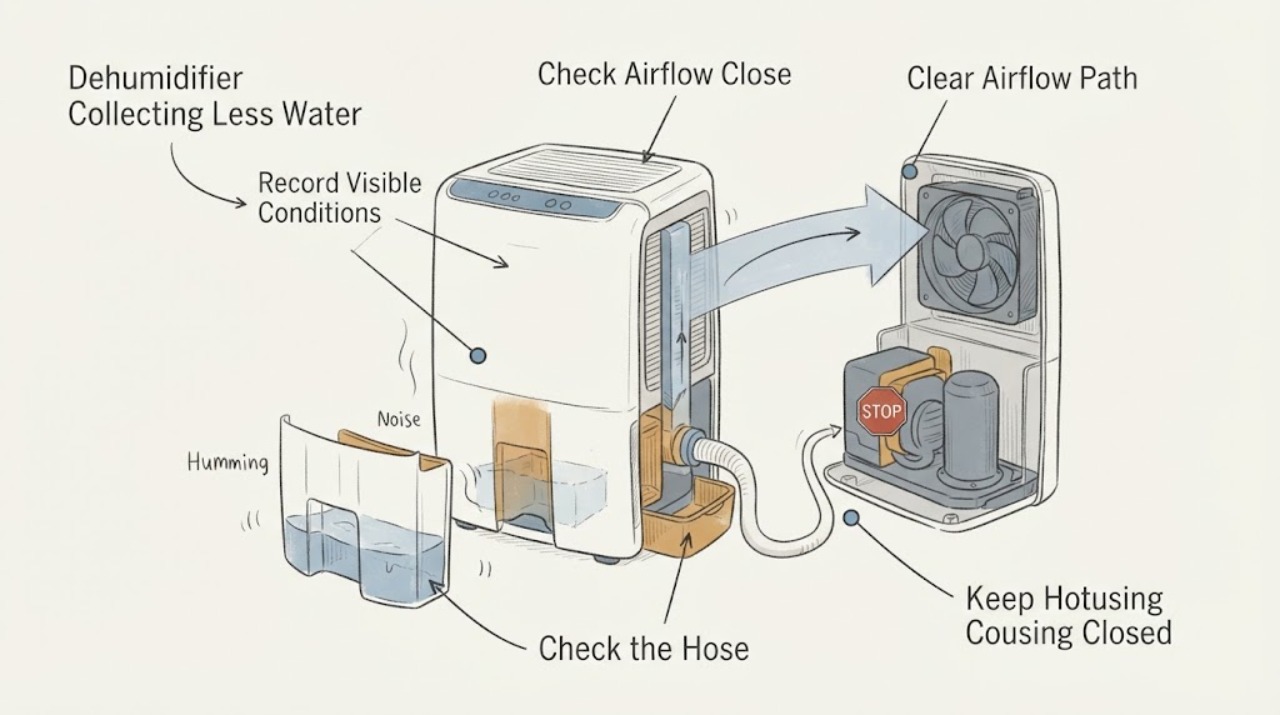
A dehumidifier that collects less water is not automatically becoming inefficient because it is older. Water yield changes with room humidity, temperature, the setpoint, open windows or doors, room size, airflow and filter condition; if the room is already below the selected humidity, little water is expected. A steady compressor or fan hum can be normal, while a new loud hum can also come from an unlevel unit or loose external fit. Compare room RH with the setpoint, check the external airflow and filter, confirm the bucket or approved drain path, look for frost through the grille, and level the unit. If RH stays high and collection remains poor after those checks, or the hum changes or persists, use the exact model manual and arrange service rather than guessing at refrigerant, compressor or motor failure.
Work through in order
Diagnostic checks
Use only checks that match the exact appliance or system and its official guide.
-
Check 1
Record the room's relative humidity, temperature, the dehumidifier setpoint, operating mode and collection amount over a comparable period. Keep windows and doors closed during the comparison if that is practical, and note whether the unit is running continuously.
Expected result: Room RH is already at or below the selected setpoint, or RH remains clearly above the setpoint while the bucket gains little water.
Next step: If RH is at target, do not treat the lower bucket level as a failure. If RH remains high, continue with the airflow, filter, bucket and frost checks and then use the exact model manual or service path.
Why this matters
Why: When RH is below the setpoint, little water is expected. Persistently high RH with little collection points to conditions, sizing, airflow or a unit-specific problem rather than proving an age-related efficiency rate.
-
Check 2
Check the room and external airflow without opening the cabinet: close nearby windows and doors, confirm the unit is appropriately sized for the room, keep curtains and furniture away from the intake and outlet, and clean a visibly dirty filter only as the model manual directs.
Expected result: A window or door is open, the room is larger or wetter than the unit's intended conditions, airflow is blocked, or the filter is dirty; otherwise these external conditions are normal.
Next step: Correct only the accessible environmental or filter condition allowed by the manual, then repeat the RH and collection comparison. If RH stays high with normal airflow, escalate with the model and measurements.
Why this matters
Why: Extra moisture load and restricted airflow can make the unit run longer or reduce effective moisture exchange. A clean, unobstructed setup makes the later performance observation more meaningful but does not identify an internal failed part.
-
Check 3
Confirm that the condensate bucket is seated and not full, and if the model has an approved hose or pump drain, inspect its accessible routing for a kink, blockage or an outlet position the manual forbids. Do not improvise a drain connection.
Expected result: The bucket-full indication is active, the bucket is not seated, or an approved hose is kinked or blocked; alternatively the bucket is seated and the approved drain route is clear.
Next step: Empty and reseat the bucket or correct only the model-approved drain routing. If collection remains poor with RH above the setpoint, preserve the observations for service rather than selecting a pump or other part.
Why this matters
Why: A full or mis-seated bucket can stop collection into the container, and an improperly routed approved drain can make the water appear to have disappeared. A clear bucket and drain path do not prove that the refrigeration system is healthy.
-
Check 4
Inspect the external grille for frost and verify that the cabinet is standing level and evenly supported. Do not remove panels or scrape ice from internal coils.
Expected result: There is no frost, light frost that clears during normal cycling, or heavy persistent ice; the unit is level or rocks/vibrates on its supports.
Next step: Follow the model manual for ambient limits, clearance and filter care. Correct a safe leveling issue and let any permitted defrost cycle complete; if heavy ice returns or the hum and poor collection persist, stop troubleshooting and arrange service.
Why this matters
Why: Light frost can occur in low ambient conditions. Heavy ice can be associated with restricted airflow or system imbalance, while an unlevel cabinet can create humming or vibration. None of these observations identifies refrigerant loss or a failed compressor.
-
Check 5
Characterize the hum from outside the cabinet while the unit cycles: note whether it is a steady compressor or fan sound, a new louder or uneven hum, rattling, or vibration that changes when the unit is placed evenly on a stable surface. Do not place hands near moving parts or run the unit with covers removed.
Expected result: The sound matches a steady operating hum and collection follows the RH conditions, or the sound is newly louder, rattling or accompanied by poor collection and vibration.
Next step: If leveling changes the sound and RH control is normal, monitor the unit. If the changed sound persists with high RH and low collection, stop at external observations and arrange qualified service with the model, sound timing and RH log.
Why this matters
Why: GE documents compressor and condenser-fan sounds as normal possibilities. Frigidaire links humming or vibration to uneven support and rattling to a loose component, but sound alone cannot establish which internal component is at fault.
Use your observations
Decision map
Find the observation that best matches what you see, then follow the next safe action.
-
PATH 01Next step
What you see
Room RH is at or below the dehumidifier's selected setpoint, and there is no persistent frost or abnormal sound.
Do this next
Keep the setpoint and operating mode consistent with the exact manual and monitor RH rather than using bucket volume alone as the performance test.
Why this path and its safety boundary
Why it matters: The unit may be collecting less because there is less moisture available to remove; this pattern does not demonstrate age-related loss of efficiency.
-
PATH 02Next step
What you see
RH stays above the setpoint while doors or windows are open, airflow is blocked, the filter is dirty, or the room is beyond the unit's intended size or conditions.
Do this next
Correct the accessible condition permitted by the manual, repeat the same RH and collection comparison, and escalate only if the problem remains with normal airflow and room conditions.
Why this path and its safety boundary
Why it matters: The moisture load or restricted airflow can account for long operation and weak collection, so the observed performance is not yet a fair test of aging.
-
PATH 03Next step
What you see
Heavy ice returns on the external coil area, especially with a dirty filter or restricted clearance, while collection remains low.
Do this next
Stop scraping or opening the cabinet, follow the model's frost and filter instructions, and arrange service if the ice returns after permitted external corrections.
Why this path and its safety boundary
Why it matters: Frigidaire associates heavy ice with restricted airflow or a system imbalance; low ambient temperature can also promote frost. The pattern does not identify refrigerant loss or a specific part.
-
PATH 04Next step
What you see
The hum is newly loud, uneven, rattling or vibration-related and remains after the cabinet is level, while RH stays high and collection remains low.
Do this next
Stop at external checks and provide the service technician with the model, age, room RH and temperature, setpoint, collection log, frost observation and when the sound occurs.
Why this path and its safety boundary
Why it matters: The combined symptom pattern needs model-specific service; the official guidance supports normal-sound and leveling checks but does not justify naming a compressor, fan, motor or refrigerant fault.
Helpful context
Understand the symptom
Separate less water from less dehumidification
A smaller amount in the bucket does not by itself show that the machine has aged out of its design performance. Frigidaire says water collection depends on the room's relative humidity, the selected humidity level, temperature, airflow and filter condition; its guidance recommends a 40–60% relative-humidity range for ordinary operation. GE likewise says a new or recently moved unit may need several days, with doors and windows closed and adequate airflow, before the room reaches its target. First record room RH with a separate hygrometer if available, the unit's setpoint, room temperature, whether the unit is running continuously, and how much water is collected over the same time period.
Treat the humming as a sound description, not a failed part
GE lists compressor noise, condenser-fan noise, water dripping and cycling among normal dehumidifier sounds. Frigidaire's noise guide says humming or vibration may occur when the cabinet is not level or is not resting evenly on its supports. A hum that is steady and unchanged can therefore be ordinary operation; a new, louder, uneven or rattling sound that accompanies poor collection deserves service after safe external checks. These guides do not support diagnosing a refrigerant leak, compressor fault or motor-bearing failure from sound alone.
Use frost and airflow observations to choose the next safe step
Look only through the external grille for frost, keep the filter and clearances in the condition specified by the model manual, and do not open the refrigeration circuit. Frigidaire explains that light frost can occur near freezing and may be melted by the coil sensor, while heavy ice can follow restricted airflow or a system imbalance. Clean or reseat only accessible external items that the manual permits. Persistent heavy ice, high RH with little collection, or a changed hum is a service pattern, not proof of a particular sealed-system component.
Common questions
FAQ
Do dehumidifiers become less efficient just because they are older?
There is no general age-based decline rate established by the opened manufacturer guidance. Compare RH with the setpoint and control room moisture, airflow, filter, bucket and frost conditions first. Persistent high RH with poor collection after those checks is a service question, not proof of a particular aged part.
Is a humming dehumidifier normal?
A compressor or condenser fan can make normal operating noise, and a unit that is not level can hum or vibrate. A new, loud, uneven or rattling sound combined with poor collection should be assessed by qualified service after safe external checks.
Could low water collection mean a refrigerant leak?
Low collection alone cannot distinguish room conditions, setpoint, airflow, frost, drainage and internal faults. The cited guidance does not support diagnosing a refrigerant leak at home; leave the sealed system closed and arrange model-specific service if RH remains high.
Read the exact guide
Official sources
- Dehumidifier - Not Reaching Proper Humidity LevelGE Appliances · Official GE Appliances guidance used for setup time, closed doors/windows, room size, airflow and filter checks; controls remain model-specific.
- Dehumidifier - Frost BuildupFrigidaire · Official Frigidaire frost guidance used for the external frost observation and safe service boundary; it does not support diagnosing refrigerant loss or a named component.
- Dehumidifier - Not Collecting WaterGE Appliances · Official GE Appliances guidance used for the distinction between RH below the setpoint and continued non-collection; it directs unresolved cases to model-specific support.
- Dehumidifier Noise GuideFrigidaire · Official Frigidaire noise guidance used for external leveling/support checks and the service boundary; it does not identify an internal failed component from sound alone.
- Dehumidifier - Normal SoundsGE Appliances · Official GE Appliances dehumidifier sound guidance used to distinguish expected operating hum from a changed symptom; it does not diagnose this unspecified unit's internal parts.
- Dehumidifier - Not Collecting WaterFrigidaire · Official Frigidaire support article for general dehumidifier troubleshooting; used for humidity/setpoint, power, bucket, airflow and filter checks without claiming a model-specific part diagnosis.
- Dehumidifier - Runs too muchFrigidaire · Official Frigidaire guidance used to explain why open doors/windows, room size, blocked airflow and RH settings change runtime and collection; no age-decline claim is made.
Community feedback
Share a repair observation
Share a plain-text repair observation. Accepted observations are published automatically; this page may take a moment to update.