
On this page
Start here
Quick answer
A ticking noise by itself does not identify a failed compressor, fan, relay or other part. First note whether it occurs only as the dehumidifier starts or cycles, or continues while the unit is stopped; GE says compressor, condenser-fan, dripping-water and normal on/off cycling sounds can occur during operation. With power disconnected, check only the removable bucket, filter cover, level support and visible grille for fit or obstruction. Frigidaire's official noise guide supports those external checks for loose rattling and vibration, but neither guide specifically proves that a ticking sound is normal. If the sound is crackling, accompanied by a burning smell, smoke, abnormal heat, water at electrical parts or damaged wiring, stop using the unit and arrange qualified service; do not open the cabinet or keep running it to locate the source.
Before you begin
Safety first
- Do not open the cabinet, reach through the grille, touch energized parts, run the unit with panels removed, keep testing an electrically abnormal sound, or order a compressor, fan, relay, capacitor or sealed-system part from the noise alone.
Work through in order
Diagnostic checks
Use only checks that match the exact appliance or system and its official guide.
-
Check 1
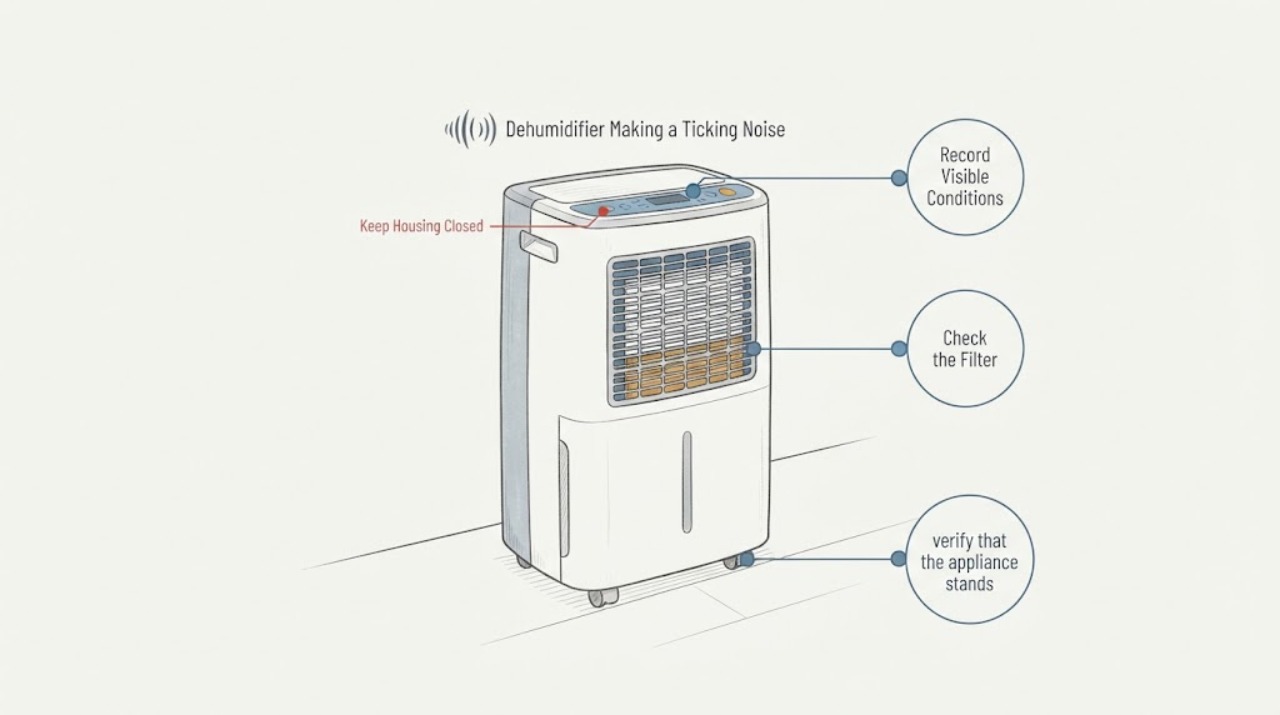
From a safe distance, record when the ticking starts and stops relative to fan operation, compressor cycling, water dripping, bucket filling and the unit being turned off. Do not place hands near the grille or run an opened unit.
Expected result: The sound tracks a normal operating event, or continues independently and the source cannot be localized safely.
Next step: Use the timing to describe the symptom to the manufacturer or service technician; do not diagnose an internal part from the timing alone.
Why this matters
Why: GE lists compressor, fan, dripping-water and on/off cycling sounds as expected sound categories, but the opened sources do not classify a generic ticking sound itself.
-
Check 2
Unplug the dehumidifier, remove and reseat only the user-removable bucket and filter cover as the appliance design shows, and check the visible grille for loose debris without reaching inside.
Expected result: The bucket or filter cover was loose/misaligned, or both parts were already properly seated.
Next step: Correct the visible fit once and monitor only if the appliance is otherwise safe. If ticking continues, stop troubleshooting at the cabinet boundary and arrange model-specific service.
Why this matters
Why: Frigidaire identifies a loose component or incorrectly installed bucket/filter cover as an external source of rattling on dehumidifiers; a correct fit does not prove an internal fault.
-
Check 3
With power disconnected, verify that the appliance stands steadily on a flat, level surface and that nothing contacts the cabinet or grille. Do not place shims inside the cabinet or loosen panels.
Expected result: The unit rocks or vibrates against its support, or it is stable while the ticking remains.
Next step: Correct only the safe external placement issue. If the sound remains, record the result and use the exact model's service route.
Why this matters
Why: Frigidaire connects humming/vibration with uneven support; stability may remove a cabinet vibration but cannot explain an isolated internal tick.
-
Check 4
With the unit closed and observed from outside, note any full-bucket light, pump indicator, error display, water on the floor or changed collection behavior. Do not assume a beep or indicator meaning from another brand.
Expected result: A water/full-bucket or pump indication is present, or the display and water path appear normal.
Next step: Follow only the exact model manual for a full bucket or drainage condition. If water reaches electrical areas, stop use and arrange service rather than testing repeatedly.
Why this matters
Why: GE documents model-dependent beeps for a full bucket, pump condition and power/button events. Those signals are separate from a generic ticking sound and do not establish a compressor or pump failure.
-
Check 5
Stop using the dehumidifier for crackling, smoke, burning odor, abnormal heat, damaged cord, water near electrical parts, repeated trips or a persistent unexplained tick. Disconnect power if safe and provide the technician with the model label, sound timing, external checks and any display/water observations.
Expected result: A safety symptom is present, or the ticking continues after the external checks.
Next step: Keep the cabinet closed and arrange manufacturer or qualified appliance service. Do not run the unit unattended or order an internal part from the noise description.
Why this matters
Why: The public evidence cannot distinguish a fan, compressor, relay, capacitor, wiring or sealed-system issue from the sound alone.
Use your observations
Decision map
Find the observation that best matches what you see, then follow the next safe action.
-
PATH 01Next step
What you see
The sound occurs only when the fan/compressor cycles or water enters the bucket, with no smoke, odor, heat or visible damage.
Do this next
Check the exact model manual and monitor without opening or repeatedly stressing the unit; arrange service if the sound is new, worsening or disruptive.
Why this path and its safety boundary
Why it matters: The timing is consistent with one of the normal sound categories GE describes, but it does not prove that a ticking sound is harmless for an unidentified model.
-
PATH 02Next step
What you see
The bucket/filter cover is not seated or the cabinet rocks/vibrates on its support.
Do this next
Unplug, correct the visible fit or level placement, and stop if the ticking remains or any part is damaged.
Why this path and its safety boundary
Why it matters: An external fit or support condition can explain rattling or vibration without proving an internal component failure.
-
PATH 03Next step
What you see
A full-bucket light, pump indication, error display, leak or changed drainage accompanies the sound.
Do this next
Use only the exact model manual for the warning; stop power use if water reaches electrical areas and arrange service.
Why this path and its safety boundary
Why it matters: The sound may be associated with a water-condition warning, but GE's examples are model-dependent and do not decode an unidentified appliance.
-
PATH 04Next step
What you see
The sound is crackling or continues independently of normal cycling, or there is smoke, burning odor, abnormal heat, damaged wiring, repeated power trips or water near electrical parts.
Do this next
Stop use, disconnect power only if safe, keep the cabinet closed and arrange qualified service; do not run the unit to reproduce the sound.
Why this path and its safety boundary
Why it matters: This is no longer a routine noise-identification question and may be an electrical or mechanical hazard.
Helpful context
Understand the symptom
Time the tick against the operating cycle
The opened report describes random ticking or clicking over long periods while the dehumidifier still works, but it provides no brand, model, recording or verified repair. Listen only from a safe distance and note whether the sound begins when the compressor or fan starts, follows a water drop into the bucket, occurs during on/off cycling, or continues after the unit is stopped. GE says compressor noise, condenser-fan noise, dripping into the bucket and normal cycling are expected categories of operating sound; that does not make every ticking noise normal.
Check removable parts and support with power disconnected
Unplug the unit before removing the bucket or filter cover. Confirm the bucket and filter cover are seated as the appliance shows, and verify that the dehumidifier stands level and is not rocking on an uneven floor. Frigidaire's official guide connects rattling with a loose component or improperly installed bucket/filter cover, and humming/vibration with uneven support. These checks can remove an external source of movement; they cannot identify an internal ticking part.
Separate sound from warning or water conditions
Look at the display and water path without opening the housing. Some dehumidifiers beep for a full bucket, pump condition or a button/power event; GE documents those as model-dependent examples. A ticking noise with a flashing full-bucket or pump indicator is a different decision from a tick with normal collection. Do not transfer a code, beep duration or button sequence from another brand to an unidentified unit.
Escalate an electrical or persistent mechanical sound
If the tick becomes crackling, is accompanied by smoke, burning odor, abnormal heat, a damaged cord, water reaching electrical areas or a unit that stops operating, disconnect power if safe and leave it off. If the external fit and level checks do not change a persistent ticking noise, use the exact model manual or manufacturer service route. The available general evidence does not support naming a compressor, fan motor, relay, capacitor or refrigerant fault.
When checks do not resolve it
Need a professional?
Safety scope: Do not open the cabinet, reach through the grille, touch energized parts, run the unit with panels removed, keep testing an electrically abnormal sound, or order a compressor, fan, relay, capacitor or sealed-system part from the noise alone.
Have this ready
- Provide the complete model label, purchase/installation date, sound timing relative to fan/compressor/water, display or bucket indicators, visible water, bucket/filter fit, level-placement result and a safe audio/video recording if available without operating an opened unit.
Common questions
FAQ
Is ticking normal for a dehumidifier?
The opened official sources do not give a universal answer for ticking. GE lists compressor, fan, dripping-water and normal cycling sounds, while Frigidaire gives external checks for loose rattling and vibration. Use timing and safe external observations, then use the exact model manual or service if the sound is persistent or worsening.
Could the bucket or filter cover cause the noise?
A loose component or incorrectly installed bucket/filter cover can contribute to rattling according to Frigidaire's guide. Unplug the unit, reseat only removable parts as designed, and stop if the noise remains or the cabinet must be opened.
Should I keep running it to find whether the tick is the compressor?
No. Timing the sound from a safe distance can help service, but repeatedly running a unit with crackling, burning odor, smoke, abnormal heat, damaged wiring or water near electrical parts is unsafe. Do not diagnose the compressor or another internal part from sound alone.
What if the noise comes with a full-bucket light or beeping?
Some GE dehumidifiers beep for a full bucket, pump condition or a power/button event. Those meanings are model-dependent; use the exact model manual rather than transferring a beep pattern from another unit.
Read the exact guide
Official sources
- dehumidifier making a ticking noise?Reddit · The opened post describes an unidentified dehumidifier making random ticking/clicking sounds for long periods while otherwise operating. It gives no brand, model or verified outcome.
- Dehumidifier - BeepingGE Appliances · GE documents one-time power/button beeps and longer full-bucket or pump-condition beeps for applicable models. It does not decode an unidentified unit's ticking sound.
- Dehumidifier Noise GuideFrigidaire Owner Support · Frigidaire applies this guide to dehumidifiers and links rattling with a loose component or bucket/filter-cover fit, and humming/vibration with uneven support. It is used as a clearly labeled general example, not as proof of another brand's internal design.
- Dehumidifier - Normal SoundsGE Appliances · GE says a dehumidifier can produce compressor, condenser-fan, dripping-water and normal cycling sounds. This is general manufacturer guidance and does not classify ticking on an unidentified model.
Community feedback
Share a repair observation
Share a plain-text repair observation. Accepted observations are published automatically; this page may take a moment to update.