
On this page
Start here
Quick answer
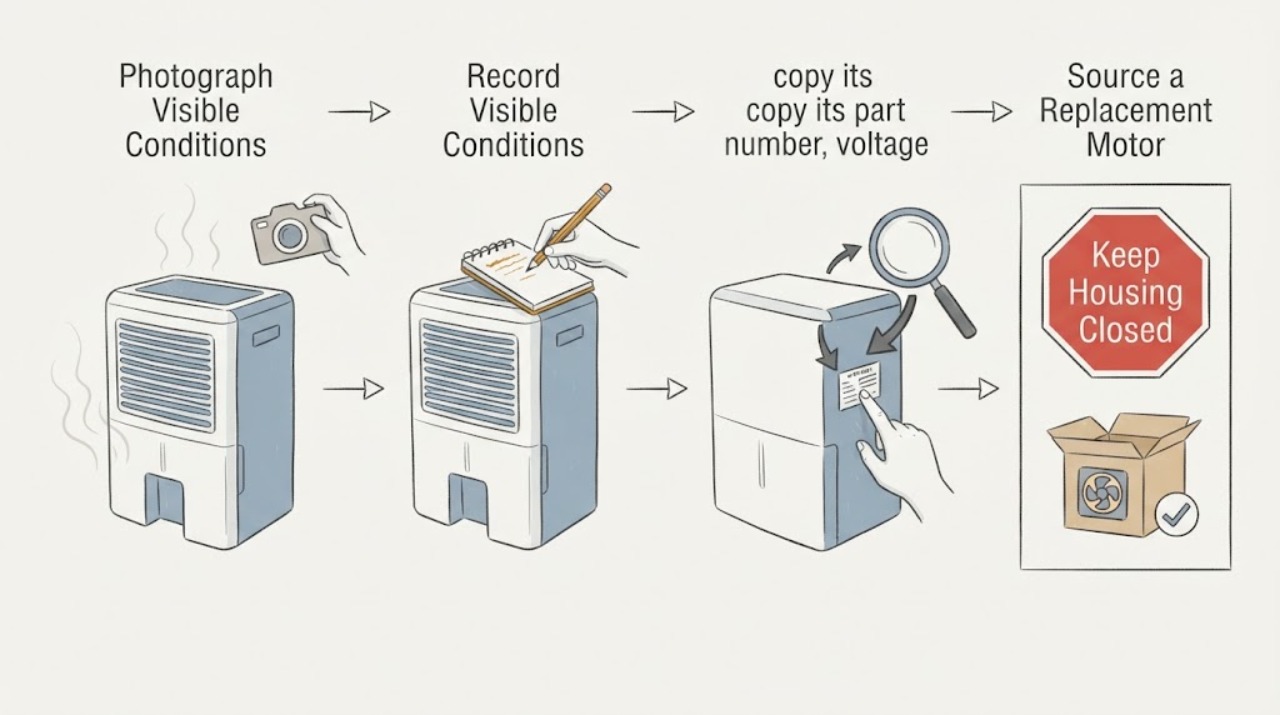
Do not order a generic dehumidifier motor from the symptom or a voltage label alone. First identify the whole-house unit's exact manufacturer and model, confirm that the failed item is the fan or blower assembly, and copy the original motor or assembly part number and nameplate information. Manufacturer documents show why this matters: Resideo lists different fan parts for specific DHM models, while Field Controls publishes separate FC-DH model families. Use the exact manual or manufacturer parts channel to verify fit; if the unit is hardwired, ducted, or requires access inside the cabinet, have an HVAC technician handle diagnosis and replacement.
Work through in order
Diagnostic checks
Use only checks that match the exact appliance or system and its official guide.
-
Check 1
Read and photograph the whole-house dehumidifier's manufacturer, complete model number, serial label, and any visible service-part label with the unit safely de-energized; do not remove covers to reach a hidden label.
Expected result: The exact manufacturer and model are readable, or only a generic description such as whole-house dehumidifier is available.
Next step: Use the exact model in the manufacturer's support or parts channel. If the model cannot be identified, ask an HVAC technician to identify the unit before sourcing a replacement.
Why this matters
Why: Manufacturer parts pages and manuals are model-scoped. A generic description is not enough to establish motor fitment.
-
Check 2
From outside the cabinet, record the symptom sequence: no airflow, a hum, intermittent starts, a stopped fan with the compressor running, or a system shutdown. Do not repeatedly cycle the unit to reproduce the symptom.
Expected result: The symptom is documented without energized access, or the unit is hardwired, inaccessible, or shows heat, smoke, damaged wiring, or water near electrical parts.
Next step: If any electrical or water hazard is present, leave the unit off and arrange professional service. Otherwise provide the symptom record and exact model to the manufacturer or technician.
Why this matters
Why: These observations help a technician separate a suspected fan problem from a capacitor, control, airflow, or protection issue, but they do not prove which component failed.
-
Check 3
If a motor or fan nameplate is already visible without disassembly, copy its part number, voltage and frequency, rated current or power, rotation, mounting pattern, shaft or wheel interface, and capacitor information; do not measure live terminals or improvise wiring.
Expected result: The original part number and physical/electrical identifiers can be matched to the exact unit, or the part is not accessible without cabinet work.
Next step: Give the complete data to the manufacturer or an HVAC parts supplier for exact verification. If access requires opening the cabinet, stop and have a qualified technician identify the part.
Why this matters
Why: A replacement must match the manufacturer's specified assembly and the unit's mechanical and electrical interface; a similar-looking motor is not established as compatible.
-
Check 4
Compare the exact model against the manufacturer's owner or installer documentation and parts listing before ordering anything.
Expected result: The manufacturer lists a matching fan or motor assembly for the exact model, or no matching listing is found.
Next step: Order only after the manufacturer or qualified supplier confirms fitment. If no confirmation is available, keep the unit out of service and obtain a technician diagnosis rather than adapting a generic motor.
Why this matters
Why: A matching listing supports that manufacturer's part path only. No listing does not make a different model's fan, capacitor, or motor a safe substitute.
Use your observations
Decision map
Find the observation that best matches what you see, then follow the next safe action.
-
PATH 01Next step
What you see
The exact model and an official parts listing identify a fan or motor assembly for that same model.
Do this next
Have the manufacturer, HVAC parts supplier, or qualified technician confirm the part number and installation scope before ordering or replacing it.
Why this path and its safety boundary
Why it matters: The replacement path is model-bounded; the listing supports that assembly for that model and does not establish compatibility with another whole-house unit.
-
PATH 02Next step
What you see
The unit has no readable model, the motor is inaccessible without removing the cabinet, or the manufacturer cannot confirm a replacement.
Do this next
Leave sourcing and cabinet access to a qualified HVAC technician who can identify the assembly and diagnose the actual failed component.
Why this path and its safety boundary
Why it matters: Motor fitment and the claimed motor failure remain unresolved; a generic motor search could create an electrical, airflow, or mechanical mismatch.
-
PATH 03Next step
What you see
There is smoke, a burning smell, damaged wiring, standing water near electrical parts, or a hardwired unit that cannot be safely isolated.
Do this next
Keep the dehumidifier off, isolate power only through a safe accessible disconnect, and arrange qualified HVAC/electrical service.
Why this path and its safety boundary
Why it matters: This is a safety stop condition, not evidence that ordering a motor will solve the problem.
Helpful context
Understand the symptom
Treat the motor as a model-specific part
A whole-house dehumidifier may use a fan, blower, capacitor, control, or another part that can produce similar symptoms. Resideo's documentation lists fan and fan-capacitor components for its named model families, and its separate fan page identifies SKU 50081282-012/U specifically for DHM065R4000. That is evidence for that Resideo model only, not a fitment claim for an unidentified unit. Field Controls likewise lists separate FC-60DH-2, FC-85DH-2, and FC-120DH-2 models.
Gather evidence without opening or powering the cabinet
Photograph the rating label, model number, wiring label, and any visible motor nameplate only when the unit is safely de-energized and accessible. Record whether the fan is silent, hums, starts and stops, or fails while the compressor runs, but do not use those observations to declare the motor bad. A technician or the manufacturer can use the exact model and nameplate data to distinguish a fan assembly, capacitor, control, or airflow problem.
When checks do not resolve it
Need a professional?
Call the manufacturer or a qualified HVAC technician before ordering when the exact model cannot be identified, when the motor is not externally accessible, or when smoke, burning smell, damaged wiring, water near electrical parts, or a hardwired connection is present.
Common questions
FAQ
Can I use any 110–120 V motor with the same wattage?
No. Official parts pages tie fan assemblies to particular whole-home models. Voltage or wattage alone does not establish the correct wheel, rotation, mounting, capacitor, wiring, airflow, or protection compatibility.
Does no airflow prove that the motor needs replacement?
No. The symptom can require separating the fan assembly from a capacitor, control, airflow, or protection issue. Record the external symptom and have the exact model diagnosed before selecting a part.
Read the exact guide
Official sources
- Whole Home Dehumidifier | Resideo PROResideo · Opened the official Resideo PRO page. It identifies A65D, A90D, and A120D models, states that service parts are available, lists fan and fan capacitor among replaceable components, and links model-specific DHM resources.
- Dehumidifier fan for DHM065R4000Resideo · Opened the exact Resideo product page. It names the DHM065R4000 model and SKU 50081282-012/U; it is an example of model-specific fitment, not a generic motor recommendation.
- WHOLE HOME DEHUMIDIFIERField Controls · Opened the official Field Controls product page. It identifies the FC-DH model family, explains ducted whole-home operation, lists separate model numbers, links installation resources, and says a licensed contractor should install a whole-home dehumidifier.
Community feedback
Share a repair observation
Share a plain-text repair observation. Accepted observations are published automatically; this page may take a moment to update.