
On this page
Start here
Quick answer
A dehumidifier can make normal compressor, fan, water-dripping, and cycling sounds, but the opened official guidance does not establish a popping noise together with an odor as a normal condition. Turn it off and unplug it safely; do not power it back on just to reproduce the sound. With power disconnected, inspect only the visible plug, cord, outlet, bucket, filter cover, and unit position, and clean a removable bucket only as the exact owner manual permits. Record the brand, model, and serial information and check whether that specific unit is recalled. Smoke, scorching, a hot plug or outlet, repeated breaker trips, or a burning/electrical odor requires continued isolation and qualified service; do not open the cabinet or test internal electrical parts.
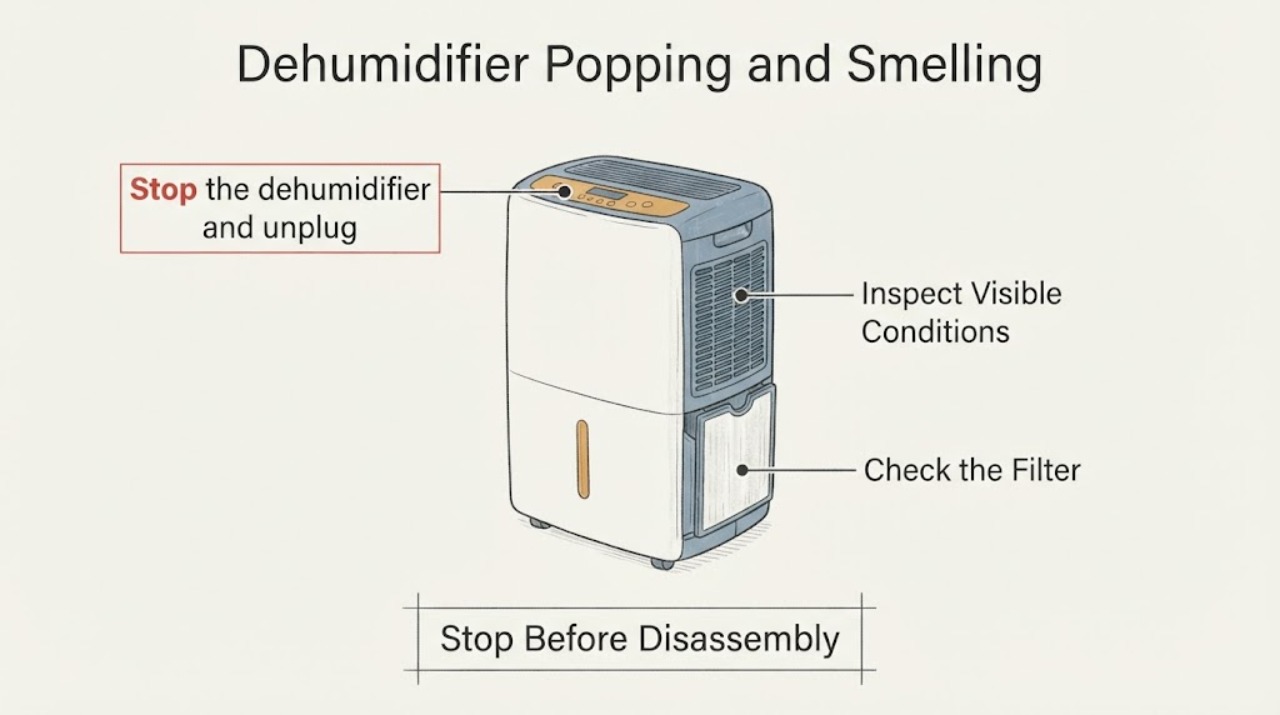
Work through in order
Diagnostic checks
Use only checks that match the exact appliance or system and its official guide.
-
Check 1
Stop the dehumidifier and unplug it from the wall when it is safe to reach the plug. Do not keep running it or restore power merely to reproduce the pop. If there is smoke, flame, sparking, a hot or scorched connection, or an unsafe wet area, move away and use appropriate emergency or electrical help rather than handling the unit.
Expected result: The unit is disconnected without touching a hot, damaged, wet, smoking, or sparking connection; or a dangerous condition prevents safe unplugging.
Next step: Keep the appliance out of use and arrange qualified appliance or electrical service. Do not remove covers, reset protection repeatedly, or perform live tests.
Why this matters
Why: A safe isolation limits further operation while the cause is unknown. A damaged connection, smoke, or fire sign is an immediate safety boundary, not a routine noise diagnosis.
-
Check 2
With power disconnected and the unit cool, inspect only the visible plug, cord, outlet, cabinet, and floor around the dehumidifier. Look for scorching, melting, looseness, moisture, impact damage, or an odor strongest at the electrical connection. Do not remove a panel or probe the appliance.
Expected result: The connection or cabinet has visible heat or damage; the floor or unit is wet; or there is no visible external damage.
Next step: If damage, heat, or moisture is present, leave it disconnected and arrange qualified service; if the exterior is intact, continue only with the non-powered setup and odor checks below.
Why this matters
Why: Visible electrical or water damage makes a restart unsafe. No visible damage does not prove that an internal component is sound or explain the pop.
-
Check 3
Without disassembling the dehumidifier, confirm that the collection bucket and accessible filter cover are fully seated and that the unit rests evenly on a flat, stable surface. Do not force a cover or run the appliance with a missing or damaged cover.
Expected result: The bucket or filter cover is loose or misaligned, the unit rocks on its support, or all three external conditions appear correct.
Next step: If the setup is visibly wrong and the exact manual permits a user correction, reseat the removable item with power disconnected and monitor only after the abnormal odor and electrical red flags are absent. If the pop or smell returns, stop and arrange service.
Why this matters
Why: Frigidaire identifies a loose component, incorrectly installed bucket or filter cover, and poor level support as possible contributors to rattling or vibration. These observations do not diagnose an internal electrical or mechanical fault.
-
Check 4
Identify the odor without leaning over a running appliance: compare a musty smell from the removable bucket with a burning, hot-plastic, or electrical smell from the cord, outlet, or cabinet. If the exact owner manual permits it, clean only the unplugged removable bucket with mild soap and water; do not use bleach or ammonia and keep excess water away from controls.
Expected result: The odor is limited to a removable bucket with visible residue; the odor is burning or electrical; or the odor source cannot be separated safely.
Next step: For bucket-only odor, follow the exact model manual and stop if the pop recurs. For burning/electrical odor or an uncertain source, keep the unit unplugged and arrange qualified service without trying a restart.
Why this matters
Why: Frigidaire says bucket odor can be associated with algae and gives unplugged cleaning limits, but a bucket explanation does not account for a repeated pop or electrical odor. An uncertain or burning smell remains a service issue.
-
Check 5
Read the model and serial label from the outside of the unit and check the manufacturer's safety page and the applicable official recall database for that exact combination. Do not treat a brand-level result or a similar-looking dehumidifier as a match.
Expected result: The exact model and serial match a recall; the label is incomplete or unavailable; or no exact recall match is found.
Next step: For an exact recall match, leave the unit unplugged and follow the recall instructions. If the identity is incomplete or the symptom continues without a recall match, give the recorded details to qualified service rather than opening the unit.
Why this matters
Why: CPSC and GE recall notices are limited to listed models and serial ranges and direct owners to stop using affected units. A missing or nonmatching result does not prove that an abnormal pop and odor are safe.
Use your observations
Decision map
Find the observation that best matches what you see, then follow the next safe action.
-
PATH 01Next step
What you see
There is smoke, flame, sparking, scorching, a hot plug or outlet, a burning/electrical odor, repeated breaker tripping, or visible water or electrical damage.
Do this next
Keep clear of smoke or fire, isolate power only if it is safe to do so, and contact appropriate emergency, electrical, or appliance service. Do not remove the cabinet or repeatedly reset protection.
Why this path and its safety boundary
Why it matters: This is an immediate electrical or fire-safety boundary. The symptom is not suitable for a user component diagnosis or a restart test.
-
PATH 02Next step
What you see
The only odor is musty and comes from a removable bucket, there are no electrical red flags, and the exact owner manual allows the bucket to be cleaned by the user.
Do this next
With the unit unplugged, clean only the permitted removable bucket using the exact manual's limits. If the pop returns, the odor persists, or the source is uncertain, stop and arrange qualified service.
Why this path and its safety boundary
Why it matters: A bucket-cleaning issue is plausible, but it does not prove that the popping noise has the same cause.
-
PATH 03Next step
What you see
The bucket and filter cover are seated, the unit is level, there is no visible exterior damage, and the sound is only the compressor, fan, dripping water, or normal cycling described by the exact manual with no abnormal odor.
Do this next
Use the exact model manual for normal-sound comparison. If a sharp pop or smell recurs, stop use and arrange service instead of continuing to test it.
Why this path and its safety boundary
Why it matters: Those observations are consistent with documented normal operating sounds, but they do not validate a sharp pop paired with a smell.
-
PATH 04Next step
What you see
The model and serial exactly match a listed dehumidifier recall, or the model identity cannot be established well enough to rule that out.
Do this next
Keep the unit unplugged. Follow the official recall instructions for an exact match; otherwise obtain the complete label information and use qualified service rather than attempting a restart.
Why this path and its safety boundary
Why it matters: Recall status is model- and serial-specific; a similar brand or shape is not enough to establish coverage.
Helpful context
Understand the symptom
Some operating sounds are expected: GE describes compressor and condenser-fan noise, water dripping into the bucket, and normal cycling. Frigidaire's noise guide separately points to an improperly seated bucket or filter cover and an uneven surface as external things to check for rattling or vibration. Those pages do not make a sharp pop together with an odor a confirmed normal condition, so the combination should be treated as an abnormal symptom until the exact model manual or a qualified technician establishes otherwise.
No model was supplied, so this article stays at the shared external-safety level. Frigidaire's cleaning guidance is a brand-specific example rather than a universal disassembly procedure: it says to unplug before cleaning, keep excess water away from controls, and use the exact owner manual for bucket handling. Use your own manufacturer's manual for any model-specific cleaning, recall, or service instruction.
When checks do not resolve it
Need a professional?
Arrange qualified appliance or electrical service if the pop or odor repeats, the source is burning or electrical, the unit trips protection, the connection or cabinet is damaged, a normal shutdown is not possible, or the model-specific manual does not resolve the condition. Provide the brand, complete model and serial information, when the sound occurs, the odor description and location, any visible damage, and whether smoke, heat, water, or a breaker trip occurred. Do not open the cabinet, bypass a control, test a capacitor or motor, or work on the sealed system.
Common questions
FAQ
Are popping sounds normal for a dehumidifier?
Some compressor, fan, dripping-water, and cycling sounds can be normal, but the opened official guidance does not establish a pop combined with an odor as normal. Stop and unplug the unit safely rather than repeatedly powering it to reproduce the sound, then compare only with the exact model manual or arrange service.
Can I clean a smelly dehumidifier bucket?
If the exact owner manual permits user cleaning, unplug the unit first and clean only the removable bucket within that manual's limits. Frigidaire's published guidance uses mild soap and water, warns against bleach or ammonia, and warns to keep excess water away from controls. Bucket cleaning does not make a recurring pop or burning odor safe to ignore.
Should I keep running it if no recall appears?
No. Recall lookup is model- and serial-specific and a nonmatch does not diagnose an abnormal pop and smell. Keep the unit disconnected if the symptom recurs or if there is any electrical odor, heat, smoke, damage, or tripping, and provide the exact identity and symptom history to qualified service.
Read the exact guide
Official sources
- Dehumidifier Noise GuideFrigidaire · Use the listed bucket, filter-cover, and level checks only as external examples and confirm against the exact manufacturer's manual.
- Dehumidifier - Clean and CareFrigidaire · Brand-specific cleaning example only; do not infer bucket disassembly or chemical compatibility for an unidentified model.
- CPSC Warning: Stop Using Recalled Gree Dehumidifiers Due to Fire HazardU.S. Consumer Product Safety Commission · Recall-check safety branch only; exact model and serial must match the CPSC notice.
- Dehumidifier - Normal SoundsGE Appliances · General symptom comparison, explicitly scoped to the GE guidance and not a universal diagnosis for every dehumidifier.
- GE Dehumidifier RecallGE Appliances · Recall-check safety branch only; do not generalize the listed compressor-short/fire hazard to unlisted models.
Community feedback
Share a repair observation
Share a plain-text repair observation. Accepted observations are published automatically; this page may take a moment to update.