
On this page
Start here
Quick answer
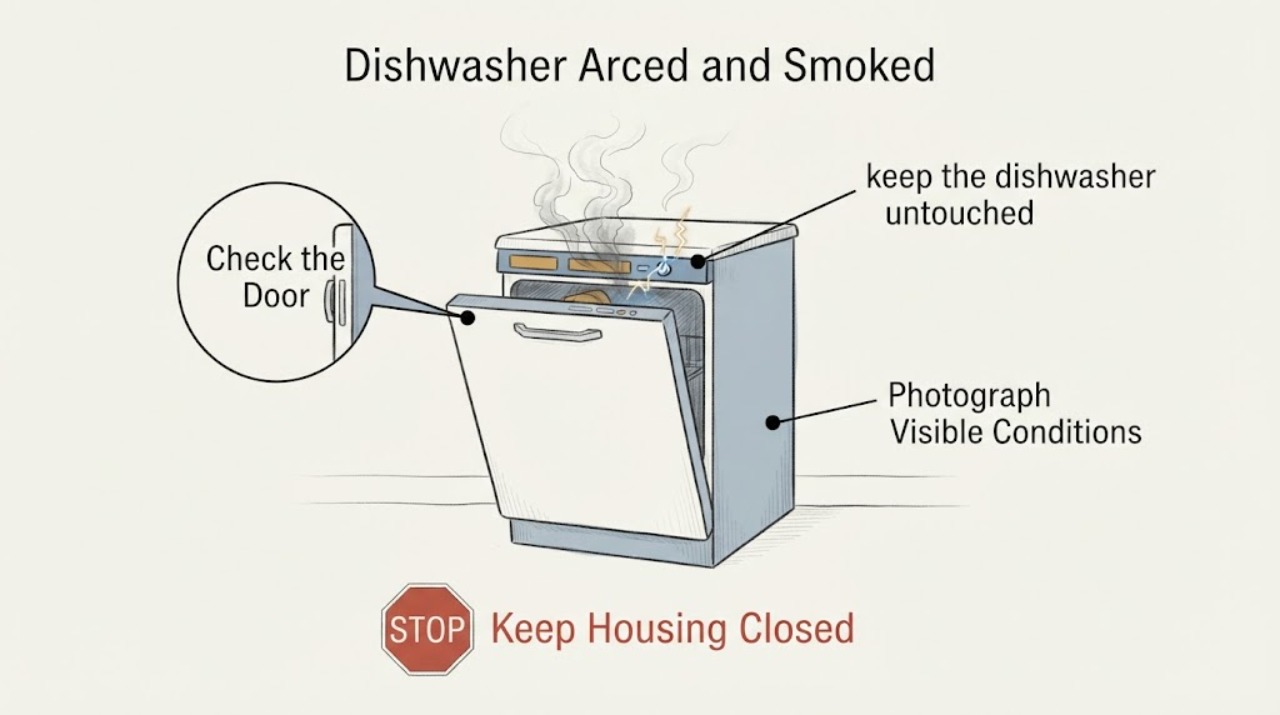
Treat arcing and smoke from a dishwasher as an electrical and fire emergency, not as a normal cycle symptom. Stop using it and keep people away. If smoke, flames, heat, or a burning odor is still present, leave the apartment and call emergency services; do not open the dishwasher or try to extinguish an appliance fire from close range. If there is no active fire and you can do so without approaching a hot, wet, or damaged appliance, switch off the dishwasher supply at the identified breaker and do not reset it. Because this is an apartment and the reported trip involved a different breaker, notify the landlord or building emergency contact and have the appliance and the building circuit checked by qualified professionals. Do not run a test cycle or identify a part from the symptom alone.
Work through in order
Diagnostic checks
Use only checks that match the exact appliance or system and its official guide.
-
Check 1
Look and listen from a safe position: is there still smoke, flame, glowing material, spreading heat, a strong burning odor, or a smoke alarm sounding? Do not open the dishwasher door to investigate.
Expected result: Smoke, flame, heat, or a burning odor is ongoing, or the appliance area is becoming more hazardous.
Next step: Leave by the safest exit, close doors if you can do so without delay, warn others, and call the local emergency number from outside. Do not re-enter until fire officials say it is safe.
Why this matters
Why: This is an active fire or electrical-fire risk, and smoke can make an apartment unsafe before flames are obvious.
-
Check 2
If there is no active smoke or flame, keep the dishwasher untouched and decide whether its power can be isolated from a dry, safe location without approaching heat, water, exposed conductors, or a damaged cord. Use the labeled dishwasher breaker only if its identity is clear; do not reset any breaker.
Expected result: The dishwasher circuit is clearly identified and can be switched off safely, or the circuit is unknown, the tripped breaker is different, or access is unsafe.
Next step: Switch off the clearly identified circuit only when safe. Otherwise stay away and contact building emergency maintenance or a qualified electrician; do not touch the appliance, receptacle, or panel beyond safe switching.
Why this matters
Why: A breaker that tripped elsewhere cannot be used to prove which device or conductor is at fault. Resetting or guessing can re-energize a damaged circuit.
-
Check 3
Once power is isolated and the area is cool and dry, record the dishwasher brand/model/serial label, which breaker or protective device moved, when the arc occurred, whether water was present, and where smoke or sparks appeared. Photograph only from a safe position.
Expected result: The label and scene can be documented without moving the appliance, removing covers, touching wiring, or disturbing soot or melted material.
Next step: Send the record to the landlord or property manager and the qualified service contacts. If documenting requires moving the dishwasher, opening a panel, or touching a wet or damaged area, stop and leave it for professionals.
Why this matters
Why: These observations help the building electrician and appliance service provider separate appliance evidence from circuit evidence; they do not establish a failed component.
-
Check 4
Notify the landlord or property manager that the event occurred in an apartment, state that a different breaker reportedly tripped, and ask for coordinated electrical and appliance evaluation before restoring power to the dishwasher.
Expected result: Building staff can identify the circuit, shared loads, protective devices, and approved service process, or they cannot make the area safe promptly.
Next step: Keep the dishwasher out of service and use the building emergency route or a licensed electrician if staff cannot respond. Do not substitute a portable outlet, extension cord, or another circuit.
Why this matters
Why: The apartment wiring and protection are part of the incident scope; an appliance-only diagnosis may miss a receptacle, branch-circuit, or building-side problem.
-
Check 5
After professionals have made the area safe, use the exact model and serial information to check the manufacturer support path and CPSC recalls; do not assume a recall, heating element, control, cord, or breaker explanation applies without matching identity.
Expected result: The model/serial matches a specific safety notice, or no matching notice is found.
Next step: Follow the matching notice or the qualified service report. If no notice matches, retain the appliance out of service until the appliance and circuit evaluations are complete.
Why this matters
Why: A matching recall can supply its own stop-use and remedy instructions. No match does not prove the dishwasher or apartment wiring is safe after an arc and smoke event.
Use your observations
Decision map
Find the observation that best matches what you see, then follow the next safe action.
-
PATH 01Next step
What you see
Smoke, flame, glowing material, strong burning odor, or a smoke alarm is still present.
Do this next
Evacuate, call emergency services from outside, and do not re-enter until cleared by fire officials.
Why this path and its safety boundary
Why it matters: The situation may be an active fire, and smoke can rapidly make an apartment unsafe.
-
PATH 02Next step
What you see
The smoke stopped, but the dishwasher, cord, receptacle, cabinet, or nearby wall has heat, soot, melted material, water, or visible damage.
Do this next
Keep everyone away, isolate power only from a safe position if clearly identified, and request coordinated building electrical and appliance service.
Why this path and its safety boundary
Why it matters: The event still has an unresolved electrical or fire-risk signature; a visual part guess is unsafe.
-
PATH 03Next step
What you see
A different breaker tripped, or the dishwasher breaker cannot be identified with confidence.
Do this next
Do not reset breakers or move the dishwasher. Notify the landlord/property manager and have a qualified electrician identify the circuit before any appliance service test.
Why this path and its safety boundary
Why it matters: The breaker behavior does not establish the fault location and may involve circuit protection or another connected load.
-
PATH 04Next step
What you see
There is no active smoke, no visible heat or damage, and professionals have isolated and assessed the circuit and appliance.
Do this next
Follow the written service or recall direction and do not restore use until the responsible professional says the appliance and circuit are safe.
Why this path and its safety boundary
Why it matters: Only after the safety assessment can a model-specific repair or recall decision be made; the original arc symptom alone does not identify a component.
Helpful context
Understand the symptom
A dishwasher that visibly arcs or produces smoke has already crossed the line where a reset or ordinary cleaning check is appropriate. The fact that a different breaker tripped does not identify whether the appliance, receptacle, branch wiring, a protective device, or another connected load caused the event. It is a reason to preserve the scene and have both the appliance and the apartment circuit assessed.
The steps below separate immediate fire response from the later handoff to building and appliance professionals. They do not tell a resident to remove a dishwasher, open its junction box, inspect live wiring, reset a breaker, or reproduce the arc.
When checks do not resolve it
Need a professional?
Call emergency services immediately for active smoke, flames, spreading heat, or a smoke alarm with an unresolved source. For a stopped event, keep the dishwasher out of service and contact the landlord/property manager plus a qualified electrician and appliance service provider before restoring power. Never reproduce the arc.
Common questions
FAQ
Why did a different breaker trip?
The breaker behavior alone cannot locate the fault. It may reflect circuit protection, shared wiring or loads, a protective device, or an appliance-side problem; only a qualified electrical assessment can establish which applies. Do not reset breakers to test the dishwasher.
Can I open the dishwasher to see where it arced?
No. After arcing and smoke, do not open the door to investigate hot, wet, soot-covered, or energized areas, remove the unit, or open electrical covers. Give the model and scene information to building and qualified service professionals.
What should an apartment resident do after the smoke stops?
Keep the dishwasher out of service, isolate power only from a clearly identified safe point, notify the landlord or property manager, and request coordinated electrical and appliance evaluation before power is restored.
Read the exact guide
Official sources
- DishwashersU.S. Consumer Product Safety Commission · CPSC dishwasher recall index; used only for post-isolation model/serial recall lookup, not for diagnosis or cross-model applicability.
- Appliance and Electrical Fire SafetyU.S. Fire Administration · Government fire-safety guidance on electrical and appliance fire hazards, damaged appliance cords, outlets, and electrical fire prevention; used for general safety boundaries only.
- Let’s Have Fun With Fire SafetyU.S. Fire Administration · Government fire-response guidance used only for the emergency branch: get low and exit when smoke is present, call the fire department, stay outside, and do not re-enter until cleared.
- Arc Fault Circuit Interrupter (AFCI): Advanced Electrical Fire Protection for the HomeElectrical Safety Foundation International · Electrical-safety guidance on arcing faults, their relation to damaged/stressed/overheated wiring, and the role of AFCI protection; not a diagnosis of this dishwasher or apartment circuit.
- Cove Appliance Recalls Dishwashers Due to Fire HazardU.S. Consumer Product Safety Commission · CPSC recall notice for specified Cove DW2450 and DW2450WS dishwashers; used only as an official example that dishwasher smoke/burning reports can require immediate stop-use, power disconnection, and repair, not as evidence that this unidentified apartment dishwasher is recalled.
- Learn About FireU.S. Fire Administration · Government fire-safety guidance on the danger and speed of smoke and the need to leave during a home fire.
- Understanding Your Home Electrical SystemElectrical Safety Foundation International · Electrical-safety guidance on tripped breakers, turning off appliances, and contacting an electrician if a problem continues; used to support the no-reset/no-guess boundary after an arc event.
Community feedback
Share a repair observation
Share a plain-text repair observation. Accepted observations are published automatically; this page may take a moment to update.