
On this page
Start here
Quick answer
A dishwasher bad smell usually comes from food residue, a dirty filter, stagnant water, a soiled door seal, or overdue maintenance. Empty the machine, inspect the filter and spray arms, wipe accessible seals, and run only the model-approved hot maintenance cycle. Wear gloves around sharp debris, never mix cleaners, and arrange service if odor comes with standing water, sewage smell, leaks, heating failure, or repeated drain problems.
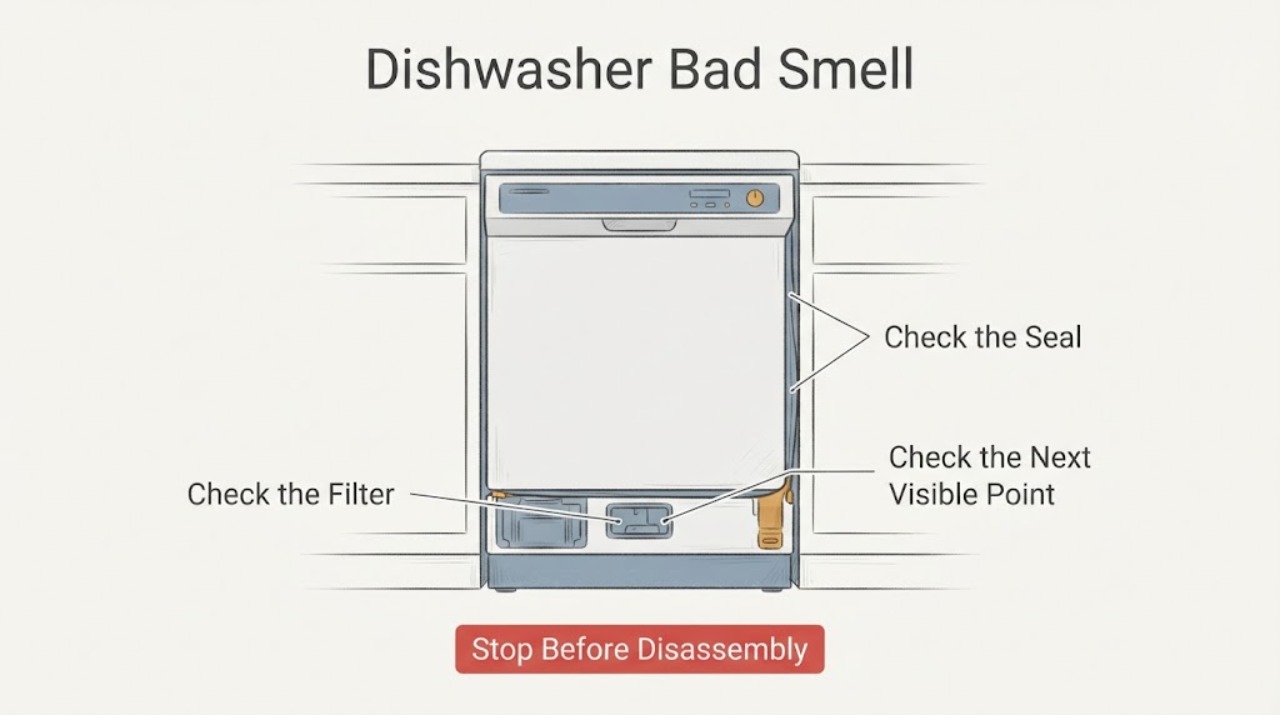
Work through in order
Diagnostic checks
Use only checks that match the exact appliance or system and its official guide.
-
Check 1
Empty the dishwasher and identify whether odor is strongest at the filter, sump area, door seal, or drain connection without reaching into standing water.
Expected result: Food residue, standing water, a dirty seal, or no visible residue is found.
Next step: Keep hands away from sharp glass and hot water. Use gloves and follow accessible model cleaning steps.
Why this matters
Why: Location distinguishes retained food from a drain or installation problem; standing water also harms cleaning.
-
Check 2
Remove and rinse the accessible filter under running water with mild soap and a soft brush, then lock it back in place.
Expected result: The filter is blocked, greasy, damaged, or already clean.
Next step: Do not run with a loose or damaged filter. Stop if sharp debris cannot be removed safely.
Why this matters
Why: Bosch identifies food debris at the filter as a performance problem and recommends gentle cleaning.
-
Check 3
Inspect spray-arm holes and door gasket; rinse accessible spray arms and wipe the seal without forcing clips or using steam.
Expected result: Spray holes or the seal contain food or grease, or both are clear.
Next step: Refit parts correctly and use the manual-approved drying or maintenance step.
Why this matters
Why: Blocked spray arms leave residue that can smell, while seal debris remains after a cycle; clear surfaces do not rule out drainage or heat faults.
-
Check 4
Run the exact manual’s empty maintenance or hottest approved cleaning programme using only a compatible cleaner.
Expected result: Odor clears, returns quickly, or the cycle leaves standing water or an abnormal smell.
Next step: Stop for a leak, sewage odor, smoke, or heating failure and arrange service.
Why this matters
Why: A maintenance cycle can remove interior residue; recurring odor or poor drainage needs water-path diagnosis.
Use your observations
Decision map
Find the observation that best matches what you see, then follow the next safe action.
-
PATH 01Next step
What you see
Odor clears after filter, seal, spray-arm, and approved maintenance cleaning.
Do this next
Repeat model-approved maintenance and remove food debris promptly.
Why this path and its safety boundary
Why it matters: The pattern supports retained food or interior residue.
-
PATH 02Next step
What you see
Odor returns with standing water, poor drainage, sewage-like smell, leak, or no heating.
Do this next
Stop using the dishwasher and arrange qualified service; do not dismantle the pump.
Why this path and its safety boundary
Why it matters: The smell is linked to a drain, pump, heater, or installation issue beyond surface cleaning.
Helpful context
Understand the symptom
Bosch’s official maintenance guide identifies food debris at the filter, blocked spray arms, and interior buildup as concerns and provides gentle cleaning steps.
Only after diagnosis
Potential parts
- dishwasher filter
Only consider this if the installed filter is cracked, cannot lock, or remains damaged after cleaning and the model manual identifies a replacement.
Confirm the dishwasher model and manufacturer fit information before ordering.
When checks do not resolve it
Need a professional?
Arrange qualified service when odor returns with standing water, poor drainage, leaks, no heating, sewage smell, smoke, or burning or chemical odor. Do not dismantle the pump or mix cleaners.
Common questions
FAQ
How often should a dishwasher be cleaned for odor control?
Use the model manual’s interval. Bosch’s maintenance guidance recommends periodic filter and interior care and explains that food debris can hinder performance.
Can I use a steam cleaner inside a dishwasher?
Do not assume it is safe. Follow the exact manual; Bosch specifically warns against steam cleaning and recommends gentle filter and spray-arm care.
Read the exact guide
Official sources
- How to Clean & Descale Bosch Dishwashers: A Complete GuideBosch · Dishwasher filter, spray-arm, pump, interior cleaning, and support
Community feedback
Share a repair observation
Share a plain-text repair observation. Accepted observations are published automatically; this page may take a moment to update.