
On this page
Start here
Quick answer
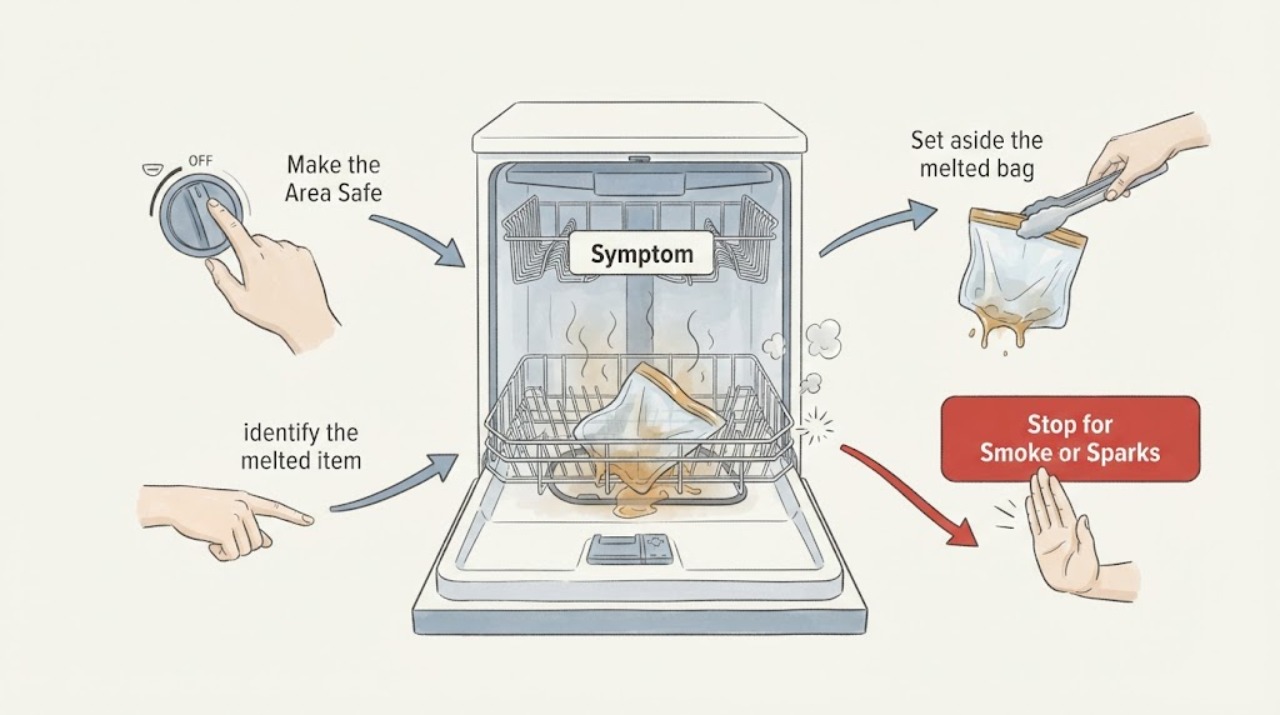
Stop the dishwasher, let it cool completely, and remove the melted plastic item. Whirlpool says to check around the heating element only after the dishwasher is fully cooled, remove accessible plastic or food debris with a non-metallic tool, and use a rinse or manufacturer-approved cleaning cycle to help with remaining odor. GE likewise says to disconnect power before maintenance or cleaning, keep the element cool, and seek service if plastic cannot be removed or the burning odor persists. Do not run another heated cycle to soften the plastic, open covers, scrape a hot element, or assume an element, thermostat, or control has failed without a model-specific diagnosis.
Work through in order
Diagnostic checks
Use only checks that match the exact appliance or system and its official guide.
-
Check 1
Stop the cycle and keep people away from the hot interior until smoke has cleared and the dishwasher is completely cool. If there is active smoke, a flame, a melted door or wiring area, a tripped breaker, or an electrical burning smell, switch the appliance off at its normal control and disconnect its circuit only if this can be done safely without touching the appliance; do not restart it.
Expected result: The event is limited to a cooled odor and a loose item, or there is continuing smoke, flame, electrical odor, visible damage, or a breaker trip.
Next step: For any continuing smoke, flame, electrical odor, visible damage, or breaker trip, leave the dishwasher off and arrange qualified appliance service. Never use water on an electrical fire.
Why this matters
Why: A localized melted item may be inspectable after cooling. Continuing smoke, electrical odor, or structural damage is outside a safe cleaning check and may indicate an appliance fault or fire risk.
-
Check 2
After the dishwasher has fully cooled, identify the melted item and inspect only the visible area around the heating element, rack, tub floor, and lower spray path. Remove loose plastic or food debris only if it is accessible without removing a component, using a non-metallic utensil or other method explicitly allowed by the model manual; do not scrape a warm element or reach under covers.
Expected result: The plastic is loose and accessible, fused to the element or another surface, absent but leaving a mark, or accompanied by a cracked rack, tub, seal, or support.
Next step: Remove only safe loose residue. Stop and request service if the plastic is fused, cannot be reached without disassembly, or has damaged the element, tub, rack, seal, or wiring area.
Why this matters
Why: Whirlpool and GE describe cooled, non-metallic removal for accessible residue. Fused residue, inaccessible pieces, or damaged appliance parts require model-specific service rather than a guessed heating-element or control diagnosis.
-
Check 3
Set aside the melted bag and check its actual material and care marking with its manufacturer. Inspect the load for other thin, disposable, warped, or unmarked plastic; if a plastic item is dishwasher-safe, follow its instructions and place it on the upper rack rather than over the heating area.
Expected result: The item is marked dishwasher-safe and suitable for the rack used, or it is thin, disposable, unmarked, warped, or not approved for dishwasher heat.
Next step: Keep the suspect item and any warped or odor-retaining items out of future loads until their maker confirms safe use. Do not substitute a different container based only on appearance.
Why this matters
Why: Whirlpool says thin or disposable plastic can melt and recommends upper-rack placement for dishwasher-safe plastic. A reusable label alone does not prove a plastic item is heat-safe or silicone.
-
Check 4
Once all visible residue is gone and no appliance damage or active odor remains, follow the dishwasher's own manual for an empty rinse or approved cleaning cycle. Keep the door open to ventilate afterward only if the manual permits it, and hand-wash or rewash dishes that carry the burnt-plastic odor instead of serving food from them while the odor remains.
Expected result: The first safe empty cycle has no smoke or renewed burning smell, or the odor returns, residue reappears, or dishes still smell strongly of plastic.
Next step: If odor returns, smoke appears, or dishes continue to carry the smell, stop using heated cycles and arrange service. Do not add unapproved chemicals or run repeated high-heat cycles to burn residue away.
Why this matters
Why: Whirlpool says a rinse or cleaning cycle can help remove odor after cooled residue is addressed. A returning odor means residue may remain or the appliance may have damage; it is not proof of a failed heater or thermostat.
-
Check 5
Document the dishwasher model, the item material and marking, where the plastic contacted the appliance, whether the element or rack is visibly damaged, and whether the odor occurs only during drying or also during washing. Give these details to the manufacturer or technician instead of ordering a generic element or control.
Expected result: The appliance is undamaged and odor resolves, or the event repeats, occurs without plastic in the load, or involves a damaged internal or electrical area.
Next step: Use the recorded pattern for model-specific service, especially for repeated odor, smoke, damaged parts, or a smell unrelated to the melted item. Keep the appliance off until the technician clears it if the smell is electrical or recurs.
Why this matters
Why: A one-time contact event is different from recurring odor with no plastic load. Without a model and inspection, the symptom cannot identify a compatible part or internal cause.
Use your observations
Decision map
Find the observation that best matches what you see, then follow the next safe action.
-
PATH 01Next step
What you see
The dishwasher is cool, the melted plastic is loose and accessible, and there is no visible damage or recurring smoke.
Do this next
Remove only accessible residue with the model-approved non-metallic method, remove the item from future loads, and use an approved rinse or cleaning cycle only after the manual permits it.
Why this path and its safety boundary
Why it matters: This fits a localized item-contact event described by the official odor guidance rather than a proven component failure.
-
PATH 02Next step
What you see
Plastic is fused to the heater, trapped below a cover, or accompanied by a cracked rack, tub, seal, support, or wiring area.
Do this next
Keep the dishwasher off and arrange model-specific qualified service. Do not open panels, remove the element, or heat the plastic deliberately.
Why this path and its safety boundary
Why it matters: The safe external-cleaning boundary has been exceeded; a generic scraping or replacement instruction could damage the appliance or expose live or hot parts.
-
PATH 03Next step
What you see
The item was thin, disposable, unmarked, warped, or not approved for dishwasher heat, while the appliance itself is undamaged.
Do this next
Keep that item out of the dishwasher, verify future plastic against the item maker's care instructions, and use the upper rack only when the item is explicitly dishwasher-safe.
Why this path and its safety boundary
Why it matters: The load item and its placement are more likely contributors than a diagnosed dishwasher fault.
-
PATH 04Next step
What you see
Burning odor or smoke returns after residue removal, occurs with an empty load, or is accompanied by an electrical smell, breaker trip, or visible appliance damage.
Do this next
Stop using the dishwasher and request qualified service. Do not diagnose or replace a heater, thermostat, control, or wiring from the odor alone.
Why this path and its safety boundary
Why it matters: The problem is no longer scoped as leftover plastic alone and may involve an unresolved residue or an appliance condition requiring inspection.
Helpful context
Understand the symptom
Treat this as a hot-residue and appliance-safety event first
A plastic bag that reaches the dishwasher heating area can melt and leave smoke, odor, and residue. The exact dishwasher design is unknown here, so use only the external steps that the appliance manual permits. Keep the door closed until visible smoke has cleared if opening would expose you to fumes, then stop the appliance and allow it to cool before inspecting. Do not try to make the residue burn away, and do not open panels or reach below the tub.
Separate the item mistake from a dishwasher fault
Whirlpool distinguishes thin or disposable plastic from dishwasher-safe items and recommends placing dishwasher-safe plastic on the upper rack. The fact that an item was sold or described as reusable does not establish that it was silicone or dishwasher-safe. If the plastic is gone but a burning odor returns, or if the rack, tub, heater support, wiring, or door area is visibly damaged, stop treating this as a loading mistake and arrange model-specific service.
When checks do not resolve it
Need a professional?
Arrange qualified appliance service if melted plastic cannot be removed without disassembly, the element or another appliance part is damaged, the burning odor persists or returns, smoke or an electrical smell appears, a breaker trips, or the dishwasher smells burnt with no plastic item present.
Common questions
FAQ
Can I run the dishwasher again to burn the remaining plastic off?
Do not deliberately heat the residue. Whirlpool discusses a rinse or cleaning cycle after the dishwasher is fully cooled and accessible residue is removed; GE says service may be required when plastic cannot be removed or the burning odor persists. Follow the model manual and stop if smoke or odor returns.
Was the bag really silicone if it was sold as reusable?
The label or appearance is not enough to establish the material or dishwasher rating. Whirlpool says thin or disposable plastic can melt and recommends checking the item's dishwasher-safe marking and using the upper rack for approved plastic. Check the bag maker's care instructions before using it again.
Do I need to replace the heating element?
Not from the smell alone. A melted item may leave residue on or near the element, but the official guidance limits the first check to a fully cooled, accessible area and directs service when residue cannot be removed or odor persists. A technician must match any part decision to the dishwasher model and inspection.
Are dishes safe after a burnt-plastic smell?
Set aside dishes or food-contact items that still carry the odor and do not serve food from them while the smell remains. Remove the source, follow the model's approved cleaning guidance, and ask the item maker or appliance service for product-specific advice if odor persists.
Read the exact guide
Official sources
- Dishwasher - Burning Odor, Removing Plastic from ElementGE Appliances · Used for the power-off-before-maintenance boundary, cool non-metallic cleaning, and service escalation when plastic cannot be removed or odor persists. GE's model-specific hot-element procedure is not reproduced or transferred.
- Melted Plastic or Charred Food Odor - DishwasherWhirlpool Product Help · Used for the cooled inspection, non-metallic removal of accessible plastic or food debris, rinse or cleaning-cycle odor guidance, and escalation when residue or odor persists. It is not used to diagnose the unbranded dishwasher or select a part.
- What Is and Isn’t Dishwasher Safe?Whirlpool · Used only for the distinction between thin/disposable plastic and dishwasher-safe plastic, upper-rack placement, and the need to check the item maker's marking. It is not used to diagnose the assigned dishwasher.
Community feedback
Share a repair observation
Share a plain-text repair observation. Accepted observations are published automatically; this page may take a moment to update.