
On this page
Start here
Quick answer
When a dishwasher cycle will not start, first note whether the display or buttons respond. From a dry, safe position, check the household breaker or accessible plug, make sure the door closes and latches without a rack or utensil blocking it, and look for a control-lock, sleep, demo or delay indication. Confirm that the dishwasher's water supply valve is open and that there is no leak or standing water. Control-lock keys and reset timing vary by model, so use the appliance's owner manual rather than a button sequence from another brand. If power is absent, a breaker trips again, the door will not latch, water is leaking, or the dishwasher still will not start after the model-approved reset, leave it off and arrange service.
Before you begin
Safety first
- Do not bypass the door latch, remove panels, perform live electrical tests, repeatedly reset a tripping breaker or run a test cycle in standing water. Use the exact owner manual for any control reset and qualified service for unresolved faults.
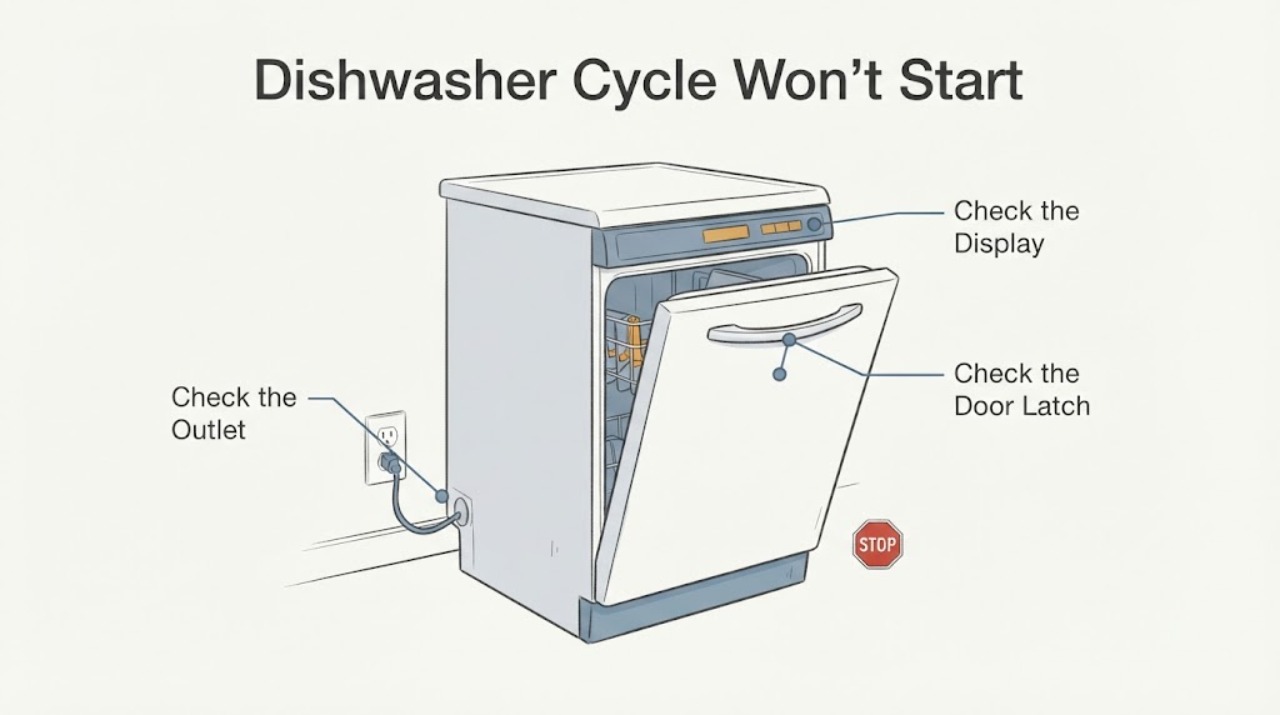
Work through in order
Diagnostic checks
Use only checks that match the exact appliance or system and its official guide.
-
Check 1
From a dry, safe position, check whether the dishwasher display, interior or status lights, or button sounds respond. If it is plugged into an accessible outlet, confirm the plug is seated; otherwise inspect only the dedicated household breaker. Do not remove an access panel or touch wet electrical equipment.
Expected result: There are no lights or sounds, the control responds normally, or the breaker is tripped or trips again.
Next step: If safe power is absent, stop and use an electrician or qualified appliance service. If the panel responds, continue with the door and control-state checks; if the breaker trips again, leave the dishwasher off.
Why this matters
Why: No response points first to power, standby or a control-state issue; a repeated trip indicates an electrical fault or unsafe condition rather than a reason to keep resetting it.
-
Check 2
With the controls off, inspect the door opening, gasket area and both racks for a utensil, dish, trim, insulation or cabinet interference. Close the door normally and look for a complete latch engagement; do not force or bypass the latch.
Expected result: The door is blocked, does not close evenly, does not latch, or closes and latches normally.
Next step: Remove only a visible loading obstruction and close the door normally. If it still will not latch or the latch feels damaged, keep the dishwasher off and arrange service; do not bridge or defeat the latch.
Why this matters
Why: A door that is not fully latched is a documented start interlock. A rack or dish obstruction can make a good latch impossible, but a normal-looking door does not prove the latch switch is healthy.
-
Check 3
Read the control panel for a lock icon, Lock/Child Lock light, Delay Start hours, Sleep/Sabbath indication or Demo Mode indication. Use the exact model manual to clear that state; do not apply another brand's hold-time or key combination.
Expected result: A lock, delay or special mode is shown, or the panel has no such indication but still ignores Start.
Next step: Follow only the owner manual for the exact model. If the control remains unresponsive after the documented procedure, stop at service rather than guessing a replacement control or button sequence.
Why this matters
Why: A locked or delayed control can intentionally prevent a cycle from starting. If no such state is indicated, the remaining problem may be a door-sensing, control or other fault that cannot be identified from a generic panel symptom.
-
Check 4
Without opening panels, confirm that the dishwasher's household water valve is open and that there is no visible leak, kinked accessible hose or standing water around the unit. Do not reach into a wet area or loosen a pressurized connection.
Expected result: The supply valve is closed or restricted, a leak or standing water is present, or the external supply appears open and dry.
Next step: Open a clearly identified shutoff only if the area is dry and there is no leak. If water is present, isolate the appliance as safely as possible and arrange plumbing or appliance service; do not run a test cycle to force filling.
Why this matters
Why: Manufacturer guidance identifies an unavailable water supply as a condition that can prevent a cycle from starting. A leak or standing water adds a water and electrical safety boundary; an open, dry supply does not prove an internal inlet component is good.
-
Check 5
If the model manual permits a control power cycle and the appliance is dry, cancel any displayed cycle as instructed, disconnect power from an accessible plug or dedicated breaker, wait the manual's stated interval, restore power and select a cycle. Do not repeatedly reset a tripped breaker or use reset as a repair.
Expected result: The dishwasher starts once after the model-approved reset, or it remains unable to start or immediately trips power again.
Next step: Leave the dishwasher off and request service if the no-start condition returns, the breaker trips, a leak appears or the controls remain unresponsive. Provide the model number, lights or sounds observed and the checks already completed.
Why this matters
Why: A single successful reset can clear a transient control state; recurrence, no change or a repeated trip means the underlying fault remains and is outside generic user checks.
Use your observations
Decision map
Find the observation that best matches what you see, then follow the next safe action.
-
PATH 01Next step
What you see
The dishwasher is dark and silent, and the accessible outlet or dedicated breaker does not provide stable power.
Do this next
Stop resetting the breaker and obtain qualified electrical or appliance service. Do not open the dishwasher or test live wiring.
Why this path and its safety boundary
Why it matters: The issue is in the power path or household circuit until proven otherwise; a control-lock procedure cannot fix absent power.
-
PATH 02Next step
What you see
Lights or button sounds are present, but a lock, delay, sleep or demo indication is visible.
Do this next
Use the exact owner manual for that model's mode-clearing instruction. Do not use a Whirlpool, GE or Bosch sequence on an unidentified machine; call service if the state will not clear.
Why this path and its safety boundary
Why it matters: The controls may be intentionally preventing a cycle rather than the dishwasher having a confirmed failed part.
-
PATH 03Next step
What you see
The panel responds but the door cannot close and latch fully, or a rack, dish or cabinet edge obstructs it.
Do this next
Remove the visible loading or clearance obstruction without force. If the door still will not latch, keep the dishwasher off and arrange service; never bypass the latch.
Why this path and its safety boundary
Why it matters: The start interlock is not satisfied. The observation does not prove the latch assembly itself is broken.
-
PATH 04Next step
What you see
The door latches, the controls are not locked or delayed, the water valve is open, and a model-approved reset does not restore starting.
Do this next
Leave the appliance off and request service with the exact model, display behavior, power status and observations. Do not buy a latch, valve or control board based only on this symptom.
Why this path and its safety boundary
Why it matters: The remaining cause is outside the safe generic checks and could involve sensing, controls, water entry or another model-specific fault; no one component is established.
-
PATH 05Next step
What you see
There is a leak, standing water, a burning smell, damaged wiring or a breaker that trips again.
Do this next
Keep clear of water and electrical parts, isolate water or power only from a dry safe position, and use qualified electrical, plumbing or appliance service. Do not energize the dishwasher to reproduce the problem.
Why this path and its safety boundary
Why it matters: This is a safety stop condition, not a normal no-start troubleshooting branch.
Helpful context
Understand the symptom
Start by separating no-power from no-start
A dark, silent dishwasher needs a power and household-circuit check before control troubleshooting. A dishwasher with lights or button sounds has a different decision path: the display may be locked, delayed, asleep, in a model-specific mode, or prevented from running by the door or water conditions. Because the brand and model are unknown, record the rating-plate information before using any model-specific control instruction.
Treat the door and water supply as start conditions
Manufacturer guidance links a cycle that will not begin to a door that is not fully latched, an obstruction from racks or dishes, and a water supply that is closed or unavailable. These are external observations. They do not establish that a latch, inlet valve or control board has failed, and they do not justify removing a panel or testing live wiring.
Do not borrow a button sequence from another dishwasher
Control Lock, Child Lock, Delay Start, Sleep or Demo Mode controls differ by model. Whirlpool, GE and Bosch all direct owners to the exact owner manual for the way to clear a locked or special state. A safe reset is only the model-approved power procedure, performed from a dry, accessible outlet or the dedicated breaker; repeated breaker trips, leaks or an unchanged no-start condition are service boundaries.
When checks do not resolve it
Need a professional?
Arrange qualified service when the exact model manual does not resolve a lock or delay state, the door will not latch, power is unstable, the water supply is open but the dishwasher will not start, or the condition returns after a model-approved reset. Stop immediately for leaks, burning smell, damaged wiring, standing water or repeated breaker trips.
Safety scope: Do not bypass the door latch, remove panels, perform live electrical tests, repeatedly reset a tripping breaker or run a test cycle in standing water. Use the exact owner manual for any control reset and qualified service for unresolved faults.
Have this ready
- Provide the dishwasher brand and full model from the rating plate, whether lights or sounds are present, any lock or delay indication, door-latch behavior, breaker status, water-valve status and whether there is standing water or a leak.
Common questions
FAQ
Can I use a three-second button hold to unlock an unidentified dishwasher?
Do not guess. Control-lock keys and hold times vary by model. Find the brand and full model on the rating plate and use that owner's manual; if the lock state cannot be cleared, arrange service.
The dishwasher has lights but still will not start. What should I check first?
Check for a lock or delay indication, then inspect the door for rack, dish, trim or cabinet interference and confirm that it latches. Also check the visible water shutoff if the area is dry. These checks do not identify a failed latch or valve, so use service if the controls remain unresponsive.
What if there are no lights or sounds?
From a dry, safe position, check the accessible plug or dedicated breaker. If power is still absent or the breaker trips again, stop resetting it and obtain qualified electrical or appliance service. Do not remove panels or test live wiring.
Can a closed water valve prevent a cycle from starting?
Yes. Manufacturer guidance lists the water supply as a start condition on applicable dishwashers. Confirm only a clearly identified valve when the area is dry; do not loosen connections or run a test cycle when there is a leak or standing water.
Should I keep resetting the dishwasher until it starts?
No. A single model-approved power cycle may clear a transient control state, but repeated resets, a returning no-start condition or a tripping breaker needs service. A reset does not prove a component is repaired.
Read the exact guide
Official sources
- Bosch Dishwasher Troubleshooting & Repair GuideBSH Home Appliances Corporation · Opened Bosch's official troubleshooting guide. It supports the same categories of external checks for Bosch models while explicitly requiring the model manual for child-lock details; it is not used to transfer Bosch controls or parts to another brand.
- Dishwasher Not Starting or Not OperatingWhirlpool Corporation · Opened Whirlpool's official support article. It documents power, door latch, water supply, control lock, delay start and model-manual/reset boundaries for Whirlpool dishwashers.
- Dishwasher - Will Not Start or Run but Has Lights or SoundGE Appliances · Opened GE's official support article. It is not evidence for any unidentified dishwasher's specific key sequence; it is used to support the general warning that these states vary by model and require the owner's manual.
- Dishwasher - Door Will Not LatchGE Appliances · Opened GE's official latch guidance. It supports checking visible cabinet, rack, dish and trim obstructions and recommends service if the door still will not latch; it does not establish a part diagnosis for an unidentified dishwasher.
Community feedback
Share a repair observation
Share a plain-text repair observation. Accepted observations are published automatically; this page may take a moment to update.