
On this page
Start here
Quick answer
First determine whether the tub fills. A dry tub points to a door latch, water supply, inlet, or overfill-float condition; a filled tub with no spray points to a blocked or obstructed spray path, the selected cycle, or a circulation problem. With power off, check the door, supply valve, float area, filters, spray-arm holes, and rack loading. Some dishwashers pause and alternate between spray levels, so a short pause or a stationary arm at one moment is not by itself a failure. If the tub fills and the wash phase still never starts after the external checks, stop and arrange model-specific service.
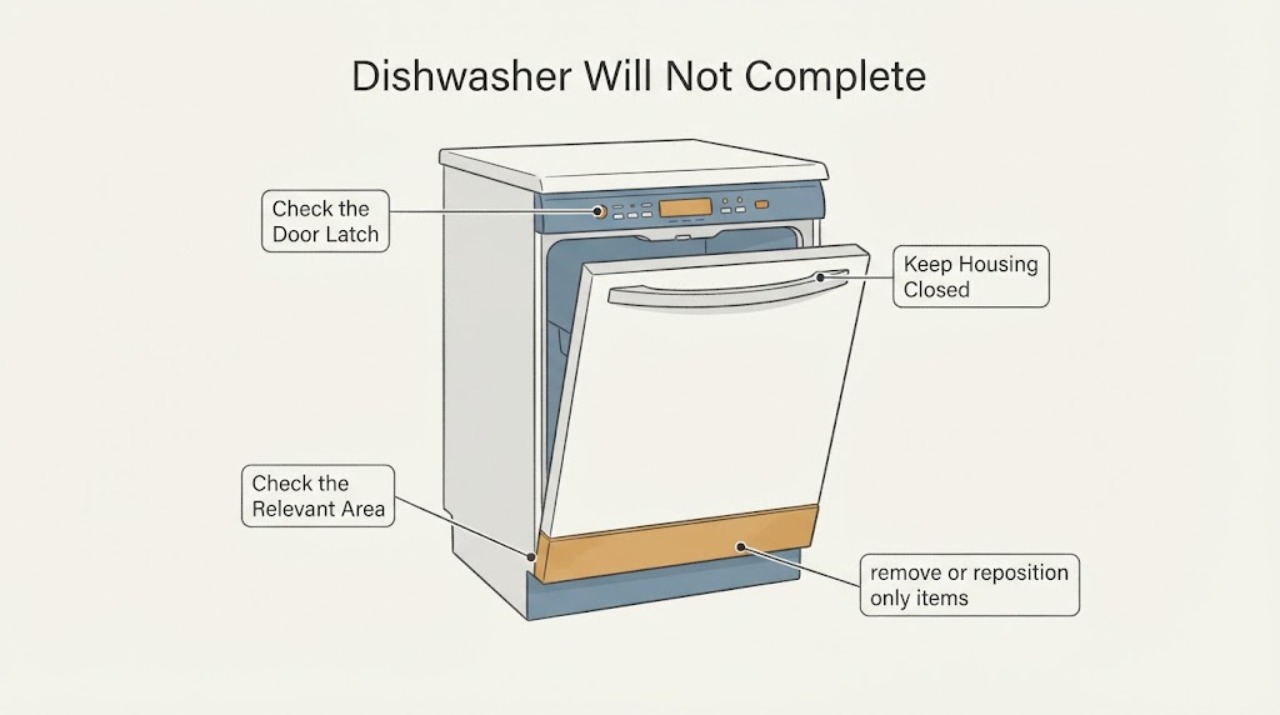
Work through in order
Diagnostic checks
Use only checks that match the exact appliance or system and its official guide.
-
Check 1
Start the dishwasher with the door fully latched, then open it only according to the model's normal pause behavior and look for water in the tub or evidence that the wash phase has begun; keep hands away from hot water and moving parts.
Expected result: The tub is dry, or it contains water but the wash phase has not started.
Next step: For a dry tub, continue with the door, supply, and float checks. For a filled tub, continue with spray-arm and cycle checks.
Why this matters
Why: A dry tub directs attention to the door, water supply, inlet, or overfill protection. A filled tub means the next question is circulation and spray-arm movement rather than basic filling.
-
Check 2
With the dishwasher stopped and safe to handle, check that the door closes and latches, the under-sink water supply valve is open, and the visible float area is free to move without food or other debris.
Expected result: The door is not latching, the supply valve is closed, or the float is obstructed; alternatively, all three external checks look normal.
Next step: Correct only the visible external condition and retry the normal cycle once. If the dishwasher still stays dry, stop troubleshooting and arrange service rather than opening the inlet or control area.
Why this matters
Why: An unlatched door can prevent filling, a closed valve can prevent water entry, and an obstructed float can prevent the machine from admitting water. If those conditions are normal, the cause may be inside the inlet or control system.
-
Check 3
After stopping the cycle and allowing the interior to be safe to touch, remove or reposition only items that hang below the rack, block the spray arms, or cover the spray-arm holes; spin each accessible arm by hand before restarting.
Expected result: An arm cannot make a full revolution, a hole is visibly blocked, or the rack/load interferes; alternatively, the arms rotate freely.
Next step: Clear only accessible food residue and rearrange the load. Do not remove a spray arm or pump cover unless the exact model manual gives that procedure.
Why this matters
Why: A blocked arm or hole prevents water from reaching the load and can make a working wash system look as if it is not spraying. Freely rotating arms shift attention to fill level, cycle selection, or circulation service.
-
Check 4
Check the selected cycle and timing behavior against the owner's manual; if the dishwasher uses alternating spray levels, listen for brief pump pauses and compare the spray-arm position before and after a short wash interval only when the model's instructions permit opening the door.
Expected result: The selected cycle intentionally uses only one rack or spray level, or the pump pauses and the arms change position; alternatively, the wash phase never produces circulation.
Next step: Allow a normal cycle to complete when the behavior matches the manual. If the wash phase never begins or repeatedly stops, arrange service rather than replacing a pump or control by guesswork.
Why this matters
Why: A rack-only cycle or alternating system can be mistaken for a failed spray arm. No circulation after the tub fills and the external checks pass points to a model-specific circulation or control problem.
-
Check 5
If the dishwasher fills and still will not spray or advance, record whether the tub remains full, whether any indicator flashes, and where the cycle stopped; keep the appliance off while arranging service.
Expected result: The machine repeatedly stops after filling, leaves standing water, flashes an unexplained indicator, or has no wash circulation despite free spray arms.
Next step: Give the technician the full model number, selected cycle, fill observation, and indicator pattern. Do not remove live panels or test wiring.
Why this matters
Why: The remaining possibilities include an internal circulation, drain, door-sensing, heating, or control fault that cannot be safely identified from a generic model-free checklist.
Use your observations
Decision map
Find the observation that best matches what you see, then follow the next safe action.
-
PATH 01Next step
What you see
The tub is dry after the dishwasher should have entered the wash phase.
Do this next
Check the visible latch, supply valve, and float area once; if filling does not resume, arrange service.
Why this path and its safety boundary
Why it matters: The problem is more consistent with a door, water-supply, inlet, or overfill-float condition than with a spray-arm blockage.
-
PATH 02Next step
What you see
The tub fills, but a spray arm is blocked by the load or cannot rotate freely by hand with the appliance stopped.
Do this next
Reposition the load and clear only accessible spray holes or residue, then run the model's normal cycle again.
Why this path and its safety boundary
Why it matters: The wash water may be present but unable to circulate through that arm or reach the dishes.
-
PATH 03Next step
What you see
The tub fills, the spray arms are unobstructed, and the selected cycle should wash, but no circulation starts or the machine repeatedly stops mid-cycle.
Do this next
Stop and schedule qualified service with the model and cycle details; do not open energized panels or replace an internal part based only on the symptom.
Why this path and its safety boundary
Why it matters: An internal circulation, sensing, drain, heating, or control issue is more likely than a simple loading problem; the exact cause is model-specific.
-
PATH 04Next step
What you see
The pump pauses briefly and spray levels alternate, or the selected cycle intentionally limits which rack is washed.
Do this next
Compare the result with the owner's manual and let the cycle run; service is appropriate only if cleaning remains abnormal or the cycle never completes.
Why this path and its safety boundary
Why it matters: That pattern can be normal operation rather than a failure to cycle or spray.
Helpful context
Understand the symptom
“Will not cycle and spray” can describe two different observations: the dishwasher stays dry, or it fills but never develops wash circulation. Start with the water level and the point where the cycle stops instead of assuming the pump or control is defective.
Spray patterns also vary by model. GE explains that some systems alternate water between lower, middle, and upper arms, so the arms do not all spray at once and the pump may pause briefly. Use the checks below to separate normal alternating wash action from a tub that never fills or a spray arm that cannot move.
When checks do not resolve it
Need a professional?
Stop and arrange service if the dishwasher stays dry after the external fill checks, fills but never starts circulation, repeatedly stops mid-cycle, leaves standing water, has a persistent door-latch problem, or would require removing panels, testing live wiring, or accessing the pump or inlet electrically.
Common questions
FAQ
How can I tell whether the dishwasher is filling but not spraying?
Check for water in the tub after the machine should have entered the wash phase. A dry tub points to filling or door-related checks; water present with free spray arms points to cycle selection or circulation service.
Is it normal for a dishwasher to pause instead of spraying continuously?
Some systems alternate spray levels and briefly pause the pump, so all arms may not spray at the same time. Compare the behavior with the model manual and judge the result by whether the cycle completes and cleans normally.
Should I remove the pump or replace the circulation motor?
Not from this symptom alone. First complete the external door, fill, float, load, spray-arm, and cycle checks. If the tub fills but circulation never starts, provide the model and observations to a qualified service provider.
Read the exact guide
Official sources
- How to Fix a Dishwasher That’s Not Filling With WaterMaytag · Maytag dishwasher external checks for door closure, water supply, inlet area, float, and service boundary; used for general symptom separation with brand scope kept explicit.
- Dishwasher - Lower Spray Arm Not SpinningGE Appliances · GE dishwasher spray-arm rotation and load obstruction guidance; used for external arm-rotation checks and service escalation.
- Spray Arm Not Working - DishwasherWhirlpool Corporation · Whirlpool dishwasher spray-arm external check and service recommendation; used for visible obstruction and free-spin guidance, not cross-brand part fit.
- Dishwasher - Circulation System with Alternating Spray ArmsGE Appliances · GE dishwasher alternating spray-arm circulation behavior and normal pump pauses; used to distinguish normal pauses from no circulation.
- Dishwasher - Detergent Stuck in CupGE Appliances · GE dishwasher spray-arm, cycle-timing, filter, and water-temperature troubleshooting; used for the model-dependent short observation and escalation boundary.
Community feedback
Share a repair observation
Share a plain-text repair observation. Accepted observations are published automatically; this page may take a moment to update.