
On this page
Start here
Quick answer
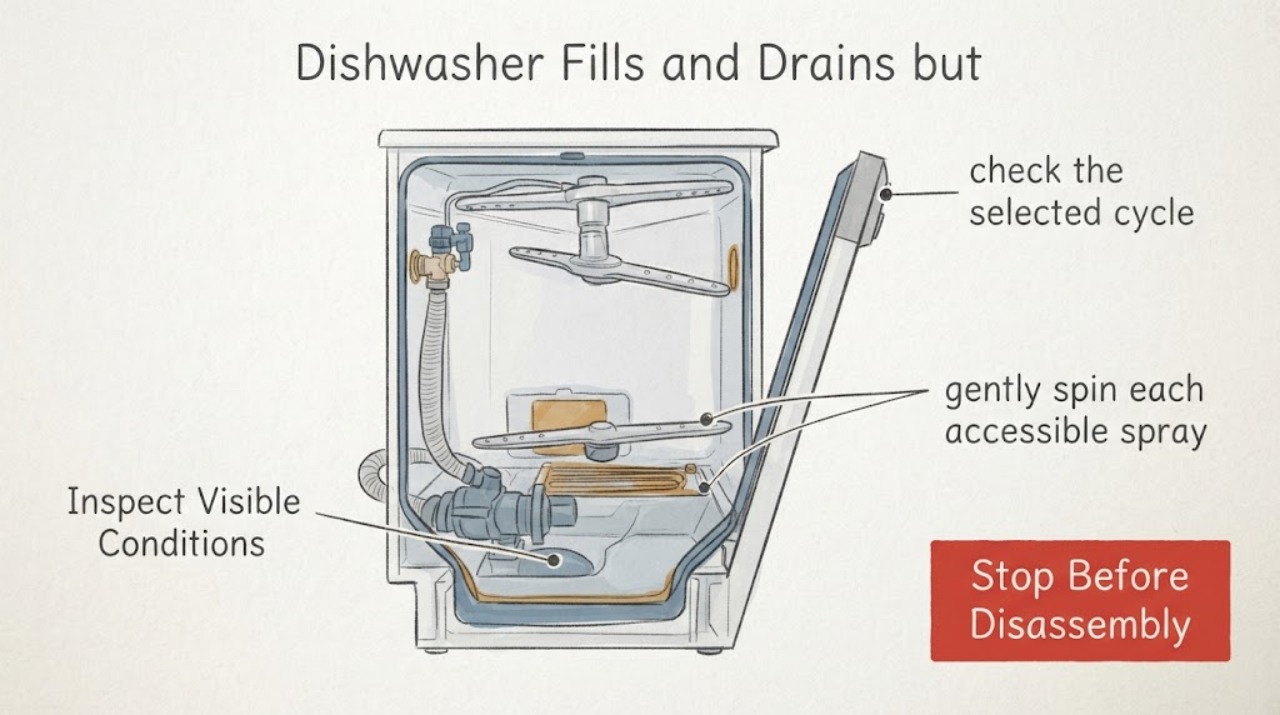
Water entering and leaving the tub does not prove that the wash stage is spraying. First identify whether there is any circulation or spray sound, then check the selected cycle, visible loading obstruction, spray-arm freedom and the removable filter using only the access described for the exact model. Manufacturer guidance also notes that a leak-detection system can make a dishwasher drain after detecting a leak. If the dishwasher fills and drains but still has no wash action after the external checks, stop short of the pump or control wiring and arrange service; the symptom alone does not prove a failed circulation pump.
Work through in order
Diagnostic checks
Use only checks that match the exact appliance or system and its official guide.
-
Check 1
Run the normal wash cycle with the dishwasher empty of loose objects and observe from outside during the portion after filling. Note whether you hear or see the normal spray/circulation action, whether the machine immediately drains, and whether any leak indicator or water appears on the floor. Do not reach into a running tub.
Expected result: There is clear spray/circulation, there is only fill-and-drain with no spray sound, or the machine drains while a leak indication or external water is present.
Next step: If water is outside the appliance or a leak indication is present, stop the cycle, close the water supply if accessible and arrange service. If there is no spray action but no leak, continue only with the power-off external checks below; do not open the pump or control area.
Why this matters
Why: Spray/circulation means the problem may be cleaning performance rather than a total absence of wash action. Fill followed by drain with no wash action does not identify the pump; a leak-detection system can also cause a dishwasher to drain after detecting a leak.
-
Check 2
With the cycle stopped and the appliance safe to open, check the selected cycle and the visible loading around the spray arms. Make sure a top-rack-only option was not selected when lower-rack washing is expected, and move only dishes or utensils that visibly block an arm or detergent dispenser.
Expected result: A top-rack-only cycle was selected, an item prevents an arm from turning, or nothing in the load obstructs the spray pattern.
Next step: Select a cycle appropriate for the full load and rearrange the obstruction, then make one controlled test. If the correct cycle and clear load still produce no wash action, proceed to the spray-arm and filter checks rather than guessing a motor or pump part.
Why this matters
Why: The official spray-arm guidance says a top-rack-only cycle does not engage lower spray arms, and loading that prevents an arm from turning can leave dishes unwashed. A clear load means the symptom is not explained by loading alone.
-
Check 3
Before starting another cycle, gently spin each accessible spray arm by hand and confirm that it moves freely without striking a rack or dish. Do not use a tool, force an arm past resistance or disassemble the arm on an unspecified model.
Expected result: An arm is blocked or resists rotation, or all accessible arms turn freely.
Next step: Rearrange the load and retest if an obstruction was found. If the arms turn freely but the appliance still fills and drains with no spray action, stop at the external checks and schedule service.
Why this matters
Why: A blocked arm can delay detergent release and soil removal; the manufacturer guidance treats resistance after loading as a reason to rearrange the dishes. Free movement rules out only this visible obstruction and does not prove that internal circulation is working.
-
Check 4
Turn the dishwasher off before accessing a removable filter or foreign-object cup that the exact model identifies at the tub bottom. Inspect for food or mineral buildup, rinse the filter as the model guide directs, and reinstall every filter and lock before operating the appliance.
Expected result: The filter or cup is visibly blocked, or it is clean and correctly locked but the wash stage still has no spray action.
Next step: Clean and securely reinstall a blocked filter, then run one controlled test. If the filter is clear or the no-wash symptom remains, do not remove the pump, motor or wiring; provide the exact model, cycle and observation to qualified service.
Why this matters
Why: Manufacturer guidance links filter maintenance with strong water flow and cleaning performance, but a clean filter does not establish a failed or healthy circulation pump. Operating without the filters properly installed can damage the appliance.
Use your observations
Decision map
Find the observation that best matches what you see, then follow the next safe action.
-
PATH 01Next step
What you see
The dishwasher fills, produces a normal spray/circulation sound, and leaves dishes dirty while the arms are free and the load is not blocking them.
Do this next
Correct the visible loading or filter condition, use only automatic-dishwasher detergent and follow the exact model's cycle guidance. Escalate if cleaning remains poor after those checks.
Why this path and its safety boundary
Why it matters: The appliance has some wash action, so the complaint may be a cleaning-performance issue rather than a complete no-wash condition; loading, water supply, detergent, temperature and filter condition remain relevant.
-
PATH 02Next step
What you see
A top-rack-only cycle was selected or a dish/rack blocks an accessible spray arm, and the symptom changes after the cycle or load is corrected.
Do this next
Use the appropriate full-load cycle and keep the spray path clear. Monitor the next cycle without opening panels.
Why this path and its safety boundary
Why it matters: The selected cycle or visible loading restriction explains why part of the tub did not receive spray; it does not indicate a pump failure.
-
PATH 03Next step
What you see
The dishwasher repeatedly fills and then drains with no observable spray action after a correct cycle, clear load, free spray arms and correctly installed filter.
Do this next
Stop repeated test cycles and schedule qualified appliance service with the exact model, cycle selected, water entry/drain timing and no-spray observation. Do not remove panels or test live wiring.
Why this path and its safety boundary
Why it matters: The remaining fault is not safely identifiable from this general symptom. It may involve wash circulation or another model-specific condition, but the evidence does not prove a pump, motor or control-board failure.
-
PATH 04Next step
What you see
Water is on the floor, a leak indicator is active, the appliance repeatedly drains, or accessing the next suspected component would require a panel, pump, motor or wiring check.
Do this next
Stop the cycle, isolate the appliance according to the exact model's safe procedure, close the water supply if accessible and arrange qualified service. Do not bypass leak protection, open the pump housing or perform live tests.
Why this path and its safety boundary
Why it matters: A leak or electrical/mechanical access issue exceeds safe external troubleshooting, and a drain response can be part of a leak-detection behavior on some appliances.
Helpful context
Understand the symptom
Separate filling and draining from washing
A dishwasher can admit water and later drain it without giving the dishes effective spray coverage. The assigned problem has no brand, model or exact cycle information, so the checks below use only general, accessible observations and manufacturer guidance. They do not identify a circulation pump, motor or control-board fault from the symptom alone.
Use the exact model manual for access details
Filter shapes, spray-arm arrangements, cycle names and leak indicators vary. If an instruction below does not match the appliance, stop and use the exact model's use-and-care guide rather than forcing a part, removing a panel or probing wiring.
Common questions
FAQ
Does water entering and draining prove that the dishwasher pump is working?
No. It confirms only that some fill and drain behavior occurred. If there is no spray or circulation after the visible cycle, loading, spray-arm and filter checks, the internal cause needs model-specific service diagnosis.
Can a top-rack-only cycle make the dishwasher seem not to wash?
Yes. The official spray-arm guidance says that cycle does not engage lower spray arms, so lower-rack dishes will not be cleaned by those arms. Check the selected cycle before diagnosing a component.
Should I keep resetting the dishwasher when it fills and drains without washing?
No. Once the correct cycle, visible loading, accessible spray-arm movement and filter installation have been checked, repeated resets do not identify the cause. Stop and arrange service, especially if there is a leak or a leak indicator.
Read the exact guide
Official sources
- Spray Arm Not Working - DishwasherWhirlpool Corporation · Opened official PDF used for the safe hand-spin/visible obstruction check and the top-rack-only limitation; it is general manufacturer guidance, not evidence for an unspecified brand or model.
- Dishes are not CleanWhirlpool Product Help · Opened official manufacturer guidance used only for general external dishwasher checks; the assigned topic has no brand or model, so it does not establish a model-specific component diagnosis.
- Cleaning the Filter - DishwasherWhirlpool Product Help · Opened official guidance used for a conditional removable-filter check only; filter style and access vary, so the exact model guide controls and no pump diagnosis is inferred.
Community feedback
Share a repair observation
Share a plain-text repair observation. Accepted observations are published automatically; this page may take a moment to update.