
On this page
Start here
Quick answer
Start with an empty dishwasher and identify whether the residue is food, detergent film, mineral scale, or standing dirty water. With power disconnected, inspect only the accessible filter, tub bottom, spray-arm openings, door seal, and visible drain connection; remove loose debris with gloves and use only the cleaning method and removable parts described by the appliance's own manual. Manufacturer guidance differs by filter design, so do not force a filter, use a wire or abrasive tool, mix cleaners, use chlorine products, or run a hot cleaning cycle with an unverified chemical. If water remains, a leak is visible, the filter or pump cover is damaged, or odor returns after a manual-approved cleaning cycle, stop using the dishwasher and arrange qualified service.
Before you begin
Safety first
- Do not mix cleaners, use chlorine products or solvents, steam-clean the appliance, use abrasive or wire tools, run without a required filter, open the pump housing, pull out a built-in dishwasher, or continue operation with a leak, burning smell, damaged electrical part, or sharp debris.
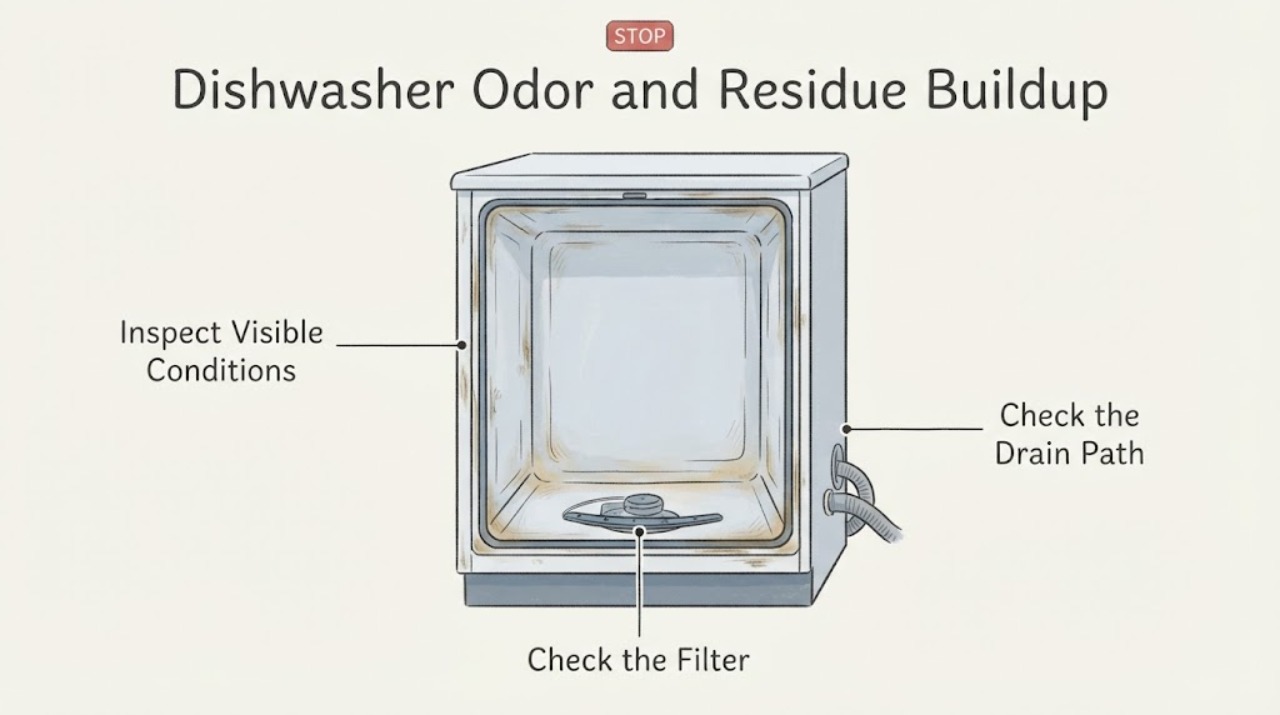
Work through in order
Diagnostic checks
Use only checks that match the exact appliance or system and its official guide.
-
Check 1
Empty the dishwasher and, before removing any filter or reaching into the tub, disconnect power at the accessible plug or approved breaker. Wear gloves and look for glass, sharp metal, or a damaged filter or pump cover.
Expected result: There are sharp fragments, a damaged filter or cover, a burning or chemical smell, an electrical fault, or no hazardous material is visible.
Next step: If damage, burning, or chemical fumes are present, keep the dishwasher off, close the water supply if a leak is also present, and call qualified service. Otherwise continue only with the owner's manual open.
Why this matters
Why: Sharp debris and damaged protective parts make cleaning unsafe; a normal odor with no visible hazard may proceed to a manual-limited inspection.
-
Check 2
Inspect the tub bottom, filter area, accessible sump opening, spray-arm openings, and door seal for food particles, grease, detergent film, scale, or mold-like residue. Remove only loose debris that can be reached without dismantling the pump or spray-arm assembly.
Expected result: Residue is concentrated on the filter or spray arms; the tub bottom has loose food; the seal is dirty; or the visible surfaces are clean.
Next step: Record the residue type and location. Clean or rinse the named user-removable part only as the model manual permits; do not poke jets with metal, scrape seals aggressively, or open the pump housing.
Why this matters
Why: A concentrated deposit identifies the next manual-approved cleaning area. Clean visible surfaces do not rule out a drain or hidden pump problem.
-
Check 3
Find the exact dishwasher model number and read its filter and spray-arm maintenance section before removing anything. Compare the manual's diagram with the installed filter, locking tabs, pump cover, and spray-arm attachment.
Expected result: The manual says the filter is user-removable and shows a matching arrangement; it shows a different arrangement; or the model/manual cannot be identified.
Next step: Follow only the matching manual. If the identity or arrangement is uncertain, leave the filter and cover in place and request manufacturer or technician guidance.
Why this matters
Why: Whirlpool and Bosch use different filter designs and removal sequences. A matching manual supports a limited cleaning task; a different or unknown arrangement does not support a generic twist, lift, or tool instruction.
-
Check 4
After the machine is safe and the manual-approved cleaning is complete, look for water that remains in the tub between cycles and inspect only the visible drain hose, air gap, or sink connection for kinks, blockage, or an incorrect high-loop/air-gap arrangement.
Expected result: The tub is dry or has only the amount the manual calls normal; dirty water returns between uses; the hose or air-gap path is visibly obstructed; or a leak is present.
Next step: Do not pull out a built-in dishwasher or open the pump. For standing water, a leak, or an unresolved visible drain issue, close the water supply, keep power off, and arrange a qualified appliance or plumbing assessment.
Why this matters
Why: Standing dirty water points toward drainage or installation rather than a deodorizing problem. A visible leak or damaged connection can create water and electrical risk.
-
Check 5
Only after the filter and visible path are correctly restored, use a dishwasher-specific cleaner or maintenance program if the exact manual authorizes it. Follow that product's label and the appliance manual exactly, and run the machine empty as directed.
Expected result: The odor and residue clear; residue remains but there is no standing water or leak; or the odor returns quickly.
Next step: Do not repeat stronger chemical treatments or combine products. If the problem persists or returns, stop using the dishwasher and provide the model number, residue location, water state, and cleaning method to service.
Why this matters
Why: Improvement supports a maintenance or residue cause but does not prove that a hidden drain or seal fault is absent. Rapid recurrence indicates an unresolved source.
Use your observations
Decision map
Find the observation that best matches what you see, then follow the next safe action.
-
PATH 01Next step
What you see
Food or grease is visibly concentrated in a user-removable filter or spray-arm opening, and the exact manual shows how that part is removed.
Do this next
Clean it only with the manual-approved method, reinstall it fully, and observe the next empty or normal cycle for recurrence. Do not use abrasive tools or run without the filter installed.
Why this path and its safety boundary
Why it matters: The residue location is consistent with a maintenance issue, but the part's removal and reinstallation remain model-specific.
-
PATH 02Next step
What you see
Water or dirty residue remains in the tub between cycles, or the odor returns with visible water at the bottom.
Do this next
Keep power off, close the water supply if there is a leak, and have the drain connection or appliance assessed. Do not remove the pump cover or slide out a built-in unit as a home cleaning step.
Why this path and its safety boundary
Why it matters: The likely decision path is drainage or installation, not a request for stronger deodorizer; GE and Bosch identify drain paths, filters, and pump areas as relevant checks.
-
PATH 03Next step
What you see
The tub is free of standing water, but white film, detergent residue, scale, or a surface odor remains after visible debris is removed.
Do this next
Use only a dishwasher-specific cleaner or manual-approved method. Do not combine products, use chlorine or solvents, use steam, or repeat acid treatments beyond the manual's direction.
Why this path and its safety boundary
Why it matters: The problem may be detergent, mineral, or surface buildup, and the appropriate cleaner depends on the appliance manual and product label.
-
PATH 04Next step
What you see
The odor persists after a manual-approved clean, returns quickly, or is accompanied by a leak, burning smell, electrical symptom, damaged filter/pump cover, or sharp debris.
Do this next
Stop using the dishwasher, disconnect power, close the water supply when appropriate, and arrange qualified service. Give the technician the model number, residue location, standing-water observation, and cleaning products used.
Why this path and its safety boundary
Why it matters: A hidden drain, seal, pump, electrical, or water-safety issue cannot be distinguished safely by surface cleaning.
Helpful context
Understand the symptom
Classify the residue before choosing a cleaner
Food particles, detergent film, hard-water scale, and water that has sat in the tub can look similar but lead to different next checks. Bosch links odor with debris in the filter and spray arms, while GE separately describes food residue at the tub bottom, blocked spray-arm jets, and dirty water caused by drain-hose installation. Because this task has no brand or model, use those as diagnostic categories rather than importing another manufacturer's filter position, cycle temperature, or cleaner dosage.
Cleaning is limited by the appliance's own manual
Filter assemblies are not universal: Whirlpool documents more than one filter arrangement, and Bosch gives a different removal and locking sequence. The safe common instruction is to remove a filter only when the owner's manual identifies it as user-removable, rinse it under running water, use a soft brush only when allowed, and reinstall it fully before operating the dishwasher. Do not use a wire brush, abrasive pad, steam cleaner, or a tool that can damage the filter or pump cover.
A maintenance cycle is a conditional last cleaning step
After visible debris is removed and the filter is correctly installed, consult the exact manual for an approved dishwasher cleaner and cycle. Bosch and Whirlpool both describe appliance-cleaner maintenance, but their programs and products are model or manufacturer specific. Never combine cleaners, add chlorine products, use household solvents, or improvise a hot cycle when the manual does not authorize it. A persistent odor with standing water or a visible leak is a drainage or service problem, not a reason to add stronger chemicals.
When checks do not resolve it
Need a professional?
Arrange service when odor or residue persists after the exact manual's cleaning procedure, standing dirty water returns, a leak or burning smell appears, the filter or pump cover is damaged, or the filter arrangement cannot be identified safely.
Safety scope: Do not mix cleaners, use chlorine products or solvents, steam-clean the appliance, use abrasive or wire tools, run without a required filter, open the pump housing, pull out a built-in dishwasher, or continue operation with a leak, burning smell, damaged electrical part, or sharp debris.
Have this ready
- Provide the appliance brand and complete model number, a photo or description of the residue location, whether water remains between cycles, visible hose or air-gap observations, the filter state, and the cleaner or cycle used.
Common questions
FAQ
Can I use bleach and another cleaner together?
No. Do not mix cleaning products. The opened Bosch maintenance guidance warns against chlorine-containing domestic detergents, and GE specifically warns that bleach and ammonia together create toxic fumes. Use only one manual-approved dishwasher cleaner according to its label.
Can I remove any dishwasher filter and scrub it?
No. Filter designs differ, and some systems are not user-cleaned in the same way. Identify the model and follow its manual. If removal is authorized, rinse and use only a soft brush where directed; do not use wire or abrasive tools.
Why does the smell return after cleaning?
A returning odor can indicate standing dirty water, a drain-hose or air-gap problem, residue in a filter or spray arm, a seal issue, or an unaddressed source. Check the visible drain state and escalate if water, leaks, or rapid recurrence remain.
Should I run the hottest cycle with a strong cleaner?
Only if the exact manual and cleaner label authorize that program and product. Do not infer a temperature, pause time, dosage, or chemical from another brand's guide, and do not use a hot cycle to conceal a leak or standing-water problem.
Read the exact guide
Official sources
- Cleaning and maintenanceBosch · Opened the Bosch official manual PDF. It instructs filter and spray-arm inspection, running-water cleaning, correct reinstallation, damp-cloth seal cleaning, no steam cleaner, no abrasive detergents, and no chlorine-containing domestic detergents. These are used as safety boundaries and examples of model-specific instructions, not as a universal procedure.
- Bosch Dishwasher Owner SupportBosch · Opened Bosch's US owner-support page. It links odor to filter and spray-arm debris, standing water to drain/pump issues, and directs persistent problems to support. It is used for decision branching, not to diagnose an unknown-brand appliance.
- My dishwasher smells badBosch · Opened Bosch's official odor page. It links odors to food in filters and ineffective drainage, recommends gloves for sharp fragments, and describes a Bosch-specific maintenance cycle and filter sequence. Only the general diagnostic categories and safety boundaries are used; Bosch-specific temperature, product and sequence are not generalized.
- Cleaning the Filter - DishwasherWhirlpool Product Help · Opened Whirlpool's official support page. It documents more than one filter style, rinsing and soft-brush limits, routine maintenance and service escalation. It is used to demonstrate why an unbranded dishwasher cannot receive a universal filter-removal step.
- Dishwasher Maintenance and CareWhirlpool · Opened Whirlpool's official owner manual. It says residue can affect performance, identifies dishwasher cleaner as a model-manual maintenance option, warns vinegar can damage the appliance if overused, and gives a model-specific filter procedure. It is used to reinforce the need for the exact manual, not to prescribe its recipe to an unknown dishwasher.
- Dishwasher - OdorsGE Appliances · Opened GE's official odor article. It distinguishes food residue, spray-arm blockage, dirty water from drain installation and filter checks, and warns against mixing bleach and ammonia or using harsh/concentrated cleaners. GE-specific quantities and chemistry are not generalized here.
Community feedback
Share a repair observation
Share a plain-text repair observation. Accepted observations are published automatically; this page may take a moment to update.