
On this page
Start here
Quick answer
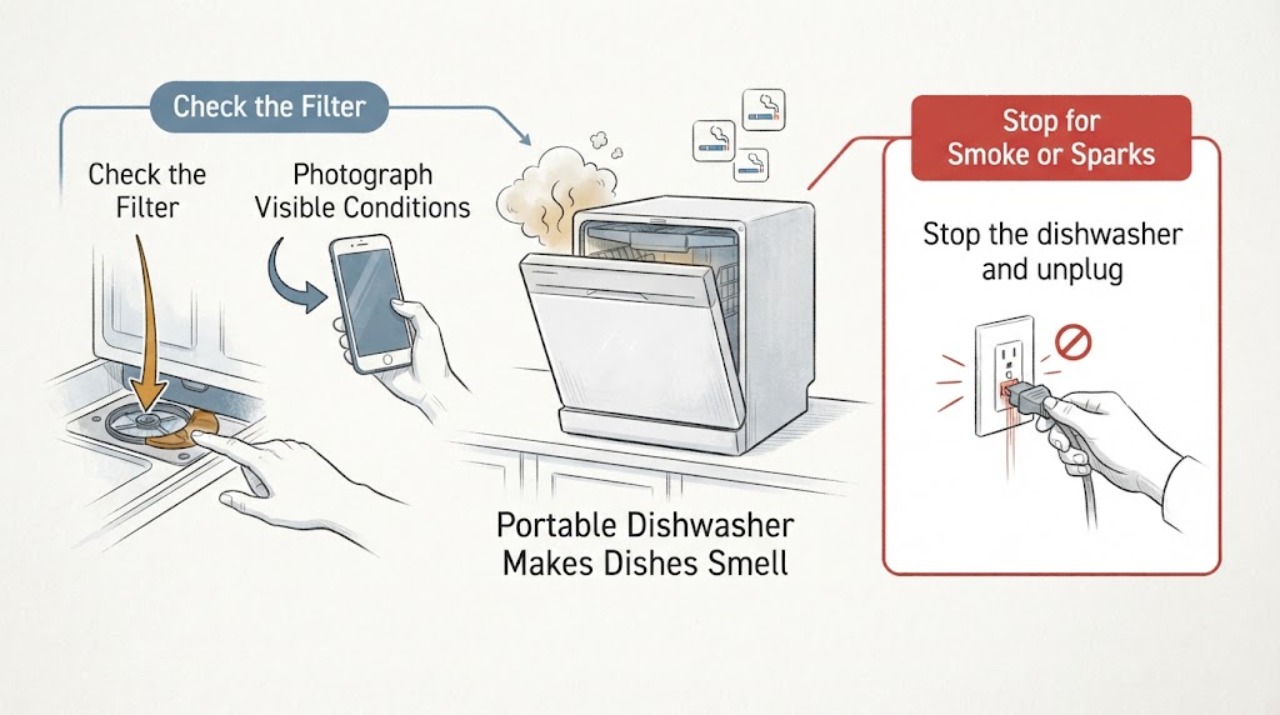
Because this second-hand portable/convertible dishwasher has no brand or model, do not assume the cigarette-like smell is trapped smoke or keep adding cleaners. You have already tried vinegar and baking soda; do not mix them or repeat chemical cycles blindly. First stop using the dishwasher if the odor is acrid, electrical, smoky, or accompanied by heat, visible smoke, melting, sparking, a hot cord or a breaker trip. When the unit is unplugged, cool and dry, inspect only the accessible tub, gasket, filter area, racks, spray arms and visible hose/coupler for residue or a melted item. Manufacturer dishwasher guidance supports model-specific filter and interior cleaning, and says vinegar and baking soda must be used in separate cycles, but the unknown portable design cannot support a generic teardown. If the smell persists after safe external cleaning or appears to come from wiring, the pump, heater or underside, stop using the machine and arrange service or replacement evaluation.
Work through in order
Diagnostic checks
Use only checks that match the exact appliance or system and its official guide.
-
Check 1
Stop the dishwasher and unplug it before inspecting if the smell is acrid, electrical, smoky or hot, or if you see smoke, melting, sparking, water at the cord/plug, a hot connector or a tripped breaker. Do not run another heated-dry or cleaning cycle to reproduce the odor.
Expected result: The smell is accompanied by visible smoke, a hot or damaged cord/plug, melted plastic, sparking, repeated breaker action or heat from the underside; or it is only a stale odor with no heat or electrical sign.
Next step: Keep the dishwasher disconnected and arrange qualified appliance/electrical service for any hazard sign. If there is no hazard sign, continue only with the external checks below and do not operate until the model-specific care route is known.
Stop if: Stop immediately for smoke, flame, arcing, exposed conductors, water entering electrical areas or a breaker that trips again.
Why this matters
Why: Smoke, melting, electrical odor or abnormal heat moves the issue outside safe odor cleaning. A stale odor without those signs is not proof that the appliance is safe, but it permits only a cool, unplugged inspection.
-
Check 2
Photograph the rating label, control panel and hose/coupler arrangement, and record whether the unit is truly portable/convertible, when the smell appears (fill, wash, drain, heated dry or after the cycle), whether clean dishes or the empty tub smell, and whether smoke is visible. Do not infer a brand or model from the exterior shape.
Expected result: The full model is found, the label is missing/illegible, the smell is present only after heated drying, or it appears during every stage including an empty rinse.
Next step: Use the exact model manual if found. If identity remains unknown, limit work to unplugged external cleaning and service evaluation; do not order a filter, pump, heater or hose based on appearance.
Why this matters
Why: A manual and safe access route depend on the exact model. Timing and whether the tub or dishes retain the odor help separate residue transfer from a heat/electrical event, but do not identify a part.
-
Check 3
With the dishwasher unplugged, cool and empty, inspect the tub bottom, door gasket, racks, spray arms, accessible filter area and any visible drain opening for food residue, ash-like film, standing water, cigarette debris, melted plastic or a non-dishwasher item. Remove only loose visible residue that the appliance’s own manual permits; do not reach into the pump or remove covers.
Expected result: Residue or standing water is visible, a plastic item is near a heating area, the accessible surfaces are clean, or the source appears under the tub/inside a panel.
Next step: Clean only accessible surfaces and model-approved filters, dry them, and document photos. For a melted item, underside odor, damaged element, pump-area smell or inaccessible source, leave the unit unplugged and arrange service rather than scraping or disassembling.
Stop if: Do not touch a heating element until fully cool, and stop for scorch marks, melted wiring, damaged insulation or water near electrical parts.
Why this matters
Why: Official dishwasher guidance associates odor with food residue, stagnant water, blocked filters and items touching a heating element. A clean accessible tub does not prove the odor is cigarette smoke or exclude an internal fault.
-
Check 4
Do not mix vinegar, baking soda, bleach, ammonia, detergent or commercial cleaners, and do not repeat the two remedies in the same cycle. Since both vinegar and baking soda were already tried, pause chemical treatment until the exact manual is identified. If the manual permits cleaning, use one documented method at a time, with an empty machine and the model’s required dry/heat setting.
Expected result: The smell improves only after cleaning, returns after drying, remains in the empty tub, or is transferred to dishes despite clean accessible surfaces.
Next step: Stop adding chemicals, rinse/air out only as the matched manual permits, and move to service evaluation for persistent odor. Do not use bleach or ammonia as an improvised cigarette-smoke treatment.
Why this matters
Why: Whirlpool’s care guidance permits separate vinegar and baking-soda cycles and explicitly says not to use them at the same time; it also warns that vinegar used too often can damage a dishwasher. A persistent odor after those attempts is not evidence that stronger or mixed chemicals are needed.
-
Check 5
Inspect only the visible portable water hose, faucet adapter, drain hose, power cord and coupler for kinks, leaks, staining or heat damage with power and water disconnected. Do not open the pump/heater compartment, remove the cabinet, bypass a float or door interlock, or run the unit with hoses disconnected.
Expected result: The smell is strongest near a hose/coupler, drain path, underside, cord/plug or control area, or no external source is found.
Next step: Photograph the external findings and arrange model-specific service or replacement assessment. Keep the water supply and appliance disconnected if there is a leak, electrical odor, heat damage or persistent smoke.
Stop if: Stop for a wet plug, damaged cord, leaking coupler, hot outlet, exposed wire, repeated breaker trip or odor from the underside.
Why this matters
Why: A portable conversion connection can add an external hose, drain and power path, but the unknown model does not establish its internal arrangement. An underside or electrical odor cannot be safely narrowed to a motor, heater, pump or control board from smell alone.
Use your observations
Decision map
Find the observation that best matches what you see, then follow the next safe action.
-
PATH 01Next step
What you see
The dishwasher is cool and unplugged, accessible surfaces show residue or ash-like film, there is no smoke/electrical warning, and the smell is strongest on the tub, gasket or racks.
Do this next
Clean and air the accessible areas using the exact model’s instructions, use no mixed chemicals, and stop if the odor persists after the documented cleaning route.
Why this path and its safety boundary
Why it matters: Residue or prior smoke exposure is plausible, but the visible finding does not prove the odor source or guarantee that dishes are safe to use immediately.
-
PATH 02Next step
What you see
The smell begins during heated drying or a cool inspection finds melted plastic, scorch marks or an item touching a heating area.
Do this next
Keep the unit unplugged, remove only a loose cool object that the matched manual permits, and request service for any element, insulation, wiring or underside damage.
Why this path and its safety boundary
Why it matters: A heat-related residue or damaged item is more relevant than a generic cigarette-smoke explanation, but the unknown portable model does not support a heater diagnosis.
-
PATH 03Next step
What you see
The empty tub, racks and accessible filter area are clean, vinegar and baking soda have already been tried separately or historically, and the smell returns after a cycle or transfers to dishes.
Do this next
Stop repeated chemical and heated cycles, keep dishes out, obtain the model information and arrange qualified appliance service or a replacement evaluation.
Why this path and its safety boundary
Why it matters: Persistent odor is abnormal in general dishwasher guidance and cannot be closed as harmless smoke residue without model-specific inspection.
-
PATH 04Next step
What you see
There is smoke, arcing, a hot/damaged cord or plug, water near electrical parts, an underside burning odor, or a breaker trip.
Do this next
Leave the appliance disconnected, keep clear of wet electrical areas, and arrange qualified appliance/electrical service. Do not operate it to confirm the cause.
Why this path and its safety boundary
Why it matters: The symptom is a potential electrical or water-damage hazard, not a cleaning problem.
Helpful context
Understand the symptom
A used portable dishwasher can transfer odor from prior smoke exposure, residue in accessible surfaces, stagnant water, or a material that heats during drying. The reported smell is not enough to identify cigarette residue, a heater problem, a pump fault or an electrical failure, especially without a brand and model.
The vinegar and baking-soda attempts are part of the history. Do not combine cleaners or keep running hot cycles to chase the smell. Decide first whether the odor is a normal residue/cleaning problem or a stop-use sign, then use only the access and care instructions that match the eventual model.
When checks do not resolve it
Need a professional?
Give the technician the rating-label photo or explain that the model is unknown, portable/convertible configuration, the exact stage when odor appears, whether dishes or the empty tub smell, prior vinegar/baking-soda attempts, visible residue/melting, hose/coupler findings and any smoke, heat, leak or breaker history.
Common questions
FAQ
Should I run vinegar and baking soda together to remove cigarette odor?
No. Whirlpool’s dishwasher-care guidance says vinegar and baking soda are separate methods and must not be used in the same cycle. Since both have already been tried, pause chemical treatment and identify the model before repeating any cleaner cycle.
How can I tell cigarette residue from an electrical burning smell?
A smell alone cannot prove the source. With power disconnected and the unit cool, inspect accessible tub, gasket, filter, spray-arm and visible hose areas. Smoke, melting, arcing, a hot cord/plug, water near electrical parts or a breaker trip means stop using the dishwasher and arrange service.
Can I take apart this used portable dishwasher to clean the smoke smell?
Not without the exact model manual. Portable/convertible hose, pump, heater and interlock arrangements vary; keep the work to unplugged external cleaning and model-approved access, then use qualified service for an underside or inaccessible odor.
Read the exact guide
Official sources
- How to clean a dishwasherWhirlpool · Opened Whirlpool’s official cleaning page. It is a generic dishwasher-care source, not proof of the unknown unit’s portable layout. It explicitly says vinegar and baking soda are separate cycles and warns that filter removability varies by model.
- Removing Odors in your DishwasherWhirlpool Product Help · Opened Whirlpool’s official dishwasher-care page. It is not a model-specific source for the assigned unknown portable unit; it is used only for general manufacturer-supported odor categories, accessible filter/seal/interior checks, and the need to use model resources.
- Dishwasher - OdorsGE Appliances · Opened GE’s official dishwasher-odor page. It is not evidence about a GE or portable model in this task; it is used only for general odor distinctions: newness, residue, standing water, items touching a cool heating area and persistent abnormal odors.
Community feedback
Share a repair observation
Share a plain-text repair observation. Accepted observations are published automatically; this page may take a moment to update.