
On this page
Start here
Quick answer
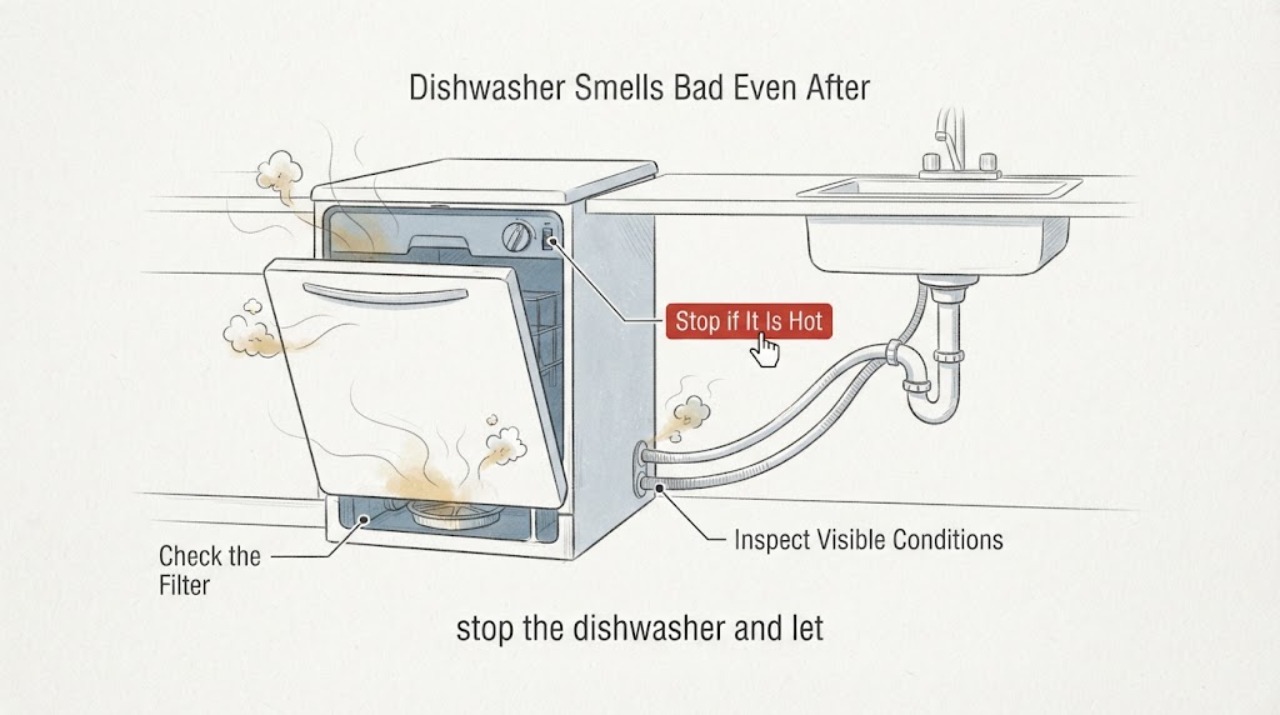
First locate the odor instead of replacing the dishwasher or repeating plumbing work. With the machine off and cool, compare the smell at the tub/filter area, the door seal, and the connected sink or disposal. Food residue, a dirty filter, spray-arm debris or stagnant water point to accessible dishwasher cleaning; an odor strongest at the sink or disposal points to the connected drain and needs plumbing attention. A large amount of water left after a cycle is a drain symptom, while a small amount can be normal. Stop using the machine for a burning or hot-plastic smell, visible smoke, electrical damage, or a suspected gas/sewer-gas hazard; leave any suspected gas area without operating switches and contact the appropriate emergency or utility service from outside.
Work through in order
Diagnostic checks
Use only checks that match the exact appliance or system and its official guide.
-
Check 1
Before cleaning, stop the dishwasher and let hot surfaces cool. Identify whether the odor is food/musty, sewer-like, solvent/petroleum-like, or burning/hot plastic, and smell only from a normal standing position without putting your face inside the machine or under the sink.
Expected result: The smell is ordinary food or mildew, strongest at the tub or door; strongest at the sink/disposal or drain opening; or resembles burning plastic, electrical odor, fuel or gas.
Next step: For food or musty odor, continue with the external cleaning checks. For sink/disposal odor, arrange plumbing evaluation if cleaning the connected drain does not resolve it. For burning or gas-like odor, stop using the area and escalate safely.
Stop if: Do not run another cycle to test a burning or hot-plastic smell. If gas is suspected, leave immediately without operating lights, phones or other electronics and contact local emergency or gas authorities from outside.
Why this matters
Why: Food or musty odor supports a cleaning and moisture branch. An odor at the connected sink supports a plumbing branch. A burning, electrical or gas-like odor is a safety event and should not be treated as residue.
-
Check 2
With power off according to the appliance manual, remove only user-removable racks and the filter or screen if the model provides one. Rinse the filter with warm water, wipe the accessible tub and door seal, and inspect the spray-arm openings for visible food debris; reinstall every filter and part securely before operating.
Expected result: Food, grease or slime is present around the filter, tub bottom, spray arms or door seal, or those areas are visibly clean.
Next step: If residue is present, clean it using the actual owner's manual and a dishwasher-approved cleaner or the approved method; run one empty cleaning cycle only after all parts are reinstalled. If the interior is clean or the smell returns, move to the water and sink-source checks.
Stop if: Do not reach into the pump opening, remove a circulation or drain pump, use sharp tools near seals, or mix bleach, vinegar, ammonia or other cleaners.
Why this matters
Why: Residue in these accessible areas is a plausible odor source. A clean accessible interior does not prove that the drain hose, pump or connected plumbing is clear.
-
Check 3
After the machine is safe to run, observe one normal cycle's end state and inspect the bottom without dismantling anything. Note whether only a small amount of water remains, whether there is a large pool, and whether the odor is strongest inside the tub or at the sink/disposal while draining.
Expected result: The tub is nearly empty with only a small residual amount, a large amount of water remains, or the smell appears at the sink/disposal during or after draining.
Next step: For a large pool, stop repeated cycles and have an appliance technician check the model-specific drain path. For a sink/disposal odor, clean or service that connected drain and arrange a qualified plumber if it persists. For a normally draining, interior-source odor, continue with the approved cleaning cycle and drying branch.
Stop if: Do not pull out the dishwasher, disconnect a drain hose, reach into standing water, or pour drain opener into the appliance or connected hose.
Why this matters
Why: Samsung's support guidance says a large amount of water after a cycle indicates a draining problem, while a small amount can be normal. A sink/disposal smell can originate in the connected plumbing rather than the dishwasher cabinet.
-
Check 4
Inspect the accessible under-sink drain connection without disconnecting it: look for a visibly kinked or crushed dishwasher hose, a loose connection, an air-gap or disposal connection with food residue, or a hose installation that does not match the appliance's manual. Do not infer the installation is wrong from appearance alone.
Expected result: The sink/disposal or air-gap area is visibly dirty or leaking, the hose is damaged or kinked, the installation cannot be identified, or the visible plumbing looks normal.
Next step: Clean only an accessible sink/disposal or air-gap surface allowed by its own instructions and correct only a plainly visible, low-risk hose position. Use a plumber for an unidentified or altered drain installation, recurring backflow, leaks or odor that remains after the connected drain is cleaned.
Stop if: Do not cut, reroute or disconnect the drain hose, remove the dishwasher, or alter an air gap, trap or disposal connection based on a generic diagram.
Why this matters
Why: Whirlpool identifies obstructions at the drain or garbage disposer as odor contributors, while Samsung directs plumbing help when sink or disposal cleaning does not resolve the smell. Model and local plumbing requirements determine whether a high loop or air gap is required.
-
Check 5
If the odor is ordinary and the machine drains normally, run only the cleaning method approved by the actual owner's manual, with the dishwasher empty, and leave the door slightly open afterward if the model allows. Do not combine cleaning agents or use an unapproved chemical.
Expected result: The odor clears after the approved cleaning and drying step, returns quickly, or remains while the dishwasher otherwise cleans and drains normally.
Next step: If the smell returns, document where and when it is strongest and have the appropriate appliance technician or plumber inspect the unresolved branch. Confirm the exact brand and model before any internal or installation-specific work.
Stop if: Stop using the dishwasher for smoke, arcing, hot-plastic smell, leaking water near electrical parts, suspected gas, or any cleaner reaction; ventilate only when safe and seek professional help.
Why this matters
Why: A temporary improvement supports residue or retained moisture as the source. A persistent odor with normal operation points toward hidden buildup, the connected plumbing, or a non-appliance environmental source; it does not prove a failed pump or valve.
Use your observations
Decision map
Find the observation that best matches what you see, then follow the next safe action.
-
PATH 01Next step
What you see
The smell is strongest at the dishwasher filter, tub bottom, spray arms or door seal, and visible residue or stagnant water is present.
Do this next
Clean the user-removable areas and run one approved empty cleaning cycle, then leave the door ajar if the manual permits; escalate if the smell returns.
Why this path and its safety boundary
Why it matters: The evidence favors accessible food, grease, moisture or mineral buildup rather than a confirmed internal part failure.
-
PATH 02Next step
What you see
The dishwasher is clean and drains normally, but the smell is strongest at the connected sink, disposal or air-gap area.
Do this next
Clean the connected sink/disposal area only as its own fixture instructions allow, then use a qualified plumber for persistent odor, backflow, leaks or an uncertain drain installation.
Why this path and its safety boundary
Why it matters: The connected drain or sink plumbing is a more likely source than the dishwasher cabinet, so replacing the appliance may not change the odor.
-
PATH 03Next step
What you see
A large amount of water remains after a cycle, or the odor returns with standing water in the tub.
Do this next
Stop repeated cycles and arrange appliance service for the exact model; do not remove the pump or disconnect plumbing as a generic fix.
Why this path and its safety boundary
Why it matters: The smell is accompanied by a drainage symptom; the filter, drain path or appliance drain system needs a model-appropriate diagnosis.
-
PATH 04Next step
What you see
The odor is burning, hot plastic, electrical, fuel-like or suspected gas, or there is smoke, arcing, heat or a leak near electrical parts.
Do this next
Leave the area if gas is suspected and contact emergency or gas authorities from outside; otherwise disconnect use when safe and arrange qualified appliance or electrical service.
Why this path and its safety boundary
Why it matters: This is a stop-use safety condition and cannot be safely classified as dishwasher residue from the available information.
Helpful context
Understand the symptom
The case does not prove the dishwasher is the source
The supplied discussion lead could not be opened as an exact Reddit post, and no brand or model was supplied. The title indicates a persistent dishwasher smell after multiple plumbing visits, but it does not establish the odor's location or a confirmed appliance failure. The guidance below therefore stays at general, externally accessible dishwasher and connected-sink checks; the installation manual for the actual machine controls any model-specific filter, drain or cleaning procedure.
Use the smell and water pattern to choose the next trade
Whirlpool and Samsung support guidance both treat food residue, grease, dirty filters, spray-arm debris and moisture or stagnant water as common odor sources. Samsung also directs the reader to check the connected sink or garbage disposal and to involve a plumber if that area remains the source after cleaning. If a large amount of water remains after a cycle, treat drainage as a separate symptom rather than assuming the odor is only a cleaning issue.
When checks do not resolve it
Need a professional?
Use a qualified appliance technician when odor persists after the approved cleaning and the dishwasher has a large amount of residual water, leaks, error indications or abnormal operation. Use a qualified plumber for odor concentrated at the sink/disposal, suspected backflow, a drain installation that cannot be identified, or an odor that remains after the connected plumbing is cleaned.
Common questions
FAQ
Could the sink or garbage disposal be causing a dishwasher smell?
Yes. If the odor is strongest at the sink or disposal, or appears when the dishwasher drains, the connected plumbing may be the source. Clean the connected fixture only within its own instructions and use a qualified plumber if the odor persists; do not assume replacing the dishwasher will solve a plumbing odor.
How much water left in a dishwasher is abnormal?
A small amount of residual water can be normal, but Samsung's guidance treats a large amount remaining after a cycle as evidence that the dishwasher is not draining. Stop repeated cycles and arrange model-appropriate service rather than naming a pump from odor alone.
Can I use bleach and vinegar together to remove the smell?
No. Do not combine cleaning agents. Use only the cleaning product or method permitted by the actual dishwasher manual, and follow the product label. If the odor is burning, chemical or gas-like, stop and seek professional help instead of running another cleaning cycle.
Read the exact guide
Official sources
- Removing Odors in your DishwasherWhirlpool Product Help · The opened Whirlpool page identifies food debris, stagnant water, mineral buildup and obstructions at the drain or garbage disposer as odor contributors. It is used as general symptom guidance because the assigned topic has no brand or model; exact cleaning and installation instructions remain model-specific.
- Samsung Dishwasher stinks or has a musty smellSamsung Support · The opened Samsung support article is used only for general symptom distinctions that do not depend on a Samsung model: clean accessible filter/interior areas, compare the sink/disposal source, treat a large amount of residual water as a drain symptom, and use a plumber when the connected sink remains the source. It is not used to infer any Samsung-specific part or code for the brandless task.
- Cleaning the Dishwasher InteriorWhirlpool Product Help · The opened Whirlpool page supports cleaning the user-accessible filter, door seals and interior, using the manual or approved cleaner, and consulting the model manual for exact instructions. It does not support pump removal or a component diagnosis.
- How to Protect Your Family from CO Poisoning and Other Post-Storm Dangers this Hurricane SeasonU.S. Consumer Product Safety Commission · The opened CPSC release says not to touch wet plugged-in appliances, to have professionals evaluate affected appliances, and to leave immediately without operating electronics if gas is smelled or heard. It is used only for the stop-use safety boundary, not for diagnosing dishwasher odor.
Community feedback
Share a repair observation
Share a plain-text repair observation. Accepted observations are published automatically; this page may take a moment to update.