
On this page
Start here
Quick answer
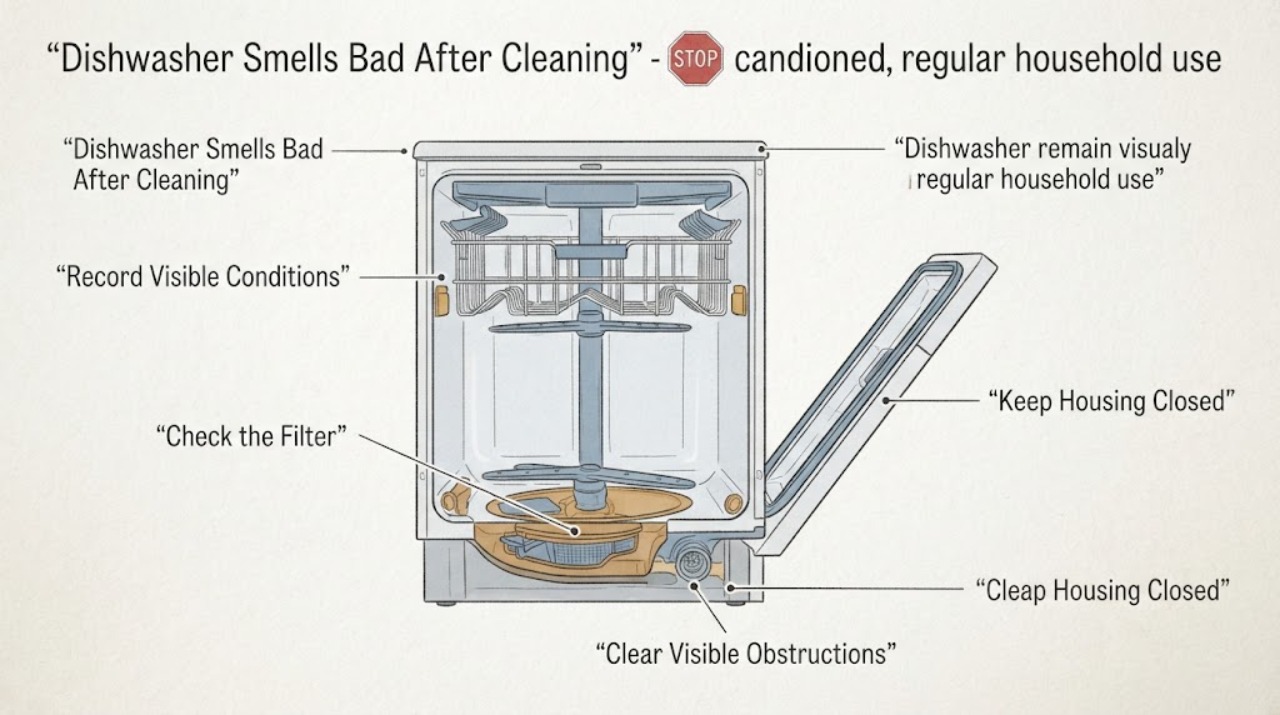
A persistent dishwasher smell does not by itself mean the appliance needs replacement. First separate an odor that returns with food debris or water left in the filter area from a new-appliance plastic, petroleum, or varnish smell. With the dishwasher empty and safe to handle, use the exact model manual to confirm the filter is present, clean, and locked, and check the visible spray arms, door seal, and accessible drain connection. Whirlpool notes that a small amount of water in the filter area can be normal, but food soil, poor cleaning, or a recurring smell can indicate filter or drainage maintenance is needed. If those checks and one single manufacturer-approved cleaning method have already been completed without changing the smell, stop repeating cleaners and arrange service; never mix vinegar, affresh, bleach, or other drain or cleaning chemicals.
Work through in order
Diagnostic checks
Use only checks that match the exact appliance or system and its official guide.
-
Check 1
Record when the odor is strongest: immediately after opening the door, after the dishwasher has sat closed, during a cycle, or only when the filter area is opened. Also describe it as food-like, musty, plastic, petroleum-like, chemical, or burning without tasting or deliberately heating anything.
Expected result: The smell is limited to a new-appliance plastic, petroleum-like, or varnish odor; returns with food residue or standing water; or is chemical, burning, or accompanied by smoke or a leak.
Next step: For a time-limited new-appliance smell, follow the exact manual and monitor whether it diminishes. For food or water-related odor, continue to the filter and drain observations. For chemical, burning, smoke, or leak symptoms, stop using the dishwasher and arrange service.
Why this matters
Why: Whirlpool documents that some plastic, petroleum, or varnish odors can occur for a limited period on newer equipment, while food debris and stagnant water can contribute to ordinary dishwasher odors. A chemical or burning odor is not a reason to keep adding cleaners or to diagnose an internal part from smell alone.
-
Check 2
With the dishwasher off and cool, use the exact model manual to inspect the filter or self-cleaning filter area and the visible spray arms. If the manual permits removal, rinse the filter with water and a soft brush, remove visible food soil from the accessible area, and reinstall every filter until it is fully locked. Do not use a wire brush, scouring pad, or force a part that does not match the manual.
Expected result: The filter is visibly soiled, missing, loose, or not locked; the spray-arm openings have visible debris; or the filter area is clean and correctly assembled.
Next step: Correct only the documented external seating or visible soil issue, then run one normal cycle and observe the result. If the filter is already clean and locked, record that result and move to the drain and residual-water check rather than repeating the same cleaning.
Why this matters
Why: Manufacturers describe the filter as a place where food is trapped and identify visible soil, reduced cleaning, and odor as reasons to inspect it. A clean and locked filter after a documented check makes repeating the same filter wash less useful; it does not prove a particular pump or control failure.
-
Check 3
After a completed cycle, look at the accessible filter area and the sink-side drain connection without removing hoses or opening the cabinet. Check whether water is only the small amount the model normally leaves in the filter area, or whether there is foul stagnant water, a high water level, poor drainage, or a visible obstruction at the accessible disposer, air gap, or drain connection.
Expected result: Only a small amount of water remains in the filter area; or water remains at a high level, the dishwasher drains poorly, or the accessible drain connection is obstructed.
Next step: If the remaining water is the model's normal small amount and drainage is otherwise normal, continue to the door-seal and single-method maintenance decision. If water is high or drainage is poor, correct only an obvious accessible sink-side obstruction described by the exact manual; otherwise stop using the dishwasher and request service.
Why this matters
Why: Whirlpool says a small amount of water in the filter area can protect seals and drain at the next cycle, while food soil, odor, and reduced cleaning can indicate filter maintenance. Persistent high water or poor drainage points to a drain-path decision rather than a reason to pour drain cleaner into the dishwasher.
-
Check 4
Wipe the visible door gasket and the inner door edge with a damp cloth and mild detergent if residue is present, and inspect the seal for trapped debris, damage, or a gap. Do not pull the gasket out, use caustic chemicals, or assume that a seal replacement fits without the model number.
Expected result: Residue is present on the accessible seal or door edge; the seal is visibly damaged or does not contact evenly; or the seal and inner door are clean and intact.
Next step: Remove only accessible residue with the mild method, then observe one cycle. If the seal is torn, displaced, or fails to contact evenly, keep an eye on leaks and arrange service; if it is intact, do not repeat seal cleaning as the sole response.
Why this matters
Why: Whirlpool includes the door seal and interior among the places to wipe when odors persist. A damaged or uneven seal can require model-specific service, but a clean intact seal does not establish that the seal is the odor source.
-
Check 5
If the previous checks did not include one documented maintenance method, choose only one method allowed by the exact manual or the cleaner's label: a dishwasher cleaner, or the manufacturer's stated alternative. Run it with the dishwasher empty and do not combine products, vinegar, bleach, affresh, drain opener, or other chemicals.
Expected result: The odor improves after the single documented method; the odor returns unchanged; or the appliance develops a chemical, burning, smoke, or leak symptom.
Next step: If the smell improves, follow the model's maintenance interval and correct the underlying loading or drain condition if it returns. If it is unchanged after a documented single method, stop repeating cleaners and contact service with the model, odor timing, filter result, and water-level observation. For chemical, burning, smoke, or leak symptoms, stop use immediately.
Why this matters
Why: Whirlpool recommends a maintenance cycle with a dishwasher cleaner according to its label and separately describes using either affresh or white vinegar for odor cleaning. The alternatives are not a recipe to combine. An unchanged odor after the documented external checks is a service decision, not evidence that more chemicals or a replacement appliance is needed.
Use your observations
Decision map
Find the observation that best matches what you see, then follow the next safe action.
-
PATH 01Next step
What you see
The odor is food-like or musty, and the filter area contains soil or the spray arms have visible debris.
Do this next
Use the exact model manual to clean and lock the filter and clear only visible spray-arm debris, then run one normal cycle. If the odor remains with a clean, locked filter, move to the drainage observation instead of repeating the wash.
Why this path and its safety boundary
Why it matters: Food residue in the filter, spray arms, or tub is a documented odor pathway, so the symptom still has an external maintenance explanation.
-
PATH 02Next step
What you see
The odor returns together with high residual water, poor draining, or an accessible sink-side drain obstruction.
Do this next
Address only an obvious accessible obstruction permitted by the exact manual. If the dishwasher still drains poorly or the obstruction is inside the appliance, stop using it and request service rather than adding drain chemicals or opening the cabinet.
Why this path and its safety boundary
Why it matters: The timing and water result make a drain-path issue more relevant than another interior fragrance or cleaner; a small normal amount of filter-area water alone is not the same finding.
-
PATH 03Next step
What you see
The dishwasher is new and the smell is plastic, petroleum-like, or varnish-like, with normal drainage and no smoke or leak.
Do this next
Follow the exact model's normal-use and cleaning guidance and monitor whether the smell diminishes over the stated period. If it persists, intensifies, or is accompanied by smoke, heat damage, or a leak, stop use and arrange service.
Why this path and its safety boundary
Why it matters: Whirlpool describes limited-duration versions of these new-appliance odors; that description does not establish that every odor is normal or that it will persist indefinitely.
-
PATH 04Next step
What you see
The filter, visible spray arms, door seal, accessible drain result, and one single documented maintenance method are all acceptable, but the odor is unchanged or is chemical or burning.
Do this next
Stop repeating cleaners and stop using the dishwasher for chemical, burning, smoke, leak, or electrical symptoms. Give service the full model, when the smell appears, the odor description, filter and water observations, and the methods already tried.
Why this path and its safety boundary
Why it matters: The supported user checks have not identified a correctable external cause. The opened guidance does not support diagnosing a pump, heater, insulation, wiring, or control part from odor alone.
Helpful context
Understand the symptom
Do not use a generic filter procedure for every dishwasher
The dishwasher brand and model are not supplied. Manufacturer layouts differ: Whirlpool says some filters are removable while some models use a self-cleaning design, and Bosch tells owners to consult the owner manual for filter removal. Use the rating-plate model to find the matching manual before lifting a spray arm or twisting a filter. The checks below describe what to decide, not a universal sequence of parts to force out.
Persistence changes the next decision
If the filter, spray arms, interior, door seal, and accessible drain path have already been checked and the odor is unchanged, repeating the same cleaning cycle is unlikely to identify the cause. Record when the smell appears, whether water remains after a completed cycle, and whether it is food-like, musty, plastic, petroleum-like, chemical, or burning. Those observations determine whether the next step is a model-specific drain assessment, a time-limited new-appliance observation, or service rather than another cleaner.
When checks do not resolve it
Need a professional?
Contact service when the smell persists after the exact model's filter, spray-arm, seal, drain, and single-method maintenance checks; when drainage remains poor or water stays high; or immediately for chemical, burning, smoke, leak, or electrical symptoms.
Common questions
FAQ
Does a small amount of water in the dishwasher filter area prove it is not draining?
No. Whirlpool says a small amount of water in the filter area can be normal and can drain at the next cycle. High standing water, poor drainage, food soil, reduced cleaning, or a recurring odor are different observations that warrant the model's drain and filter checks.
Should I keep running vinegar, affresh, bleach, or drain cleaner until the smell goes away?
No. Whirlpool describes either affresh or white vinegar as odor-cleaning options and separately recommends a dishwasher cleaner according to its label. Treat them as separate alternatives, never mix products, and do not use drain opener in the dishwasher. If one documented method made no difference, move to the service decision.
Can I remove the dishwasher filter to clean it?
Only if the exact model manual shows that the filter is removable. Whirlpool says filter designs vary, and Bosch likewise directs owners to the owner manual for removal. When the manual permits removal, use water and a soft brush, reinstall it locked, and never operate the dishwasher without its filters correctly installed.
When does a persistent dishwasher smell mean I should stop trying to clean it?
Stop repeating cleaning when the filter, visible spray arms, door seal, accessible drain result, and one single documented maintenance method have been checked without improvement. Stop immediately for a chemical or burning smell, smoke, a leak, or an electrical symptom, and give service the model and the observations rather than guessing at a replacement part.
Read the exact guide
Official sources
- Removing Odors in your Dishwasher - Product HelpWhirlpool Product Help · Used for the documented odor sources, time-limited new-appliance odor examples, filter/spray-arm/door-seal/drain checks, and the separate cleaning alternatives. The task has no brand or model, so Whirlpool-specific product behavior is presented as manufacturer guidance and not as a universal internal diagnosis.
- Water Remains In Filter Area - DishwasherWhirlpool Product Help · Used to distinguish a small normal amount of filter-area water from visible soil, odor, reduced cleaning, or a drainage symptom. It does not establish a universal water level or an internal part diagnosis for an unidentified dishwasher.
- How to Clean the Dishwasher FiltersWhirlpool Product Help · Used for the model-dependent removable versus self-cleaning filter distinction, soft-brush/rinse boundary, locking the filter, and the warning not to operate without filters. It is not used to prescribe a Whirlpool sequence for another brand.
- How to Properly Clean Your Dishwasher FilterBosch Home Appliances · Used only as corroboration that filter access and removal should follow the exact owner manual and that a soft brush and mild soap are used in the Bosch procedure. Bosch-specific removal steps are not transferred to the unidentified dishwasher in this topic.
Community feedback
Share a repair observation
Share a plain-text repair observation. Accepted observations are published automatically; this page may take a moment to update.