
On this page
Start here
Quick answer
A mini dishwasher does not need a visible blanket of suds to clean dishes. Judge the result by food residue, greasy film, white mineral spots, detergent residue, water coverage and whether the cycle completes. Use only automatic-dishwasher detergent, measure it from the product label and the machine's manual, and do not add hand dish soap to create foam. Hard water can reduce cleaning performance and leave film or scale, but reduced sudsing alone does not prove hard water. Confirm hardness through the local water utility or a suitable test, then use a built-in softener or dishwasher salt only if the exact mini-dishwasher manual provides one. In a public school office, stop the unit and arrange service for leakage, persistent foam, a cycle that will not complete, unsafe wiring, or poor cleaning after detergent, loading, filter, spray-path and water-hardness checks.
Before you begin
Safety first
- Use only automatic-dishwasher detergent and documented user-level cleaning. Do not add hand dish soap, laundry detergent, unapproved acids or salt, open the pump/heater/wiring, bypass a safety condition, or run repeated tests after a leak or electrical fault.
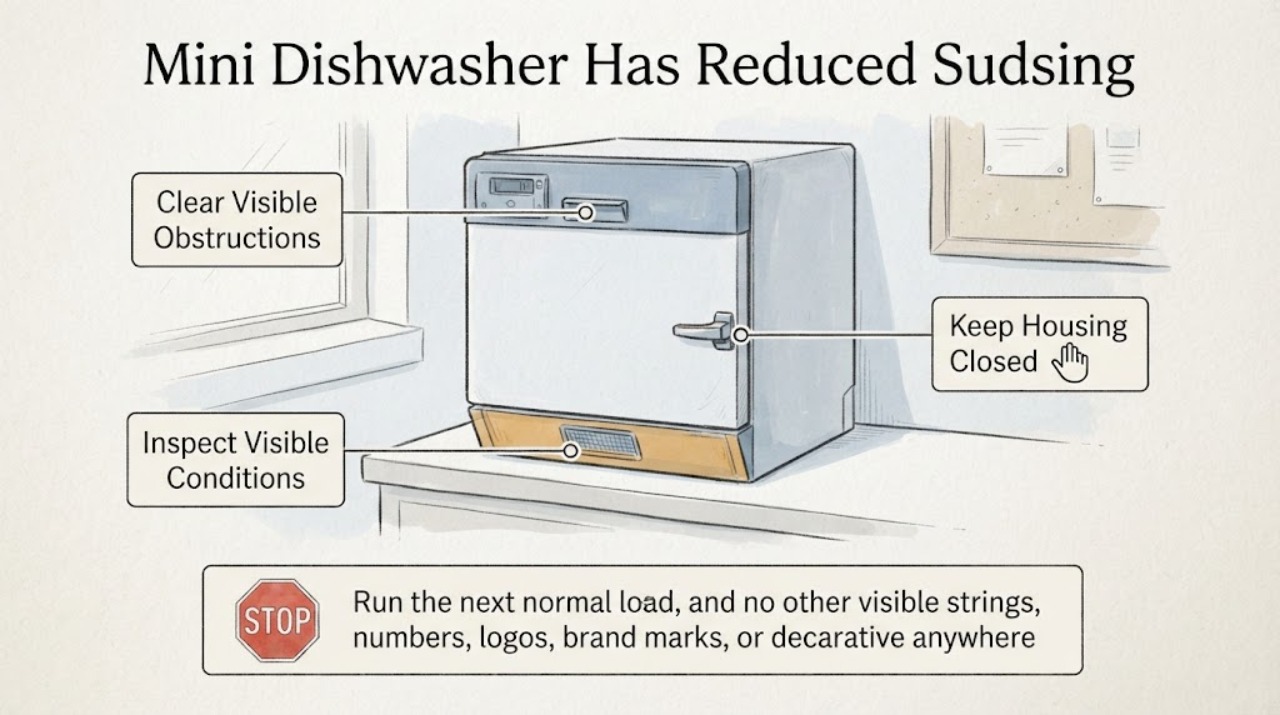
Work through in order
Diagnostic checks
Use only checks that match the exact appliance or system and its official guide.
-
Check 1
Run the next normal load with only fresh automatic-dishwasher detergent, using the package and exact machine manual for the dose. Do not add hand dish soap, laundry detergent or extra detergent to make bubbles. Load a small, repeatable set of normally soiled items so the result can be compared.
Expected result: The load is clean with little visible foam, or food, grease, white film or detergent residue remains; or the unit produces persistent foam and cannot complete the cycle.
Next step: If dishes are clean and the cycle completes, stop using suds as the pass/fail test. If cleaning is poor, continue with the filter, spray-path and hardness checks. If foam remains or the cycle will not complete, stop the unit, allow foam to dissipate and follow the exact manual or arrange service.
Why this matters
Why: Low visible suds with clean dishes is normal evidence of adequate cleaning. Residue or poor cleaning can result from dose, detergent freshness, loading, water temperature, filter or spray coverage; persistent foam points to an incorrect product, excess dose or residue from hand-washing products rather than a need for more bubbles.
-
Check 2
Inspect the accessible filter, spray-arm openings and loading pattern with the dishwasher off and cool. Remove only food debris or visible obstruction that the manual identifies as user-cleanable, and keep dishes from blocking the spray path.
Expected result: The filter or spray path is dirty/blocked, dishes were shielding one another, or these areas are clear and water coverage still appears weak.
Next step: Clean and reload according to the exact manual, then compare another normal load. If water coverage remains weak, the unit leaks, makes an abnormal mechanical sound or cannot finish, stop user troubleshooting and request service rather than opening the pump area.
Why this matters
Why: Restricted circulation or poor loading can leave food on dishes even when detergent chemistry is correct. A clear accessible path with weak circulation does not prove a pump or motor failure, especially without an exact model manual.
-
Check 3
Look for independent signs of hard water: white scale or cloudiness on glasses, mineral film inside the tub, scale at the water inlet, or a hardness result from the local water utility or a suitable test. Do not infer hardness from reduced suds alone.
Expected result: Hardness is documented or mineral deposits are present, or no hardness evidence is found.
Next step: If hard water is confirmed, check whether the exact mini-dishwasher has a water-softener reservoir or a supported hardness setting. Follow that manual only. If the machine has no such feature, use the detergent and rinse-aid guidance on its label/manual rather than adding unapproved salt or chemicals.
Why this matters
Why: Hard water can leave mineral deposits and make good cleaning more difficult; official guidance recommends determining the water condition rather than guessing from foam. If no hardness evidence exists, changing detergent chemistry solely to increase suds is unsupported.
-
Check 4
Verify the office's routine: detergent has been stored dry, the dispenser or tank is closing correctly, the water supply and drain are connected as the manual requires, and no hand-washing soap or pre-soak residue is entering the machine.
Expected result: Detergent is damp/old, the dispenser or water path is abnormal, hand soap may be entering the load, or the setup matches the manual.
Next step: Correct only the documented user-level issue and repeat a controlled load. If the dispenser, inlet, drain, wiring or internal circulation needs access beyond the manual, keep the shared office appliance out of service and arrange qualified repair.
Why this matters
Why: Whirlpool says detergent freshness, correct amount, dispenser use and avoiding hand-dish-soap residue affect sudsing and wash performance. A correct setup with repeated poor cleaning points beyond the simple bubble observation.
Use your observations
Decision map
Find the observation that best matches what you see, then follow the next safe action.
-
PATH 01Next step
What you see
The dishes are clean and the cycle completes even though little or no foam is visible.
Do this next
Keep the documented detergent dose and evaluate the load by food residue, film, spots and cycle completion rather than bubble height.
Why this path and its safety boundary
Why it matters: Reduced visible sudsing is not a fault by itself; automatic dishwasher detergent is designed to clean without the foam produced by hand dish soap.
-
PATH 02Next step
What you see
There is white film or scale on dishes/tub and hard water is confirmed independently.
Do this next
Check the exact mini-dishwasher manual for a supported softener, salt reservoir or hardness setting. Use only the specified dishwasher softener salt if the machine provides that feature; do not improvise a salt container.
Why this path and its safety boundary
Why it matters: Mineral hardness is a plausible contributor to the cleaning complaint, but it does not identify a detergent fault or prove that the machine lacks suds.
-
PATH 03Next step
What you see
The machine has persistent foam, leaks, or stops before completing a cycle.
Do this next
Turn the dishwasher off, allow foam to dissipate, prevent further use until the correct detergent and manual procedure are confirmed, and arrange service if the issue repeats or water has leaked.
Why this path and its safety boundary
Why it matters: Incorrect detergent, excess dose or hand-soap residue can create foam that affects operation and may push water out; a cycle fault cannot be diagnosed from suds alone.
-
PATH 04Next step
What you see
Cleaning remains poor after a controlled detergent load, accessible filter/spray check and verified water-hardness review.
Do this next
Keep the shared office unit out of service if it leaks or presents an electrical/water hazard, record the exact model and symptoms, and arrange qualified appliance service. Do not open pumps, heaters or wiring to chase a bubble-related diagnosis.
Why this path and its safety boundary
Why it matters: The remaining cause may involve water temperature, inlet, circulation, dispensing, drainage or a model-specific control, none of which can be identified from suds level alone.
Helpful context
Understand the symptom
Suds are not the cleaning score
The amount of foam in the wash water is a poor stand-alone test. Whirlpool explains that automatic-dishwasher detergent is formulated not to create the foam produced by dish soap, while incorrect or excessive detergent can create too many suds and hurt wash performance. For this mini dishwasher, judge a completed load by food left on the dishes, greasy film, white scale or spots, detergent residue, spray coverage and whether the cycle drains and completes. The absence of bubbles alone does not show that the machine has lost cleaning power.
Treat the public-office water and detergent as variables
A school office may have a shared or recently changed water supply, different detergent users and mixed loading habits. Do not respond by adding hand dish soap, doubling detergent or adding salt at random. Check the detergent label, the exact mini-dishwasher manual, the filter and spray path, and the local water-hardness information. Hard water can cause mineral film and diminished cleaning, but it must be established by water evidence and the machine's supported softening arrangement, not by the number of bubbles.
When checks do not resolve it
Need a professional?
Stop and arrange service for persistent foam, leakage, an incomplete cycle, unsafe wiring or water connections, weak circulation after accessible checks, or poor cleaning that continues after the detergent and water-hardness variables are controlled. Do not treat reduced bubbles alone as a failed dishwasher.
Safety scope: Use only automatic-dishwasher detergent and documented user-level cleaning. Do not add hand dish soap, laundry detergent, unapproved acids or salt, open the pump/heater/wiring, bypass a safety condition, or run repeated tests after a leak or electrical fault.
Have this ready
- Provide the complete appliance model, office water source and hardness information, detergent product and dose, cycle selected, load type, photos of any film/scale or foam, whether the unit leaks or stops, and what accessible checks were completed.
Common questions
FAQ
Does a dishwasher need visible suds to clean dishes?
No. Whirlpool says automatic dishwasher detergent does not create the suds made by hand dish soap. A clean completed load is better evidence than visible foam; evaluate food residue, film, spots, detergent residue and cycle completion.
Can hard water be diagnosed because the dishwasher has fewer bubbles?
No. Hard water can contribute to mineral deposits and poorer cleaning, but the water condition should be confirmed through the local water utility or a suitable test and compared with the exact machine manual. White film or scale is more useful evidence than bubble level.
Should I add more detergent or dish soap when there are few suds?
Do not add hand dish soap to create foam. Use only automatic-dishwasher detergent and follow its label and the exact mini-dishwasher manual. Too much or incorrect detergent can create excessive suds, residue, leaks or poor operation.
Can I add dishwasher salt to any mini dishwasher?
No. Whirlpool notes that not every dishwasher has a salt reservoir. Use dishwasher water-softener salt only when the exact appliance manual provides that feature and specifies its operation; never substitute table, sea, rock or de-icing salt.
Read the exact guide
Official sources
- Dishwasher - Detergent Use and Water HardnessGE Appliances · Opened official GE dishwasher guidance and used only for the general principle that hardness is a dissolved-mineral condition to verify with a utility or county extension source. GE's model-specific dose examples are not transferred to the unknown mini dishwasher.
- Detergent Usage GuidelinesWhirlpool Product Help · Opened official Whirlpool dishwasher guidance. It is used for general detergent principles only; exact dose and controls must come from the mini-dishwasher's own manual.
- Filling the Dishwasher Water SoftenerWhirlpool Product Help · Opened official Whirlpool water-softener guidance. It supports the conditional distinction between machines with and without a salt reservoir; it does not establish that the assigned mini dishwasher has one.
- Leaking from DoorWhirlpool Product Help · Opened official Whirlpool dishwasher guidance. It supports category-level detergent/suds principles and safety boundaries; it does not identify the unknown mini-dishwasher brand, model or control layout.
Community feedback
Share a repair observation
Share a plain-text repair observation. Accepted observations are published automatically; this page may take a moment to update.