
On this page
Start here
Quick answer
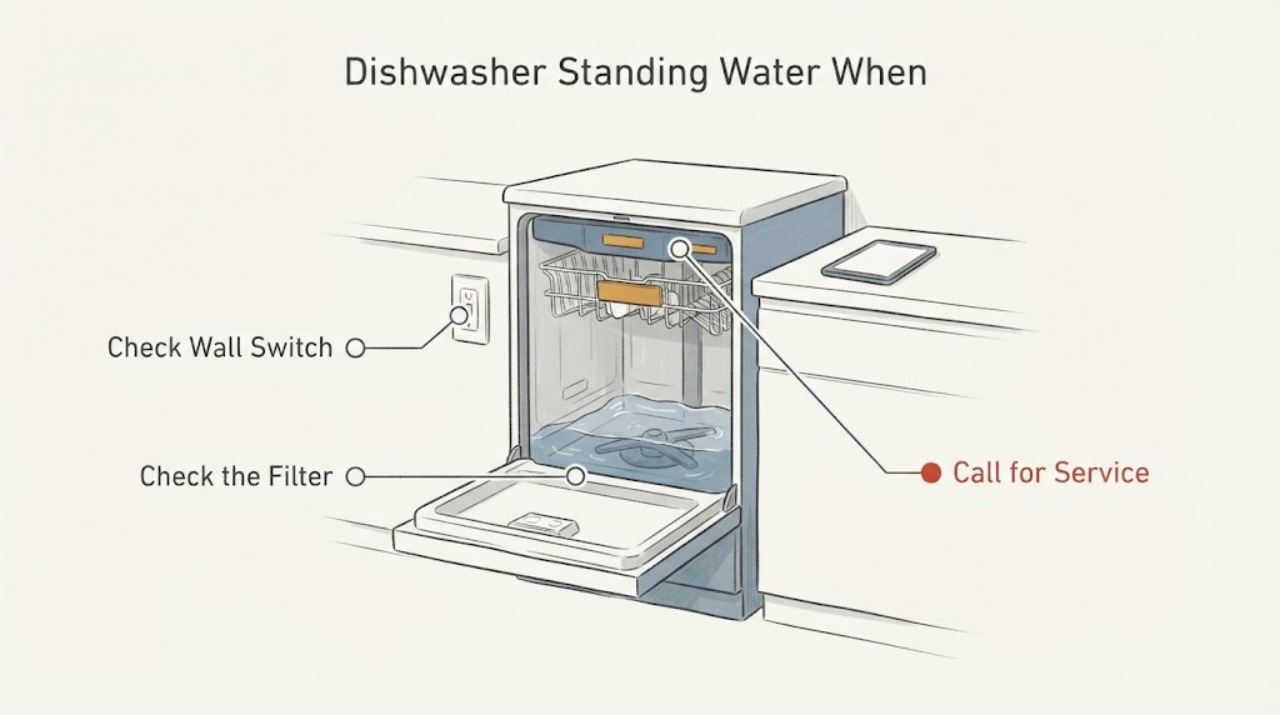
A small amount of water down in the dishwasher filter area can be normal, but water across the tub or water that returns after a cycle points to a drain-path problem. Treat the dishwasher and the garbage disposal as two connected but separate appliances: first turn off dishwasher power and the disposal switch, remove standing water with a cup or hand pump, and inspect the dishwasher filter, visible sump debris, drain hose routing, air gap, and sink/disposal connection from the outside. A clogged or failed disposal can block the dishwasher outlet, while a kinked hose, missing high loop, blocked air gap, or retained disposal knockout plug can cause backup even when the dishwasher itself is working. Never put a hand into the disposal, use drain-opening chemicals in the dishwasher, clear a jam with power connected, or disconnect an under-sink hose while water or electrical risk is uncontrolled.
Work through in order
Diagnostic checks
Use only checks that match the exact appliance or system and its official guide.
-
Check 1
Identify where the water is sitting before disassembling anything: inspect the recessed filter area, the rest of the tub, the sink, and the air-gap outlet if one is installed.
Expected result: Only a small amount is down in the filter area, or water covers the tub/near the door or returns from the sink or air gap.
Next step: If the water is only in the filter recess, confirm the exact model's normal level before treating it as a fault. If water covers the tub or backs up, keep the dishwasher and disposal off and continue with safe drainage checks.
Why this matters
Why: A small amount in the filter area can be normal, while tub-level water or backflow points to restricted drainage or an air-gap/sink connection problem.
-
Check 2
Turn off dishwasher power at the breaker when possible, switch off the garbage disposal, and bail standing water into a bucket with a cup or hand pump; do not use drain-opening chemicals.
Expected result: The water can be removed without exposing live electrical parts, or there is a leak, burning smell, damaged wiring, repeated breaker trip, or power cannot be safely isolated.
Next step: Proceed only when power is isolated and the area is stable. For a leak, burning smell, damaged wiring, repeated breaker trip, or uncertain isolation, leave both appliances off and arrange qualified service.
Why this matters
Why: Removing water makes the filter and visible drain path safer to inspect. Electrical or leak hazards are outside a safe owner check and can involve pump, wiring, or plumbing damage.
-
Check 3
With power isolated, remove and rinse the dishwasher filter only as the dishwasher's manual shows, then look with a flashlight at the visible sump opening for food, labels, seeds, toothpicks, or glass; do not reach into a pump or use sharp tools.
Expected result: The filter or visible sump is coated/blocked, or it is clear but the dishwasher still does not drain.
Next step: Clean and reseat the filter, then run only the model-approved short drain/rinse test when the disposal and sink path are safe. If water remains, move to the under-sink visual checks and service boundary rather than removing the pump.
Why this matters
Why: A restricted filter or sump can reduce the water reaching the drain path. A clear filter does not prove the pump, impeller, wiring, or control is working.
-
Check 4
Inspect the under-sink drain route from outside: look for a crushed or sagging dishwasher hose, a secured high loop or clear air gap, a visibly blocked sink/disposal inlet, and—if the disposal was recently installed—evidence that its dishwasher knockout plug was removed; do not disconnect the hose.
Expected result: The hose is kinked/low, the air gap spills or is visibly blocked, the disposal inlet is obstructed, or the route appears correctly looped and open.
Next step: Correct only an obvious external kink or restore the hose's documented high-loop support. Clean an accessible air-gap cap only as its own instructions allow. If the connection needs hose removal, trap work, or knockout-plug extraction, stop and arrange service rather than opening the plumbing with water present.
Why this matters
Why: A low or kinked hose can allow wastewater to return; a blocked air gap or sink/disposal inlet can stop flow; a retained knockout plug blocks a newly connected dishwasher. A correct-looking external route does not rule out an internal blockage.
-
Check 5
Treat the garbage disposal as a separate appliance: with its switch off and power disconnected, inspect from above with a flashlight and tongs only, and use the disposal's own documented jam wrench/reset method from below if the exact unit provides one; never put a hand into the chamber.
Expected result: The disposal is silent, hums without turning, turns freely and runs, or repeatedly trips/stays inoperative after its model-approved reset.
Next step: If the disposal is jammed and the model manual supports it, keep power off, use the specified wrench and tongs, then retest only with water flowing. If it remains silent, trips, leaks, or jams again, leave it off and call disposal/plumbing service; do not use chemical drain cleaner or disconnect the shared hose.
Why this matters
Why: A hum with no rotation or a visible object is consistent with a mechanical jam; silence, repeated trips, or a reset that will not stay engaged can indicate an electrical or motor problem. A working disposal does not prove that the dishwasher drain hose or pump is clear.
Use your observations
Decision map
Find the observation that best matches what you see, then follow the next safe action.
-
PATH 01Next step
What you see
Only a small amount of water is down in the dishwasher's filter recess and it disappears on the next normal drain.
Do this next
Use the exact dishwasher manual for its normal water level and keep the filter clean; seek service if water spreads across the tub, backs up, or remains after a completed cycle.
Why this path and its safety boundary
Why it matters: That amount can be normal for some dishwasher designs and does not establish a clogged dishwasher or failed disposal.
-
PATH 02Next step
What you see
The disposal is blocked or inoperative and the dishwasher drain hose terminates at that disposal, or the sink/air gap backs up when the dishwasher drains.
Do this next
Keep power off while using only the disposal's model-approved jam procedure; if it is silent, repeatedly trips, leaks, or the connection needs to be opened, arrange disposal or plumbing service before running the dishwasher.
Why this path and its safety boundary
Why it matters: The two appliances share a downstream path, so a disposal/inlet/air-gap restriction can prevent dishwasher water from leaving without proving the dishwasher pump is faulty.
-
PATH 03Next step
What you see
The disposal runs, but the dishwasher hose is kinked/low or the air gap spills or is blocked.
Do this next
Correct only the visible routing or clean an accessible air-gap cap according to its instructions; do not detach the hose or open the trap in a wet apartment cabinet without qualified help.
Why this path and its safety boundary
Why it matters: A hose-routing or air-gap restriction can cause slow drainage or backflow even when the disposal motor works.
-
PATH 04Next step
What you see
The filter, visible sump, external hose route, air gap, and disposal path look clear, but the dishwasher still leaves tub-level water or makes no drain-pump sound.
Do this next
Leave standing water contained, keep the dishwasher off, and schedule appliance service with the dishwasher model number; do not remove panels or perform live voltage tests.
Why this path and its safety boundary
Why it matters: The remaining possibilities include a pump/impeller, wiring, door switch, timer, or control issue that cannot be identified safely from this model-unspecified report.
Helpful context
Understand the symptom
Separate the dishwasher symptom from the disposal fault
The dishwasher and garbage disposal share an under-sink drain path, but they are different appliances. A disposal that hums, stays silent, trips, or is visibly blocked can restrict the dishwasher outlet; a dishwasher filter, drain pump, hose, air gap, or hose-routing problem can leave water even when the disposal runs. The wording ‘clogged and broken’ is not a diagnosis of either appliance, so use the water path and the observed disposal behavior to decide what to do next.
Check whether the water amount is actually abnormal
Water only in the recessed filter area may be normal on some dishwashers; Whirlpool describes a small amount there as protecting seals and being replaced during the next cycle. Water spread across the tub, water near the door, sink water returning into the tub, or water that remains after a completed drain cycle is a different symptom and warrants the drain-path checks below. Because no dishwasher brand or model was supplied, use its own manual for the exact normal water level and filter-removal method.
Keep the apartment kitchen safe while the path is wet
Before touching a filter, sump, disposal opening, or under-sink connection, switch off dishwasher power at the breaker when possible, switch off the disposal, and shut the under-sink water valve if a leak is present. Bail water into a bucket or use a hand pump; do not pour drain opener into the dishwasher or disposal. If there is a burning smell, smoke, damaged wiring, repeated breaker trip, leak, or uncertainty about isolating power, stop and call a qualified technician.
When checks do not resolve it
Need a professional?
Arrange qualified appliance, plumbing, or disposal service when the dishwasher keeps tub-level water after the filter and external drain-path checks, the disposal is silent, repeatedly trips, leaks, or jams again, the hose/trap must be disconnected, the air gap continues to spill, or the dishwasher has an electrical smell, damaged wiring, or repeated breaker trips. Give the technician the dishwasher and disposal model numbers and whether the two appliances share the disposal inlet.
Common questions
FAQ
Is a little water in the bottom of a dishwasher always a blockage?
No. Whirlpool says a small amount in the recessed filter area can be normal because it helps keep seals from drying. Water across the tub, near the door, returning from the sink, or remaining after a completed drain is a different symptom.
Can a broken garbage disposal make a dishwasher hold water?
Yes, when the dishwasher drains through the disposal inlet, a blocked inlet or downstream disposal path can stop the dishwasher from draining. A working disposal does not prove that the hose, air gap, filter, sump, or dishwasher pump is clear.
Can I pour drain cleaner into the standing water?
No. Whirlpool's dishwasher guidance warns against drain-opening chemicals inside the dishwasher because they can damage components and create safety hazards. Bail the water and use the external inspection or service path instead.
What should I do if the disposal hums but will not turn?
Treat it as a possible mechanical jam: disconnect power, keep hands out, and use only the exact disposal model's documented wrench and tongs procedure. If it stays inoperative, trips again, leaks, or jams again, leave it off and arrange disposal service.
What if the dishwasher hose under the sink needs to be removed?
Do not remove it as an improvised first step in a wet apartment cabinet. A hose connection can release contaminated water and expose a shared drain path; contain the water and have a qualified appliance or plumbing technician perform the disconnection if the external checks do not resolve the problem.
Read the exact guide
Official sources
- Clearing a Jammed DisposerWhirlpool Product Help · Opened official Whirlpool disposer guidance used for general safety distinctions only. The unknown disposal model must use its own manual for wrench, reset, and overload details; no Whirlpool-specific part or control is asserted.
- What Is a Dishwasher Air Gap?Whirlpool · Opened official Whirlpool explainer used for general air-gap and backflow concepts in a model-unspecified apartment kitchen. Local plumbing code and the appliance manual control exact installation requirements.
- Fixing a Jammed Garbage DisposalInSinkErator · Opened official InSinkErator page used only to reinforce universal safety boundaries (switch off, no hands, tongs) and the need to use the exact disposal's documented method. Its brand-specific wrench/overload details are not transferred to the unknown apartment disposal.
- Dishwasher Not DrainingWhirlpool Product Help · Opened official Whirlpool general troubleshooting page. It is used only for external/common drain checks and safety boundaries because the assigned topic has no dishwasher brand or model; it does not diagnose a specific pump or control part.
- Not Draining - Water Remain at End of Cycle - DishwasherWhirlpool Product Help · Opened official Whirlpool guidance used for general symptom distinctions and external drain-path concepts in this model-unspecified dishwasher topic. It does not establish a particular apartment dishwasher's model-specific normal water level.
Community feedback
Share a repair observation
Share a plain-text repair observation. Accepted observations are published automatically; this page may take a moment to update.