
On this page
Start here
Quick answer
First determine whether the dryer completed an automatic cycle early or stopped abruptly. A sensor cycle can end when the load reaches its selected dryness, while an air-only cycle is not supposed to add heat. If the drum stopped with damp clothes, no display, a tripped breaker, an error, unusual noise, overheating, burning odor or poor airflow, stop treating it as a normal cycle ending. With the dryer off and unplugged before inspection, clean the lint screen, check only the accessible vent hose and exterior hood for restriction, confirm the door is fully latched and record the selected cycle and display. Do not open panels, take energized electrical readings, bypass a door switch or repeatedly reset a breaker; persistent stopping needs model-specific service or an electrician for a supply problem.
Before you begin
Safety first
- Unplug before inspection. Do not open panels, take energized electrical readings, bypass a door switch, alter a breaker/fuse rating, run with a damaged cord, or repeatedly restart a dryer that smells hot, smokes, trips protection or makes an abnormal noise.
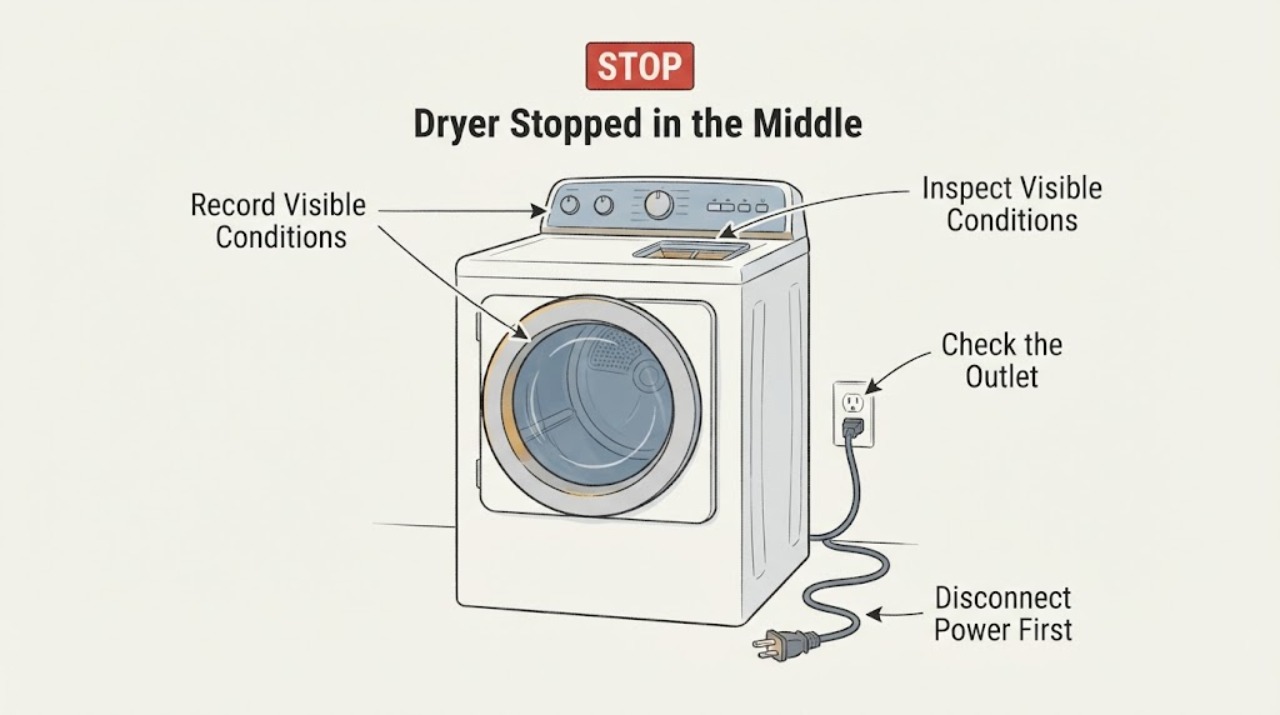
Work through in order
Diagnostic checks
Use only checks that match the exact appliance or system and its official guide.
-
Check 1
Record whether the drum stopped because the clothes were dry or because it stopped before the load was dry. Note the selected cycle, estimated time, display or error message, whether the drum is still warm, and whether the machine can be restarted normally without any warning sign.
Expected result: The load is dry and the cycle ended without an error, or the load is damp and the dryer stopped unexpectedly, shows an error, loses its display or will not restart.
Next step: For a normal-looking completion, compare the cycle with the model manual and avoid changing parts. For an abrupt stop, continue with the power, door and airflow checks while keeping the dryer off until it is safe to inspect.
Why this matters
Why: A dry load with a completed automatic cycle is consistent with sensor-controlled shutoff; damp clothes or a loss of power/operation is not explained by the normal dryness decision alone.
-
Check 2
If the dryer is stopped, unplug it before inspection. From outside the appliance, check whether the display is powered, the outlet/cord appears intact, and the household breaker or fuse has changed state. Do not open the breaker panel, take energized electrical readings, replace a fuse with a different rating or repeatedly reset a breaker that trips again.
Expected result: The display/outlet is dead, a breaker or fuse has interrupted power, power is present but the dryer will not restart, or the supply appears normal.
Next step: If the protection has tripped, follow the model and household instructions for one safe reset only; if it trips again or the cord/outlet is damaged, leave the dryer off and call an electrician. If power is normal but the dryer still stops, continue with the external checks and service boundary.
Why this matters
Why: A supply interruption can stop a cycle without proving an internal dryer fault. A repeated trip, damaged cord/outlet or uncertain supply requires electrical assessment; normal power shifts attention to the door, cycle, airflow or a model-specific appliance fault.
-
Check 3
With power disconnected, empty the lint screen and inspect it for heavy residue. Look behind the dryer without moving it unsafely for a crushed or sharply kinked vent hose, then observe the exterior vent hood only when the dryer is later operating normally; do not remove ducting or reach into the vent as a trial repair.
Expected result: The lint screen is blocked or coated, the hose is crushed/kinked, the exterior flap does not open or airflow is weak, or the accessible path looks clear.
Next step: Clean the accessible lint screen as the model manual directs and have a qualified vent professional address a crushed, blocked or inaccessible exhaust path. If airflow is clear but the dryer still stops, stop repeated cycles and arrange model-specific service.
Why this matters
Why: Restricted airflow can leave clothes warm and damp and can contribute to poor drying performance or overheating. A clear visible path does not rule out a hidden restriction or an internal fault.
-
Check 4
Check that the door is fully closed and latched with no clothing caught in the opening, and confirm that the selected cycle is appropriate for the load. Do not tape, hold down or bypass the door switch; do not assume an Air Dry/Fluff or sensor cycle should behave like a timed heated cycle.
Expected result: The door was not latched, clothing was caught, the cycle was air-only/incorrect, or the door and cycle were already correct.
Next step: Correct the visible door/load or cycle condition and use the exact manual to restart once. If the door is correctly latched and the same premature stop returns, leave the appliance off and use service rather than bypassing the safety switch.
Why this matters
Why: A door/latch or selection condition can interrupt starting or alter heat and timing. A correctly latched door and suitable cycle do not identify an internal failure if the dryer still stops.
-
Check 5
Stop testing immediately if there is a burning odor, smoke, scorching, a hot or damaged cord, unusual grinding/banging, no heat with a damp load, repeated breaker trips or an error that returns. Do not remove panels or attempt to identify a motor, thermal fuse, sensor or control board by substitution.
Expected result: One of these warning signs is present, or the dryer completes a monitored cycle normally after the external checks.
Next step: For any warning sign, keep the dryer out of service and contact qualified appliance service or an electrician as appropriate. For a normal result, monitor the next load without overloading and stop if the symptom returns.
Why this matters
Why: A warning sign indicates an unresolved safety or appliance fault; a single normal cycle only shows that the symptom was not reproduced and does not prove the dryer is repaired.
Use your observations
Decision map
Find the observation that best matches what you see, then follow the next safe action.
-
PATH 01Next step
What you see
The dryer stopped with clothes dry, the selected automatic cycle ended normally and no warning, error or power interruption occurred.
Do this next
Check the model manual for that cycle's expected completion behavior and use a timed cycle only when appropriate for the load; do not replace a part based on this result.
Why this path and its safety boundary
Why it matters: The result is consistent with sensor-controlled completion rather than an abrupt failure.
-
PATH 02Next step
What you see
The load is damp, the display is blank or an error appears, and the breaker/fuse or outlet has interrupted power.
Do this next
Keep the dryer off, check the supply only from a safe external position, and call an electrician if protection trips again or the cord/outlet is damaged. Do not keep resetting it to finish the load.
Why this path and its safety boundary
Why it matters: The cycle stopped because power was interrupted or the supply is not stable; the dryer fault is not yet isolated.
-
PATH 03Next step
What you see
The door is latched and the cycle is appropriate, but the lint screen/vent path is restricted or airflow outside is weak.
Do this next
Clean the accessible lint screen and have the vent path cleaned or repaired safely; if stopping continues after airflow is restored, arrange appliance service.
Why this path and its safety boundary
Why it matters: Restricted airflow can explain damp results and overheating-related interruption, but it does not confirm an internal thermal or motor component.
-
PATH 04Next step
What you see
The dryer repeatedly stops after external checks, or there is burning odor, smoke, scorching, unusual noise, no heat, a returning error or a repeated breaker trip.
Do this next
Stop using the dryer and contact qualified appliance service; use an electrician when the supply, outlet, cord or breaker is implicated.
Why this path and its safety boundary
Why it matters: An unresolved appliance or electrical fault remains and cannot be safely diagnosed by opening the dryer or bypassing a safety device.
Helpful context
Understand the symptom
Separate a normal cycle ending from an abrupt stop
A dryer that is quiet with clothes dry at the selected dryness level may have completed an automatic cycle rather than failed. Maytag says automatic cycles sense humidity and turn off when the desired dryness is reached; its page also says Air Dry or Fluff does not add heat. By contrast, a drum that stops while clothes remain wet, a blank display, an error, a breaker trip or a new safety symptom needs a different path. The exact behavior still depends on the unprovided model and cycle.
What the external checks can and cannot show
A secure door, clean lint screen, unobstructed accessible vent path and correct cycle can eliminate simple operating conditions, but they do not prove an internal component is good. Whirlpool directs owners to unplug before inspecting the vent and to arrange service for persistent performance problems, no heat, error codes or unusual noises. GE's guidance likewise treats supply, overheating, sensor-cycle behavior and a recurring timer stop as reasons to narrow the issue or obtain service, with model-specific electrical requirements.
When checks do not resolve it
Need a professional?
Call qualified appliance service if the dryer repeatedly stops with damp clothes, shows an error, has no heat or unusual noise, or continues after safe external checks. Call an electrician for a repeated breaker/fuse trip, damaged cord/outlet or uncertain supply.
Safety scope: Unplug before inspection. Do not open panels, take energized electrical readings, bypass a door switch, alter a breaker/fuse rating, run with a damaged cord, or repeatedly restart a dryer that smells hot, smokes, trips protection or makes an abnormal noise.
Have this ready
- Provide the complete model and serial number, gas or electric configuration, selected cycle, load type/size, time into the cycle, whether the display stayed on, any error, temperature/airflow observations, breaker behavior and whether the door latched.
Common questions
FAQ
Could the dryer have simply finished the cycle?
Yes, if the load is dry and an automatic sensor cycle ended normally. Maytag says automatic cycles sense humidity and turn off at the selected dryness. Damp clothes, a blank display, an error or a safety symptom points to a different problem.
Should I reset the breaker and keep running the dryer?
Do not repeatedly reset it. Check the supply only from a safe external position and follow the model/household instructions for one safe reset; if protection trips again, the cord/outlet is damaged or the cause is uncertain, leave the dryer off and call an electrician.
Does stopping mid-cycle prove the motor or thermal fuse failed?
No. The same symptom can result from normal sensor completion, cycle selection, door/latch conditions, power interruption, airflow restriction or an internal fault. The opened official sources do not justify naming a part without model-specific diagnosis.
Read the exact guide
Official sources
- Dryer is not Drying or Experiencing Long Dry Times - Product HelpWhirlpool Product Help · Opened official Whirlpool guidance. Used for unplug-before-inspection, lint-screen and accessible vent checks, load/cycle observations, airflow warning signs and service triggers. It does not establish a universal internal cause for an unidentified dryer.
- Dryer - Timer Stops During the CycleGE Appliances · Opened official GE Appliances support text. Used only for the boundary that power requirements are model-specific, a blocked front can contribute to overheating, automatic cycles may advance sporadically, some models shut off with no detected load, and unresolved cases need service. GE-specific voltage/amperage details are not generalized to this unknown dryer.
- Dryer Stops Mid-Cycle - Product HelpMaytag Product Help · Opened official Maytag guidance. Used for the distinction between automatic sensor completion, Air Dry/Fluff and other cycle types, and for the model-specific service boundary; no Maytag model is assigned to this generic topic.
- Dryer Not Starting or No Operation - Product HelpWhirlpool Product Help · Opened official Whirlpool guidance. Used for door/latch, cycle selection, control-lock and power-interruption checks, with explicit model-specific limitations; it is not used to diagnose a part for this generic topic.
Community feedback
Share a repair observation
Share a plain-text repair observation. Accepted observations are published automatically; this page may take a moment to update.