
On this page
Start here
Quick answer
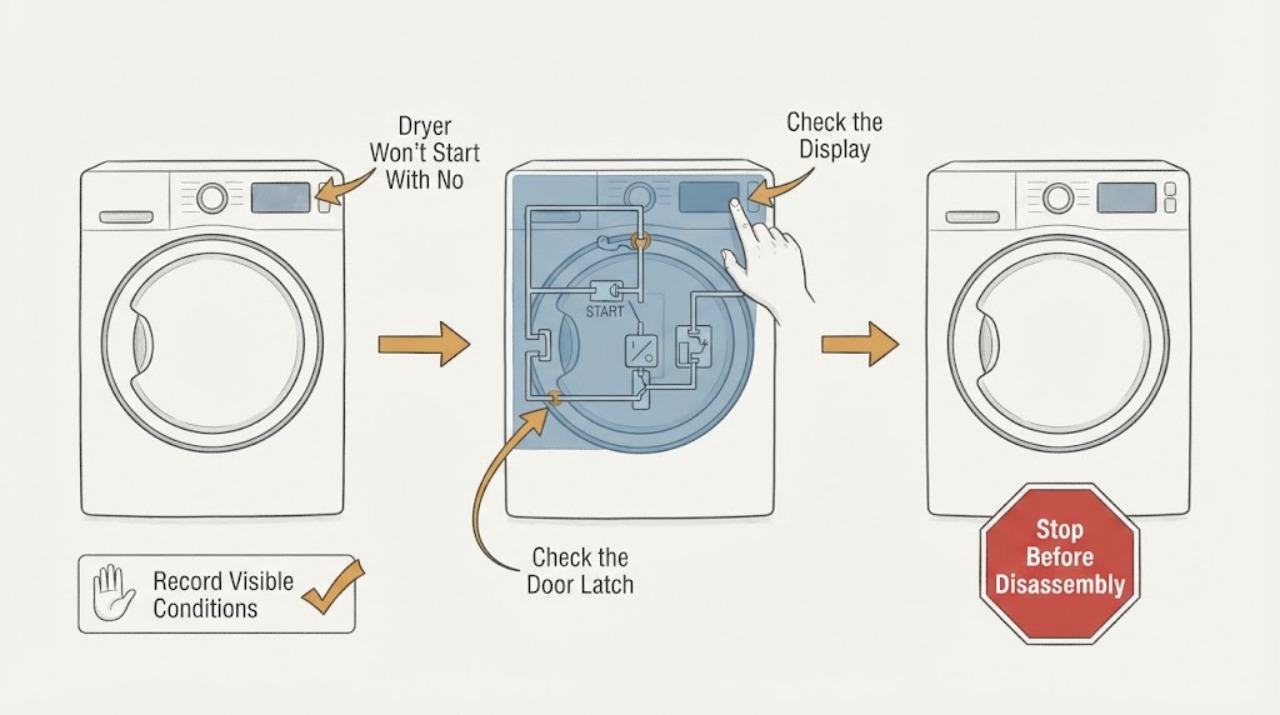
If a dryer still will not start after a thermal fuse and door switch were reportedly replaced, do not replace the same parts again, bridge a safety switch, or test live wiring. First document whether the drum light or controls work, confirm the plug and household protection are normal without repeated resets, and check from outside that the door closes, the latch is not blocked, and the exact model's control-lock and start procedure are being used. Record the model, dryer type, parts and repair work already performed. If there is no response, a hot or damaged cord, a burning smell, repeated fuse or breaker operation, or any need to open the cabinet, leave the dryer disconnected and arrange qualified appliance or electrical service.
Work through in order
Diagnostic checks
Use only checks that match the exact appliance or system and its official guide.
-
Check 1
Leave the dryer disconnected while you record whether the drum light, display or control indicators were working before the failure. From outside, check that the plug is fully seated, the receptacle is not loose or discolored, and the cord has no cuts, melting or heat damage. Do not remove a plug cover, take a live measurement or repeatedly reset a breaker.
Expected result: The dryer is completely dark, the controls light but the motor does not start, the cord or receptacle is damaged or hot, or power appears normal with no visible damage.
Next step: Keep the dryer disconnected for damage, heat, repeated protection operation or uncertainty. If the external supply is safe but the symptom persists, continue only with the door/control observations and arrange qualified service instead of opening the cabinet.
Why this matters
Why: A dark dryer makes an external supply or control path possible; a lit control with no start shifts attention to model-specific control, door and cycle conditions. Damage or heat is an electrical safety issue, and normal-looking power does not prove an internal part is good.
-
Check 2
Using only the exact model's owner instructions, confirm that Control Lock or a similar lock is not active, the selected cycle is a run cycle rather than a wrinkle or standby option, and the documented Start or Push-to-Start control is being operated as specified. Do not guess a button sequence from another brand and do not keep pressing Start as a test.
Expected result: A lock indicator or non-running option is active, the control responds but the cycle does not start, or the settings look correct and the controls remain unresponsive.
Next step: Correct only the documented user setting once. If the control remains unresponsive or the dryer still will not start, leave it out of use and provide the exact model and observations to qualified service.
Why this matters
Why: A locked control or non-running option can prevent a start on some models. Correct settings can remove that user-state branch, but a persistent no-start after the documented operation does not identify a failed board, motor or safety part.
-
Check 3
With power isolated and the drum stopped, inspect the door or lid from outside. Confirm it closes fully, no clothing or debris is caught at the opening, and the visible latch area is not bent, scorched or pushed out of position. Do not defeat, tape, short or manually hold a door switch, and do not remove the front panel.
Expected result: The door does not latch, an item blocks the opening, the visible latch area is damaged or scorched, or the door closes normally with no visible obstruction.
Next step: Remove only an accessible item that is clearly blocking closure and use the model instructions once. For damage, scorching, a repeat no-start or any need to access the switch, keep the dryer disconnected and call qualified service.
Why this matters
Why: A blocked or incomplete latch can prevent a dryer from starting on models that require a closed door. A normal external latch does not prove the switch or wiring is correct, especially after an unverified replacement.
-
Check 4
Write down the complete model and serial information, whether the dryer is electric or gas, the exact thermal fuse and door-switch part identities if known, who installed them, and whether any wiring, terminal, vent or cabinet work was disturbed. Do not order another part or reopen the repair based only on the no-start symptom.
Expected result: The model and repair record are complete and match an exact manual, or the model, part identity or repair history is missing or uncertain.
Next step: Give the record to the manufacturer or a qualified technician and request diagnosis of the complete start and safety circuit. Do not bridge the fuse or switch, substitute an unverified part, or use a generic wiring diagram.
Why this matters
Why: Exact identity is required to check the correct start circuit, power arrangement and manufacturer instructions. An uncertain replacement history leaves compatibility, wiring and the original cause unresolved.
-
Check 5
Check only accessible lint-filter and vent conditions after the dryer is disconnected and cool, such as a visibly blocked filter, crushed exterior duct or restricted outlet. Treat this as a safety observation, not a diagnosis of why a thermal fuse opened; do not dismantle the dryer or repeat a heat cycle to test it.
Expected result: Lint or a visible external restriction is present, the vent path appears clear, or there is a burning odor, heat damage or evidence of overheating.
Next step: Correct only an accessible filter or external obstruction according to the model manual. Keep the appliance disconnected and arrange qualified dryer service for any overheating sign, repeated fuse failure or unresolved no-start.
Why this matters
Why: A visible restriction can contribute to unsafe drying conditions, but it cannot prove the cause of a no-start or fuse event. Odor, heat damage or repeated safety-device operation raises the professional-service boundary.
Use your observations
Decision map
Find the observation that best matches what you see, then follow the next safe action.
-
PATH 01Next step
What you see
The dryer has no lights or response, while the plug and receptacle are cool, intact and correctly connected.
Do this next
Do not repeat breaker resets or open the cabinet. Give the dryer type, model and power observations to a qualified appliance technician or electrician.
Why this path and its safety boundary
Why it matters: An external supply, household protection or internal power path remains possible; the absence of an error code does not distinguish them.
-
PATH 02Next step
What you see
The controls light, but a documented lock or non-running cycle is active and the door closes without an obstruction.
Do this next
Clear only the documented lock or select the model's normal run cycle once. If the no-start persists, stop testing and arrange model-specific service.
Why this path and its safety boundary
Why it matters: A user-control state is more likely than a confirmed failed replacement part, although exact behavior varies by model.
-
PATH 03Next step
What you see
The door will not latch, the latch area is scorched or damaged, a replacement switch is uncertain, or clothing/debris remains at the opening.
Do this next
Do not bypass or repeatedly replace the switch. Keep the dryer disconnected and arrange qualified service with the model and repair history.
Why this path and its safety boundary
Why it matters: A door-safety path remains unresolved. The appearance of a replacement part does not prove correct fitment or wiring.
-
PATH 04Next step
What you see
A burning smell, smoke, melted insulation, hot connection, repeated fuse or breaker operation, or overheating evidence is present.
Do this next
Stop use and isolate power only if safe; leave the area and call emergency services for smoke or fire. Otherwise keep the dryer disconnected and obtain qualified appliance/electrical service.
Why this path and its safety boundary
Why it matters: This is a fire or electrical safety boundary, not a prompt to replace another fuse or run another test cycle.
Helpful context
Understand the symptom
A thermal fuse or door switch may be part of a dryer safety circuit, but the fact that those parts were replaced does not establish that they were the cause, that the replacements fit, or that the underlying condition is corrected. With no model and no error display, the useful decision is whether the dryer has safe external power and a normal control/door state; internal diagnosis remains unresolved.
The manufacturer pages used here are Whirlpool and GE examples of model-dependent dryer checks. They do not transfer a control sequence, voltage arrangement, part number or terminal procedure to an unbranded dryer. Use the exact owner and installation manual for the appliance in front of you, and keep the cabinet closed.
When checks do not resolve it
Need a professional?
Arrange qualified dryer service when the no-start remains after safe external power, control and door observations, especially when a thermal fuse or door switch has already been replaced without resolving the symptom. Provide the exact model and serial information, dryer type, parts and repair history, control/light response, door-latch observation, circuit or fuse behavior, and any heat, odor or cord damage. Do not replace another safety part, bridge a fuse or switch, open the cabinet, or perform live electrical tests without model-specific professional procedures.
Common questions
FAQ
Why will a dryer still not start after the thermal fuse and door switch were replaced?
Those replacements do not prove that the parts matched the model, that the original cause was corrected, or that another part of the start and safety circuit is healthy. Check only documented external power, control and door conditions, then give the exact model and repair history to qualified service.
Can I bypass the thermal fuse or door switch just to see if the dryer runs?
No. Do not bridge, tape or manually defeat a dryer safety device. A no-start after a replacement needs model-specific diagnosis with the appliance disconnected, not a bypass or repeated part swap.
What can I check without opening the dryer?
Record whether the controls or drum light work, inspect the plug and receptacle from outside, confirm the documented control-lock and start state, and check that the door closes without clothing or debris at the latch. Use the exact manual for the model and stop for heat, odor, damage or repeated protection operation.
Does no error code mean the dryer is safe to keep testing?
No. A no-error display does not rule out a power, control, latch, wiring or safety condition. Keep the dryer disconnected for burning odor, smoke, hot or damaged connections, repeated fuse or breaker operation, or any diagnosis that requires cabinet access.
Read the exact guide
Official sources
- Not Starting or Not Operating - DryerWhirlpool Product Help · Whirlpool dryer no-start troubleshooting categories: power indication, control lock, model-dependent start control, door latch/obstruction, cycle selection and service/manual routing. It does not establish compatibility for an unknown dryer.
- Dryer - Will Not Run or StartGE Appliances · GE dryer no-start external checks for plug, door, cycle, start control, visible door-switch condition, circuit/fuse state and model-specific cord/terminal instructions; used as a manufacturer-specific example only.
- Appliance and Electrical Fire SafetyU.S. Fire Administration (FEMA) · U.S. government fire-safety guidance on dryers, damaged appliance cords, outlets, power strips and electrical-fire prevention.
Community feedback
Share a repair observation
Share a plain-text repair observation. Accepted observations are published automatically; this page may take a moment to update.