
On this page
Start here
Quick answer
A dryer that warms, then pauses the heat, may be regulating temperature normally; GE explains that a safety thermostat can cycle the heat source off when temperature rises, and automatic cycles may turn heat off as clothes dry. First check whether Air Only or a low-heat setting was selected, then run the manufacturer's basic empty-drum test on a heated timed cycle for five minutes and observe whether the inside is warm. If it heats but clothes stay damp, inspect the lint screen and outside exhaust path for weak airflow, kinks or blockage. If it never heats on a correct cycle, an electric supply or gas-supply issue may be involved, or service may be needed. Stop for smoke, burning odor, gas odor, excessive cabinet heat or a damaged cord; do not open the cabinet or test internal parts.
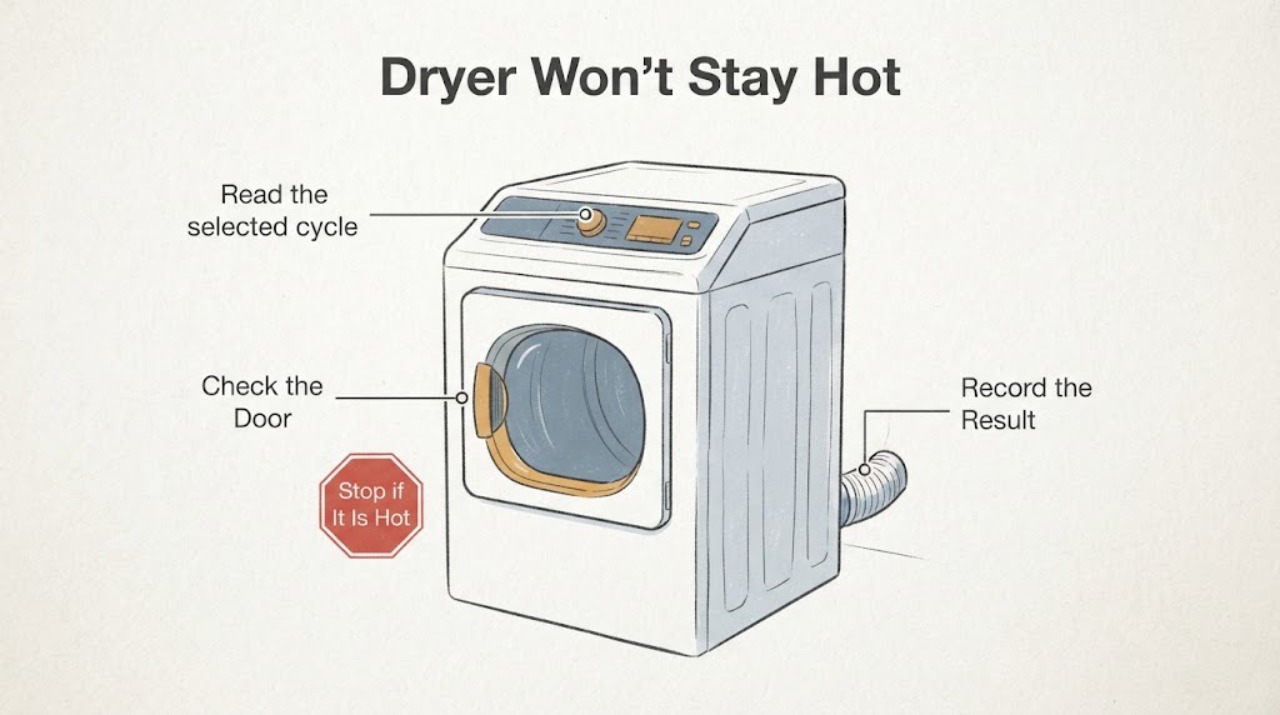
Work through in order
Diagnostic checks
Use only checks that match the exact appliance or system and its official guide.
-
Check 1
Read the selected cycle and temperature option. Choose a heated timed or normal cycle for the test, and make sure Air Only, Air Fluff, no-heat, low-heat or an energy-saving option is not the reason the load feels cool.
Expected result: Air Only or another no-heat setting is selected, or a heated cycle is selected but the dryer still produces no warmth.
Next step: Select a heated cycle supported by the exact manual and continue with the short heat test. Do not change wiring or controls to force heat.
Why this matters
Why: Maytag and Whirlpool state that Air Only/Air Fluff does not add heat at any time. A no-heat setting is a normal explanation for cool air, while a correct heated cycle leaves a supply or service question open.
-
Check 2
With the dryer empty, select a heated timed cycle and run it for about five minutes, then stop or pause it and open the door carefully. Judge whether the drum air is warm; do not touch a heater, drum surface or internal wiring.
Expected result: The inside is warm, or there is no warmth at all after the correct heated test.
Next step: If warm, continue with the lint, vent and load checks. If cold, identify whether the dryer is electric or gas and check only the external supply condition allowed by its manual; arrange service if the supply is normal.
Why this matters
Why: Maytag's user test uses a heated timed cycle and a five-minute empty-drum observation. Warm air means the dryer is producing heat and the remaining issue is performance, cycling or airflow; no heat means an external supply or service check is needed.
-
Check 3
If the dryer warms and then seems to lose heat, watch one normal or timed cycle without repeatedly opening the door. Note whether heat returns, whether the load continues drying and whether the drum or cabinet becomes abnormally hot.
Expected result: Heat returns during the cycle and clothes dry, or heat stays absent and the load remains wet; the cabinet is normal or unusually hot.
Next step: For normal cycling, use the correct cycle and load. For persistent cold air, poor drying, abnormal heat or any odor, stop further testing and arrange service rather than naming the thermostat, heater or control board.
Why this matters
Why: GE explains that temperature, load moisture and airflow affect the internal temperature, and a safety thermostat can cycle the heat source off until excess heat subsides. A returning heat source with normal drying is consistent with regulation; persistent cold air or excessive heat is not cleared by normal cycling.
-
Check 4
Clean the lint screen and inspect the vent hose, wall connection and outside hood with the dryer off and unplugged before reaching behind it. Look for a kink, crushed section, lint, debris or a hood flap that does not open during a supervised operation. Do not disconnect a gas-dryer vent to run a test.
Expected result: Airflow outside is weak or absent, the hose is kinked or obstructed, lint is accumulating, or the vent path is clear and airflow is strong.
Next step: Correct only an obvious external lint or routing issue and reconnect all ducting before use. If airflow remains weak, have the vent professionally cleaned or inspected. For a gas dryer, never operate without the vent because combustion fumes can enter the room.
Why this matters
Why: CPSC says lint or an obstructed exhaust duct can restrict airflow, build excessive heat and create a fire risk. GE and Whirlpool identify weak outside airflow, crushed ducting and lint as common contributors to long or poor drying; a clear external path does not prove an internal part is good.
-
Check 5
Use a moderate, similar-fabric load and verify that the door closes, the lint filter is seated and the dryer has its correct external supply. For an electric dryer, check for a tripped paired supply breaker without opening the terminal block; for a gas dryer, check only that the appliance gas shutoff is open and stop for any gas odor.
Expected result: The load is packed or mixed, a breaker is tripped, the gas valve is closed, or the load and external supply are normal while heat still fails.
Next step: Correct only the load or documented external supply condition, then perform one controlled test. If the supply is normal and the dryer remains cold, leave internal diagnosis to qualified service.
Why this matters
Why: Whirlpool and Maytag identify load size, cycle selection, electric supply and gas-supply status as external causes of no heat or long drying. These observations narrow the next step but do not identify a failed heater, igniter, fuse, thermostat or control.
Use your observations
Decision map
Find the observation that best matches what you see, then follow the next safe action.
-
PATH 01Next step
What you see
A correct heated test produces warmth, heat returns during the cycle, and the load dries without excessive heat or odor.
Do this next
Use the correct cycle and load, keep the lint screen clean and monitor the outside exhaust. Do not replace an internal part from the impression that the dryer was briefly cool.
Why this path and its safety boundary
Why it matters: The heat source is cycling in response to temperature or moisture; the observation does not support a failed heater or thermostat by itself.
-
PATH 02Next step
What you see
The dryer warms but clothes remain damp, the cycle takes much longer, the laundry area becomes humid or outside airflow is weak.
Do this next
Stop and clean or professionally inspect the lint screen, hose, wall connection and outside duct path. Reconnect the full vent before using the dryer, and use the exact manual's vent limits.
Why this path and its safety boundary
Why it matters: The pattern is consistent with restricted exhaust airflow or load-related drying performance; it is also a fire-safety concern if lint is accumulating.
-
PATH 03Next step
What you see
A heated timed test stays cold, and the documented electric or gas supply checks are normal.
Do this next
Keep the dryer off and arrange qualified service with the model number, cycle selected, heat-test result and supply type. Do not open the cabinet, bypass a safety device or make live measurements.
Why this path and its safety boundary
Why it matters: The symptom needs model-specific service; the public checks cannot distinguish the heater, ignition system, thermal protection, wiring or controls.
-
PATH 04Next step
What you see
There is smoke, a burning or electrical odor, a gas odor, visible scorching, a damaged cord, excessive cabinet heat or no exhaust airflow.
Do this next
Turn the dryer off, disconnect power only if the connection is safe to reach, leave a gas appliance off, and contact qualified service. Leave the area and use local emergency procedures for active fire or a strong gas release.
Why this path and its safety boundary
Why it matters: These are fire, gas or electrical safety signs and should not be investigated by repeated cycles.
Helpful context
Understand the symptom
“Won't stay hot” can describe three different results: the heat is cycling as designed, the dryer is heating but airflow is poor, or the dryer never produces heat on a heated cycle. The same low-temperature impression can occur when the load is damp, the room is cold or the vent is restricted, so use the cycle and airflow observations before naming an internal component.
Because the brand and model are not supplied, use the exact Owner's Manual for cycle names, gas or electric configuration and installation limits. The manufacturer pages below support external checks only; they do not authorize a cross-model part diagnosis.
When checks do not resolve it
Need a professional?
Give the technician the complete model and serial numbers, dryer type, cycle and temperature setting, whether the five-minute heated test produced warmth, the vent-run observations and any odor, noise or error code.
Common questions
FAQ
Is it normal for a dryer to stop heating for part of a cycle?
It can be. GE explains that the heat source can cycle off when temperature rises, and automatic systems respond to load moisture and temperature. Heat should return and the load should dry without excessive heat, odor or weak airflow.
Why does the dryer feel warm but clothes stay wet?
Restricted airflow, a kinked or crushed vent, a blocked outside hood, a dirty lint screen or an overloaded load can leave clothes warm but damp. Check the external exhaust path and load before assuming an internal heating failure.
Can I run a gas dryer with the vent disconnected to see whether it heats?
No. GE warns that operating a gas dryer without its vent can allow carbon monoxide fumes into the room. Keep the vent connected and arrange service if the airflow or heat problem persists.
Read the exact guide
Official sources
- Dryer - Explanation of Dryer TemperaturesGE Appliances · Opened official GE dryer guidance. It explains why airflow, load and room conditions affect temperature and why a safety thermostat can cycle heat off; it is not a model-specific temperature specification here.
- Dryer is not Drying or Experiencing Long Dry TimesWhirlpool Product Help · Opened official Whirlpool guidance. It is used for general external checks and service boundaries, not for a particular unprovided dryer model.
- Dryer is Not HeatingMaytag Product Help · Opened official Maytag dryer guidance and used it for general user-level distinctions, while leaving exact cycle names and model-specific procedures to the reader's manual.
- Dryer - Heat Management SystemsGE Appliances · Opened official GE support guidance and used only to explain that some dryer heat systems cycle during a normal cycle; exact implementation varies by model.
- Dryer - Things To Check For A Venting IssueGE Appliances · Opened official GE guidance for external airflow checks, duct material and the gas-dryer warning; exact vent limits remain model-specific.
- Overheated Clothes Dryers Can Cause FiresU.S. Consumer Product Safety Commission · Opened CPSC safety alert. It supports lint and exhaust safety checks and stop-use boundaries, not diagnosis of a particular dryer component.
Community feedback
Share a repair observation
Share a plain-text repair observation. Accepted observations are published automatically; this page may take a moment to update.