
On this page
Start here
Quick answer
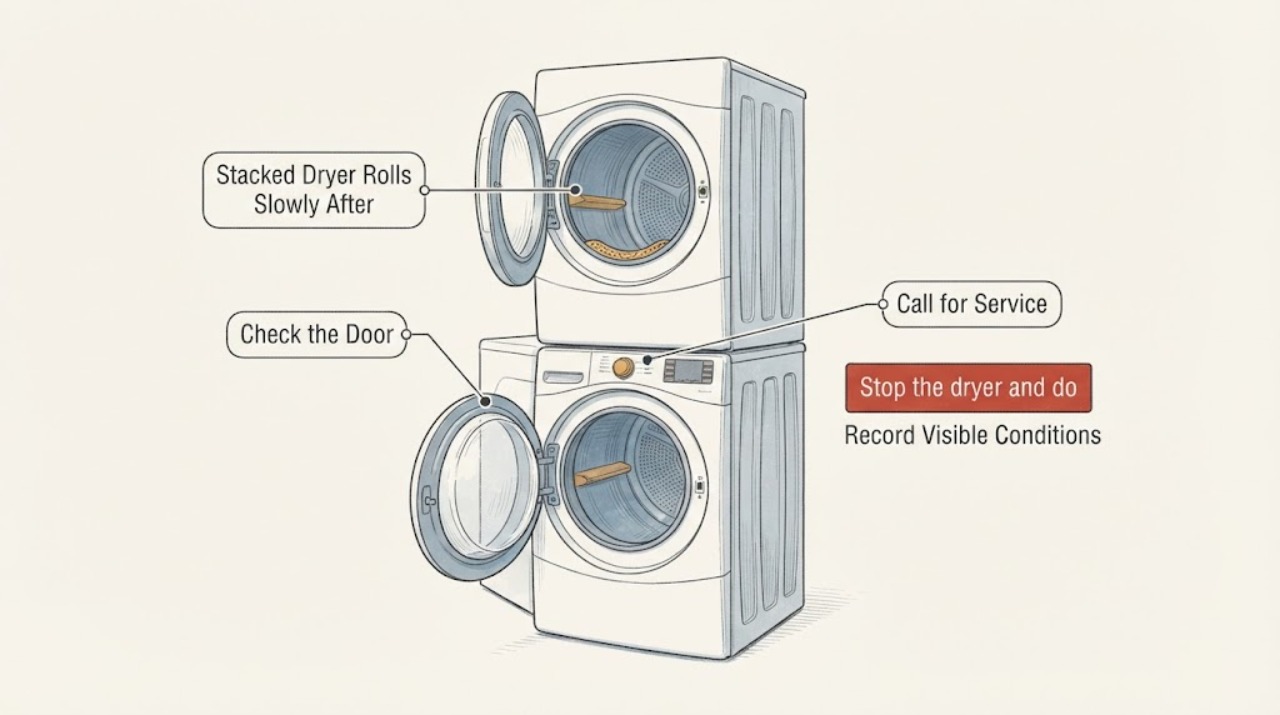
If a stacked dryer rolled normally before a repair but now rolls slowly, stops, scrapes, or moves differently after being taken apart and reassembled, stop using it and have the same repairer return to inspect the work. Do not unstack the unit, reopen the cabinet, hand-force the drum, order a motor or roller, or run repeated test loads. Whirlpool's dryer safety guidance says to disconnect electrical power and gas before service, never operate with missing panels or guards, and remove a dryer from use when it has unsafe or abnormal operation. From a safe position, record the exact before-and-after change, any scraping, thumping, burning odor, gas odor, movement, or displaced visible panel/stack hardware, then give the model and repair details to the original repairer or a qualified stacked-laundry technician.
Work through in order
Diagnostic checks
Use only checks that match the exact appliance or system and its official guide.
-
Check 1
Stop the dryer and do not start another cycle. If an electrical disconnect is safely accessible, isolate electrical power; if the appliance is gas-fired, leave gas work to a qualified person and do not disturb gas connections. Do not unstack the unit or remove a panel.
Expected result: There is a burning smell, smoke, gas odor, repeated breaker trip, sparking, a hot or damaged cord, or a visible missing/broken panel; or none of those warning signs are present.
Next step: For smoke, sparking, or a gas odor, leave the area as appropriate and contact the relevant emergency, gas, or qualified service support. Otherwise keep the dryer off and contact the original repairer for a return inspection.
Stop if: Stop immediately for smoke, gas odor, exposed wiring, sparking, a hot cord, a missing guard/panel, or a unit that moves or leans.
Why this matters
Why: Any warning sign raises fire, shock, or gas risk and makes further testing unsafe. The absence of a warning sign does not make a dryer that changed after repair safe to operate.
-
Check 2
Without reaching into the dryer or forcing the drum, write down exactly what changed after the repair: slow rolling, stopping, scraping, thumping, rubbing, an uneven gap, or a new vibration. If a video is needed, record only from a safe distance while the appliance remains off; do not create a new test cycle.
Expected result: The post-repair symptom is repeatable from prior observation, or the symptom description is uncertain because the dryer has not been safely observed since the repair.
Next step: Send the timeline, safe video if already available, model/data-plate information, repair date, work performed, and any promised part to the original repairer. Ask for inspection of the reassembly before authorizing another part.
Why this matters
Why: A before-and-after timeline is useful evidence for a service callback, but it does not identify a motor, belt, roller, bearing, or control fault.
-
Check 3
From outside the assembled stack, look without touching or adjusting for a unit that is visibly leaning, shifted, vibrating against surrounding surfaces, has a displaced visible stack kit/fastener, a door or panel that no longer sits correctly, or a crushed or kinked exhaust duct.
Expected result: The stack, visible panel, door, or exhaust path appears displaced or damaged; or nothing external looks displaced.
Next step: Do not level, prop, unstack, tighten hidden fasteners, or rearrange the duct yourself. Photograph the observation and have the original repairer or a qualified stacked-laundry technician correct and verify the installation.
Why this matters
Why: Whirlpool identifies leveling, stack stability, and exhaust airflow as relevant to stacked-dryer operation, but an external appearance check cannot confirm the internal reassembly or a component fault.
-
Check 4
Read the dryer model and serial/data-plate information from a stable position without moving the stack. Note whether the dryer is gas or electric, whether it is a stacked laundry center or a separate stacked pair, what the technician said was needed, and which panels or parts were handled.
Expected result: The full model and configuration are available, or the label cannot be read safely and the stack identity remains uncertain.
Next step: Give the complete model/configuration and the repair timeline to the original repairer. If the identity cannot be confirmed, arrange an on-site assessment rather than ordering a part or opening the stack.
Why this matters
Why: Whirlpool's support path uses the model number to select the correct manual and service information. Similar stacked dryers can have different service procedures and parts, so a generic motor or roller recommendation is not proof of fit.
-
Check 5
If the repairer asks whether the dryer can be tested, explain that the abnormal rolling began after reassembly and ask for an inspection before another cycle. Do not test with a light load, defeat or alter a door or safety interlock, or reach toward a moving drum.
Expected result: The repairer can return and inspect the work, or the original repairer is unavailable or declines to recheck it.
Next step: Use the original repairer first; if unavailable, use a qualified appliance technician experienced with stacked dryers and provide the complete service history. Keep the dryer out of use until the inspection is complete.
Why this matters
Why: A post-repair change is a service handoff issue, not a reason for the user to reproduce a potentially unsafe movement. Whirlpool's manual says not to operate with missing/broken parts or bypassed safety devices.
Use your observations
Decision map
Find the observation that best matches what you see, then follow the next safe action.
-
PATH 01Next step
What you see
The dryer worked normally before the repair and began rolling slowly or abnormally only after the technician reassembled it, with no smoke or gas odor.
Do this next
Keep the dryer off and ask the original repairer to inspect the reassembly, stack stability, visible panels, and the work already performed before approving a new motor or other part.
Why this path and its safety boundary
Why it matters: The timing supports a post-service reinspection request, but it does not prove which internal part or adjustment is involved.
-
PATH 02Next step
What you see
There is smoke, a burning or gas odor, sparking, a repeated breaker trip, exposed wiring, a hot cord, a missing panel, or visible stack movement.
Do this next
Stop using the dryer, leave the area if a gas or fire hazard is present, and contact appropriate emergency/gas support or qualified appliance service. Do not re-energize it for comparison.
Why this path and its safety boundary
Why it matters: The symptom has a fire, shock, gas, or mechanical handling risk that should not be investigated with another user test.
-
PATH 03Next step
What you see
The outside of the stack appears level and intact, but the drum still rolls improperly after the repair.
Do this next
Keep the cabinet closed and arrange an inspection by the original repairer or a qualified stacked-laundry technician using the exact model and service history.
Why this path and its safety boundary
Why it matters: A clean exterior does not clear the internal reassembly or establish a motor, belt, roller, or bearing diagnosis.
-
PATH 04Next step
What you see
The slow or abnormal rolling was already present before the repair, or the user cannot establish that it began after the service.
Do this next
Keep the dryer off if operation is abnormal and provide the full symptom history and model information to qualified service; do not transfer a generic parts diagnosis from another dryer.
Why this path and its safety boundary
Why it matters: The after-repair workmanship link is uncertain, so the technician must diagnose the original symptom under the exact model rather than accept a guessed replacement motor.
Helpful context
Understand the symptom
The change after service is the key decision signal
A dryer that was working before a technician disassembled and reassembled it, then began rolling slowly or abnormally, should be treated as a post-service safety and workmanship issue. That timing does not prove that the motor, belt, rollers, or another part is defective. It does support stopping use and asking the same repairer to inspect the reassembly, stack alignment, visible panels, and any work performed before a new part is approved.
Keep a stacked unit closed and stable
Stacked laundry equipment adds handling and alignment risk. Whirlpool's safety guidance requires power and gas isolation before service and says not to operate with missing panels or guards. Keep the dryer assembled and out of service while you document what changed; external observations can help the repairer, but they cannot safely replace an inspection inside the stack or cabinet.
When checks do not resolve it
Need a professional?
Provide the model and serial/data-plate information, gas/electric configuration, stacked-laundry arrangement, repair date, the work and part discussed, what was normal before service, and the exact post-repair rolling symptom. Include a safe-distance video only if it already exists and does not require another test.
Common questions
FAQ
Does slow rolling after the repair prove that the motor is bad?
No. The timing makes the reassembly and the work already performed important to inspect, but it does not prove a motor, belt, roller, bearing, or control fault. Keep the dryer off and have the original repairer or qualified stacked-dryer service identify the cause.
Should I take apart the stacked dryer to see whether the belt or rollers are aligned?
No. Do not unstack the unit or open the cabinet after a post-repair change. Whirlpool requires power and gas isolation before service and warns against operation with missing or broken panels; arrange a qualified inspection instead.
Can I run one small load to see whether it still rolls slowly?
No. A dryer that changed to abnormal rolling after service should not be used as a test instrument. Document the symptom from a safe position if it has already been observed and ask the repairer to inspect it before another cycle.
What information should I give the repairer?
Give the full model and serial information, gas or electric configuration, whether it is a laundry center or stacked pair, the repair date and work described, what was normal before service, the exact new rolling symptom, and any odor, smoke, breaker, movement, panel, door, or exhaust changes.
Read the exact guide
Official sources
- Leveling a Stacked Laundry CenterWhirlpool · Opened Whirlpool Product Help page used only to support the high-level meaning that an unlevel stacked unit can create vibration, wear, and operating issues. The article does not reproduce its handling/propping procedure.
- Use and Care Guide: Electric or Gas DryerWhirlpool · Opened official Whirlpool dryer manual used for general dryer safety and service boundaries. It does not identify the assigned unknown dryer model or prove a motor, belt, roller, or other component diagnosis.
- Not Drying - Stacked Laundry Center / Laundry Tower DryerWhirlpool · Opened Whirlpool Product Help page for stacked dryer/laundry tower context. Used only for external airflow/leveling and model-number service boundaries, not for an unknown-model internal fault diagnosis.
Community feedback
Share a repair observation
Share a plain-text repair observation. Accepted observations are published automatically; this page may take a moment to update.