
On this page
Start here
Quick answer
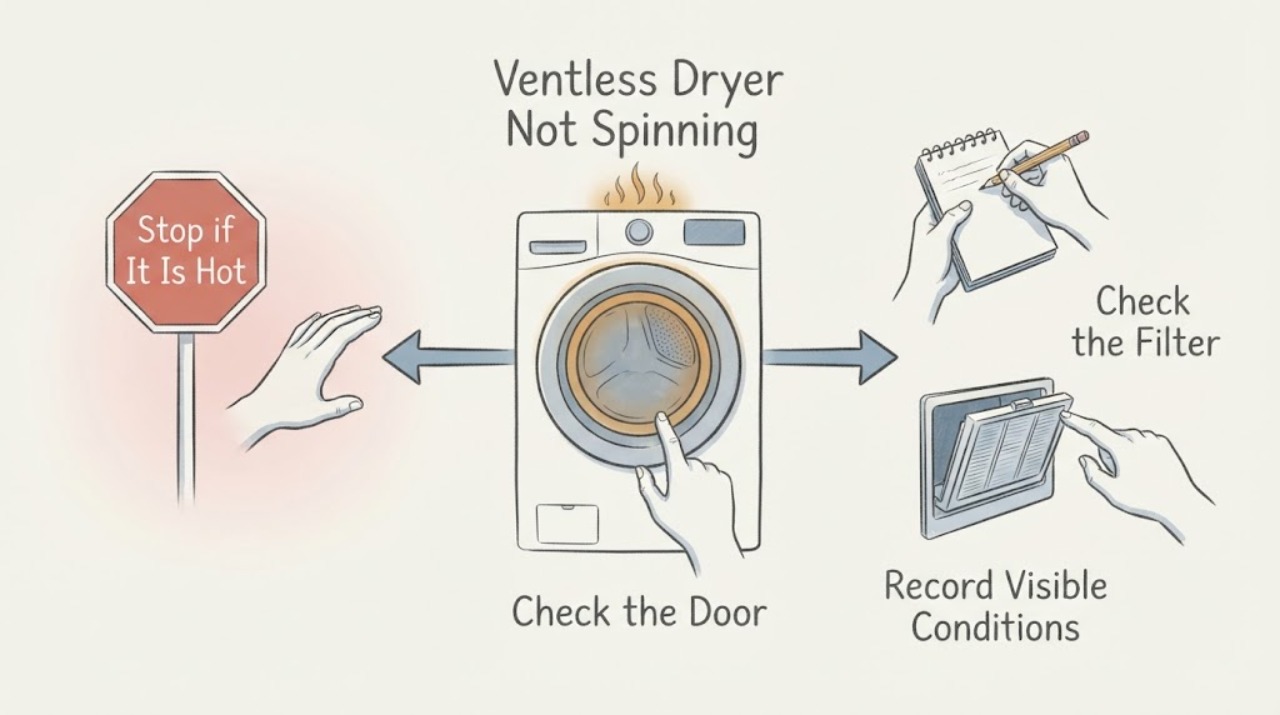
If a ventless dryer is not spinning and is unusually hot, smells burnt, smokes, scorches clothing, or seems close to a fire, stop the cycle immediately and keep the dryer out of service. Do not restart it to see whether the drum moves, do not bypass a safety device, and do not guess that a thermal fuse, belt, motor, or heater is the cause. ENERGY STAR explains that ventless heat-pump dryers use a closed air loop and manage moisture through a tank or drain, so their filter, condensate, and airflow arrangement is model-specific. After the machine is fully cool and safely de-energized, only inspect accessible lint or filter areas allowed by the exact manual; arrange qualified dryer service for any overheating, non-spinning, smoke, burning odor, or visible damage.
Work through in order
Diagnostic checks
Use only checks that match the exact appliance or system and its official guide.
-
Check 1
Press stop or cancel and leave the dryer off. If there is smoke, flame, a strong burning smell, glowing material, or an immediate electrical hazard, move away and use local fire/emergency procedures; do not open the door to investigate a fire or reach into a hot drum.
Expected result: The machine is merely warm with no odor or visible damage, or there is smoke, flame, scorching, burning odor, melted material, or a hot/damaged cord or outlet.
Next step: For any smoke, flame, scorch, burning odor, or electrical hazard, keep the dryer out of service and obtain emergency or qualified electrical/appliance help. Do not re-energize it to confirm the symptom.
Why this matters
Why: A near-fire symptom is outside normal drying behavior. CPSC and USFA identify excessive heat and lint/airflow problems as fire risks, while a visible fire or electrical hazard requires emergency handling rather than troubleshooting.
-
Check 2
Once the dryer is fully cool and power is safely isolated, record whether the drum was stationary, whether the load or cabinet was unusually hot, and whether the symptom occurred at startup, during a cycle, or after the dryer stopped. Do not restart the cycle and do not turn the drum by force.
Expected result: The drum never moved, stopped while heat remained, or only failed with a particular load; the cabinet or clothes show heat or scorch evidence.
Next step: Keep the dryer off, photograph the display and visible damage, and provide the timing and load details to qualified service. Do not perform a second heated cycle.
Why this matters
Why: These observations help a technician distinguish the reported event without claiming a failed belt, motor, heater, bearing, or thermal fuse. A non-spinning drum with heat present is not a safe user test condition.
-
Check 3
After cooling, inspect only the user-accessible lint filter, lint screen, condensate container, and visible air inlets that the exact manual identifies; remove loose lint or empty the tank only as the manual permits. Do not remove panels, heat exchangers, blower covers, belts, heaters, or thermal devices.
Expected result: An accessible filter or tank is visibly full or blocked, or accessible areas look clear while overheating/non-spinning remains unexplained.
Next step: If the manual-approved accessible maintenance reveals heavy lint or a full tank, leave the dryer off and arrange service before operation when the incident included overheating or non-spinning. If accessible areas are clear, do not escalate into cabinet disassembly; request qualified inspection.
Why this matters
Why: CPSC and ENERGY STAR support regular filter maintenance, but a ventless dryer's internal closed-loop airflow and moisture path are model-specific. A clean accessible filter does not clear an internal obstruction or drive/heat fault.
-
Check 4
Check the installation and identity from outside: read the model label, confirm the dryer is plugged directly into the wall as required for a major appliance, keep clothing and combustibles away, and do not assume a conventional exterior vent exists on a ventless model.
Expected result: The model is identifiable and the area/cord are intact, or the cord/outlet is damaged, an extension cord is used, clutter/lint is present, or the model and ventless configuration are uncertain.
Next step: For a damaged cord/outlet, extension-cord use, heavy surrounding lint, or uncertain model, leave the dryer unused and arrange qualified electrical/appliance service. Give the exact model to the technician so the correct ventless maintenance path can be used.
Why this matters
Why: USFA advises direct wall connection and keeping the appliance area clear; ENERGY STAR describes ventless systems as not using an exterior exhaust vent. Installation observations do not diagnose why the drum stopped or why heat rose.
Use your observations
Decision map
Find the observation that best matches what you see, then follow the next safe action.
-
PATH 01Next step
What you see
The dryer became unusually hot or smelled burnt while the drum was not spinning, even if there is no visible flame.
Do this next
Keep the dryer off after cooling and arrange qualified dryer service. Do not run an empty test cycle or replace a guessed part.
Why this path and its safety boundary
Why it matters: The combination is a stop-use safety event; it does not identify a belt, motor, heater, thermal fuse, or control failure.
-
PATH 02Next step
What you see
Smoke, flame, glowing lint or fabric, severe burning odor, or electrical damage is present.
Do this next
Leave the area and follow local fire/emergency procedures. Do not open the dryer, move it, or restore power to inspect it.
Why this path and its safety boundary
Why it matters: This exceeds routine maintenance and may be an active fire or electrical hazard.
-
PATH 03Next step
What you see
The dryer is fully cool and only an accessible lint screen or condensate container is visibly full, with no smoke, odor, scorching, or damage.
Do this next
Clean or empty only as the exact manual allows, keep the dryer out of service, and obtain qualified inspection before another heated cycle because overheating was reported.
Why this path and its safety boundary
Why it matters: The accessible maintenance condition may contribute to poor drying or airflow, but it does not explain or clear a prior non-spinning/overheating event by itself.
-
PATH 04Next step
What you see
The accessible filters and surrounding area are clear, but the drum still does not spin or the dryer previously overheated.
Do this next
Keep the dryer off and request qualified service with the model, display code, event timing, load, heat/odor details, and photos. Do not open the chassis or test a thermal fuse.
Why this path and its safety boundary
Why it matters: The remaining fault is outside the supported user-accessible checks; the public sources do not establish a component diagnosis.
Helpful context
Understand the symptom
Not spinning plus overheating is an immediate stop-use symptom
A dryer that is not tumbling while becoming unusually hot has lost a basic motion or heat-safety boundary. The supplied topic has no brand or model and the Reddit lead could not be opened, so it does not establish whether the event involved smoke, scorch marks, a burning odor, or a specific component. Treat the reported near-fire concern conservatively: stop the cycle, keep the dryer off, and arrange inspection rather than repeating a heat test.
Ventless does not mean the airflow and moisture path are universal
ENERGY STAR explains that heat-pump ventless dryers recirculate air in a closed loop and remove moisture through a condenser, tank, or drain. A ventless label therefore does not tell you where this machine's filters, heat exchangers, condensate path, or drum-drive parts are located. Use only the exact model manual for accessible filter or tank care; do not open the cabinet to search for a blockage or thermal device.
When checks do not resolve it
Need a professional?
Stop using the dryer and arrange qualified appliance service for any not-spinning plus overheating event, burning odor, smoke, scorch marks, abnormal cabinet heat, repeated stopping, damaged cord/outlet, or recurrence after accessible manual-approved maintenance. Use emergency fire procedures for active smoke or flame. Do not restart to test, bypass a safety device, open the cabinet, or guess a belt, motor, heater, or thermal-fuse replacement.
Common questions
FAQ
Can I restart a ventless dryer that stopped spinning and felt too hot?
No. Stop using it and let it cool; do not run an empty test cycle or repeat a heated load. Non-spinning combined with overheating is not safe to diagnose by trial operation.
Does a clean lint filter rule out a dryer fire risk?
No. CPSC identifies lint and airflow restrictions as fire contributors and says the dryer interior may need qualified cleaning. On a ventless model, the closed-loop filter, condenser, blower, and condensate arrangement is model-specific.
Should I replace the thermal fuse or belt?
Not from this symptom alone. The assigned topic has no model or inspection evidence, and the public safety guidance supports stopping use and service rather than guessing a component or opening the chassis.
Does ventless mean the dryer cannot overheat because it has no exhaust vent?
No. ENERGY STAR describes ventless heat-pump dryers as closed-loop systems without an exterior vent, but they still have model-specific filters, condensate handling, airflow, and heat-transfer components. An overheating or non-spinning event still requires service.
Read the exact guide
Official sources
- Appliance and Electrical Fire SafetyU.S. Fire Administration · Supports direct wall connection for major appliances, avoiding extension cords, and replacing damaged cords/outlets. It does not diagnose the dryer or authorize internal repair.
- Heat Pump DryerENERGY STAR · Supports the statement that heat-pump ventless dryers use a closed loop, do not require an exterior vent, manage condensate through a tank or drain, and benefit from filter maintenance. It is not a substitute for the assigned model's manual or a diagnosis of the stopped drum.
- CPSC Publication 5022 - Overheated Clothes Dryers Safety AlertU.S. Consumer Product Safety Commission · Supports treating excessive heat as a fire concern, accessible lint/filter care, qualified service for chassis cleaning, and keeping combustible clutter clear. It is general dryer guidance and does not diagnose this unbranded ventless dryer's stopped drum.
- Clothes Dryer Fire SafetyU.S. Fire Administration · Supports professional installation/service, lint-filter care, and keeping dryer airflow and area clear. The flyer is general clothes-dryer safety and does not identify a particular internal failure.
Community feedback
Share a repair observation
Share a plain-text repair observation. Accepted observations are published automatically; this page may take a moment to update.