
On this page
Start here
Quick answer
A dryer that will not start and has a burning or plastic smell should be left off and disconnected from power; do not keep pressing Start to see whether it catches. Maytag's official guidance supports checking the start control, door latch, cycle, controls lock and household supply for a no-start, but those checks do not make it safe to re-energize a dryer that smells burnt. With power isolated, inspect only accessible areas for a scorched plug, outlet, cord or visible lint/exhaust problem, and arrange qualified appliance or electrical service for any smell, heat mark, smoke, damaged wiring or persistent no-start. Do not open the cabinet, bypass a thermal or door safety, or guess a motor, belt, heater or control failure.
Before you begin
Safety first
- Do not restore power to test a burning smell, run an air-only or heated cycle, open the cabinet or terminal area, perform live electrical tests, bypass a thermal fuse/thermostat/door switch, or order a motor, belt, heater or control part from the symptom alone.
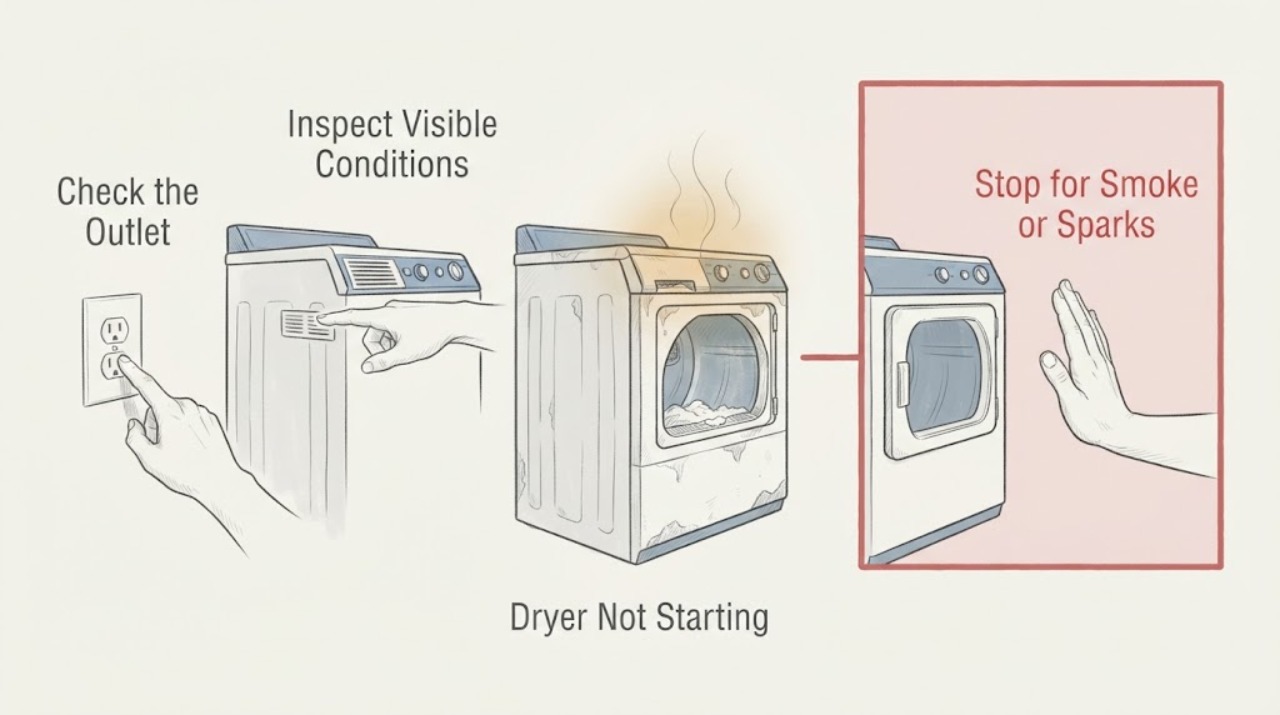
Work through in order
Diagnostic checks
Use only checks that match the exact appliance or system and its official guide.
-
Check 1
Stop pressing Start, remove the load only if it can be done without touching hot or damaged parts, and disconnect the dryer from power or switch off its accessible breaker. Keep the dryer off after a burning or plastic smell.
Expected result: There is smoke, flame, abnormal heat, a strong electrical/plastic odor or no visible hazard but the no-start remains.
Next step: For smoke or flame, leave the area and use emergency/fire procedures. Otherwise keep power isolated and continue only with external observations and service routing.
Why this matters
Why: The odor changes this from a routine no-start check to a possible fire or electrical hazard; absence of smoke does not identify a safe cause.
-
Check 2
With power isolated, inspect only the accessible plug, outlet face, cord and nearby wall area for blackening, melting, loose fit or heat damage. Do not remove the outlet cover or dryer terminal cover.
Expected result: The supply area is marked/damaged, or it appears normal while the smell came from the dryer.
Next step: Leave the appliance disconnected. Use a licensed electrician for a damaged outlet/branch supply and qualified appliance service for an appliance-side odor.
Why this matters
Why: A damaged supply connection needs electrical assessment; a normal-looking outlet does not clear the dryer or its internal wiring.
-
Check 3
With power off, inspect and clean only the removable lint screen and look at the visible rear exhaust connection for crushing, separation or heavy lint. Do not open the dryer or reach into the heater/motor compartment.
Expected result: The lint screen or visible exhaust is heavily restricted/damaged, or the accessible path appears clear.
Next step: Keep the dryer off and arrange a complete vent/appliance inspection when restriction, scorching or odor is present; do not perform a heated test cycle.
Why this matters
Why: Maytag identifies lint and restricted exhaust as fire/airflow concerns, but an external check cannot prove that airflow caused this odor or that the dryer is safe to run.
-
Check 4
Without restoring power, record the last selected cycle, whether the display had power, whether the door was latched, whether a controls-lock indicator was present, and whether the smell came before or after pressing Start.
Expected result: The door/cycle/lock state was visibly wrong, or those conditions were normal before the smell and no-start.
Next step: Give the record and complete model/serial label to service. Do not restore power merely to verify the door or cycle theory.
Why this matters
Why: Maytag lists these as possible no-start conditions, but correcting a setting cannot be treated as a repair for a burning smell.
-
Check 5
Arrange qualified appliance service, and electrical service when the outlet, cord or branch supply is damaged. Provide the smell description, location, timing, visible marks, lint/exhaust observations and whether the dryer had been used heavily.
Expected result: The appliance remains disconnected, or a safety issue is found at the supply, vent or dryer.
Next step: Keep the dryer out of service until assessed. Do not bypass a fuse, thermostat, door switch or other safety control and do not order a part from the symptom alone.
Why this matters
Why: The evidence cannot distinguish a supply fault, wiring damage, motor/drive issue, heater path, thermal protection or control problem without model-specific inspection.
Use your observations
Decision map
Find the observation that best matches what you see, then follow the next safe action.
-
PATH 01Next step
What you see
Smoke, flame, rapidly increasing heat or a strong burning electrical/plastic odor is present.
Do this next
Leave the area and use emergency/fire procedures; disconnect power only if safe and accessible. Do not open the dryer or restart it.
Why this path and its safety boundary
Why it matters: This is an immediate fire/electrical safety event, not a normal dryer no-start.
-
PATH 02Next step
What you see
The accessible plug, outlet or cord shows blackening, melting, looseness or heat damage.
Do this next
Keep the dryer disconnected and have a qualified electrician inspect the supply; do not substitute an outlet or cord without the correct installation information.
Why this path and its safety boundary
Why it matters: The supply connection may be unsafe independently of the dryer and requires electrical assessment.
-
PATH 03Next step
What you see
The removable lint screen or visible exhaust path is heavily restricted, crushed, separated or scorched.
Do this next
Leave the dryer off and arrange complete vent and appliance inspection; do not test by running a heated cycle.
Why this path and its safety boundary
Why it matters: Restricted airflow is a fire and drying-performance concern, but it does not prove that it is the only cause of the burning smell or no-start.
-
PATH 04Next step
What you see
The supply, lint screen and visible exhaust look normal, but the dryer still will not start after the odor event.
Do this next
Keep power isolated and arrange qualified appliance service. Do not open the cabinet, perform live measurements or keep resetting the dryer.
Why this path and its safety boundary
Why it matters: Hidden wiring, drive, heater, safety or control causes remain possible and cannot be identified from the external checks.
Helpful context
Understand the symptom
Stop before troubleshooting the no-start
A burning or plastic smell is not an ordinary confirmation that a heavily used dryer needs a reset. Leave the dryer off, disconnect its plug or accessible circuit power, keep flammable materials away, and do not run an air-only or empty cycle to identify the smell. Maytag's dryer safety material warns about fire and electrical hazards and limits repairs to qualified service; an odor that appeared with a no-start needs the same caution even if no smoke is visible.
Separate the appliance from the household supply
With power off, look only at the accessible plug, outlet face, cord and nearby wall area for scorching, melting, looseness or a burnt electrical smell. Do not pull apart a terminal block or reconnect damaged wiring. GE's no-start guidance calls out burned, broken or loose power connections as a repair condition and says model-specific installation information is needed; an electrician may be appropriate when the outlet or branch supply is marked or damaged.
Use the lint and exhaust path as an inspection clue, not a restart test
After power is isolated, check the lint screen and the visible exhaust connection for heavy lint, crushing or a disconnected section. Maytag's manual links poor airflow and a blocked lint screen or exhaust to dryer results and fire warnings, but it does not authorize opening the cabinet to clean hidden areas when a burning smell is present. Have the full appliance and vent path inspected if lint, scorching or restricted airflow is suspected.
Record the no-start conditions for service
Without restoring power, record whether the display was on, whether the smell came from the plug/outlet or dryer cabinet, whether the door was fully latched, which cycle was selected, and whether a controls-lock indicator was visible. Maytag's no-start article lists these user-facing conditions, but a normal door or cycle setting cannot explain away a burning smell or prove an internal component is safe.
Escalate instead of naming a part
A dryer that remains off after a burning-smell event should stay disconnected until a qualified technician or electrician determines whether the supply, wiring, motor circuit, heater path, airflow or another area is involved. The sources do not support choosing a motor, belt, heater, thermal fuse, thermostat or control board from this symptom combination, and none supports bypassing a safety device.
When checks do not resolve it
Need a professional?
Safety scope: Do not restore power to test a burning smell, run an air-only or heated cycle, open the cabinet or terminal area, perform live electrical tests, bypass a thermal fuse/thermostat/door switch, or order a motor, belt, heater or control part from the symptom alone.
Have this ready
- Provide the complete model and serial label, electric or gas configuration if known, smell type and location, when it appeared, whether smoke/heat/marks were present, supply/cord observations, lint/exhaust observations, selected cycle and door/lock state.
Common questions
FAQ
Can I run the dryer on air-only to see whether the smell goes away?
Do not use a restart test to investigate a burning or plastic smell. Keep the dryer disconnected and have the appliance or supply inspected; a no-heat run would not prove that the dryer is safe for a later heated cycle.
Could a clogged vent cause both the smell and the no-start?
Restricted lint or exhaust is a documented fire and airflow concern, so inspect only the removable screen and visible exhaust with power off. It may not explain every no-start event, and it does not justify opening or restarting the dryer after a burning smell.
Should I replace the motor, belt or heating element?
No. The combination of no-start and odor does not identify one of those parts. Keep the cabinet closed and let qualified service determine whether the supply, wiring, drive, heater, safety circuit or control area is involved.
What external reasons can make a Maytag dryer not start?
Maytag lists the Start control, household supply, firmly latched door, selected cycle and Controls Locked status among model-dependent no-start checks. Perform those only as a record with power isolated when a burning smell is present; they do not override the stop-use decision.
Read the exact guide
Official sources
- Electric Dryer Owner's ManualMaytag · This opened Maytag manual covers several dryer models and is used only for general safety and external maintenance boundaries, not as proof of the assigned dryer's exact internal design or parts.
- How To Fix a Dryer That Won't StartMaytag · Maytag's guide covers Start, power, door, cycle and Controls Locked checks and directs readers to the model owner's manual for features. It does not diagnose an odor or authorize internal repair.
- Dryer - Will Not Run or StartGE Appliances · GE's general dryer guidance identifies plug, door, cycle, Start, breakers and visible burned/loose power connections as no-start or service checks. It is a clearly labeled cross-brand example and does not transfer GE-specific settings or parts to an unidentified dryer.
- Dryer Not Starting or No OperationMaytag Product Help · Maytag lists Start-button operation, electronic controls, household fuses/breakers, door latch and cycle selection as model-dependent no-start checks; it does not make a burning-smell dryer safe to restart.
Community feedback
Share a repair observation
Share a plain-text repair observation. Accepted observations are published automatically; this page may take a moment to update.