
On this page
Start here
Quick answer
First classify the odor: a damp or musty smell usually follows moisture mixed with dust in the cyclone or a filter refitted before it was fully dry, while an electrical or acrid smell is a stop-use symptom. Turn the machine off, disconnect a cordless model from its charger, and keep a corded model unplugged before inspecting it. Empty the bin without overfilling, check the cleaner head, wand, and visible air path for picked-up material or a blockage, and wash only the filter parts that the exact Dyson model says are washable. Dyson says to wash filters with cold water only, use no detergent, and leave them to dry completely for at least 24 hours; a wet filter can damage the motor. Clean a bin only as the model permits and refit every part completely dry. Do not add fragrance to a filter, pick up water or burning objects, or spray/deodorize the machine. For an electrical/acrid or burning smell, smoke, heat, sparking, melting, repeated cut-outs, liquid ingress, or a smell that remains after safe model-directed care, do not plug in or use the vacuum; arrange Dyson support or qualified service.
Before you begin
Safety first
- This article covers odor classification, model identification, emptying and visible picked-up material, model-approved filter care, fully dry reassembly, accessible cleaner-head and airflow inspection, and external charger/battery observations. A qualified technician must handle the motor, battery, charger, control, wiring, seals, non-user-serviceable covers, and any electrical, fire, or liquid-ingress diagnosis.
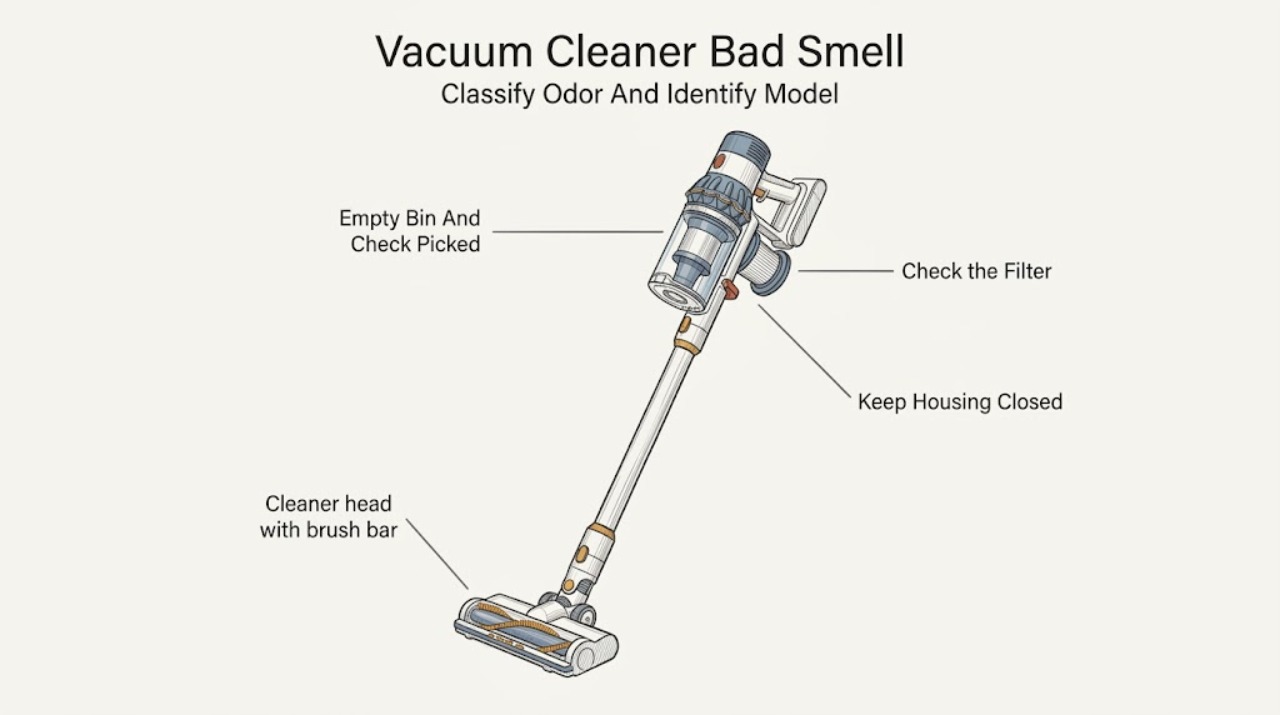
Work through in order
Diagnostic checks
Use only checks that match the exact appliance or system and its official guide.
-
Check 1
Stop the vacuum and record the exact model, whether it is cordless, corded, upright, canister, handheld, robot, or wet/dry, and where the smell is strongest. Distinguish damp/musty, dusty or pet-related odor from electrical/acrid, hot-plastic, smoke, or burning odor. For a cordless model, disconnect it from the charger before handling attachments or filters; for a corded model, unplug it from a dry safe position.
Expected result: The smell is damp/musty and centered at the bin or exhaust, it follows a wet pickup, it is strongest at the cleaner head or duct, or it is acrid/electrical with heat, smoke, sparking, or melting.
Next step: For a damp odor with no hazard, continue with the bin, cyclone, filter, and airflow checks. For any electrical or burning odor or other hazard sign, keep the vacuum disconnected and arrange Dyson or qualified service.
Stop if: Do not run the machine to locate a burning odor, sniff near a hot motor or charger, or assume that a cordless vacuum is safe merely because its trigger is released.
Why this matters
Why: Odor location and character determine the safe branch. Damp odor can come from moisture contacting dust or a wet filter, while acrid or burning odor can indicate an electrical, motor, battery, charger, or friction problem and should not be diagnosed by repeated operation.
-
Check 2
With the machine off and disconnected from charging or mains power, empty the clear bin before debris reaches the model's MAX mark. Inspect only the bin inlet, cyclone opening, wand ends, hose or duct openings, and cleaner-head entry for visible damp debris, pet hair, food, soil, or another odor source. Follow the exact model guide for removing a bin; do not dismantle a cyclone assembly that the guide does not identify as user-removable.
Expected result: The bin is overfilled, contains damp or decomposing material, the smell is strongest at the bin/cyclone, a visible blockage or wet pickup is present, or the visible path is clear and dry.
Next step: Dispose of the picked-up material safely, empty the bin, and clear only an accessible blockage using the exact model procedure. Clean the bin only as permitted by that manual; then continue to filter care before refitting anything.
Stop if: Do not wash a cyclone or motor body unless the exact manual expressly permits it, poke into a blockage with a sharp object, spray deodorizer, or restart with liquid or debris inside.
Why this matters
Why: Dyson's smell guidance says that under normal use an unpleasant odor can be caused by something the machine picked up, and specifically links musty odor to dust contacting water. Overfilling and a blockage can keep odor-producing material in the airflow and can also stress the motor.
-
Check 3
Remove only the filter unit(s) named by the exact Dyson manual. Tap off loose dust, wash with cold water only, and use no detergent. Shake or squeeze only as the model instructions show, then leave the filter in an airy dry place for a minimum of 24 hours, or longer if it is not completely dry. Check it by touch before refitting; do not use the vacuum with a wet, missing, damaged, or incorrectly seated filter.
Expected result: The filter is visibly dirty, smells musty, was previously reinstalled damp, is still wet after drying, is damaged, or is clean, completely dry, and correctly refitted.
Next step: Allow the filter to dry completely and refit it securely before any normal use. If the odor persists, do not compensate with scented products; proceed to the cleaner-head and airflow inspection and then service if needed.
Stop if: Do not use detergent, perfume, essential oil, a dishwasher, washing machine, tumble dryer, oven, microwave, naked flame, or direct high heat to dry a Dyson filter.
Why this matters
Why: Dyson states that a filter can retain dust and contribute to odor, that a wet filter can cause a smell and damage the motor, and that filter washing and frequency are model-dependent. A filter that is clean and fully dry but leaves an odor points to the bin/cyclone, cleaner head, picked-up material, or a component-level issue rather than a reason to add fragrance.
-
Check 4
With power disconnected, remove only user-removable tools, wand, and cleaner-head parts named by the exact model guide. Inspect the brush bar, soleplate or intake, wand, hose, seals, and visible exhaust for hair, damp debris, a melted object, or a blockage. Keep fingers away from a brush bar that can move, and do not remove a cover, motor, guard, or non-washable assembly just to chase an odor.
Expected result: Hair or debris is wrapped around the brush bar, a damp or foul material is trapped in the head or duct, the airflow is restricted, a belt or plastic part appears overheated or damaged, or the visible path is clear.
Next step: Clear only accessible material according to the exact guide and refit every part securely. If the brush bar will not turn normally, the odor returns as soon as the motor runs, or any part is hot, melted, or damaged, stop and arrange service.
Stop if: Do not operate with a jammed brush bar, remove a belt or motor cover, force a tool, use water on a non-washable assembly, or test a suspected friction fault by holding the trigger.
Why this matters
Why: An odor localized to the cleaner head or duct can come from picked-up material, friction, or restricted airflow. A melted component, repeated brush-bar stall, hot smell, or clear airflow path with continuing odor is not a routine cleaning result and may involve the motor, wiring, or control.
-
Check 5
For a cordless Dyson, inspect the charger, dock, battery housing, contacts, and accessible cable for moisture, scorching, swelling, cracks, or unusual heat without opening anything. For any Dyson vacuum, note whether it picked up water, damp soil, a hot or burning item, or a chemical product. Do not reconnect power or charging after liquid exposure or visible damage.
Expected result: The odor is strongest at the charger, dock, battery, plug, or cable; the battery is swollen or hot; a liquid or burning object was picked up; or the charging and power hardware is visibly normal.
Next step: Keep the vacuum and charger disconnected and contact Dyson or qualified service for any electrical, battery, liquid-ingress, or heat symptom. If there is no hazard and the issue is only a dry debris odor, complete the model-directed cleaning and drying branch.
Stop if: Do not open, short, puncture, heat, freeze, wet-clean, or independently replace a battery, charger, cable, motor, or control board; do not charge a swollen, hot, wet, or damaged battery.
Why this matters
Why: A charger, battery, or mains odor is an electrical/fire risk, not a filter-cleaning problem. Dyson safety guidance for its cordless equipment warns against shorting or heating battery contacts and says not to pick up water or burning objects; wet contamination can also make a musty odor.
-
Check 6
After all model-approved washable parts are fully dry and every removable component is correctly seated, record whether the odor disappeared, returned immediately on normal use, or is present even while the vacuum is idle or charging. Record the model, part where the smell is strongest, filter and bin history, picked-up material, cut-outs, heat, noise, and any visible damage for Dyson support or a qualified technician.
Expected result: The odor is gone after dry cleaning, returns only with a particular tool, returns whenever the motor runs, remains while charging or idle, or is accompanied by heat, smoke, sparking, swelling, or repeated automatic cut-out.
Next step: Use the vacuum only if the smell is gone and the model guide permits normal operation. Otherwise keep it disconnected and arrange Dyson support or qualified service with the model and symptom record.
Stop if: Do not keep running the vacuum to prove a smell is harmless, mask it with fragrance, or replace an internal part based only on odor location.
Why this matters
Why: A resolved odor after correct dry cleaning supports picked-up material or filter moisture as the likely source. A localized or immediate returning odor makes a cleaner head, seal, motor, battery, charger, or control issue more likely; an odor while charging or with heat is an electrical escalation.
Use your observations
Decision map
Find the observation that best matches what you see, then follow the next safe action.
-
PATH 01Safety boundary
What you see
The odor is damp or musty, is strongest at the bin/cyclone or exhaust, follows slightly damp pet hair or another wet pickup, or the filter was refitted before it was completely dry.
Do this next
Empty the bin, clear only visible picked-up material, wash only the model-approved filter with cold water and no detergent, and leave it completely dry for at least 24 hours before refitting. Clean the bin only as the exact guide permits.
Why this path and its safety boundary
Why it matters: Dyson's official troubleshooting attributes this pattern to dust in the cyclone contacting water or to a wet filter; it is more consistent with contamination and drying than with an electrical fault.
Safety stop: Do not wash a non-washable assembly, add fragrance, refit a damp filter, or restart while liquid remains in the machine.
-
PATH 02Safety boundary
What you see
The bin and fully dry filter are normal, but the odor is localized to the cleaner head, brush bar, wand, hose, or an attachment, with visible hair, damp debris, blockage, or a melted object.
Do this next
Disconnect power, remove only the parts named by the model guide, clear accessible debris, and refit them securely. Arrange service if the smell returns as soon as the motor runs or any part is hot, melted, or damaged.
Why this path and its safety boundary
Why it matters: Picked-up material, friction, or restricted airflow in that removable path is more likely than a filter-only issue. A hot-plastic or burning smell, repeated brush-bar stall, or damaged part changes this to a service branch.
Safety stop: Do not force the brush bar, remove motor or belt covers, insert tools into ducts, or use water on a non-washable cleaner head.
-
PATH 03Safety boundary
What you see
The smell is acrid, electrical, burning, or hot-plastic, or there is smoke, sparking, scorching, melting, unusual heat, repeated cut-out, or a smell at the motor, cord, charger, dock, or battery.
Do this next
Stop immediately and disconnect from charging or mains power only from a dry safe position. Keep the vacuum and charger away from combustible material and arrange Dyson or qualified service; seek appropriate emergency help for active fire or smoke.
Why this path and its safety boundary
Why it matters: An electrical, motor, battery, charger, control, or friction fault is possible. Dyson's troubleshooting treats an electrical/acrid smell as a reason not to plug in or use the machine until repaired.
Safety stop: Do not restart, repeatedly charge, open the battery or motor housing, short contacts, test live voltage, or attempt to mask the smell with cleaning products.
-
PATH 04Safety boundary
What you see
The vacuum picked up water, damp material, a hot or burning object, or a chemical/strongly scented substance, even if the smell is not yet electrical.
Do this next
Stop using and disconnect the vacuum. Do not charge or run it to dry itself. Follow the exact model's support route for liquid or contamination exposure and arrange service if any liquid reached a non-washable assembly or the odor persists.
Why this path and its safety boundary
Why it matters: Moisture can combine with dust and contaminate a filter or cyclone; hot or burning material can damage the machine and create a fire risk. A cordless model can also be unsafe to charge after liquid exposure.
Safety stop: Do not use a hair dryer or heater, wash the motor/battery body, add fragrance, or continue operation to clear the smell.
-
PATH 05Safety boundary
What you see
The odor was damp or dusty, the bin and accessible airflow path were cleaned as allowed, the filter was washed correctly and fully dried, and no heat, damage, or electrical symptom remains.
Do this next
Use the vacuum only with every component correctly seated and dry. Keep the exact model's filter interval and avoid wet pickup unless that model is explicitly designed for it; stop again if the odor returns.
Why this path and its safety boundary
Why it matters: The change after dry model-directed care supports picked-up material or filter moisture as the source rather than proving that every internal component is healthy.
Safety stop: Do not refit a damp filter, overfill the bin, apply scent to the filter, or treat a returning electrical smell as routine maintenance.
-
PATH 06Safety boundary
What you see
The smell remains after the model-directed bin, filter, and accessible-head care, returns immediately when the motor runs, appears while charging or idle, or cannot be located safely.
Do this next
Keep the vacuum disconnected and arrange Dyson support or qualified service. Provide the model and serial information, odor type/location, care performed, and any heat, cut-out, noise, or charging observations.
Why this path and its safety boundary
Why it matters: A motor, electrical, battery, charger, seal, control, or inaccessible contamination fault is more likely; odor alone cannot identify a replacement part.
Safety stop: Do not keep testing, open the machine, bypass protection, or choose a filter, battery, charger, motor, or cleaner-head replacement without model confirmation and qualified diagnosis.
Helpful context
Understand the symptom
A bad smell has two different safety paths
A musty smell after picking up damp debris is a cleaning and drying investigation; an acrid, electrical, or burning smell is not. Dyson's support material is model-led: its vacuum range includes cordless, upright, canister, handheld, robot, and wet or dry machines, and filter, bin, cleaner-head, battery, and charging procedures differ. Identify the exact machine before copying a removal or wash instruction. A model-specific support flow can also expose replacement-part or service options, but it does not make a different model's part or procedure interchangeable.
Stop immediately for an electrical or burning odor
Do not keep testing a vacuum that smells acrid or electrical, smokes, sparks, becomes unusually hot, melts, trips protection, or has been exposed to liquid. Switch it off and disconnect a cordless vacuum from its charger or unplug a corded vacuum only from a dry, safe position. Never put fragrance or scented product on a filter, pick up water or burning objects unless the exact wet-cleaner manual explicitly allows it, open the motor or battery housing, short contacts, or continue using a damaged charger, cord, battery, seal, or cleaner head. Internal electrical, battery, motor, and charging faults require Dyson or qualified service.
Safety boundary
Stop conditions
- Stop immediately for electrical/acrid or burning odor, smoke, sparks, scorching, melting, unusual heat, repeated cut-outs, liquid near electrical parts, a swollen battery, or a hot/damaged charger, cord, plug, or dock.
- Do not plug in, charge, or use a machine with an electrical odor until Dyson or qualified service has assessed it. Disconnect only from a dry safe position.
- Wash only model-approved filters or other explicitly washable parts with the exact instructed method. Do not use detergent, fragrance, a dishwasher, washing machine, tumble dryer, oven, microwave, naked flame, or high heat; refit parts only when fully dry.
- Do not pick up water or burning objects, open the motor or battery housing, short battery contacts, remove non-user serviceable covers, bypass protection, or mask an odor with scented products.
- A smell that persists or returns after safe model-directed care requires Dyson support or qualified service rather than continued testing or an unverified part replacement.
Only after diagnosis
Potential parts
- vacuum filter
Consider a replacement filter only if the exact model's support guide identifies the filter as replaceable and it remains damaged, deformed, or odor-retaining after correct cold-water washing and complete drying; odor alone does not establish filter failure.
Confirm the exact Dyson model and the manufacturer's fit information before ordering. Filter shape, count, and washability vary across Dyson vacuum families.
When checks do not resolve it
Need a professional?
Safety scope: This article covers odor classification, model identification, emptying and visible picked-up material, model-approved filter care, fully dry reassembly, accessible cleaner-head and airflow inspection, and external charger/battery observations. A qualified technician must handle the motor, battery, charger, control, wiring, seals, non-user-serviceable covers, and any electrical, fire, or liquid-ingress diagnosis.
Common questions
FAQ
Why does my Dyson vacuum smell musty?
Dyson says a damp or musty smell can occur when dust in the cyclone contacts water, including moisture from slightly damp pet hair, or when a filter is put back while wet. Empty the bin, clean only model-approved parts, wash the filter with cold water and no detergent, and leave it completely dry for at least 24 hours before refitting.
Can I put perfume or essential oil on a Dyson filter to remove the smell?
No. Dyson's V10 safety manual specifically warns against applying fragrance or scented products to filters because the chemicals can be flammable. Remove the odor source, wash only the exact model-approved filter with cold water, and dry it completely instead.
How long should a Dyson filter dry before I use the vacuum?
Dyson's general cordless filter-care guidance says at least 24 hours in an area with airflow, and the filter must be completely dry before refitting. If it still feels damp or your exact manual specifies longer, wait longer; do not use heat, a dryer, an oven, a microwave, or a naked flame.
What should I do if my Dyson vacuum smells like burning plastic or electricity?
Stop immediately and do not plug in, charge, or use the vacuum until it has been assessed. Disconnect it only from a dry safe position, and arrange Dyson or qualified service, especially if there is smoke, sparking, heat, melting, a swollen battery, or a damaged charger or cord. Do not open the motor or battery housing.
Why does the smell return after I wash the Dyson filter?
Check that the exact model's filter was fully dry and correctly seated, then inspect the bin, cyclone opening, cleaner head, wand, hose, and visible exhaust for picked-up damp material or a blockage. Dyson says an unpleasant smell can come from something the vacuum picked up. If the odor returns as soon as the motor runs, appears while charging, or persists after dry model-directed care, keep the vacuum disconnected and arrange service.
Read the exact guide
Official sources
- Support | Vacuum cleaners | DysonDyson · Official Dyson vacuum support hub covering multiple machine families; the page itself routes owners to model-specific support and does not make parts or cleaning procedures universal.
- Vacuum filter careDyson · Official Dyson cordless vacuum filter-care page with a model selector. Its instructions are for the listed cordless families; corded, robot, wet/dry, and other machines require their own guide.
- Support | Troubleshooting | DysonDyson · Official Dyson troubleshooting journey for a specific supported vacuum configuration; use it for the documented odor decision and drying principles, not as a universal button sequence or part-fit guide.
- Operating manualDyson · Official Dyson V10 SV12 Animal manual only; it is used here for explicit safety and care examples and must not be generalized to other Dyson models.
Community feedback
Share a repair observation
Share a plain-text repair observation. Accepted observations are published automatically; this page may take a moment to update.