
On this page
Start here
Quick answer
First identify the smell: a musty, pet, or food odour usually points to trapped debris in the bag or bin, filters, hose, or brush, while a hot-rubber or electrical burning smell is a stop-use symptom. Turn the Hoover off, unplug it or remove the battery where the model allows, and do not run it again to ‘test’ a burning smell. For a non-burning smell, empty the dust bag or bin, remove only accessible hair and debris from the hose and nozzle, and inspect the filters using the exact model manual. Clean a filter only if it is marked washable; Hoover says washable filters must air-dry completely before refitting, and some official guidance says this can take up to 24 hours. A blocked airflow path or filter can also make the cleaner overheat or cut out. If the smell persists after the accessible parts are clean and fully dry, suction is poor, the brush stops, smoke or heat appears, the cord is damaged, or the odour is electrical or burning, stop using the vacuum and arrange Hoover or qualified service. Do not use water, solvents, fragrance, carpet powder, or wet debris unless the exact model instructions permit it.
Before you begin
Safety first
- This article covers odour classification, power isolation, bag or bin emptying, visible debris, model-approved filter care, and accessible airflow checks. Belt, motor, bearing, thermal-protection, battery, wiring, control, internal blockage, and live electrical work require qualified service.
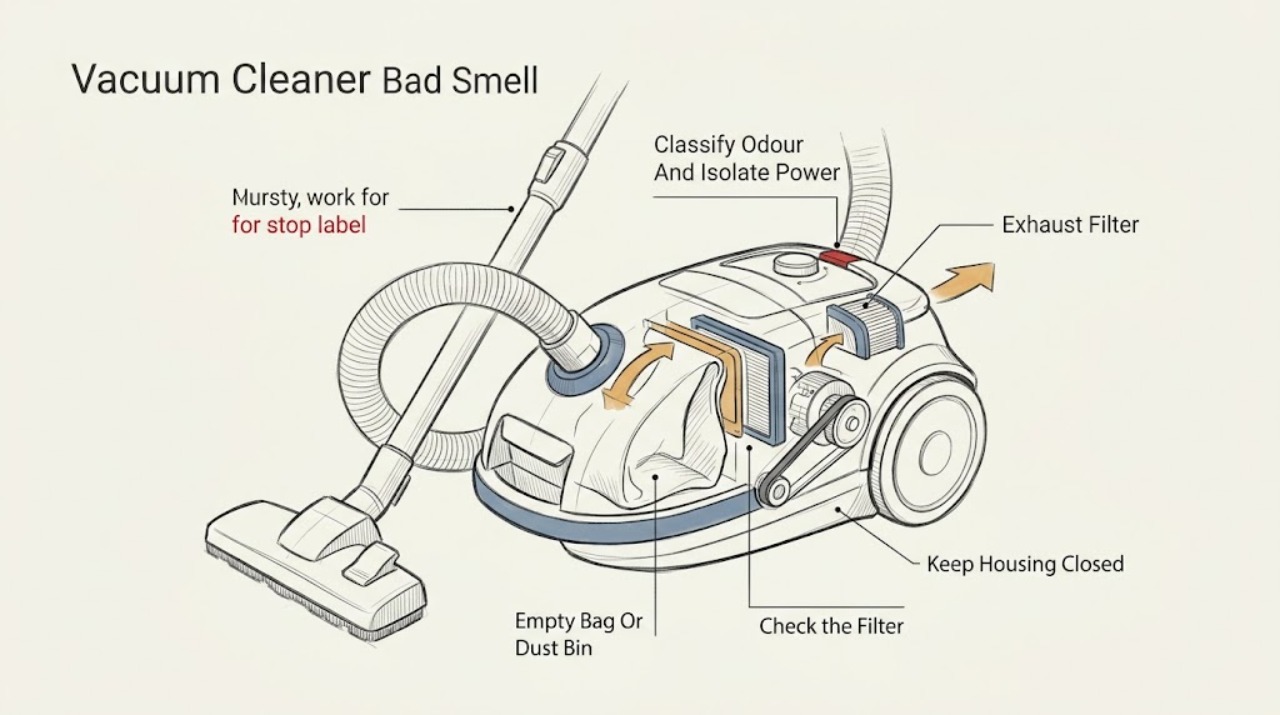
Work through in order
Diagnostic checks
Use only checks that match the exact appliance or system and its official guide.
-
Check 1
Stop the Hoover and identify whether the smell is musty, pet-like, sour or food-like, damp, hot rubber, electrical, or accompanied by smoke. Record whether it comes from the floor nozzle, dust bag or bin, exhaust outlet, cord, or motor housing. Disconnect the mains plug, or remove the battery only according to the model instructions, before examining it.
Expected result: The smell is stale or organic with no heat, the smell is hot rubber or electrical, smoke or visible melting is present, or the machine was exposed to liquid or flammable material.
Next step: For a non-burning smell, continue with the disconnected bag/bin, filter, hose, and brush checks. For heat, smoke, electrical odour, liquid inside, or a damaged cord, leave it unplugged and arrange service.
Stop if: Do not restart a vacuum that smells electrically burnt, smokes, sparks, has a hot or damaged cord, or has taken in flammable liquids, cleaning fluids, aerosols, or their vapours.
Why this matters
Why: Hoover identifies trapped dust, food, pet hair, filters, hoses, and brushes as common sources of ordinary odour, but burning smell, smoke, liquid exposure, or flammable-material exposure creates a fire, shock, or motor-damage risk.
-
Check 2
With the cleaner disconnected, empty the dust bag or bin using the exact model procedure. Wipe accessible dust and residue from the container with a suitable dry or model-approved method, and check for food, damp debris, or pet material that could have remained inside. Refit the bag or bin securely without operating the cleaner open.
Expected result: The bag or bin is full, contains damp or decomposing debris, has a persistent residue or sour smell, is damaged, or is clean and correctly refitted.
Next step: Dispose of the contents safely, clean only the accessible container as the manual permits, and fit the correct model-specific bag or bin. Continue to filter and airflow checks if the smell remains.
Stop if: Do not wash a container or expose electrical parts to water unless the exact manual says it is washable; never run the cleaner without the required bag, bin, or filters fitted.
Why this matters
Why: Hoover's smell guidance links old dirt, food debris, and trapped pet hair with musty or unpleasant odours. A damaged or incorrectly seated bag or bin can also disturb airflow, while a clean container makes the filters or airflow path more likely.
-
Check 3
Locate every user-accessible pre-motor, dust-box, and exhaust filter from the exact Hoover manual. Inspect for caked dust, hair, mould-like residue, dampness, tears, or a filter that is not seated. Brush or wash only if the filter is designated washable; otherwise use the documented cleaning or replacement route.
Expected result: A filter is clogged or damp, the filter is washable, the filter is non-washable or damaged, or the filters are clean, intact, and correctly fitted.
Next step: Disconnect the filter, remove loose debris, and clean it only by the model instructions. Air-dry a washable filter completely—official Hoover guidance says this may take up to 24 hours—then refit it; replace a non-washable or damaged filter through the model support route.
Stop if: Do not use a damp filter, scrub or chemically treat it unless the model manual permits that, operate without a required filter, or probe the motor housing.
Why this matters
Why: Hoover says a clogged filter can trap bacteria and mould and create a musty smell, and official support links blocked filters with reduced airflow and overheating. A damp, damaged, or incorrectly installed filter can make odour and motor stress worse.
-
Check 4
After power is isolated, inspect the accessible hose, wand, nozzle, brush roll, and tool openings for compacted hair, food, mud, or other debris. Remove only visible obstructions using the model's instructions, keeping fingers and tools away from moving brush mechanisms and hidden electrical parts.
Expected result: Hair or debris is packed in the brush or hose, the nozzle airflow is restricted, a damp or perishable material is present, or the accessible path is clear.
Next step: Remove the accessible obstruction, empty the debris, and reassemble the hose and nozzle securely. If a brush is jammed, damaged, or requires cover removal, stop at the model-approved external check and arrange service.
Stop if: Do not reach into a powered brush, use sharp objects that could puncture a hose or cable, pick up hot ash or sharp objects, or wash a non-washable assembly.
Why this matters
Why: Hoover attributes odour to dirt trapped in the hose or brush, especially pet hair and perishable food debris; a restriction can also make the cleaner work harder and overheat. A clear path makes a filter, belt, motor, or internal fault more likely.
-
Check 5
If the cleaner previously cut out or a filter or container was washed, leave the cleaner disconnected and allow the model's required cooling and drying time. Refit only fully dry parts, confirm the bag, bin, filters, hose, and covers are correctly seated, and perform at most a brief supervised check for a non-burning smell.
Expected result: The cleaner had activated thermal protection, a filter or bin is still damp, the smell disappears after dry cleaning and cooling, or the smell returns immediately with heat, noise, smoke, or weak airflow.
Next step: Complete the exact model's cool-down and drying requirements once. If the odour returns, the cleaner cuts out again, or airflow remains poor, unplug it and arrange service instead of repeated tests.
Stop if: Do not run the vacuum with damp parts, leave it unattended, repeatedly reset thermal protection, or continue a test when heat, smoke, burning odour, sparking, or abnormal noise appears.
Why this matters
Why: Hoover's manual says thermal protection can shut the cleaner off and directs a 30-minute cool-down plus blockage check for the applicable model. A returning burning smell or overheating after airflow parts are clear suggests a belt, motor, electrical, or internal blockage issue rather than ordinary dirt.
-
Check 6
After the safe external checks, compare the smell and performance with the original symptom and record the model, filter condition, bag or bin state, obstruction findings, cut-out behavior, and any heat or smoke. Do not remove covers or attempt belt, motor, battery, wiring, or control repairs.
Expected result: The odour is gone, the odour persists but is only stale, the odour is burning or electrical, the brush does not turn, the cleaner overheats or cuts out, or the cord, battery, housing, or filter is damaged.
Next step: Return the cleaner to service only when all required parts are dry and correctly fitted and no heat or burning smell remains. Otherwise keep it isolated and contact Hoover support or a qualified service engineer with the model and observations.
Stop if: Do not continue using the cleaner for burning or electrical odour, smoke, sparks, exposed conductors, a damaged cord or battery, liquid inside, or repeated overheating.
Why this matters
Why: A resolved stale odour supports a contamination or accessible airflow cause. Persistent odour with poor suction or heat can involve a belt, motor, bearing, thermal protector, or internal blockage; burning, smoke, or damage is a safety stop regardless of suction.
Use your observations
Decision map
Find the observation that best matches what you see, then follow the next safe action.
-
PATH 01Safety boundary
What you see
The smell is stale, musty, sour, pet-like, or food-like, there is no smoke or abnormal heat, and the bag/bin, filters, hose, or brush contain visible residue or hair.
Do this next
Disconnect the cleaner, empty the bag/bin, clear accessible debris, and clean or replace filters only by the exact manual. Dry all washable parts completely before refitting.
Why this path and its safety boundary
Why it matters: Trapped organic debris or a dirty filter is more likely than an electrical fault; Hoover specifically links food, pet hair, dust, hoses, brushes, and filters with unpleasant smells.
Safety stop: Do not use fragrance or wet cleaning on parts unless the model instructions permit it, and stop if the smell changes to burning or electrical.
-
PATH 02Safety boundary
What you see
The smell is accompanied by weak suction, a full-bag or blockage indication, a clogged filter or hose, or an automatic shutoff after running.
Do this next
Isolate power, empty the bag/bin, inspect the accessible airflow path and filters, allow the model's documented cool-down, and escalate if the cut-out or odour returns.
Why this path and its safety boundary
Why it matters: Restricted airflow and thermal protection are more likely. Hoover's applicable manual directs unplugging, cooling, and checking for blockages rather than repeated restarting.
Safety stop: Do not repeatedly reset thermal protection, operate with blocked or damp filters, or dismantle the motor housing.
-
PATH 03Safety boundary
What you see
The smell is hot rubber, electrical, or burnt, or the vacuum produces smoke, sparks, unusual heat, or a scorched cord or housing.
Do this next
Turn the cleaner off immediately, disconnect it from power if safe, keep it isolated, and arrange Hoover or qualified service. Provide the model and whether the brush was rotating or jammed.
Why this path and its safety boundary
Why it matters: A worn or slipping belt, overheating motor, electrical fault, or damaged cord is possible; the source cannot be safely confirmed by continued operation.
Safety stop: Do not run another test, open the base, replace a belt, bypass a thermal device, or continue using the appliance while the burning smell remains.
-
PATH 04Safety boundary
What you see
The cleaner picked up wet material, was used on a wet surface despite being a dry vacuum, or contacted cleaning fluid, aerosol, flammable liquid, hot ash, or another prohibited material.
Do this next
Leave the cleaner disconnected, do not energize it to dry or clear the material, and contact the model's service route for inspection.
Why this path and its safety boundary
Why it matters: Moisture, vapour, heat, or flammable residue can create shock, fire, filter, or motor damage; ordinary filter cleaning is not enough to establish safety.
Safety stop: Do not use a household dryer or heater, spray cleaners into the vacuum, or continue operation after liquid or flammable exposure.
-
PATH 05Safety boundary
What you see
The bag/bin, accessible hose and nozzle, and model-approved filters are clean and fully dry, but the smell returns or suction, brush operation, noise, or heat remains abnormal.
Do this next
Keep the vacuum disconnected and arrange qualified Hoover service. Do not select a replacement belt, motor, or filter by appearance; use the exact model and product code.
Why this path and its safety boundary
Why it matters: The remaining cause may be an internal blockage, belt, motor, bearing, thermal protector, wiring, or model-specific component rather than removable dirt.
Safety stop: Do not remove covers, perform live tests, bypass protection, or continue operation for persistent burning smell, smoke, sparks, or damaged power parts.
Helpful context
Understand the symptom
Classify the odour before taking anything apart
A stale, pet, or food smell can be held by dust and organic debris; a hot-rubber or electrical smell changes the response to immediate shutdown. Hoover sells multiple vacuum formats, so a filter may be inside a dust box, under a bag, or at the exhaust depending on the model. Record the product code and whether the smell comes from the nozzle, bin or bag, exhaust, cord, or motor area before following the exact manual.
Clean airflow parts only when the model allows it
Empty a bag or bin and remove visible hair, food, and dust from accessible areas with the appliance disconnected. Hoover's model-specific advice supports washing some filters in warm water, but it also says filters must be completely dry before refitting; other filters are not washable and should be brushed or replaced according to the manual. Do not guess a filter location, use detergent, or put a damp part back into a powered cleaner.
Treat heat, smoke, and liquid exposure as service symptoms
Hoover's guidance distinguishes ordinary stale odour from a burning smell and says to turn the cleaner off straight away for the latter. A thermal cut-out, repeated overheating, wet pickup on a dry vacuum, damaged cord, or suspected belt or motor problem is not corrected by adding fragrance or repeatedly restarting the unit. Keep the cleaner unplugged and use the model support route or a qualified engineer.
Safety boundary
Stop conditions
- Stop and disconnect the Hoover immediately for burning or electrical smell, smoke, sparks, melting, a hot or damaged cord, exposed conductors, or repeated overheating.
- Do not use a dry vacuum on wet surfaces or for wet pickup, and do not pick up flammable liquids, cleaning fluids, aerosols, hot ash, cigarette ends, or sharp objects unless the exact product is expressly designed for that use.
- Do not operate with a damp filter, missing bag/bin/filter, open cover, blocked airflow path, or an unset brush assembly; allow washable parts to dry fully first.
- Do not open the motor, battery, wiring, thermal-protection, belt, or control area, perform live electrical tests, or repeatedly restart a cleaner that has cut out.
- Keep the appliance isolated and arrange qualified Hoover service when the smell persists after safe model-approved cleaning or any internal damage is suspected.
When checks do not resolve it
Need a professional?
Arrange qualified Hoover service when a stale smell persists after the exact model's bag or bin, accessible hose or nozzle, and filter checks; when suction remains poor, the brush will not turn, thermal protection repeatedly operates, or the odour returns after all parts are fully dry. Stop immediately for burning or electrical smell, smoke, sparks, liquid or flammable-material exposure, a damaged cord or battery, or visible melting.
Safety scope: This article covers odour classification, power isolation, bag or bin emptying, visible debris, model-approved filter care, and accessible airflow checks. Belt, motor, bearing, thermal-protection, battery, wiring, control, internal blockage, and live electrical work require qualified service.
Common questions
FAQ
Why does my Hoover vacuum smell musty or like a dog?
Hoover links musty and pet odours with dust, pet hair, food debris, and bacteria or mould trapped in the bag or bin, filter, hose, or brush. Disconnect the cleaner, empty it, clear accessible debris, and clean or replace filters only as the exact model manual allows.
Can a clogged Hoover filter cause a bad smell?
Yes. Hoover says a clogged filter can trap dirt and bacteria, contribute to mould, restrict airflow, and create a musty smell. Clean or replace it according to the model instructions and refit it only when completely dry.
How long should a Hoover filter dry before I use the vacuum?
Follow the exact model manual and wait until the filter is completely dry. Hoover's official filter guidance says drying can take up to 24 hours for some washable filters; do not shorten that time by using heat or by running the cleaner with a damp filter.
What should I do if my Hoover smells like burning rubber?
Turn it off immediately and disconnect it. Hoover identifies a worn belt and overheating motor as possible causes of a burnt smell, but continued operation can worsen damage. Do not open the base or keep testing; arrange qualified service.
Can I use baking soda or scented powder to remove a Hoover vacuum smell?
Do not add powders or fragrance unless the exact Hoover model instructions expressly allow them. Hoover warns that excessive carpet powder can increase blockages; remove the odour source in the bag or bin, filter, hose, or brush instead.
When should I stop using a Hoover vacuum with a bad smell?
Stop for burning or electrical smell, smoke, sparks, abnormal heat, a damaged cord or battery, liquid or flammable-material exposure, or repeated overheating. Also arrange service when a stale smell or poor suction persists after model-approved cleaning and fully dry filters.
Read the exact guide
Official sources
- Why Does My Hoover Smell? 6 Ways To Get Rid Of Vacuum SmellsHoover UK · Official Hoover UK guidance written for Hoover vacuum cleaners generally; filter, bag, bin, belt, and accessory details remain model-dependent.
- Empty the dirt container and clean the filtersHoover Service / Hoover Advice Centre · Official Hoover service article for the listed models; the exact release catches and filter layout are model-specific.
- Customer SupportHoover · Official Hoover US support hub; model and region determine the available manuals, parts, and service route.
- Clean or replace the filtersHoover Service / Hoover Advice Centre · Official Hoover service article for the listed Pure Power models; the safety principle and need to check the exact model apply broadly, while filter location and replacement interval do not.
- Hoover Vacuum Cleaner Sensory Allergy TS2061 Instruction ManualHoover Service · Official manual for TS2061 and its documented variants; the 30-minute thermal cool-down, filter layout, and exact maintenance sequence are not universal to every Hoover model.
Community feedback
Share a repair observation
Share a plain-text repair observation. Accepted observations are published automatically; this page may take a moment to update.