
On this page
Start here
Quick answer
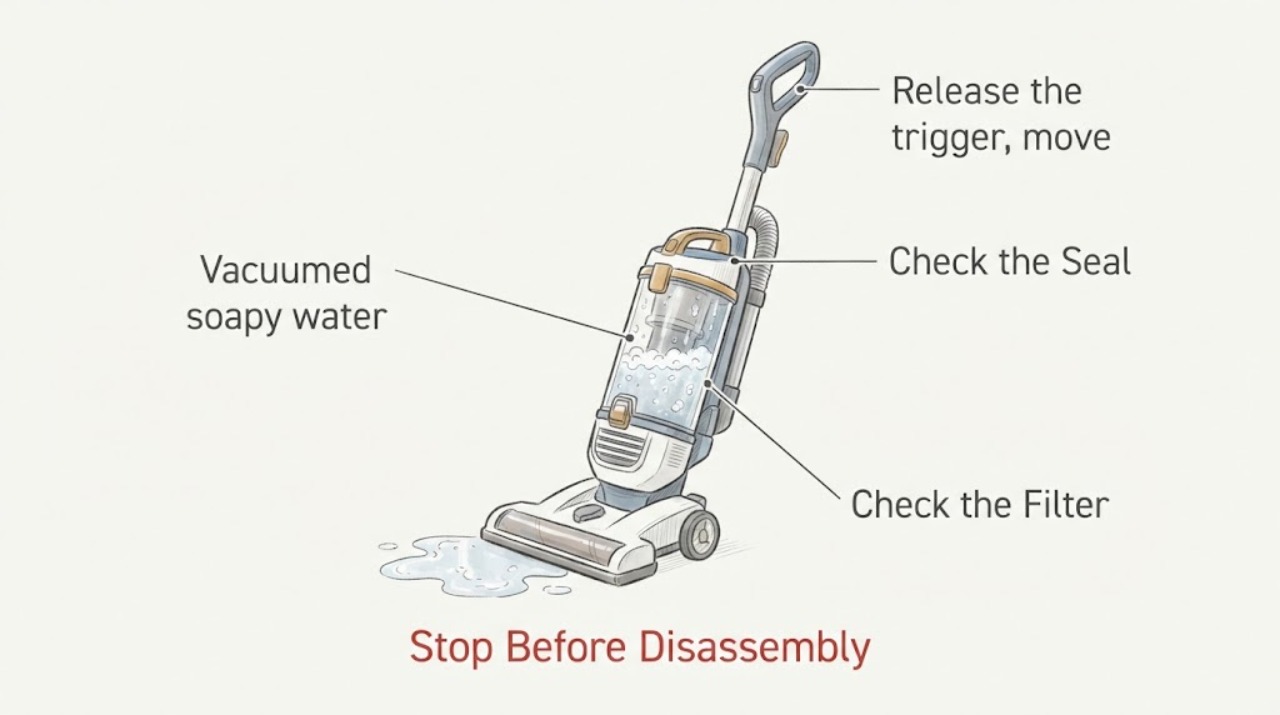
Stop the Dyson V11 Extra immediately, release the trigger, keep it off the charger, and do not switch it on to see whether it still works. Dyson's V11 safety instructions say the machine is for dry locations, must not pick up water or liquids, and should not be used if it has been damaged or exposed to water; they direct the owner to Dyson support rather than disassembly. If the liquid is confined to an accessible clear bin, empty it and clean that bin only as Dyson describes, then keep the bin and seals completely dry. A removable filter may be washed with cold water without detergent and must dry completely for at least 24 hours before refitting, but a wet motor body, cyclone, battery, charger, unusual odor, heat, smoke, or liquid that reached hidden passages requires Dyson service. Do not use a hair dryer, add more cleaner, charge the machine, or open the motor or battery.
Work through in order
Diagnostic checks
Use only checks that match the exact appliance or system and its official guide.
-
Check 1
Release the trigger, move the V11 Extra away from the spill, and keep it off the wall charger or dock. If the machine, hands, or charger contacts are wet, do not handle the charger until everything can be handled from a dry, safe position.
Expected result: The machine is now off with no heat, smoke, odor, sparking, or battery damage, or it is hot, smoking, smells burnt, pulses, or shows visible battery or casing damage.
Next step: For any heat, smoke, burning odor, sparking, casing damage, or suspected battery leakage, move away from the machine if safe and contact Dyson or emergency services as appropriate. Do not charge, restart, or open it.
Why this matters
Why: A stopped, cool machine limits further exposure but does not prove that liquid stayed out of the motor. Heat, smoke, odor, damage, or abnormal battery behavior is a higher-risk condition than a wet accessible bin.
-
Check 2
With the trigger untouched, remove the wand and empty the clear bin without shaking liquid into the motor body. Inspect the visible bin and seals for soapy residue; if the bin needs cleaning, use only the damp-cloth method described by Dyson and do not add detergent or immerse the main body.
Expected result: Liquid appears confined to the accessible clear bin, or soap or liquid is visible around the cyclone inlet, seals, main body, or other inaccessible passage.
Next step: Leave the bin and seals off the machine until completely dry. If liquid reached the main body or an inaccessible passage, stop at external inspection and arrange Dyson service; do not rinse, blow, or vacuum the residue through the machine.
Why this matters
Why: Dyson allows damp-cloth cleaning of the clear bin and requires the bin and seals to be completely dry before replacement. Liquid beyond that accessible bin boundary is not covered by the user cleaning procedure and may have reached the airflow or motor path.
-
Check 3
If the removable filter is visibly wet or soapy and you can remove it using the V11 instructions without touching wet electrical parts, wash the filter unit with cold water only and no detergent, then place it in a dry, well-ventilated area.
Expected result: The filter is still damp or smells of cleaner, or it is completely dry after at least 24 hours and the main body shows no liquid exposure.
Next step: Do not refit or run the vacuum while the filter has any moisture. If cleaner reached the filter housing, main body, or hidden airflow path, contact Dyson rather than extending the drying experiment or powering the machine.
Why this matters
Why: Dyson says a wet filter can damage the motor when refitted and requires complete drying for at least 24 hours. A dry filter does not prove that liquid did not enter the motor or cyclone.
-
Check 4
Inspect the wand and cleaner head externally for pooled liquid, residue, or a blocked opening only after the machine is off. Do not run the trigger to purge liquid, use heat to dry it, immerse the head, or put hands near a brush bar that could start unexpectedly.
Expected result: Only detachable exterior surfaces are damp and can be wiped according to the applicable Dyson instructions, or liquid has entered an opening or remains in the main body or motor path.
Next step: Wipe only permitted exterior surfaces and keep the parts separated and unpowered. For liquid in an opening, persistent cleaner odor, pulsing, no start, or unusual noise, stop and request Dyson service.
Why this matters
Why: Visible external residue can be documented without proving the internal condition. Dyson's V11 guide limits maintenance to described procedures and warns that the automatic cut-out and blockage guidance do not convert liquid exposure into a normal blockage.
-
Check 5
Record the V11 Extra serial number, battery attachment type, screen type, liquid amount and cleaner used, whether the machine was running afterward, and what parts were visibly wet before contacting Dyson support.
Expected result: The machine remains unused and dry externally, or it was restarted or charged after the spill and now has a fault, odor, heat, or abnormal sound.
Next step: Give Dyson the recorded details and follow the exact V11 Extra support path. Do not disassemble the motor, cyclone, charger, or battery while waiting for guidance.
Why this matters
Why: Dyson's V11 support page uses battery and screen configuration or serial number to select the correct support path. Restarting or charging after liquid exposure changes the service history but does not establish which component is damaged.
Use your observations
Decision map
Find the observation that best matches what you see, then follow the next safe action.
-
PATH 01Next step
What you see
The spill was caught in the accessible clear bin, the main body and battery area stayed dry, and there is no heat, odor, damage, or abnormal behavior.
Do this next
Clean the clear bin only as Dyson describes, leave it separated until dry, and contact Dyson if any liquid was near the cyclone inlet or if the machine behaves abnormally.
Why this path and its safety boundary
Why it matters: The visible exposure may be limited to a user-serviceable bin area, but the dry-vacuum warning still means the machine should not be restarted until the bin and seals are completely dry.
-
PATH 02Next step
What you see
The filter is wet or soapy, but liquid is not visible in the main body and the battery and charger remain dry.
Do this next
Wash and dry the filter for at least 24 hours with good airflow, do not refit it while damp, and ask Dyson whether the liquid exposure warrants service before any restart.
Why this path and its safety boundary
Why it matters: The filter can be handled under Dyson's cold-water, no-detergent cleaning and drying procedure; its dryness is required before it returns to the machine.
-
PATH 03Next step
What you see
Soapy water reached the cyclone, motor housing, battery area, charger, or another opening, or the machine was run after the spill.
Do this next
Keep the machine off and uncharged, do not disassemble or apply heat, and contact Dyson with the serial number and exposure details for service guidance.
Why this path and its safety boundary
Why it matters: This exceeds Dyson's described dry-vacuum maintenance boundary. Drying the outside cannot establish that hidden electrical or motor parts are safe.
-
PATH 04Next step
What you see
There is a burning smell, smoke, unusual heat, visible battery damage or leakage, sparking, or a damaged charger after the incident.
Do this next
Do not touch leaking battery liquid, charge, restart, or open the machine. Move people away if needed and contact Dyson or emergency services for an active fire or smoke event.
Why this path and its safety boundary
Why it matters: Treat this as an electrical or battery safety event rather than a suction or filter problem.
Helpful context
Understand the symptom
Treat soapy water as liquid exposure, not a normal blockage
The V11 Extra is a dry vacuum. Dyson's V11 instructions prohibit picking up water or liquids and say not to use a machine that is not working as it should or has been dropped into water. The instructions do not provide a user procedure for flushing liquid from the cyclone or motor. After an accidental pickup, the safest useful step is to stop operation, keep the machine uncharged, and distinguish an accessible wet bin or filter from liquid that may have reached the main body.
What can be cleaned and what should stay closed
Dyson's V11 guide permits the clear bin to be cleaned with a damp cloth only and says the bin and seals must be completely dry before refitting. It separately describes washing the filter unit in cold water without detergent and drying it completely in good airflow for at least 24 hours. Those instructions do not authorize washing the main body, charger, battery, cyclone, or motor, and they do not make a liquid-damaged machine safe to restart.
Why charging is a separate risk
A V11 has different battery and screen configurations, so Dyson's support page asks the owner to identify the machine by battery and screen type or serial number. The V11 manual warns against using a damaged or modified battery or machine and against charging outside the stated conditions. If soapy water may have reached the battery area, contacts, charger, or main body, leave the unit off and give Dyson the model and serial information instead of trying a charging test.
When checks do not resolve it
Need a professional?
Keep the Dyson V11 Extra off and uncharged after accidental liquid pickup. Contact Dyson service if liquid reached the motor body, cyclone, battery or charger, if the filter cannot be dried completely, if the machine was restarted after the spill, or if there is heat, odor, smoke, sparking, battery damage, pulsing, or no start. Do not disassemble, apply heat, bypass safety features, or use the machine to test whether it recovered.
Have this ready
- Provide Dyson V11 Extra, the serial number, battery attachment and screen type, the liquid and cleaner involved, approximate amount, whether the trigger was pressed afterward, which parts were wet, and every symptom observed. Keep the machine off and uncharged while arranging guidance.
Common questions
FAQ
Can I just let a Dyson V11 Extra dry and try it again?
Do not use a restart as the test. Dyson says the V11 must not pick up water or liquids and directs owners not to use a damaged or water-exposed machine and to contact Dyson. A fully dry accessible bin or filter does not prove that liquid stayed out of the motor or electrical path.
Can I wash the V11 filter after vacuuming soapy water?
Dyson's V11 instructions allow the filter unit to be washed with cold water only and no detergent, then dried completely in good airflow for at least 24 hours. Do not refit it while damp, and ask Dyson about service if liquid reached the filter housing or main body.
Can I rinse the Dyson clear bin to remove cleaner residue?
Dyson's V11 guide says to clean the clear bin with a damp cloth only, not detergent, and to make the bin and seals completely dry before replacement. Do not immerse or rinse the main body, cyclone, battery, or charger.
What if the vacuum still turns on after it picked up liquid?
Turning on does not prove that the machine is safe or undamaged. Stop using it, do not charge it, record where the liquid went and any odor or heat, and contact Dyson with the V11 configuration and serial number. Do not open the motor or battery to inspect it.
Read the exact guide
Official sources
- Maintain your vacuum filter. Extend its life.Dyson · Opened Dyson's official filter-care page, which includes a V11 filter guide. It supports cold-water/no-detergent washing and complete drying; it is not evidence that a liquid-exposed V11 motor or cyclone is safe to restart.
- Support | Choose your Dyson V11™ vacuum cleanerDyson · Opened Dyson's V11 support hub. It confirms that V11 variants differ by click-in or screw-in battery and LED or LCD screen, and directs identification by configuration or serial number before selecting support.
- V11 click in battery LED display OUG-compliance document 5.15.25.pdfDyson · Opened Dyson's official V11 click-in-battery LED-display user guide. It is used for V11-family safety and user-maintenance boundaries; the V11 support hub shows multiple battery and screen variants, so the serial number and exact V11 Extra configuration remain the authority for model-specific service steps.
Community feedback
Share a repair observation
Share a plain-text repair observation. Accepted observations are published automatically; this page may take a moment to update.