
On this page
Start here
Quick answer
A buzzing or humming sound from an Electrolux dishwasher is often tied to the cycle phase: Electrolux documents water filling, water circulation, a wash-pump hum that starts and stops as spray arms alternate, and a drain-pump hum that changes as water is pumped out. First note when the sound starts, whether water is entering or draining, and whether it changes with spray-arm movement. Check only visible loading, spray-arm clearance, standing water, and accessible filter/drain-hose conditions supported by the model guide. Stop using the dishwasher for a burning smell, leak, repeated electrical trip, or a sound that is accompanied by failure to fill, wash, or drain; do not open the pump housing or perform live testing.
Before you begin
Safety first
- Limit user checks to listening by cycle phase, visible loading and spray-arm clearance, the externally visible drain-hose route, and model-approved accessible filter cleaning with power isolated. Do not open the sump or pump housing, reach into moving spray arms, probe live wiring, bypass a door or float switch, or run the dishwasher with a leak or electrical warning.
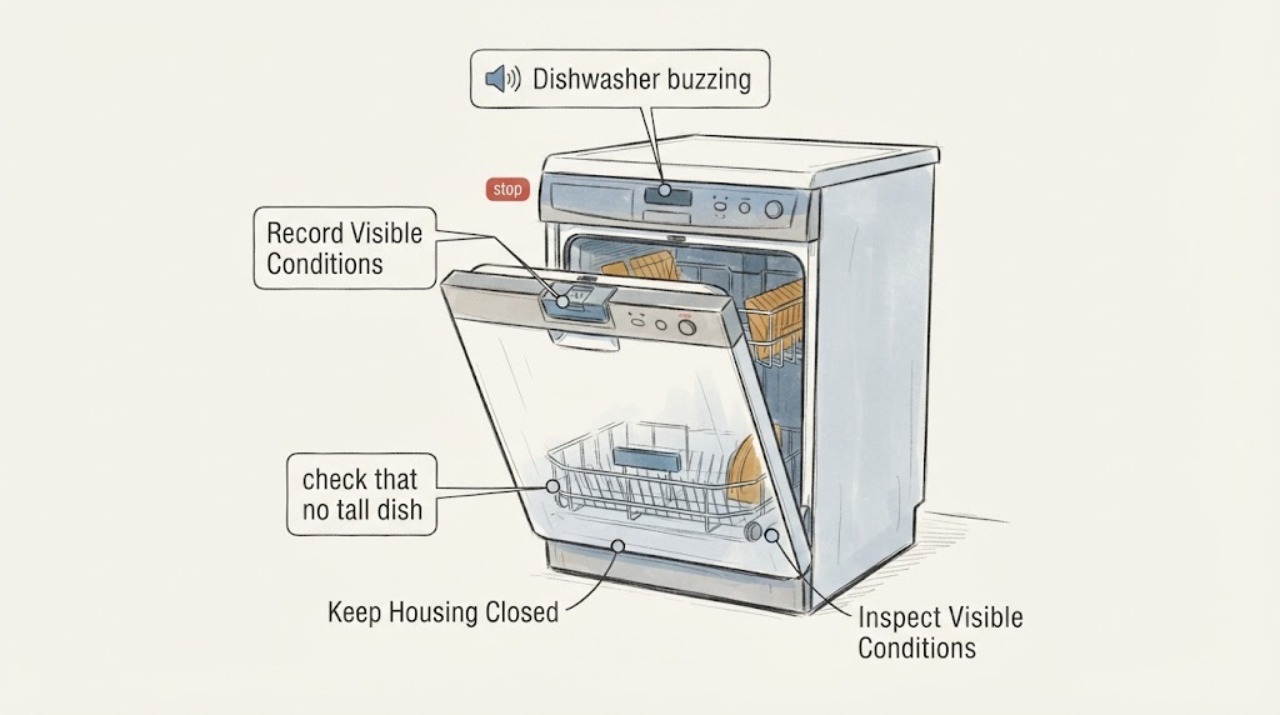
Work through in order
Diagnostic checks
Use only checks that match the exact appliance or system and its official guide.
-
Check 1
Listen from outside the closed dishwasher and note whether the buzz begins during water fill, wash circulation, drain, or drying; record whether it starts/stops or changes as the cycle advances.
Expected result: The sound starts with filling, repeats as spray arms alternate, is strongest while water is leaving, or appears during a fan-assisted drying period.
Next step: Compare the sound and phase with the exact model's owner's manual and continue only if the dishwasher fills, washes, drains, and dries normally.
Stop if: If the sound is continuous, newly harsh, or unrelated to a recognizable phase, continue with the safe external checks and service boundary.
Why this matters
Why: The timing can match Electrolux's documented water-valve/fill, wash-pump, drain-pump, or drying-fan operations. Timing alone does not prove a failed pump or valve.
-
Check 2
After stopping the cycle normally and waiting for the racks and spray arms to be safe to inspect, check that no tall dish, pan, utensil, or loose item can contact a spray arm; rotate accessible spray arms gently by hand only when the appliance is inactive.
Expected result: An item touches or blocks a spray arm, or all visible spray-arm clearance is clear and the buzzing remains.
Next step: Rearrange only the visible load, then run the model's normal cycle and listen for recurrence; do not remove the pump or spray-arm assembly.
Stop if: Continue to distinguish drain performance and standing water; do not assume the wash pump is defective.
Why this matters
Why: Electrolux identifies loading interference as a cause of abnormal contact sounds. Clear loading can remove the external cause, while a persistent buzz with no interference needs further observation rather than a guessed part.
-
Check 3
At the end of a cycle, look for standing water covering the filter area and inspect the visible drain-hose route for a kink or displacement. If the model manual identifies an accessible glass trap/filter, clean it only as that manual directs with power isolated.
Expected result: Water remains, the hose is kinked or moved, or the visible drain path and accessible filter are clear.
Next step: Correct only the accessible hose alignment or clean the model-approved filter, then stop if water remains or the buzzing returns with poor drainage.
Stop if: Continue to the service branch if the buzz is accompanied by incomplete draining or a new cycle failure.
Why this matters
Why: A drain condition can make a pump sound persist or prevent the cycle from completing. Electrolux documents hose kinks, clogged glass trap/filter, and a disposal knockout plug as drainage checks; none identifies a failed pump by itself.
-
Check 4
Observe whether the dishwasher actually fills and circulates water while the buzz is present, without opening the door during an active cycle or reaching inside moving parts.
Expected result: The dishwasher fills and washes normally, or the buzz occurs with no fill, weak/no circulation, an incomplete cycle, or a drain failure.
Next step: If performance is normal, document the phase and compare it with the manual; if a function fails, stop repeated cycles and arrange service.
Stop if: Do not perform a live test or open the sump/pump area; use the exact model information for qualified diagnosis.
Why this matters
Why: Normal fill, circulation, and completion make a documented operating sound more plausible. A sound paired with loss of a function is a service symptom, but it does not distinguish a valve, pump, impeller, wiring, or control fault.
-
Check 5
Check for a leak, burning or hot-plastic odor, smoke, water near electrical connections, or a household breaker/GFCI that trips while the dishwasher buzzes.
Expected result: Any safety warning is present, or the dishwasher is dry and electrically stable but the buzzing remains unexplained.
Next step: Stop the dishwasher; disconnect power only from a safe, dry position and shut off the water supply if a leak requires it. Arrange qualified appliance/electrical service.
Stop if: Record the model, cycle phase, sound pattern, and performance result for the exact manual or service team.
Why this matters
Why: A safety warning changes the task from sound identification to stop-use and service. A dry appliance with a persistent unexplained sound still does not support naming an internal component.
Use your observations
Decision map
Find the observation that best matches what you see, then follow the next safe action.
-
PATH 01Next step
What you see
The buzz or hum starts and stops with wash circulation, while the dishwasher fills, cleans, drains, and completes normally
Do this next
Compare the sound with the exact model manual and monitor it; do not replace a pump based on the noise alone.
Why this path and its safety boundary
Why it matters: The pattern is consistent with Electrolux's documented wash-pump and spray-arm operating sounds.
-
PATH 02Next step
What you see
The sound is strongest during drain and water is slow to leave or remains at the end of the cycle
Do this next
Check the visible hose route and model-approved glass trap/filter, then arrange service if drainage or the buzz persists.
Why this path and its safety boundary
Why it matters: The timing and symptom support an external drainage path check, not a confirmed drain-pump failure.
-
PATH 03Next step
What you see
A tall item or utensil contacts a spray arm and the sound stops after the load is rearranged
Do this next
Keep the spray-arm path clear and use the dishwasher normally; do not dismantle the spray arm or pump to chase the sound.
Why this path and its safety boundary
Why it matters: The observed change supports a loading/clearance cause for the contact noise.
-
PATH 04Next step
What you see
The buzzing is accompanied by no fill, no circulation, incomplete drain, a leak, burning odor, smoke, or a repeated electrical trip
Do this next
Stop use, isolate water/power only if safe, and arrange qualified Electrolux service; do not open the sump, pump, wiring, or control area.
Why this path and its safety boundary
Why it matters: The noise is no longer an isolated normal-operation question and the public checks cannot identify the internal component safely.
Helpful context
Understand the symptom
“Buzzing” is not precise enough to identify a dishwasher part. A sound heard during fill, wash circulation, or drain may come from a different normal operation, and the same appliance can change sound as the spray arms alternate. The useful first observation is when the sound occurs and what the water and cycle are doing at that moment.
No Electrolux model number was supplied, so this guide stays at the family level. It uses only visible loading, accessible cleaning, and external hose observations. Pump, valve, wiring, and control diagnoses require the exact model manual and qualified service.
When checks do not resolve it
Need a professional?
Use qualified appliance service for a persistent unexplained buzz, failed fill/wash/drain function, suspected pump or valve issue, leak, electrical warning, or any repair requiring internal access.
Safety scope: Limit user checks to listening by cycle phase, visible loading and spray-arm clearance, the externally visible drain-hose route, and model-approved accessible filter cleaning with power isolated. Do not open the sump or pump housing, reach into moving spray arms, probe live wiring, bypass a door or float switch, or run the dishwasher with a leak or electrical warning.
Common questions
FAQ
Is a buzzing or humming Electrolux dishwasher always a bad pump?
No. Electrolux documents normal wash-pump and drain-pump hums whose timing changes with spray-arm movement or draining. A pump cannot be identified from sound alone, especially without a model number.
Why does the dishwasher buzz only while it is draining?
Electrolux says drain-pump hum is usually steady at first and fluctuates as water is pumped out. If water remains or the cycle fails, check the visible hose route and model-approved filter/trap, then arrange service if the problem persists.
Could the loading cause a dishwasher noise?
Yes. Electrolux says a tall dish, pan, or utensil can interfere with spray-arm movement. Stop the cycle normally, clear the visible spray-arm path, and do not dismantle the pump or spray-arm assembly.
When should I stop using the dishwasher because of buzzing?
Stop when the sound is accompanied by a leak, burning or hot-plastic odor, smoke, water near electrical parts, a repeated breaker/GFCI trip, or failure to fill, circulate, drain, or complete the cycle. Isolate power or water only from a safe position and arrange qualified service.
Read the exact guide
Official sources
- Dishwashers - What are normal dishwasher operations sounds?Electrolux · Family-level normal fill, circulation, motor, fan, and loading/contact sound guidance; no model-specific pump diagnosis
- Dishwasher - Noise GuideElectrolux · Family-level phase-to-sound descriptions for water valve, wash pump, drain pump, detergent dispenser, ball valve, spray arms, and whooshing spray arms
- Dishwashers - Not DrainingElectrolux · Family-level external drain-hose, glass-trap/filter, disposal-knockout, and service boundary guidance when buzzing is paired with incomplete draining
- Support for DishwashersElectrolux · Official support routing and model/topic lookup boundary; used to direct unresolved model-specific symptoms to the correct manual/support path
Community feedback
Share a repair observation
Share a plain-text repair observation. Accepted observations are published automatically; this page may take a moment to update.