
On this page
Start here
Quick answer
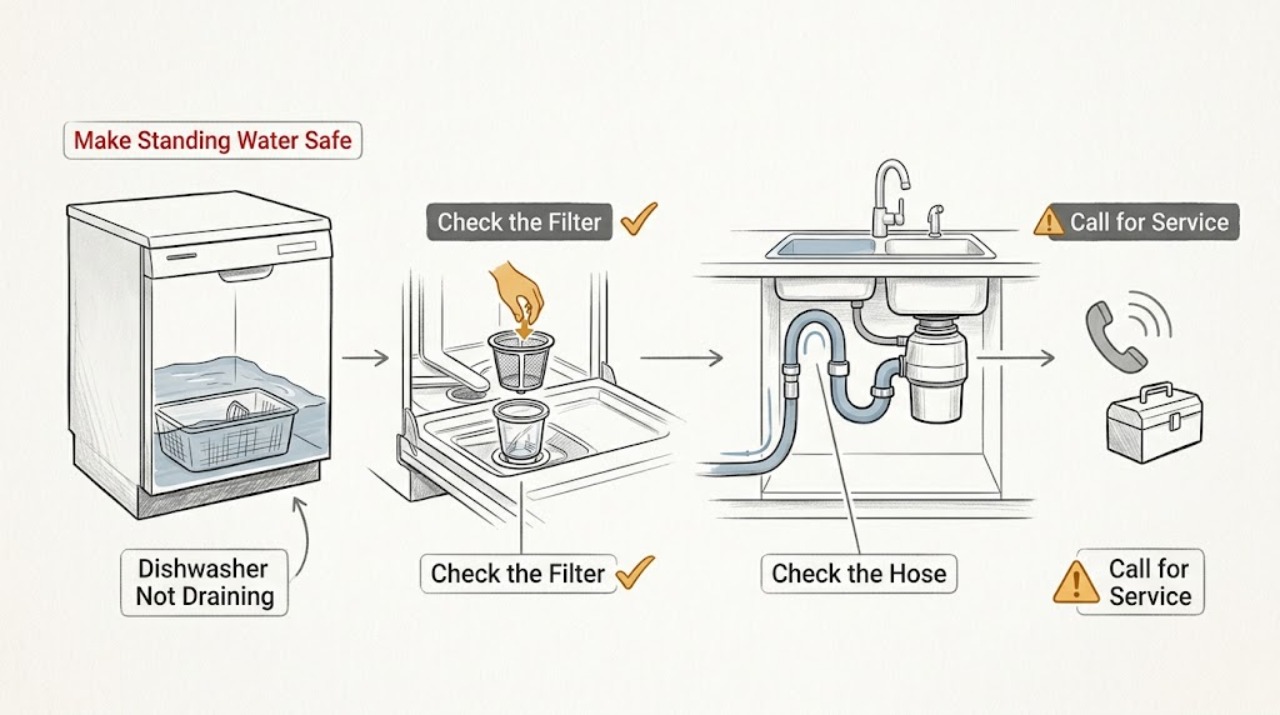
Treat standing water in an Electrolux dishwasher as a water-and-electricity safety issue first: do not reach into the water or keep cycling the appliance while it is energized, and stop for a leak near electrical parts, backflow, smoke, a burning smell, or a damaged cord. With the dishwasher safely off and the water cool enough to handle, use the exact manual to remove and rinse only the accessible glass trap or filters, then inspect the visible drain hose for a kink, crush, twist, or a missing/incorrect high loop. Check the sink spigot, air gap if fitted, and garbage-disposer inlet; a disposer knockout plug left in place can block drainage after installation. If the filters, visible sump, hose route, and sink connection are clear but water remains, or the pump is silent, only hums, or protection trips, stop: the drain pump, check valve, wiring, or control needs Electrolux-authorized or qualified service. Do not open the pump, disconnect a water-filled hose, or perform a live test.
Before you begin
Safety first
- The user may isolate power and water safely, inspect the visible hose route and sink connection, and clean documented removable filters after de-energizing the appliance. Qualified service personnel must handle the pump, check valve, hidden hose, control, wiring, anti-flood system, appliance removal, and live testing.
Work through in order
Diagnostic checks
Use only checks that match the exact appliance or system and its official guide.
-
Check 1
Stop the current programme and assess the water from a dry position. Look for water on the floor, around the door, or near the electrical base; note whether it may be hot or contaminated. If the exact model provides a documented cancel/drain control, use it only when there is no leak or electrical hazard; otherwise isolate power at the plug or breaker from a safe location before touching water or filters.
Expected result: Water is near electrical parts, actively leaking, flowing back, hot/unsafe to handle, the anti-flood condition is indicated, or the water is contained in the tub and cool with no hazard visible.
Next step: For a leak, backflow, anti-flood indication, smoke, burning odor, damaged cord, or water near electrics, close the water tap if safely accessible, isolate power, and arrange service. If water is contained and the appliance is safely off, continue with the accessible filter check.
Stop if: Do not reach into energized water, pull out the dishwasher, loosen a water or drain hose, or run another cycle to force drainage.
Why this matters
Why: A leak, backflow, anti-flood state, or water near electrics is a safety/service condition rather than a routine filter check. Contained cool water permits only model-documented, de-energized external checks.
-
Check 2
With the dishwasher off and power isolated as the exact Electrolux manual requires, remove only the documented accessible glass trap, cylinder/fine filter, or coarse filter. Empty food residue and rinse the parts under running water; inspect the visible sump opening for loose debris without inserting fingers, tools, or a hand into the pump. Reinstall and lock each filter exactly as documented.
Expected result: Food, glass, bones, pits, or other debris blocks a filter; a filter is missing or not locked; the visible filter/sump area is clear; or the part will not release or reseat normally.
Next step: Rinse and correctly reseat only the documented removable filter parts. If a part is stuck, damaged, or will not lock, stop and arrange service. If the filter path is clear, inspect the visible hose and sink connection next.
Stop if: Do not reach through the sump to turn an impeller, remove a pump cover, use a sharp tool to clear a blockage, or clean filters while power is connected.
Why this matters
Why: Food or debris in the filter system can restrict drainage. A missing or incorrectly positioned filter can also affect the drain path. A clear, correctly seated filter does not rule out a hose, sink connection, pump, or control fault; a stuck part must not be forced.
-
Check 3
Without moving the appliance or disconnecting plumbing, inspect the visible drain hose under the sink and behind accessible cabinetry. Look for a kink, crush point, twist, sag, or a route that does not maintain the high loop/height required by the exact Electrolux installation instructions. Compare the route with the applicable manual rather than imposing a dimension from another region or model.
Expected result: The hose is kinked, crushed, twisted, sagging, newly moved, visibly damaged, or routed below the documented high-loop/height requirement; or its visible route is normal.
Next step: Correct only a clearly accessible kink or support issue allowed by the Electrolux manual, without pulling the appliance or opening a connection. If the hose is damaged, hidden, or the route requires appliance removal, call service or a qualified installer.
Stop if: Do not pull out a built-in dishwasher, disconnect a hose containing water, cut the hose, or substitute a hose-routing dimension from another model.
Why this matters
Why: A restricted or incorrectly routed hose can prevent complete drainage or allow dirty water to return. A normal visible route makes a hidden obstruction, sink connection, pump, check valve, or control more likely but does not identify which one.
-
Check 4
Inspect the household drain connection that the Electrolux hose visibly enters. Check for a blocked sink spigot or drain air gap if fitted, and if connected to a garbage disposer, verify that the dishwasher inlet knockout plug was removed during installation. Do not dismantle the siphon or disconnect a wet hose; use a plumber for a blocked household drain.
Expected result: The sink spigot or air gap is blocked, the disposer inlet still has a knockout plug, the household sink itself drains poorly, or the connection appears clear.
Next step: Have the sink-side obstruction or disposer installation corrected by the appropriate plumber/installer; do not run the dishwasher against a blocked drain. If the connection is clear and water still remains, stop and proceed to service escalation rather than opening the pump.
Stop if: Do not remove a siphon, disconnect a water-filled line, or use chemical drain cleaner in the dishwasher or its hose.
Why this matters
Why: A blocked sink-side connection can leave the dishwasher full even when its filters are clean. An unremoved disposer knockout plug prevents discharge. A clear connection shifts suspicion toward the hose beyond the visible section or the appliance drain system.
-
Check 5
Record the full Electrolux model and serial information, water level and condition, filter result, hose route, air-gap/disposer result, programme stage, flashing lights or error code, and whether any drain sound was silent, clicking, or humming. Give the record to Electrolux support or a qualified dishwasher technician; do not perform a live drain-pump test.
Expected result: Drainage returns after an accessible filter, hose-route, or sink correction; water remains with all visible checks normal; the pump is silent or only hums; backflow/anti-flood returns; or protection trips/odor appear.
Next step: Stop repeated cycles and arrange model-specific service. If the household drain is the problem, use a plumber; if the appliance drain system, pump, wiring, or control needs access, use Electrolux-authorized or qualified appliance service.
Stop if: Do not open the pump or control area, probe wiring, bridge a safety device, or replace a pump from the symptom alone.
Why this matters
Why: Recovery after an external correction supports that restriction or installation condition as the immediate cause. Persistent water with those checks normal makes an internal drain pump, check valve, wiring, control, or hidden blockage more likely; sound alone cannot identify a part.
Use your observations
Decision map
Find the observation that best matches what you see, then follow the next safe action.
-
PATH 01Safety boundary
What you see
Water is leaking onto the floor or near electrical parts, flowing back into the dishwasher, or an anti-flood/protection condition is active.
Do this next
Close the water tap if safely accessible, isolate power from a dry location, keep clear of the water, and contact Electrolux service. Use a plumber if the leak is clearly in the household connection.
Why this path and its safety boundary
Why it matters: This is a water/electrical safety condition, not a safe opportunity to keep cycling the dishwasher or open the pump.
Safety stop: Do not touch energized water, pull out the appliance, loosen hoses, or restart it to test drainage.
-
PATH 02Safety boundary
What you see
The dishwasher is safely off and the accessible glass trap/filter contains food, glass, or other debris, or a filter is not locked in its documented position.
Do this next
Rinse and reseat only the documented removable filter parts, then reassess according to the exact manual. If the part is damaged, stuck, or water remains, call service.
Why this path and its safety boundary
Why it matters: A filter-system restriction or seating problem is more likely than an immediately proven pump failure.
Safety stop: Do not reach into the sump, turn the impeller, or use tools to clear a hidden pump obstruction.
-
PATH 03Safety boundary
What you see
Filters are clear, but the visible hose is kinked/squashed/sagging, the high loop or documented height is wrong, or the sink spigot, air gap, or disposer inlet is blocked/uncleared.
Do this next
Correct only a visible routing issue allowed by the manual and have the sink/disposer connection cleared or the knockout plug removed by the appropriate installer/plumber. Do not run the appliance against a blocked drain.
Why this path and its safety boundary
Why it matters: A downstream installation or sink-side restriction is more likely than an internal pump fault until that path is corrected.
Safety stop: Do not pull out the dishwasher, disconnect wet plumbing, cut the hose, or apply chemical drain cleaner.
-
PATH 04Safety boundary
What you see
The filters, visible sump, hose route, and sink/air-gap/disposer connection are clear and correctly seated, but the tub still contains water after a completed cycle.
Do this next
Keep the dishwasher out of service and arrange Electrolux-authorized or qualified appliance service. Provide the model, water level, lights/code, and external-check results.
Why this path and its safety boundary
Why it matters: A hidden hose obstruction, check valve, drain pump, wiring, or control issue is more likely; the user checks have reached their safe limit.
Safety stop: Do not open the pump, force water through the hose, perform a live test, or order a pump solely from the symptom.
-
PATH 05Safety boundary
What you see
The machine is silent or only hums during a documented drain attempt, repeatedly returns an error/protection state, or has odor/damage after the visible path is normal.
Do this next
Isolate power and arrange model-specific service. If water is near electrics or there is smoke/burning odor, treat the call as urgent.
Why this path and its safety boundary
Why it matters: An internal drain pump, check valve, wiring, control, or electrical safety fault is possible, but sound and code patterns do not safely identify a replacement part.
Safety stop: Do not probe wiring, bypass anti-flood or door protection, open the control/pump housing, or continue cycles to compare sounds.
Helpful context
Understand the symptom
Start with standing-water safety
A little water may remain in a sump on some designs, but water across the tub after a completed cycle means the drain path needs checking. Do not put your hand into dirty or hot water while the dishwasher is powered, and do not pull out a built-in machine or loosen a hose to make the water drain. If water is near the electrical base, is flowing back, or the anti-flood system, cord, or appliance shows a hazard, isolate it safely and arrange service.
Work from the filters outward
Electrolux models use different filter and sump layouts, so follow the exact manual for names and removal. Electrolux guidance identifies food and debris in the glass trap and filters as a possible restriction. Once the accessible filter system is clean and seated, inspect the hose route and sink-side connection. A high loop or required hose height helps prevent incomplete drainage and backflow; the exact installation instructions control the local dimension.
Stop before the pump and control boundary
If the filters, visible sump, hose route, air gap or disposer connection are clear but water remains, the drain pump, check valve, hidden hose, wiring, or control may be involved. A hum, click, or silence does not identify a safe replacement part, and a blocked impeller must not be reached through the sump. Keep the dishwasher out of service and provide the model, code, water level, and external-check results to Electrolux support or a qualified technician.
Safety boundary
Stop conditions
- Stop immediately for water near electrical parts, an active leak, backflow, anti-flood indication, smoke, burning odor, a hot or damaged cord/plug, or repeated protection trips; isolate power safely and arrange service.
- Do not reach into standing water or the sump while the dishwasher is energized, and do not pull out a built-in dishwasher or loosen a hose full of water.
- Do not open the drain pump/control area, probe wiring, perform a live test, bypass a door or anti-flood device, or force an impeller.
- Do not use sharp tools or chemical drain cleaner in the dishwasher, cut or replace the hose from the symptom alone, or run cycles against a blocked sink connection.
- If the filter, visible hose route, and sink/air-gap/disposer connection are normal but water remains, stop repeated cycles and arrange Electrolux-authorized or qualified appliance service.
Only after diagnosis
Potential parts
- Electrolux dishwasher drain pump
Consider this only after the exact model is identified and a qualified diagnosis confirms that the filter, hose, sink connection, and hidden blockage are not the cause and the pump has failed; standing water alone does not justify ordering a pump.
Drain-pump fitment is model-specific. Confirm the complete model/product number and manufacturer or authorized-service fit information before ordering; do not substitute a pump by appearance or sound.
When checks do not resolve it
Need a professional?
Safety scope: The user may isolate power and water safely, inspect the visible hose route and sink connection, and clean documented removable filters after de-energizing the appliance. Qualified service personnel must handle the pump, check valve, hidden hose, control, wiring, anti-flood system, appliance removal, and live testing.
Common questions
FAQ
Why is my Electrolux dishwasher not draining?
Start with the safely de-energized accessible glass trap/filter, then inspect the visible drain hose for a kink, crush, twist, or incorrect high-loop/height routing. Check the sink spigot, air gap if fitted, and disposer inlet. If those are clear but water remains, a hidden blockage, pump, check valve, wiring, or control needs service.
Is it safe to reach into standing water in an Electrolux dishwasher?
Not while the dishwasher is energized, and not if the water may be hot or unsafe to handle. Isolate power safely before touching filters, and stop for water near electrical parts, active leakage, backflow, anti-flood indication, smoke, odor, or damaged wiring. Do not pull out the appliance or loosen a wet hose yourself.
Can a clogged Electrolux dishwasher filter leave water in the tub?
Yes. Electrolux guidance identifies food and debris in the glass trap and filter system as a possible drainage restriction. With power isolated, rinse only the documented removable filters and reseat them correctly; do not reach into the sump or pump.
How does the drain hose affect an Electrolux dishwasher?
A kinked, crushed, twisted, sagging, or incorrectly routed hose can prevent complete drainage or allow dirty water to return. Inspect only the visible route and compare it with the exact Electrolux installation manual. Do not pull out a built-in dishwasher or disconnect the hose to test it.
When should I call Electrolux dishwasher service?
Call when the filters, visible hose route, and sink/air-gap/disposer connection are clear but water remains, or when the pump is silent/only humming, backflow or an anti-flood state returns, there is a leak, or internal pump, check-valve, wiring, or control access would be needed. Electrolux advises service when drainage trouble continues.
Read the exact guide
Official sources
- Dishwasher - Drain Hose GuideElectrolux · Supports the general hose-routing and disposer-plug decision; use the exact Electrolux installation manual for the local required height and configuration.
- Dishwashers - Not DrainingElectrolux · Directly supports the filter, hose, disposer, and service branches for Electrolux-family dishwashers; exact model documentation controls controls and reset details.
- Water is flowing back into the dishwasherElectrolux · Supports the backflow, hose-routing, and safety boundary for Electrolux dishwashers; exact model and local installation instructions govern the repair path.
- Dishwasher Glass Trap and Filter GuideElectrolux · Supports the accessible filter/food-residue branch; exact filter names, release directions, and safety steps must come from the Electrolux model manual.
Community feedback
Share a repair observation
Share a plain-text repair observation. Accepted observations are published automatically; this page may take a moment to update.