
On this page
Start here
Quick answer
If an Electrolux dryer door is locked, stop the cycle using the normal controls and wait until the drum has stopped and the appliance is safe to handle; never pull the door or bypass the interlock. Check the visible door pin or latch, handle, seal, and any laundry caught at the opening. If a padlock symbol is shown, use the child-lock sequence in the exact model manual because the button combination varies. A door that remains jammed, has a damaged latch or handle, displays a persistent door error, or will not release after the model-approved reset needs an authorised service engineer. Do not remove the cabinet or disassemble the door-lock mechanism as a household troubleshooting step.
Work through in order
Diagnostic checks
Use only checks that match the exact appliance or system and its official guide.
-
Stop the active dryer safely
If the dryer is running, hot, tumbling, or showing an active programme, stop it with the normal control and wait until the drum has fully stopped and the door area is safe to approach. If it is safe to do so, disconnect the plug before any visible inspection; do not pull on the door while the appliance is active.
Expected result: The door releases after the programme ends and the appliance is safe, the drum remains active or hot, or the door stays locked after a normal stop and cool-down.
Next step: Continue only when the drum is stopped and the exterior is safe. If it remains locked, record the display, programme, and whether the drum was hot before moving to the visible latch check.
Stop if: Stop immediately for smoke, burning odor, sparks, a hot or damaged cord, a gas odor, a drum that will not stop, or heat or steam escaping from a damaged door area; leave the appliance disconnected and arrange qualified help.
Why this matters
Why: Release after a normal stop supports a temporary operating safety state. A door that remains locked after the appliance is stopped and safe needs the latch, control-lock, code, and service branches rather than force.
-
Inspect the visible latch, handle, seal, and opening
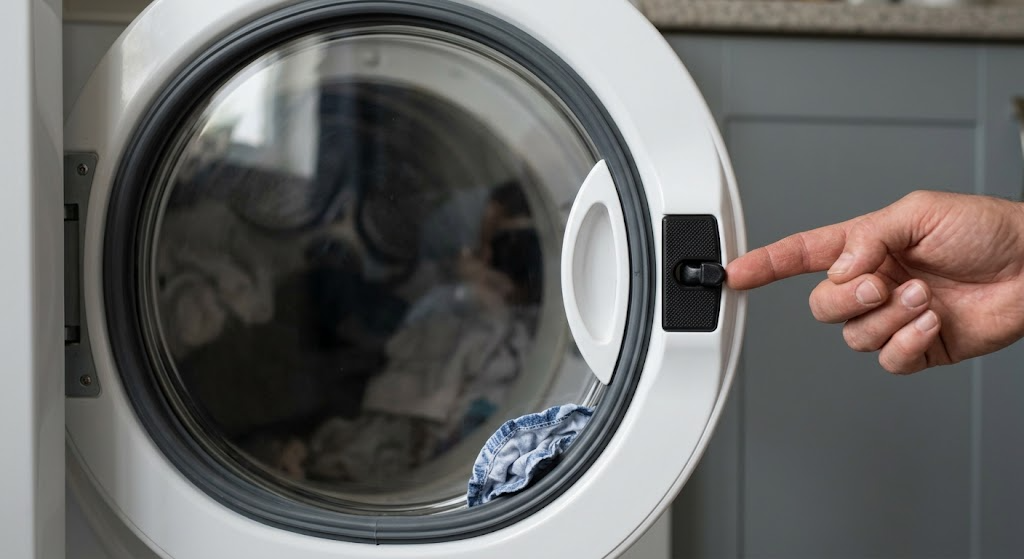
From outside the dryer, inspect the door pin or latch, handle, gasket or seal, and the edge of the opening for a trapped garment, lint, debris, misalignment, cracks, or a visibly broken piece. Remove only loose laundry or debris that is accessible without tools or force; do not pry the door or reach into the lock body.
Expected result: Laundry or debris is caught at the seal, the latch and handle look complete and aligned, or the pin, handle, seal, or door edge is damaged or displaced.
Next step: If the obstruction comes away freely and the hardware is intact, close the door gently and use the model's normal start or stop sequence once. If damage, misalignment, or a jam remains, keep the dryer unplugged and request service.
Stop if: Do not bend the latch, force the handle, insert a card or tool, remove the door, or open the cabinet to reach the lock.
Why this matters
Why: An obstruction can prevent the door from closing or releasing correctly. Visible damage or misalignment makes a mechanical door or latch fault more likely and cannot be safely corrected by pulling the locked door.
-
Check for a padlock or child-lock indicator
With the control panel powered only if the appliance is dry and otherwise safe, look for a padlock or child-lock symbol. Use only the button or button combination highlighted on the exact Electrolux model panel or in its user manual; do not apply a sequence borrowed from another model.
Expected result: The padlock disappears and controls respond, the symbol remains after the model-specific sequence, or no padlock is shown.
Next step: If the lock clears, try the intended programme only after confirming the door closes without force. If it does not clear, record the exact model and symbol and continue to the code and reset check without forcing the door.
Stop if: Do not defeat a child or door safety lock, hold the latch open, or operate the dryer with a damaged door or seal.
Why this matters
Why: A disappearing padlock supports child lock as the reason the controls appeared unresponsive. A persistent symbol may mean the sequence was wrong for the model or that a separate control fault is present; no symbol shifts attention back to the physical latch, programme state, and any error code.
-
Record the display and verify closure without slamming
Record any displayed code or warning, then close the door gently until it reaches its normal latch position. On models that show E40, use the Electrolux E40 guidance; on any other model, use the code lookup for that exact model instead of transferring the meaning across dryers.
Expected result: The door closes and latches with no code, the display reports E40 or another door-related warning, or the door appears closed but the code or locked state persists.
Next step: If closure is normal, continue to the one model-approved reset check. If a code persists, save a photo of the display and arrange service with the code and model number.
Stop if: Do not slam the door, bend the striker, hold the latch closed by hand, or continue if the seal, hinge, or door glass is damaged.
Why this matters
Why: A door that will not reach its normal latch position points toward an obstruction, damaged seal, latch, or overload. Electrolux's E40 material treats proper closure and locking as prerequisites for starting; a persistent code after visible checks may require service intervention.
-
Try only the reset specified for the exact model
After the dryer is stopped, cool, dry, and free of visible damage, follow the exact Electrolux manual's reset instruction. Where the model's official guidance permits it, disconnect the plug for the stated interval and reconnect it once; do not repeatedly reset a dryer that trips power or immediately returns the lock fault.
Expected result: The door releases and the warning clears, the dryer powers back up but the door remains locked, or the breaker trips or the same warning returns.
Next step: If the lock clears and the door closes normally, run only a short model-approved test while attended. Otherwise leave the dryer unplugged and request authorised service; do not substitute a door-lock part by appearance.
Stop if: Stop for a repeated breaker trip, smoke, odor, heat damage, or any need to access internal wiring or the interlock.
Why this matters
Why: A one-time recovery after reset can indicate a temporary control state. A repeated lock, immediate return of the warning, or a protective-device trip is evidence for a persistent latch, sensor, wiring, or control problem that needs professional diagnosis.
-
Escalate a persistent locked door
Arrange an authorised Electrolux service visit when the door remains jammed after safe visible checks and the model-approved reset, when the latch, handle, seal, hinge, or door is damaged, or when a door warning returns. Provide the model or product number, exact code or symbol, programme state, whether the drum was hot, and the observations already made.
Expected result: The service record contains a repeatable locked-door symptom and its context, or the lock releases but the door cannot close or the dryer will not start normally.
Next step: Keep the dryer disconnected and do not use it until the damaged or persistent door fault has been assessed and repaired.
Stop if: Do not disassemble the door-lock mechanism, bypass the interlock, test live circuits, or continue operating with a door that is not secure.
Why this matters
Why: A repeatable failure helps the engineer distinguish a mechanical latch or handle issue from a door-sensing, wiring, or control problem. Release of the door alone does not prove the dryer is safe to operate if the hardware is damaged.
Use your observations
Decision map
Find the observation that best matches what you see, then follow the next safe action.
-
PATH 01Next step
What you see
The dryer is still tumbling or hot, or the locked state appeared during an active programme.
Do this next
Use the normal stop control and wait for the drum to stop and the appliance to become safe. If it will not stop, smells burned, smokes, or remains dangerously hot, disconnect power only from a safe position and arrange qualified help.
Why this path and its safety boundary
Why it matters: The door may be in an operating safety state, and forcing it can create an injury or hardware fault.
-
PATH 02Next step
What you see
A padlock symbol is visible and the controls do not respond except for the model's permitted power controls.
Do this next
Use the exact Electrolux manual's child-lock sequence. If the padlock remains or the door is physically jammed, stop using the dryer and request service rather than bypassing the lock.
Why this path and its safety boundary
Why it matters: Child lock is more likely than a broken latch, but the release sequence is model-dependent.
-
PATH 03Next step
What you see
Laundry or debris is caught at the opening, or the pin, latch, handle, seal, hinge, or door edge is visibly damaged or misaligned.
Do this next
Remove only loose accessible debris without tools. Keep the dryer unplugged and arrange authorised service for any damaged, displaced, or still-jammed hardware.
Why this path and its safety boundary
Why it matters: The door cannot be treated as a software-only lock; the obstruction or mechanical damage may prevent safe closure or release.
-
PATH 04Next step
What you see
There is no padlock, the door hardware looks intact, the dryer is stopped and cool, but the door stays locked or a door warning returns after the exact model reset.
Do this next
Leave the dryer disconnected, save the code or display photo, and arrange authorised service. Do not order or install a lock assembly without exact model confirmation and qualified diagnosis.
Why this path and its safety boundary
Why it matters: A persistent latch, door-sensing, wiring, or control fault is more likely than a temporary control state, and the generic symptom cannot identify which component has failed.
-
PATH 05Next step
What you see
There is smoke, a burning smell, sparking, a hot or damaged cord, repeated breaker trips, gas odor, or water near electrical parts.
Do this next
Leave the area or shut off the relevant supply from a safe location, keep the dryer disconnected, and contact qualified electrical, gas, or appliance service as appropriate.
Why this path and its safety boundary
Why it matters: This is an appliance or electrical safety event, not a door-release troubleshooting branch.
Helpful context
Understand the symptom
A locked door is a safety state until the cause is clear
An Electrolux dryer door can appear locked because a programme is still active, a padlock indicates child lock, laundry or debris is obstructing the latch, or the latch, handle, or door-sensing system is damaged. A running or hot dryer should not be forced open. Use the normal controls and the exact model manual first, then inspect only what is visible from outside. The same word “locked” does not identify a particular replacement part.
Use the model manual for the release sequence
Electrolux's padlock guidance shows that child-lock controls differ between models, including among Zanussi and Electrolux-family dryers. Treat any button combination as model-specific. If the door is still jammed after the correct control sequence, or if the latch or handle is visibly damaged, preserve the model number and arrange service rather than prying the door or opening the cabinet.
Do not make an internal door-lock repair into a home test
Electrolux states that work inside a tumble dryer requires specific skills and knowledge and should be carried out by qualified authorised service engineers. Disconnecting power is necessary before authorised internal work, but it is not permission to bypass the door interlock, measure live wiring, or disassemble the lock without the exact service procedure.
Only after diagnosis
Potential parts
- dryer door latch or lock assembly
Only consider this part after a qualified diagnosis or exact model documentation confirms a latch or lock fault and visible obstruction, handle, seal, and control-lock causes have been ruled out.
Confirm the exact Electrolux model or product number and the manufacturer's fit information before ordering; do not select a part by appearance or by a code from another model.
When checks do not resolve it
Need a professional?
Request authorised Electrolux service when the dryer door remains jammed after the safe, model-specific checks; when the latch, handle, seal, hinge, or door is damaged; when a door code returns; or when the appliance has electrical, heat, smoke, gas, or repeated breaker symptoms. Keep the dryer disconnected until assessed.
Common questions
FAQ
Why is my Electrolux dryer door locked after the cycle?
First allow the dryer to stop and become safe, then check the visible latch, handle, seal, and opening for an obstruction or damage. If a padlock is shown, use the exact model's child-lock sequence. A door that remains jammed or damaged needs authorised service.
How do I turn off the padlock on an Electrolux dryer?
The child-lock button combination varies by model. Use the buttons highlighted on the control panel or the exact user manual; do not borrow a sequence from another Electrolux-family dryer.
Can I force open an Electrolux dryer door?
No. Pulling, prying, or bypassing the interlock can damage the latch and create an unsafe appliance. Stop the dryer normally, disconnect power only when safe, and request service if the door remains locked.
Should I replace the dryer door lock myself?
Do not choose or install a lock assembly from the symptom alone. Electrolux identifies internal door-interlock work as a qualified-service task; a technician should confirm the fault and exact model fit before any replacement.
Read the exact guide
Official sources
- How to disassemble and assemble the door safety interlock (tumble dryer)Electrolux · Supports keeping internal interlock work with qualified authorised service engineers and disconnecting the plug before internal access.
- Tumble dryer displays error message E40Electrolux · Supports the model-specific door-closure/code branch, visible seal and latch checks, and one documented 30-second reset for applicable E40 guidance.
- Tumble dryer's door will not open or is defective / brokenElectrolux · Supports checking the visible door pin/latch and handle and escalating a damaged or still-jammed dryer door to an engineer.
- Tumble dryer displays a padlockElectrolux · Supports the child-lock branch and the requirement to use the exact model's manual because release sequences vary.
Community feedback
Share a repair observation
Share a plain-text repair observation. Accepted observations are published automatically; this page may take a moment to update.