
On this page
Start here
Quick answer
Stop the dryer if the sound is accompanied by scraping, burning odor, smoke, a hot electrical connection, a gas odor, or a drum that is not turning normally. With the dryer off and cool, empty pockets and inspect the drum for loose objects or fasteners, then identify whether the sound follows the load or remains with the appliance. Electrolux describes some chimes, airflow, valve, burner, and support sounds as normal, while persistent noise during an empty load, severe vibration, or an inaccessible mechanical sound calls for service.
Work through in order
Diagnostic checks
Use only checks that match the exact appliance or system and its official guide.
-
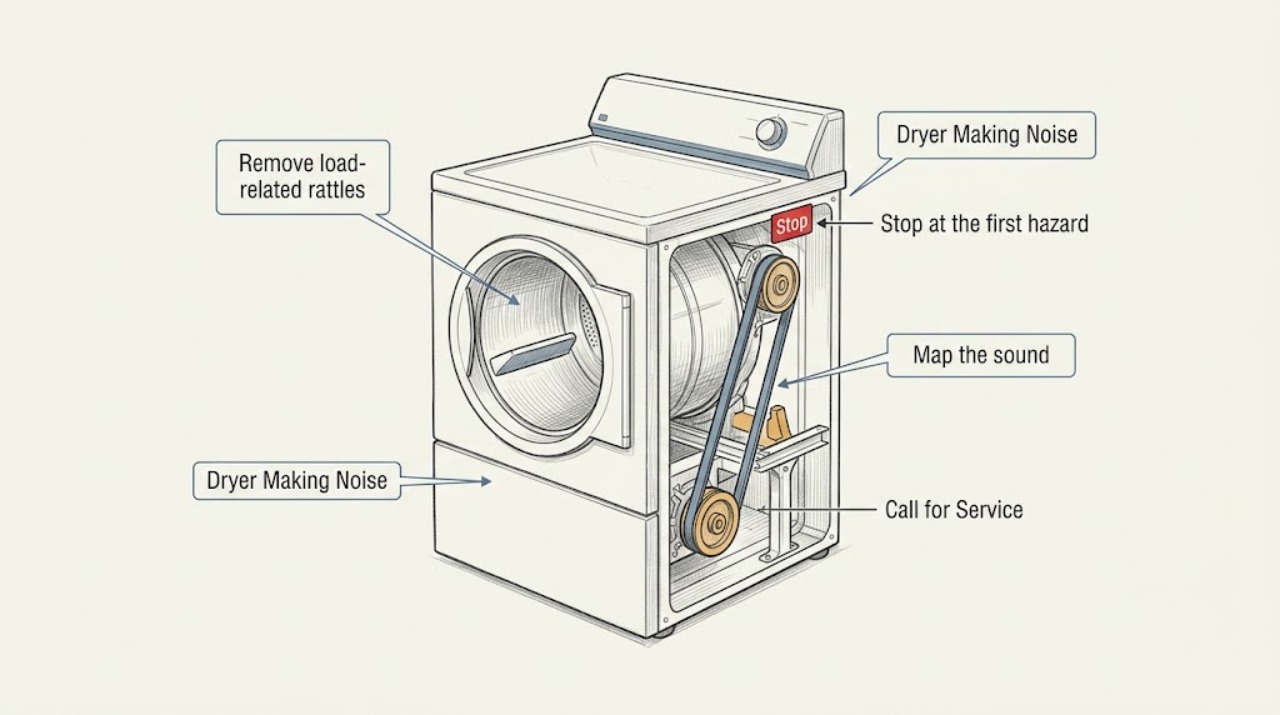
Stop at the first hazard sign
Press Pause or turn the dryer Off. If you smell burning, see smoke, feel unusual heat at the plug or outlet, hear electrical buzzing, smell gas, or see the drum stall or rub, keep the dryer off and disconnect power only from a dry, safe location. For a gas odor, do not operate switches or use a phone in the area; leave and contact the gas supplier or emergency help from a safe location.
Expected result: The noise stops with the cycle, or there is an odor, smoke, hot connection, gas odor, scraping, or abnormal drum movement.
Next step: Keep the dryer isolated and arrange qualified service. Do not remove panels, reach into a moving drum, bypass a thermal device, or continue operating to see whether the sound improves.
Why this matters
Why: A hazard sign changes the task from sound identification to fire, gas, or electrical safety. It is not a reason to run another load for comparison.
-
Map the sound to a cycle stage and location
With the dryer off, cool, and safe, write down whether the sound occurs at startup, during drum rotation, when heat begins, during cool-down, when the exhaust air changes, or at the end of the cycle. From outside the cabinet, note whether it is strongest at the drum front, rear, blower/exhaust area, motor area, pedestal, or floor contact. Do not place hands inside while parts can still move or be hot.
Expected result: The sound is a single chime, a load-related rattle, a repeating scrape or squeak, a thump with movement, or a hum that remains without a load.
Next step: Use the matching branch and compare only with the exact Electrolux owner's guide for the model. If the source is behind a panel or cannot be localized safely, stop at observation and escalate.
Why this matters
Why: The sound signature narrows the next check: chime/airflow/valve sounds may be model-normal, loose objects follow the load, and persistent repeating mechanical sounds belong to the appliance.
-
Remove load-related rattles
When the drum is stationary and cool, remove the load and check pockets, zippers, hooks, buttons, belt buckles, and other metal fasteners. Look inside the drum for a coin or loose object and remove only an object that is plainly loose and reachable without tools. Turn garments with fasteners inside out or secure them as appropriate for the fabric.
Expected result: A foreign object or fastener is found, or the drum is clear but the same noise was previously heard with different loads.
Next step: If the object was removed and no stop condition exists, proceed to a cautious empty-load comparison only as permitted by the manual. If the sound persists with the drum clear, keep the load out and continue diagnosis or arrange service.
Why this matters
Why: A loose object can strike the drum and produce a rattle or clank that disappears when removed. A sound across different loads is more likely to originate in the dryer.
-
Separate the appliance sound from the load
Only if there is no smoke, odor, scraping, severe vibration, hot connection, or other stop condition, follow the Electrolux guidance for a short empty-load comparison. Stay nearby, keep the door closed during operation, and stop immediately if a hazard appears; do not repeat the cycle to force a fault.
Expected result: The noise disappears when empty, or it remains with the empty drum and is present at the same stage of the cycle.
Next step: For a load-only result, change the garment preparation and load composition. For a persistent result, keep the dryer out of service if the sound is harsh, worsening, or mechanical, and provide the recording and timing to service.
Why this matters
Why: A load-only noise points to garments or fasteners. A persistent empty-drum noise points to the dryer and should not be dismissed as clothing movement.
-
Check level, pedestal, and contact points
With power off, inspect the dryer externally for rocking, a cabinet contacting a wall, a loose pedestal or stacking support, and a floor that is not firm and level. If the unit was recently installed, verify from the model installation instructions that required shipping material was removed. Do not climb on the appliance or dismantle a stacked unit to reach a support.
Expected result: The dryer rocks, walks, contacts surrounding cabinetry, a pedestal is loose, or the floor/support is uneven; or the cabinet is stable and clear of contact.
Next step: Correct only an obvious external contact or leveling issue within the owner's instructions. If the unit is stacked, the support is loose, or noise persists after the external check, arrange qualified service.
Why this matters
Why: Movement and contact can create vibration, thumping, or squeaking without proving an internal component failure. A stable, correctly supported cabinet makes an internal or load-related source more likely.
-
Treat heat, motor strain, and vent symptoms as stop signals
After the dryer has cooled, note whether the noise appeared with an overloaded drum, a restricted exhaust path, or a cycle that left the cabinet unusually hot. Clean the lint screen as directed and visually check the accessible exhaust outlet for obvious blockage without operating the dryer in an unsafe configuration. Do not open the motor area or bypass a thermal limiter.
Expected result: The motor hums or stops after a heavy load, the cabinet or outlet is unusually hot, airflow is restricted, or the sound persists after a normal-size load and clear accessible outlet.
Next step: Allow the appliance to cool and follow the model's vent and load instructions. If overheating, repeated stopping, odor, or noise returns, keep it off and arrange service.
Why this matters
Why: Load and airflow can increase motor or heat stress, while a persistent sound or thermal shutdown may involve a motor, blower, belt, support, or safety component that needs diagnosis.
-
Record evidence before requesting service
Record the model, sound description, cycle stage, load or empty-drum result, location, whether the drum turns smoothly by the normal user control, vibration or walking, heat or odor, and any recent installation or stacking change. A short recording made from a safe distance can help; never record by reaching near moving or energized parts.
Expected result: The sound is persistent with an empty drum, worsens, returns after external checks, or cannot be localized without removing a cover.
Next step: Use Electrolux support or an authorized service provider with the recorded evidence and keep the dryer off if any stop condition occurred.
Why this matters
Why: A repeatable appliance-level sound or inaccessible source is beyond a safe user check. Repeated operation can turn a support or motor symptom into additional damage.
Use your observations
Decision map
Find the observation that best matches what you see, then follow the next safe action.
-
PATH 01Next step
What you see
The sound is a model-listed chime, airflow, valve, burner, or support sound, with normal drum movement and no odor, smoke, unusual heat, or worsening behavior.
Do this next
Arrange qualified service and follow the exact model guidance.
Why this path and its safety boundary
Why it matters: The sound may be normal for that model; a change in character or new hazard sign overrides this branch.
-
PATH 02Next step
What you see
Rattle or clank is present with a particular load and disappears when the drum is empty.
Do this next
Arrange qualified service and follow the exact model guidance.
Why this path and its safety boundary
Why it matters: The load source is addressed without assuming an internal dryer fault; recurring noise with other loads needs service.
-
PATH 03Next step
What you see
The dryer rocks, walks, contacts a wall, or a pedestal/stacking support is loose.
Do this next
Arrange qualified service and follow the exact model guidance.
Why this path and its safety boundary
Why it matters: A support-related vibration may be removed; continued movement or squeaking requires service.
-
PATH 04Next step
What you see
The noise remains with an empty drum, repeats once per rotation, becomes scraping or grinding, or is paired with heat, odor, smoke, a hot connection, or abnormal stopping.
Do this next
Arrange qualified service and follow the exact model guidance.
Why this path and its safety boundary
Why it matters: The dryer remains out of service while the drum support, belt, blower, motor, wiring, and safety system are assessed.
Helpful context
Understand the symptom
A noise is a timing and location problem
Listen for when the sound starts: immediately when the drum begins, only when tumbling, during heat or cool-down, or at the end of a cycle. A rattle that follows one garment is different from a scrape that repeats once per drum revolution. A hum near the rear or exhaust path is different from a thump that makes the cabinet move. Record the sound rather than repeatedly running a dryer that may be overheating or damaging a support.
Normal does not mean every new sound is safe
Electrolux lists some operating sounds as normal, but its guidance still starts with stopping the dryer and checking for foreign objects. A new, worsening, or persistent sound that remains with an empty drum should be treated as an appliance fault, especially when paired with heat, odor, vibration, or a loss of normal drum movement.
When checks do not resolve it
Need a professional?
Contact Electrolux support or an authorized service provider for a persistent appliance-level noise, repeated vibration after external checks, motor or thermal symptoms, or any sound with an electrical, gas, or fire warning sign.
Common questions
FAQ
Are some Electrolux dryer noises normal?
Yes. Electrolux lists certain chimes, airflow, valve, burner, and suspension-roller sounds as normal depending on the model. A new, harsh, worsening, or persistent sound—especially with heat, odor, smoke, or abnormal movement—needs a safety stop and possible service.
Why does my Electrolux dryer rattle or clank?
Check pockets and metal fasteners first. Electrolux recommends stopping to check the drum and comparing with an empty load. If the sound remains with the drum empty, it is more likely coming from the dryer and should be escalated if it persists.
What if the dryer is vibrating or walking?
Stop and check from the outside whether the unit is level, firmly supported, contacting a wall, or loose on a pedestal. A newly installed unit may also need its installation materials checked against the manual. Do not dismantle a stacked appliance; persistent movement needs service.
Should I keep running the dryer to identify the noise?
No. Only make the brief empty-load comparison described by Electrolux when no safety warning is present and you can stop immediately. Do not repeat operation when there is scraping, grinding, burning odor, smoke, gas odor, unusual heat, severe vibration, or abnormal drum movement.
Read the exact guide
Official sources
- What should I do if my dryer stops operating?Electrolux · Electrolux dryers; motor-overheat and thermal-limiter guidance.
- Dryer - Not Drying and Extended Drying TimeElectrolux · Electrolux dryers; lint-screen, exhaust, ventilation, and gas-dryer safety guidance relevant when noise accompanies heat or airflow symptoms.
- Laundry Dryer NoisesElectrolux · Electrolux laundry dryers; sound categories and installation checks are general guidance and must be reconciled with the exact model guide.
- Is it normal for my dryer to make sounds or noises?Electrolux · Electrolux dryers; normal operating sound examples and load-versus-appliance comparison.
Community feedback
Share a repair observation
Share a plain-text repair observation. Accepted observations are published automatically; this page may take a moment to update.