
On this page
Start here
Quick answer
Treat the element replacement as an unverified repair, not proof that the new element is the correct part or that the connections and reassembly are sound. The EOB3400 family has regional and PNC variants, and its official manual calls the fan mode True Fan Cooking: select that function and the intended temperature with the cavity empty and the door closed. First record the rating-plate model and PNC, confirm the clock and settings, and compare one supervised preheat in fan mode with one in Conventional Cooking without opening the cabinet. If only fan mode remains cold, or if both modes stay cold after the visible controls and supply checks, stop choosing parts and have an authorised Electrolux technician verify the exact variant, element compatibility, wiring and reassembly. Stop immediately for smoke, burning smell, arcing, hot or damaged wiring, or a breaker that trips again.
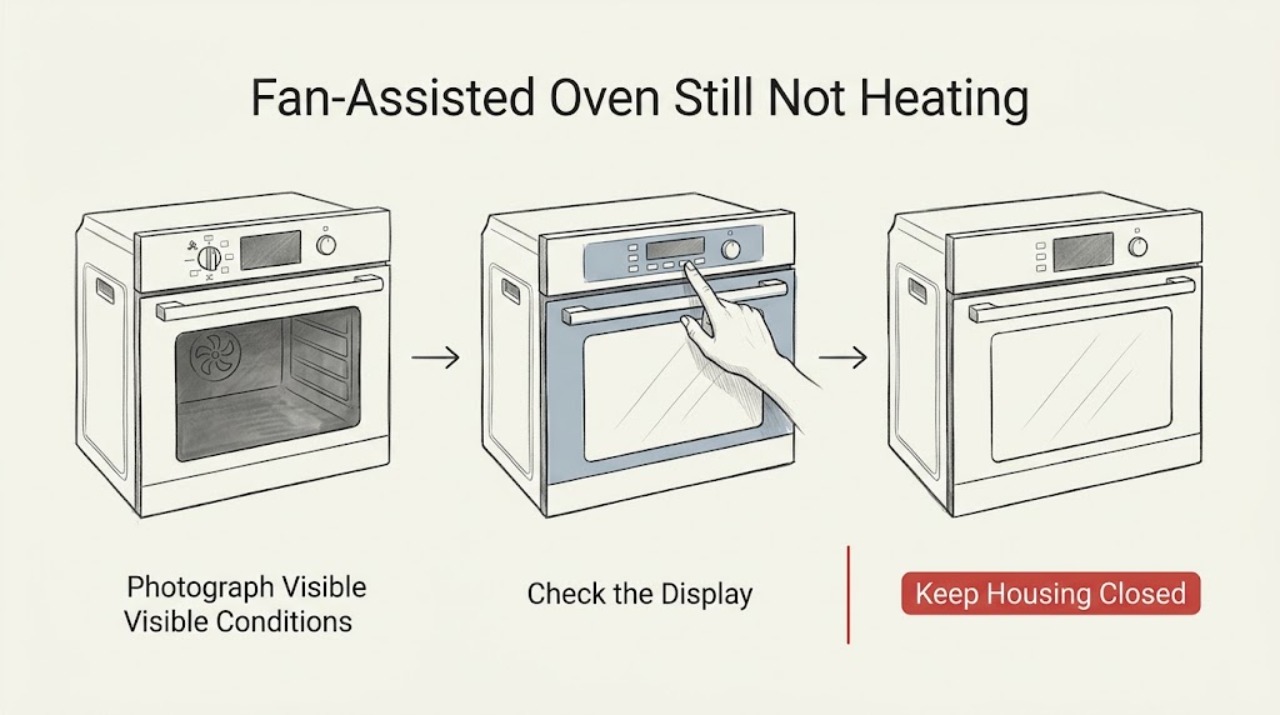
Work through in order
Diagnostic checks
Use only checks that match the exact appliance or system and its official guide.
-
Check 1
With the oven cool and not opened, photograph the rating plate and record the complete model code, PNC, market, the old and replacement element markings if already available, the date of the repair, and exactly which functions were tested.
Expected result: The plate supplies a complete EOB3400 variant and PNC, or it shows only the broad EOB3400 family name; the replacement part is documented or its identity is unknown.
Next step: Give the complete identity and repair record to Electrolux or the original technician. Do not order another element, select a wattage by appearance, or infer compatibility from a similar EOB3400 listing.
Stop if: Stop using the oven if the repair left exposed wiring, a loose cover, a damaged cord, or visible heat damage.
Why this matters
Why: EOB3400 variants can have different PNC records. Without the PNC, a part that physically fits cannot be treated as confirmed compatible, and the repair history cannot identify the failed circuit.
-
Check 2
Check the user-facing controls only: make sure the clock is set, select the EOB3400 manual's True Fan Cooking function rather than Light, Grill, Defrost, or another non-baking function, set a temperature, and leave the empty cavity door closed during one supervised preheat attempt.
Expected result: The display or indicator responds and the cavity becomes warm, or the display is active but the cavity stays cold; a clock or setting symbol may also remain unresolved.
Next step: If the documented setting restores heat, use the exact manual for normal cooking. If fan mode remains cold, move to the mode comparison and post-repair service branch; do not open the cabinet.
Stop if: Stop for smoke, a burning smell, sparks, abnormal heat, or any repeat breaker/fuse operation.
Why this matters
Why: A missing clock or incomplete function/temperature setting can prevent heating. Heat in this test shows that the oven can energise a heating function, but it does not prove the replaced element is correct or that fan mode is healthy.
-
Check 3
If the first test is safe, turn the controls off and make one separate, supervised comparison using Conventional Cooking at an appropriate manual setting. Observe only the display/indicator, fan sound, and whether the empty cavity warms; do not remove panels or touch the fan, element, terminals, or wiring.
Expected result: Conventional Cooking warms while True Fan Cooking stays cold; both modes warm; or neither mode warms despite a live display.
Next step: For a mode-specific failure or no heat in both modes, stop further testing and ask authorised service to verify the exact PNC, compatible element, connectors, selector/control path, and safe reassembly. Do not repeat blind part replacement.
Stop if: Do not continue if the door, cover, wiring, or control area is damaged or if the oven behaves unpredictably.
Why this matters
Why: A single cold fan mode is a mode-specific or post-repair path, not proof of a failed fan-ring element. Heat in both modes makes a total power loss less likely. No heat in either mode keeps supply, control, setting, and post-repair reassembly in scope.
-
Check 4
If the oven warms but cooking is consistently too cool or too hot, record the selected function, set temperature, preheat indication, rack position, and the approved thermometer method from the exact manual; compare more than one controlled test rather than one recipe.
Expected result: The oven reaches a stable temperature with a repeatable offset, or it cannot reach or hold the selected temperature.
Next step: Use calibration only if the exact EOB3400 manual supports it. If the oven cannot reach or hold temperature or the offset remains after the documented method, arrange authorised service rather than opening the cabinet.
Stop if: Stop for uncontrolled heating, a thermal warning, smoke, burning odour, or hot/damaged wiring.
Why this matters
Why: A repeatable measurement issue is different from a no-heat failure. Electrolux notes that measurement position, timing, and thermometer accuracy affect conclusions, and a continuing problem may require sensor or other service investigation.
-
Check 5
Check the visible fuse, RCD, or breaker status only from a safe position. If it has operated, reset it no more than once when there is no smell, heat, damage, or moisture, and observe whether it operates again during the controlled test.
Expected result: The oven returns after a single reset, the fuse/RCD/breaker trips again, or the outlet/cord shows heat or damage.
Next step: Leave the oven off after a repeat trip or visible damage and arrange a qualified electrician for the supply concern and/or authorised Electrolux appliance service. Never increase fuse capacity or bypass protection.
Stop if: Immediate stop for arcing, smoke, burning smell, hot plug/outlet, damaged cable, or a breaker that will not stay on.
Why this matters
Why: A recurring trip can indicate an installation, supply, or appliance fault and is not evidence that another element is needed. Electrolux directs recurring fuse problems to a qualified electrician or professional service.
Use your observations
Decision map
Find the observation that best matches what you see, then follow the next safe action.
-
PATH 01Next step
What you see
True Fan Cooking remains cold after the clock, function, and temperature are confirmed, but Conventional Cooking warms normally.
Do this next
Stop further user testing and ask authorised Electrolux service to verify the PNC-specific element and the repair's wiring and reassembly. Do not order another part from the symptom.
Why this path and its safety boundary
Why it matters: The fault is narrowed to the fan-mode path or the post-repair work; it does not identify the element, fan motor, selector, connector, or control board.
-
PATH 02Next step
What you see
Both True Fan Cooking and Conventional Cooking remain cold while the display responds.
Do this next
Check the clock and visible breaker status once, then arrange authorised service if the oven stays cold. Do not open panels or measure live wiring.
Why this path and its safety boundary
Why it matters: A mode-only explanation is less likely; settings, supply, control, and the post-repair circuit remain possible, and a heater cannot be selected from this observation.
-
PATH 03Next step
What you see
The oven reaches heat but has a repeatable temperature offset with no safety warning.
Do this next
Follow only the exact model's approved temperature-check or calibration guidance. If it cannot reach or hold temperature, request service for sensor, control, and heating-path assessment.
Why this path and its safety boundary
Why it matters: This is a temperature-verification or calibration question, not proof that the recently replaced element failed.
-
PATH 04Next step
What you see
Smoke, burning smell, arcing, hot or damaged wiring or plug, uncontrolled heating, or a breaker/fuse trips again.
Do this next
Turn the controls off, isolate power only by a safe normal means if accessible, leave the oven out of service, and contact a qualified electrician or authorised Electrolux service. Do not reset repeatedly or attempt another repair.
Why this path and its safety boundary
Why it matters: This is an electrical or thermal safety stop regardless of which component was replaced.
Helpful context
Understand the symptom
A replacement element changes the order of decisions. It does not, by itself, prove that the replacement matches this EOB3400 variant, that the fan-assisted circuit is the one affected, or that the repair was fully reassembled. Do not repeat the replacement or open the oven cabinet to test terminals. Preserve the old and new part information for the technician.
Electrolux's EOB3400 documentation labels the circulating mode True Fan Cooking and gives separate conventional and fan-cooking guidance. The family name is not a complete compatibility key: the official EOB3400EAX parts page shows several PNC versions and asks for the PNC before compatible spares can be identified. Use the rating plate and the manual for the exact suffix and market rather than treating every EOB3400 variant as identical.
The safe public checks can show whether this is a mode or control issue, a wider supply problem, or a post-repair fault that needs service. They cannot prove a heater, fan, sensor, connector, selector, or control board from the symptom alone.
When checks do not resolve it
Need a professional?
Arrange authorised Electrolux appliance service when fan-assisted heating remains cold after the documented user-facing setting and power checks, when only one heating mode works after an element replacement, when the exact PNC or replacement compatibility is uncertain, or when the oven cannot reach or hold temperature. Use a qualified electrician for a recurring fuse/RCD or breaker trip, damaged supply, hot outlet, or installation concern. Stop immediately for smoke, burning smell, arcing, hot or damaged wiring, uncontrolled heating, moisture near electrical parts, or any protection that trips again. Do not open the cabinet, perform live measurements, choose a part by appearance or wattage, or continue replacing parts by guesswork.
Common questions
FAQ
Does a new element prove that the fan-assisted circuit is fixed?
No. A replacement does not prove PNC compatibility, correct wiring, complete reassembly, or that the failed path was the element. Compare the documented fan and conventional functions once from the user controls, then have service verify the repair if fan mode remains cold.
What is the fan-assisted setting called on an EOB3400?
The opened EOB3400 English manual calls the circulating bake function True Fan Cooking. The exact control layout and variant still need to be confirmed from the rating plate and PNC-specific manual.
Can I test the element or its terminals with a meter?
Do not test live terminals or open the oven cabinet as a consumer troubleshooting step. Electrolux's repair guidance requires power isolation, compatible-part verification, and the necessary repair know-how; use authorised service for the post-replacement electrical checks.
Why can the oven fan or lamp operate while there is no heat?
The fan, lamp, and heating functions are not the same observation. A working display, lamp, or fan does not prove that a heating circuit is energised. Confirm the function and clock, then use the mode comparison and service boundary above rather than selecting a heater or control part from that symptom.
Read the exact guide
Official sources
- Model EOB3400EAX - Spares & AccessoriesElectrolux UK · The official model page lists multiple PNC versions of EOB3400EAX and states that the PNC is required to identify compatible spares. It is used here for identity and compatibility boundaries, not for selecting a part for the unspecified EOB3400 variant.
- Temperature on the oven's display differs from the measured temperatureElectrolux UK · General Electrolux guidance on temperature checks, thermometer method, door closure, child lock, and when a persistent discrepancy needs service. Use only the exact EOB3400 manual for any calibration procedure.
- Oven does not heat upElectrolux UK · General Electrolux support distinguishes one heating type from several and covers safe checks for manual temperature/function selection, fuse/RCD, clock, Duration/End, Demo, Child Lock, and professional escalation. It is not a substitute for the exact EOB3400 PNC manual.
- How to replace fan/ring heating element (3)Electrolux UK · The opened guidance warns to disconnect mains power, verify compatible parts, account for injury, burn, and electric-shock risks, and recognize that nonprofessional repair can have safety or warranty consequences. It is not used here as a user-facing replacement procedure or as proof of EOB3400 compatibility.
- EOB3400BOW / EOB3400EAX Oven User ManualElectrolux · The opened English manual identifies EOB3400 variants, documents True Fan Cooking, Conventional Cooking, clock and heating-function settings, safety thermostat/cooling fan behavior, and the oven-does-not-heat troubleshooting table. The rating plate and PNC must be checked for the exact local variant.
Community feedback
Share a repair observation
Share a plain-text repair observation. Accepted observations are published automatically; this page may take a moment to update.