
On this page
Start here
Quick answer
A pop near the end of a self-clean cycle followed by both ovens becoming unusable is not a normal preheat problem. Leave the Electrolux E36DF76EPS off, keep clear of the hot range until it has cooled, and do not run Self Clean again. From a dry, safe position, record whether the display, lights, and surface controls still have power and whether a breaker has tripped; reset a breaker only once if there is no odor, heat, smoke, sparking, or visible damage. Electrolux says the door remains locked until the oven cools and its error guide treats thermal-runaway and persistent door-lock conditions as service matters. A pop can be a symptom of an electrical or thermal event, but it does not identify a fuse, relay, control board, or heating element. If both ovens remain dead or cold after cooling, arrange qualified Electrolux appliance service and do not open the cabinet.
Before you begin
Safety first
- Do not force the self-clean door, open the rear cover, measure live voltage, bridge a door lock, bypass thermal protection, change fuse or breaker ratings, or replace a fuse, relay, control board, sensor, or heating element from the pop symptom alone. Do not rerun Self Clean or repeatedly reset the supply. Stop for smoke, burning odor, sparking, melted material, a hot or damaged cord, gas odor, or a repeated breaker trip.
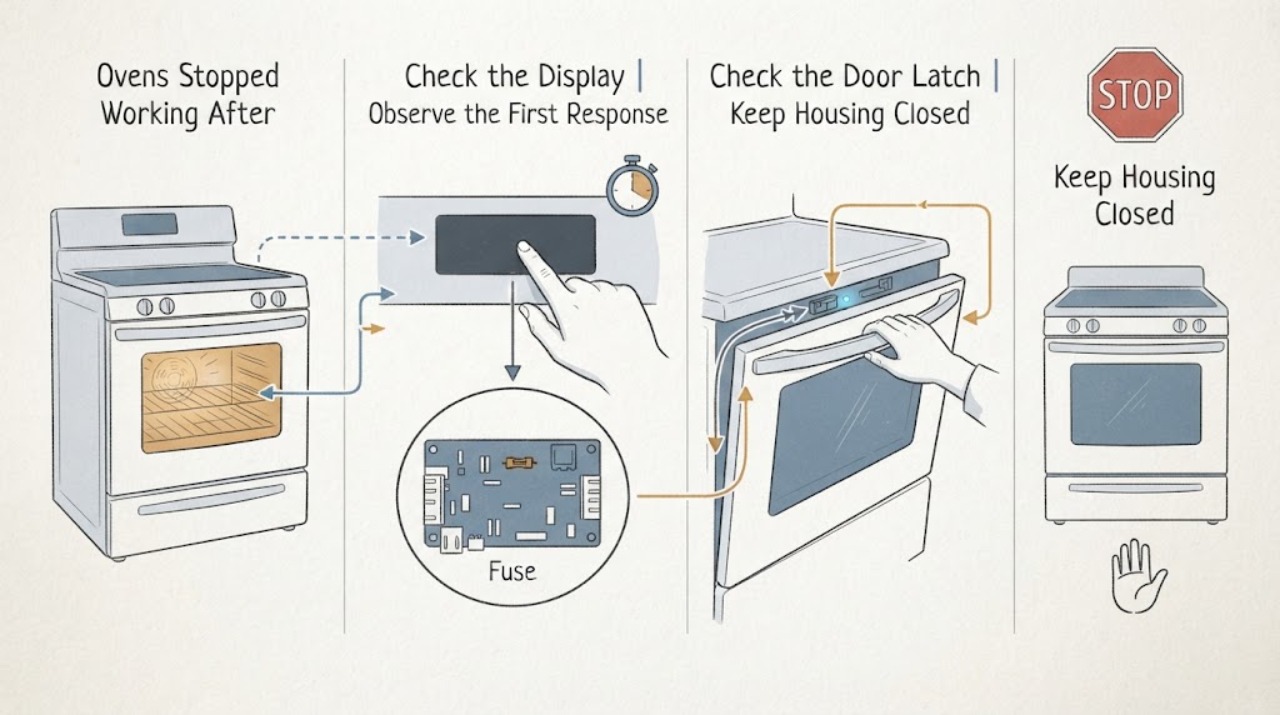
Work through in order
Diagnostic checks
Use only checks that match the exact appliance or system and its official guide.
-
Check 1
Stop using the range and keep people away from the hot door and control area. Do not restart Self Clean, open the door by force, spray cleaner into the controls, or touch the cabinet while it is hot. Wait for the appliance to cool normally and note the time, the pop, any smoke or odor, and whether the cooling fan continues.
Expected result: The range cools with no smoke, burning smell, sparking, gas odor, or visible damage, or a hazard is present or continues.
Next step: For smoke, burning odor, sparking, melted material, a hot or damaged cord, or a gas odor, leave the area as appropriate, isolate power or gas only when safe, and obtain urgent qualified help. Otherwise continue only after the range is cool and dry.
Why this matters
Why: A pop after a high-heat cycle is a safety-relevant event rather than evidence of an ordinary mode-selection error. Smoke, odor, arcing, or damaged wiring raises an immediate electrical or fire boundary.
-
Check 2
From a dry, safe position, check the visible display, oven lights, and control response without opening a panel. Inspect only whether the range is visibly plugged in or the supply connection is undisturbed; if a household breaker has tripped, reset it once only when there is no hazard and the circuit is clearly identified.
Expected result: The display and other functions are dead, the display returns after one safe breaker reset, or the display works but both ovens remain cold or unresponsive.
Next step: If the breaker trips again, the cord or outlet is hot or damaged, or the range stays dead, leave it off and use a qualified electrician or Electrolux appliance service. If the display works but neither oven heats, do not run another cooking or cleaning cycle; arrange appliance service.
Why this matters
Why: A fully dead range keeps the supply and internal power path in scope. A powered display with both ovens cold after a pop keeps the post-clean thermal or control event in scope. Neither observation identifies a particular part.
-
Check 3
When the range is fully cool, observe the door-lock indicator and record any exact code or message before changing settings. Do not pry the door, defeat the latch, enter a technician test mode, or repeatedly cycle the breaker.
Expected result: The lock clears normally with cooling, the lock remains engaged, a thermal or door-lock message appears, or no code is shown.
Next step: If the door remains locked after the normal cool-down or a code returns, leave the range off and provide the code and model to authorized service. If no code appears but both ovens still fail, continue only with service handoff rather than a guessed part.
Why this matters
Why: A locked door immediately after Self Clean can be a normal cool-down state. A persistent lock or thermal message needs the model guide and service; no code does not rule out an internal electrical or thermal fault after the pop.
-
Check 4
Do not perform a new preheat or self-clean test to see whether the sound repeats. Instead, document whether the upper and lower oven cavities both lost heat, whether the cooktop burners still operate, whether the display clock remains lit, and whether any smell, noise, or breaker change occurred after the pop.
Expected result: Both ovens are affected, only one cavity is affected, the cooktop still works, or all functions are dead.
Next step: Keep the range off and arrange qualified Electrolux service. Give the provider the exact E36DF76EPS identity, the self-clean stage, pop timing, affected cavities, display state, breaker result, and any hazard observations; do not remove panels or test components.
Why this matters
Why: A shared symptom across both ovens is useful evidence about the range's common supply or control path, but it is not proof of a relay, fuse, or board failure. A one-cavity symptom may require a different model-specific assessment.
-
Check 5
If Electrolux support specifically asks for a reset and the range is cool, dry, and free of hazard signs, follow the exact model guide or support instruction once. The general Electrolux error guide describes disconnecting power for 30 seconds, but the E36DF76EPS model documentation controls; do not repeat a reset if the pop symptom, code, or no-heat condition returns.
Expected result: The controls recover and both ovens heat normally under one supervised, ordinary cooking test, or the dead/no-heat condition returns.
Next step: Stop testing and arrange qualified service if the symptom returns. Never use a reset to bypass thermal protection, never run Self Clean again to confirm the fault, and never select a replacement component from the sound alone.
Why this matters
Why: A one-time recovery may clear a transient control state but does not prove that the high-heat event caused no damage. A return of no heat, a code, a lock, or an odor means the underlying condition remains.
Use your observations
Decision map
Find the observation that best matches what you see, then follow the next safe action.
-
PATH 01Next step
What you see
The range remains hot or the door is locked immediately after Self Clean, but there is no smoke, odor, sparking, or visible damage.
Do this next
Leave the door closed and allow normal cooling. If the lock does not clear after the normal cool-down or any code returns, arrange authorized service rather than prying or bypassing it.
Why this path and its safety boundary
Why it matters: The lock may still be the normal cool-down state described by Electrolux, and forcing it could damage the safety mechanism or expose someone to heat.
-
PATH 02Next step
What you see
After cooling, the display and both ovens are dead, or the breaker will not stay reset after one safe attempt.
Do this next
Leave the range off and arrange a qualified electrician for the circuit or an authorized Electrolux technician for the appliance. Do not open the rear cover, change a fuse rating, or re-energize it repeatedly.
Why this path and its safety boundary
Why it matters: The common power path or an internal electrical protection/control condition is more likely than a simple cooking-mode mistake, but the pop does not identify a fuse or board.
-
PATH 03Next step
What you see
The display works after cooling, but both ovens remain cold in a confirmed cooking mode and no error code is shown.
Do this next
Do not run another Self Clean cycle or repeat preheat experiments. Arrange qualified Electrolux service with the model and event history, and request assessment of the common power, control, and heating paths.
Why this path and its safety boundary
Why it matters: A powered control with shared no-heat after a self-clean pop is still a post-thermal event requiring diagnosis; lack of a code does not make it safe to guess an internal part.
-
PATH 04Next step
What you see
Smoke, burning odor, arcing, a hot or damaged cord, melted material, gas odor, or a repeated breaker trip occurred during or after the pop.
Do this next
Keep people away, leave for gas odor, isolate power or gas only when safe, and obtain urgent qualified help. Do not re-energize the range for a reset or cooking test.
Why this path and its safety boundary
Why it matters: This is an immediate electrical, fire, or gas safety boundary rather than a routine no-heat branch.
Helpful context
Understand the symptom
Why the pop changes the diagnosis
The assigned symptom is not simply that an oven failed to preheat. It is a high-heat self-clean event followed by a pop and loss of operation in both oven cavities. That sequence changes the first decision to safety and power isolation. It does not prove which internal component failed, so a fuse, relay, control board, sensor, or element should not be named as the repair without an inspection.
The door may stay locked while hot
Electrolux says a self-clean door remains locked until the oven cools. Do not force the door or treat a still-locked door as proof that the latch is broken. Once the unit is cool, document the display and door-lock status and leave internal access to qualified service.
When checks do not resolve it
Need a professional?
Arrange authorized Electrolux appliance service when both oven cavities remain dead or cold after the range has cooled, the display does not recover, a door-lock or thermal message returns, a reset does not restore normal operation, or any internal inspection would be needed. Use a qualified electrician for a recurring breaker, outlet, wiring, or installation concern and qualified gas help for a gas odor.
Safety scope: Do not force the self-clean door, open the rear cover, measure live voltage, bridge a door lock, bypass thermal protection, change fuse or breaker ratings, or replace a fuse, relay, control board, sensor, or heating element from the pop symptom alone. Do not rerun Self Clean or repeatedly reset the supply. Stop for smoke, burning odor, sparking, melted material, a hot or damaged cord, gas odor, or a repeated breaker trip.
Have this ready
- Provide the full model E36DF76EPS, the self-clean duration or stage when the pop occurred, whether the upper and lower ovens were both affected, display and lock status after cooling, breaker result, cooktop status, exact code or message, and any smoke, odor, heat, sparking, or sound observations.
Common questions
FAQ
Is a pop during Electrolux Self Clean normal?
A pop followed by both ovens no longer working should not be treated as a normal completion signal. Leave the range off, allow it to cool, document the display and power state, and arrange service if the no-heat or dead condition remains.
Why is the door still locked after Self Clean?
Electrolux says the door remains locked until the oven cools sufficiently. Do not force it. If it remains locked after normal cooling or a door-lock message returns, provide the model and code to authorized service.
Does the pop prove the control board or fuse failed?
No. The sound and timing are important evidence, but they do not identify a fuse, relay, control board, sensor, or element. Internal diagnosis and any component decision belong to qualified service.
Can I reset the breaker and try Self Clean again?
No. If there is no hazard, a qualified person may follow the exact model reset instruction once after the range is cool, but do not repeat resets or rerun Self Clean after a pop. A returning no-heat symptom needs service.
Read the exact guide
Official sources
- Ovens - How do I set my oven or range to self-clean? | ElectroluxElectrolux · Opened Electrolux owner-support guidance for ovens and ranges. The assigned E36DF76EPS identity is supplied by the task; verify any model-specific control sequence in its use and care guide.
- Oven Error Codes and Alarms Guide | ElectroluxElectrolux · Opened Electrolux error guidance used for safe post-clean escalation; exact code coverage and reset sequence must be checked against the E36DF76EPS model guide.
Community feedback
Share a repair observation
Share a plain-text repair observation. Accepted observations are published automatically; this page may take a moment to update.