
On this page
Start here
Quick answer
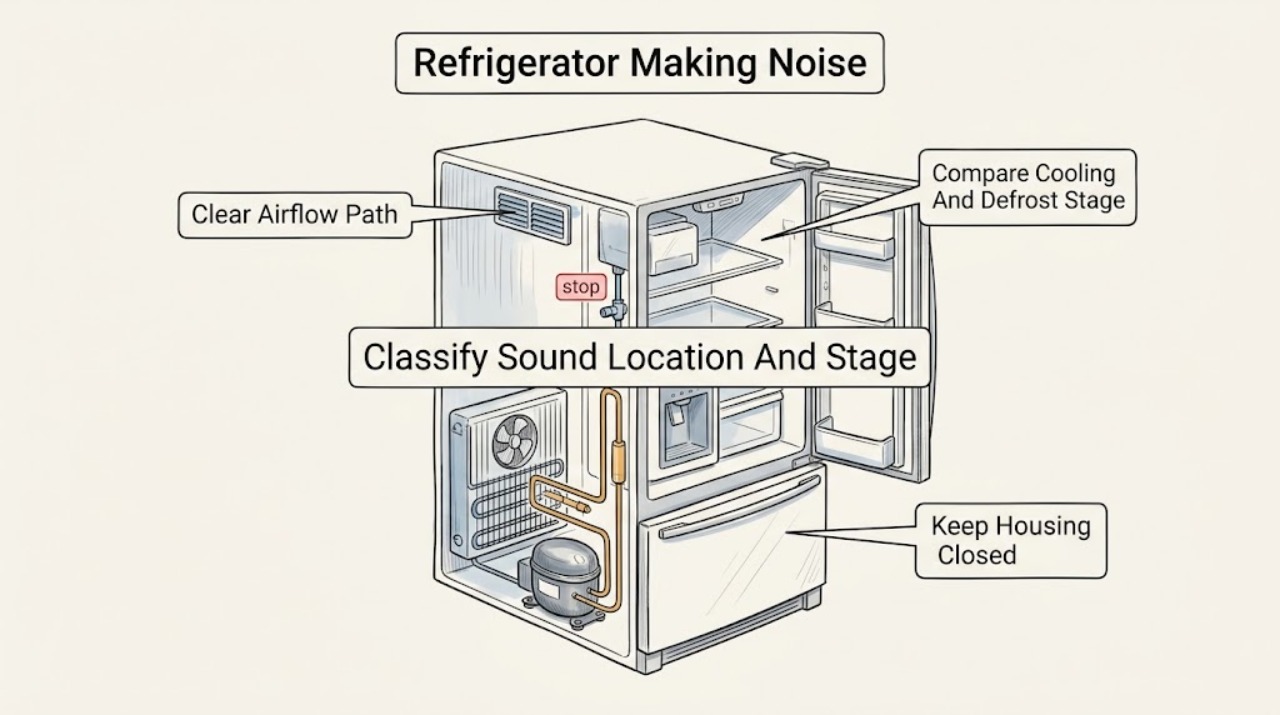
Start with where the Electrolux refrigerator noise comes from and when it occurs. A low hum or vibration during cooling can come from the compressor; rushing, blowing, or whistling can come from evaporator or condenser airflow; gurgling can be refrigerant moving through the evaporator; hissing or sizzling followed by a pop can occur during defrost; clicking, clunking, buzzing, or water sounds can occur during ice making or dispensing. Those sounds are only normal when they match the refrigerator's operating stage and the unit is cooling normally. Check externally that the cabinet is stable, shelves and containers are not rattling, doors seal, vents are not blocked, and the refrigerator is not pressed against a wall; do not touch the compressor, fans, refrigerant tubing, wiring, or sealed system. A new loud grinding, scraping, repeated clicking without cooling, violent vibration, electrical buzz, burning odor, hot plug, water near electrics, or noise accompanied by warming or leaking is a stop condition. Record the sound, location, timing, and temperature, then use the exact model manual or arrange qualified Electrolux service.
Before you begin
Safety first
- This article covers external listening, accessible stability, shelf/container, vent, door, and model-approved dispenser observations only. Qualified personnel must handle panels, fans, compressors, valves, wiring, defrost components, refrigerant lines, and sealed-system work.
Work through in order
Diagnostic checks
Use only checks that match the exact appliance or system and its official guide.
-
Check 1
Stand clear of moving parts and listen briefly without opening covers. Record whether the sound is from the rear/bottom cabinet, inside the freezer or fresh-food compartment, a door dispenser or ice chute, a shelf/bin, or the floor/cabinet contact. Note whether it starts when the compressor runs, a door opens or closes, a defrost cycle occurs, the ice maker fills, ice dispenses, or the sound is continuous.
Expected result: The sound is a low hum/vibration, rushing/blowing/whistling, gurgling, hissing/sizzling/popping, clicking/snapping, clunking/thumping, buzzing, dripping/water running, rattling, grinding, or an electrical/arc-like sound, and it is linked or not linked to a run stage.
Next step: Use the matching sound branch and record temperature, frost, leaks, alarms, and whether the sound changes when a door opens. Stop immediately for smoke, burning odor, sparks, abnormal heat, or water near electrical parts.
Stop if: Do not put a hand into a fan or chute, touch the compressor or tubing, or remove a grille or cover to listen closer.
Why this matters
Why: Location and timing provide the first decision: compressor/airflow/refrigerant, defrost, ice-maker/valve/dispenser, cabinet vibration, or a potentially abnormal electrical/mechanical sound. Electrolux's sound guide describes several stage-linked sounds, but a new persistent sound or a sound with warming is not diagnosed by its label alone.
-
Check 2
With doors closed, check that the refrigerator is stable and that accessible bottles, shelves, bins, kick plates, wall clearance, and nearby objects are not vibrating against one another. Look through the open compartment for food touching an air vent or a shelf load that is resonating; do not pull the appliance out or remove a rear panel.
Expected result: The noise changes when a container or shelf is moved, the cabinet or kick plate vibrates against a surface, the refrigerator is unstable, a vent is blocked, the unit is pressed close to a wall, or all accessible surfaces are quiet and clear.
Next step: Reposition only loose containers or accessible shelf contents and restore clear vent space. If the cabinet remains unstable, the sound is internal, or temperature performance changes, arrange service rather than moving or leveling a built-in unit yourself.
Stop if: Do not remove panels, reach into fans, adjust sealed-system tubing, or place objects under the appliance without the model manual's instruction.
Why this matters
Why: A change after an accessible object is moved supports a rattle or contact issue. Blocked airflow can also make the refrigerator work harder and change fan or compressor noise. A clear, stable exterior makes an internal fan, compressor, valve, defrost, or control issue more likely, but does not identify a part.
-
Check 3
Over one or more normal cooling periods, note whether the sound occurs only while the refrigerator is actively cooling, changes or stops when a door opens, or appears during a defrost period. Check the displayed or measured compartment temperature and look for new frost, warming, or an alarm; do not force a defrost cycle or expose the evaporator.
Expected result: A hum or airflow sound accompanies normal cooling; a fan-like sound changes with door state; gurgling occurs during cooling; hissing/sizzling or a pop is brief during defrost; or noise persists with warming, heavy frost, or an alarm.
Next step: If temperature remains stable and the sound matches a documented stage, monitor and use the model manual. If the sound persists outside that stage, becomes harsh, or accompanies warming or frost, stop user-level diagnosis and arrange qualified service.
Stop if: Do not touch the fan, compressor, defrost heater, refrigerant line, or electrical wiring and do not use direct heat to alter frost.
Why this matters
Why: Electrolux associates compressor hum/vibration, evaporator or condenser airflow, refrigerant gurgling, and defrost hissing/sizzling with normal operating mechanisms. A persistent or newly harsh sound with warming, heavy frost, or an alarm is more consistent with a performance fault than an ordinary operating sound.
-
Check 4
If the refrigerator has an ice maker or dispenser, listen only during a normal fill, ice drop, chute movement, or dispensing attempt. Observe whether the sound is a brief buzz, clunk/thump, click/snap, water flow, or a chattering/straining sound, and check externally that the door and chute close. Do not hold a dispenser paddle continuously or reach into the ice-maker mechanism.
Expected result: A brief sound occurs only during ice making or dispensing; a water valve buzzes without a connected supply; clicking repeats while no ice dispenses; the chute is jammed; or the sound is grinding, electrical, continuous, or accompanied by a leak.
Next step: Use the exact manual for an accessible ice-bin or chute check and verify the water supply only from a safe external position. If the sound repeats without an ice cycle, the chute will not close, water leaks, or the sound is harsh, arrange appliance or plumbing service.
Stop if: Do not insert tools into the chute, force the auger or ice maker, disconnect water lines, or remove the ice-maker cover.
Why this matters
Why: Electrolux maps ice-maker and dispenser sounds to falling cubes, fan/valve activity, refrigerant during ice making, chute solenoids, and water-valve filling. A valve sound without water, repeated straining, grinding, a leak, or a continuous electrical sound is not established as normal by the guide.
-
Check 5
Record the model, sound description, location, run stage, duration, frequency, temperature, frost, water, alarms, door state, and any change after moving an accessible container or clearing a vent. If a hazard or worsening performance is present, stop using the refrigerator as directed by the manual and keep people away from hot, wet, damaged, or arcing areas.
Expected result: The sound stops after a safe external correction; remains stage-linked with stable temperature; returns continuously; becomes louder or mechanical/electrical; or is accompanied by warming, leaks, smoke, burning odor, heat, or repeated trips.
Next step: Provide the record and exact model to Electrolux or qualified appliance service; use qualified electrical or plumbing service when the circuit or water connection is implicated. Do not continue testing a hazardous or worsening unit.
Stop if: Do not remove covers, perform live tests, touch moving or hot components, recharge refrigerant, or repeatedly reset an alarm or breaker.
Why this matters
Why: A stable stage-linked sound with normal performance may be an operating sound. Recurrence after external checks, a change in character, or an associated cooling, water, or electrical symptom makes a fan, compressor, valve, control, defrost, or sealed-system diagnosis more likely and requires professional assessment.
Use your observations
Decision map
Find the observation that best matches what you see, then follow the next safe action.
-
PATH 01Safety boundary
What you see
A low hum/vibration, airflow, gurgle, or brief defrost sound occurs at the rear or inside the cabinet during the corresponding cooling or defrost stage, and refrigerator/freezer temperatures remain stable.
Do this next
Check only accessible stability and vent clearance, use the model manual, and monitor. Arrange service if the sound becomes harsh, continuous, or is joined by warming, heavy frost, leaks, or an alarm.
Why this path and its safety boundary
Why it matters: The sound is consistent with Electrolux's documented compressor, fan, refrigerant, or defrost operating sounds. This is not a guarantee that a future change is harmless, so timing and performance should continue to be monitored.
Safety stop: Do not open the rear or interior covers or touch the compressor, fan, heater, tubing, or wiring.
-
PATH 02Safety boundary
What you see
The sound is a rattle, buzz, or vibration that changes when an accessible container, shelf, kick plate, wall contact, or vent obstruction is moved, without a cooling or electrical hazard.
Do this next
Reposition only the accessible item and restore clear airflow; if the refrigerator is unstable or built-in, use the manual or service rather than forcing it. Arrange service for persistent vibration.
Why this path and its safety boundary
Why it matters: An accessible contact or airflow/load issue is more likely than an internal component failure. If the sound persists after the external correction, the remaining source is not safely identified.
Safety stop: Do not pull out a built-in unit, remove panels, or shim or alter the appliance without model-specific instructions.
-
PATH 03Safety boundary
What you see
A click, clunk, buzz, snap, or water sound occurs only during ice making, chute movement, or dispensing, with no leak and normal refrigerator temperature.
Do this next
Observe one normal cycle and use the exact manual for an accessible ice-bin or chute check. Arrange appliance/plumbing service if the noise repeats without a stage, strains, grinds, or leaks.
Why this path and its safety boundary
Why it matters: Ice-maker, water-valve, chute, dispenser, or drain-pan activity is more likely. The guide's normal-sound mapping depends on the sound being brief and tied to that stage.
Safety stop: Do not force the ice maker, insert tools into the chute, disconnect water lines, or keep dispensing against a jam.
-
PATH 04Safety boundary
What you see
Noise is new, grinding, scraping, repeated clicking, electrical/arc-like, or continuous, or it occurs with warming, heavy frost, water leakage, smoke, burning odor, abnormal heat, or repeated protection trips.
Do this next
Stop user-level diagnosis and arrange qualified Electrolux appliance service; use qualified electrical or plumbing service where appropriate. Protect food and isolate power only from a safe position if a hazard is present.
Why this path and its safety boundary
Why it matters: An internal mechanical, electrical, defrost, fan, compressor, valve, control, or sealed-system fault is more likely than a normal operating sound. The associated hazard or performance change makes continued testing unsafe.
Safety stop: Do not restore power repeatedly, remove covers, touch moving/hot/electrical parts, or attempt refrigerant or component repair.
Helpful context
Understand the symptom
A normal sound has a matching operating stage
A refrigerator can make several sounds while cooling, defrosting, making ice, dispensing, or moving air. The useful question is not just “what does it sound like?” but “where is it, what was the refrigerator doing, and is the temperature stable?” A sound that is brief and stage-linked is different from a new sound that persists while the refrigerator warms.
Check only external vibration and airflow
Before assuming a compressor or fan failure, check that the refrigerator is stable, containers and shelves are not touching, doors close, interior vents are clear, and the cabinet has space to circulate air. Electrolux notes that blocked airflow can make the unit work harder. Do not reach through a grille or remove a rear cover to find the sound source.
Noise plus a performance change is a different problem
A hum, airflow sound, or water sound is less concerning when the refrigerator maintains temperature and no hazard is present. Noise accompanied by warming, a high-temperature alarm, frost, a leak, repeated protection trips, smoke, burning odor, or abnormal heat should be treated as a service issue. Sound alone cannot identify a motor, fan, valve, control, or sealed-system part.
Safety boundary
Stop conditions
- Stop using the refrigerator for smoke, burning or electrical odor, sparks/arcing, abnormal heat, a hot or damaged plug/cord, water near electrical parts, or repeated breaker/GFCI trips; isolate power only from a safe position.
- Stop and arrange service for grinding, scraping, harsh or continuous clicking, a sound that changes with door pressure, a fan or motor that appears to strike ice, or noise accompanied by warming, heavy frost, leaks, or an alarm.
- Do not remove rear, evaporator, ice-maker, or control covers; touch the compressor, fans, defrost heater, refrigerant tubing, water valve, wiring, or sealed system; or perform live tests.
- Do not force an ice maker or dispenser, disconnect plumbing, use direct heat, or repeatedly reset a breaker or alarm to make a noise stop.
When checks do not resolve it
Need a professional?
Safety scope: This article covers external listening, accessible stability, shelf/container, vent, door, and model-approved dispenser observations only. Qualified personnel must handle panels, fans, compressors, valves, wiring, defrost components, refrigerant lines, and sealed-system work.
Common questions
FAQ
What refrigerator noises are normal on an Electrolux?
Electrolux maps compressor hum or vibration, evaporator/condenser airflow, refrigerant gurgling, defrost hiss or sizzle, ice-maker clunks, chute clicks, water-valve buzzing, and drain-pan dripping to operating stages. Treat a sound as normal only when it is brief or stage-linked and temperatures remain stable.
Why does my Electrolux refrigerator hum or vibrate?
A compressor, motorized damper, or fan can produce hum or vibration. First check that accessible containers, shelves, kick plates, walls, and vents are not rattling or blocked. A new harsh or continuous hum, especially with warming or frost, requires service rather than a guessed compressor replacement.
Why does my Electrolux refrigerator make a gurgling or hissing sound?
Electrolux associates gurgling with refrigerant flow and hissing or sizzling, sometimes followed by a pop, with defrost activity. Timing matters: if the sound is new, harsh, continuous, or accompanied by warming, frost, leaks, or an alarm, arrange qualified service.
Why does my Electrolux refrigerator click or buzz near the ice maker?
Brief clicks, snaps, clunks, or buzzing can occur during chute movement, ice making, or water-valve filling. If the sound repeats without an ice cycle, strains, grinds, occurs without water, or leaks, use the model manual for an accessible check and arrange appliance or plumbing service.
Can blocked vents make an Electrolux refrigerator noisy?
Blocked vents can disrupt airflow and make the refrigerator work harder, changing fan or compressor behavior. Move only accessible food away from vents and keep circulation paths clear. If the sound or temperature problem persists, arrange service.
When should I stop using an Electrolux refrigerator because of noise?
Stop for sparks, smoke, burning odor, abnormal heat, a hot or damaged plug, water near electrical parts, repeated trips, grinding or scraping, or noise with warming, heavy frost, leaks, or an alarm. Isolate power only from a safe position and arrange qualified service.
Read the exact guide
Official sources
- Book an Electrolux Appliance RepairElectrolux · Electrolux USA service route; eligibility and availability vary by region and model.
- Support for RefrigeratorsElectrolux · Support-category route; model-specific articles and procedures vary by market and refrigerator format.
- Refrigerators Noise GuideElectrolux · General Electrolux refrigerator noise guide; exact sound, cycle, and component behavior varies by model.
- Refrigerator Too ColdElectrolux · General Electrolux refrigerator/freezer guidance; exact control ranges and airflow layout vary by model.
- Refrigerator Clean and Care GuideElectrolux · General refrigerator cleaning guidance; product access and materials vary by model.
Community feedback
Share a repair observation
Share a plain-text repair observation. Accepted observations are published automatically; this page may take a moment to update.