
On this page
Start here
Quick answer
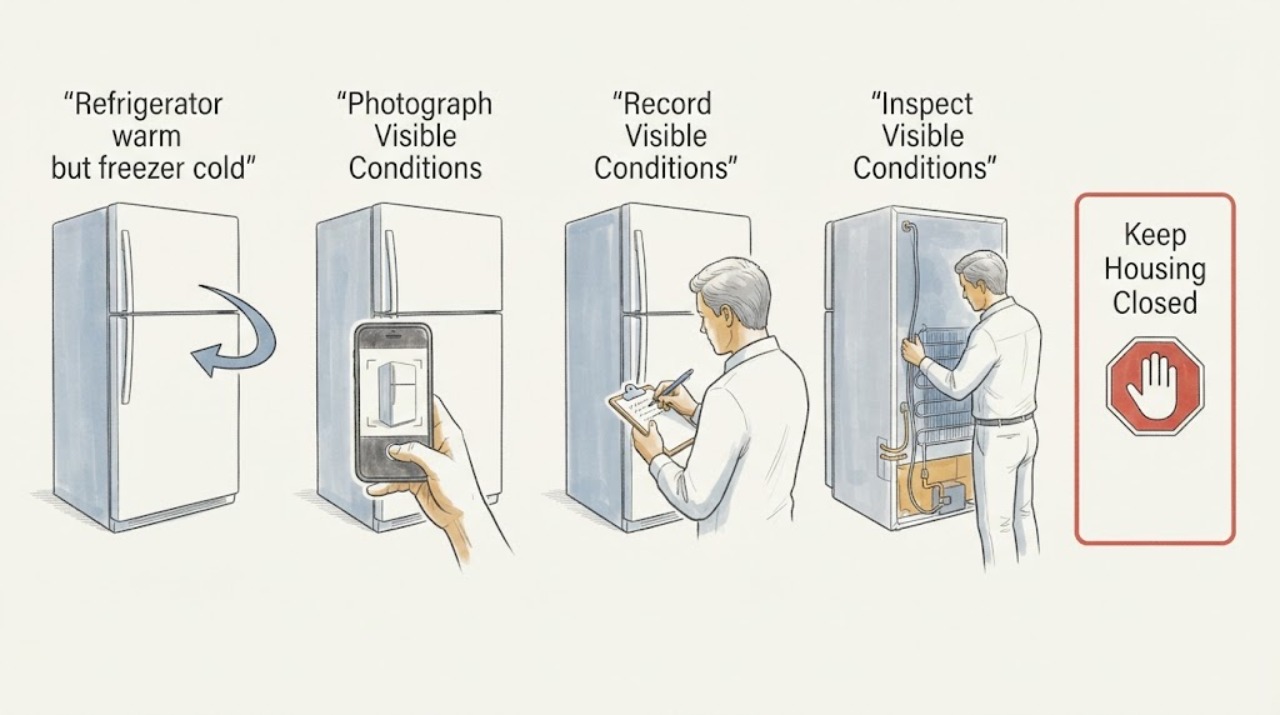
The EI12BF25US is an exact Electrolux 11.8 cu. ft. bottom-freezer model, but the opened owner guide does not list 18C as a fault code. Its control section shows refrigerator settings of 36–47°F and freezer settings of 3 to −11°F, so a flashing 18C or −18C must first be identified as a temperature display, unit setting, or an actual code rather than assumed to be an error. Measure both compartments with appliance thermometers: a warm refrigerator with a cold freezer is a real cooling/airflow symptom even if the display looks normal. Because this model's guide warns about flammable refrigerant and says not to use mechanical defrost devices or puncture tubing, do not use a hair dryer or sharp tool again and do not remove the evaporator cover. Protect food, inspect only the door seals and visible vents, document the prior thaw attempt and any returning frost, and arrange model-specific service if the fresh-food section stays above a safe temperature.
Work through in order
Diagnostic checks
Use only checks that match the exact appliance or system and its official guide.
-
Check 1
Photograph the complete display and the EI12BF25US rating label before changing anything. Record whether the characters are 18C or −18C, which compartment or indicator is active, whether the digits flash, and whether an alarm or other code appears. Do not enter a diagnostic mode or keep pressing buttons to reproduce the display.
Expected result: The display is a steady temperature setting, a flashing number, a number with a minus sign, or an unfamiliar code that cannot be matched to the owner's guide.
Next step: Keep the photo, full model, serial information, and display context together. Use the EI12BF25US guide for normal temperature controls; if the display is flashing or remains unexplained, arrange Electrolux-qualified service instead of substituting another model's code table.
Stop if: Stop if interpreting the display would require opening the control area, entering service mode, or testing energized wiring.
Why this matters
Why: The exact owner guide documents refrigerator and freezer temperature ranges but does not define 18C as a fault. A minus-18°C-style value may be a freezer temperature representation, while a flashing or otherwise unlisted display indicates a performance concern that the guide sends to service; the display alone cannot prove a sensor or control failure.
-
Check 2
Protect perishable food and measure both compartments with appliance thermometers. Put one thermometer in the middle of the fresh-food section and one among freezer packages, minimize door openings, and record the readings and times rather than relying on the panel or on smell and appearance.
Expected result: The refrigerator is at or below 40°F, above 40°F, or unknown; the freezer is near 0°F/−18°C, warmer, or unknown; and the two readings differ substantially.
Next step: Move temperature-sensitive food to a known-safe cold location. Discard refrigerated perishables that have been above 40°F for four hours or more or whose time is uncertain, and keep the doors closed while documenting readings for service.
Stop if: Do not taste food to decide whether it is safe and do not continue operating solely to watch the number change when temperatures are unsafe.
Why this matters
Why: FDA recommends a refrigerator at or below 40°F (4°C) and a freezer at 0°F (−18°C). A warm fresh-food section with a cold freezer confirms a compartment-specific cooling or airflow symptom, while unknown or unsafe temperatures are first a food-safety decision, not proof of a particular part.
-
Check 3
With the appliance stationary and dry, inspect only visible airflow and sealing points: confirm the fresh-food vents are not blocked by containers, the refrigerator and freezer doors close fully, and each gasket has visible contact without a large gap, tear, or trapped food. Look at accessible liner surfaces for frost or moisture, but do not remove a panel, scrape frost, or apply heat.
Expected result: A vent is blocked, a door is held open, a gasket visibly fails to contact the cabinet, the fresh-food liner has localized moisture/frost, or all visible airflow and seals look normal.
Next step: Move only the visible obstruction, clean and close the gasket gently, and recheck both temperatures after normal operation. If the fresh-food section remains warm or visible frost returns, stop owner troubleshooting and provide the observations to service.
Stop if: Do not chip ice, use a hair dryer or other heat source, remove the evaporator cover, or reach toward a fan.
Why this matters
Why: The EI12BF25US guide says overcrowding reduces air circulation and causes uneven cooling, and its installation and troubleshooting guidance links door closure, gaskets, and frost/moisture to temperature behavior. Visible airflow or seal issues can be corrected without claiming a fan or damper failure; normal external checks leave an internal airflow, defrost, or refrigeration issue unresolved.
-
Check 4
Document the frost history without repeating the prior intervention. Write down when the freezer door was left ajar, when frost was first seen, when the user attempted to melt it, whether the fresh-food section temporarily improved, and whether frost, warmth, or condensation returned. Photograph only accessible surfaces and keep the refrigerator unplugged or operating only as the manual and food-safety situation permit; do not expose hidden coils.
Expected result: Cooling improved only temporarily after the thaw attempt, frost returned, frost is absent but the refrigerator remains warm, or water from thawing reached the cabinet floor or an electrical area.
Next step: Stop attempting to melt or scrape frost and arrange trained service with the model, display photo, temperature readings, frost timeline, and any water location. Keep away from wet electrical areas and isolate power only from a safe accessible point if required by a hazard.
Stop if: Stop immediately for a puncture, hissing refrigerant-like sound, smoke, burning odor, damaged cord, or water near electrical parts; do not restart to reproduce it.
Why this matters
Why: A temporary improvement followed by recurring frost or renewed warm fresh-food temperatures indicates an unresolved condition, but the timeline does not identify a defrost heater, fan, sensor, damper, or sealed-system component. The owner's guide specifically warns against mechanical defrost and refrigerant-tubing damage, so further intervention could add fire, leak, or electrical risk.
-
Check 5
Verify only the model-documented external operating state: cooling is turned on, the displayed refrigerator setting is within the guide's 36–47°F range, the freezer setting is within its 3 to −11°F range, and no vacation or other visible mode explains the warm section. Do not force extreme settings or repeatedly power-cycle the appliance.
Expected result: Cooling is off or a visible mode is active, the setting is outside the guide's range, the controls look normal but the refrigerator remains warm, or the display continues flashing.
Next step: Restore only a clearly visible model-documented setting, then remeasure both compartments after stabilization. If the setting is normal but cooling or the display remains abnormal, arrange model-specific service.
Stop if: Do not remove the control panel, alter wiring, access the sealed system, or run service procedures.
Why this matters
Why: The EI12BF25US control section distinguishes the refrigerator and freezer settings and notes that displayed values are control targets, not guaranteed compartment temperatures. A normal setting with a warm refrigerator keeps the physical cooling/airflow symptom in play; a persistent flashing display is the manual's service boundary rather than a cue to guess a part.
-
Check 6
Check for immediate safety escalation before any further observation: look from a dry safe position for water near the cord or outlet, an electrical smell, smoke, sparking, damaged plug, or an inaccessible leak. Keep the doors closed and preserve the temperature and display record.
Expected result: The cabinet is dry and electrically normal, or water, heat, odor, smoke, sparking, damaged power hardware, or unsafe food temperatures are present.
Next step: Stop using the refrigerator when safe, keep clear of wet electrical areas, isolate water or power only from a dry accessible location, move food, and obtain qualified appliance or electrical service. Do not open panels or handle refrigerant tubing.
Stop if: Do not touch a wet plug or outlet, repeatedly reset a breaker, use heat, or restart after smoke, arcing, or a refrigerant-like leak.
Why this matters
Why: The manual requires a grounded dedicated outlet, warns of electric shock and fire hazards, and identifies flammable refrigerant. A hazard outranks display interpretation and makes continued operation or frost experiments unsafe.
Use your observations
Decision map
Find the observation that best matches what you see, then follow the next safe action.
-
PATH 01Next step
What you see
The display shows a steady −18C-style freezer value, the freezer thermometer is near 0°F/−18°C, and the fresh-food thermometer is above 40°F.
Do this next
Protect or discard food according to measured temperature and time, inspect only visible vents and door seals, and arrange service if the refrigerator section does not return to a safe temperature.
Why this path and its safety boundary
Why it matters: The number is more consistent with a freezer temperature representation than a universal error code, while the measured warm refrigerator confirms a separate fresh-food cooling or airflow problem. It does not identify a fan, damper, sensor, or sealed-system part.
-
PATH 02Next step
What you see
The display flashes 18C/−18C, contains another symbol or code, or cannot be matched to the EI12BF25US guide, and either compartment is not at a safe measured temperature.
Do this next
Keep the display photo and thermometer readings, move food to safe cold storage, and arrange Electrolux-qualified service without entering service mode or repeatedly resetting the controls.
Why this path and its safety boundary
Why it matters: Electrolux's guide says flashing digital displays indicate a detected performance problem and directs the owner to service for interpretation. The code is not safely portable from another model, and the temperature symptom takes priority over a reset.
-
PATH 03Next step
What you see
The fresh-food vents are visibly blocked or a door/gasket is not closing, the freezer remains cold, and no active leak or electrical hazard is present.
Do this next
Correct only the visible obstruction or gentle gasket-cleaning issue, close the doors, and remeasure after stabilization. Escalate if the warm section persists or frost returns.
Why this path and its safety boundary
Why it matters: A visible airflow or sealing condition can explain uneven cooling without proving an internal component failure. The EI12BF25US guide warns that overcrowding reduces circulation and that poor seals increase frost and temperature problems.
-
PATH 04Next step
What you see
The fresh-food section improved briefly after the earlier thaw attempt but became warm again, or frost has returned on accessible surfaces.
Do this next
Do not apply more heat or use sharp tools. Photograph the accessible result, protect food, and arrange trained service with the full history and display context.
Why this path and its safety boundary
Why it matters: The time sequence indicates an unresolved cooling, airflow, or defrost condition; it does not establish a failed heater, fan, sensor, damper, or compressor. Repeating the thaw attempt risks damage because the guide warns against mechanical defrost devices and puncturing tubing.
-
PATH 05Next step
What you see
Water from thawing reaches an electrical area, the cord or outlet is hot or damaged, there is smoke/burning odor/sparking, or measured food temperatures are unsafe.
Do this next
Stop using the refrigerator from a safe position, keep clear of wet electrical parts, isolate power or water only if safely accessible, move or discard food according to temperature and time, and obtain qualified emergency or appliance service.
Why this path and its safety boundary
Why it matters: This is an immediate fire, shock, refrigerant, or food-safety boundary. Display interpretation and further cooling tests should stop.
Helpful context
Understand the symptom
The important distinction is between a number on the panel and the temperature inside the cabinet. The Electrolux EI12BF25US manual presents this North American model's setpoints in Fahrenheit and does not identify 18C as an error. The exact community report describes −18C flashing while the freezer seemed cold and the refrigerator section was warm, but the report does not establish that the number itself caused the cooling problem. Record the sign, units, compartment indicator, and whether the display is flashing before choosing a diagnostic path.
The previous frost-melting attempt is a safety boundary, not a repair. This guide warns that the appliance uses flammable refrigerant, prohibits mechanical defrost devices and puncturing refrigerant tubing, and says repairs are for trained personnel. Do not repeat heat, scraping, sharp tools, panel removal, or live testing. Keep food safe and use only external checks until the exact symptom is handed to a qualified technician.
When checks do not resolve it
Need a professional?
Arrange Electrolux-qualified refrigerator service when the exact meaning of 18C/−18C cannot be confirmed from the EI12BF25US guide, the display flashes or returns, the refrigerator compartment remains above 40°F while the freezer is cold, frost returns after the prior thaw attempt, or visible checks do not restore safe temperatures. Stop immediately for water near electrical parts, a damaged cord or outlet, smoke, sparking, burning odor, hissing or suspected refrigerant damage, and protect or discard food based on measured temperature and time. Do not use a hair dryer, sharp tool, mechanical defrost device, evaporator-panel removal, service mode, live electrical test, or sealed-system repair.
Common questions
FAQ
Is 18C or −18C an Electrolux EI12BF25US error code?
The opened EI12BF25US owner guide does not define 18C as a fault code. Its freezer control range includes values down to −11°F, and a −18°C-style value may be a temperature representation or a different display context. Record the sign, compartment, flashing state, and full model before asking service to interpret it.
Why can the freezer be cold while the refrigerator section is warm?
A cold freezer and warm fresh-food section is a measured two-compartment symptom. Blocked visible vents, an incomplete door seal, or frost-related airflow restriction can contribute, but the symptom does not identify a fan, damper, defrost part, sensor, or sealed-system failure. Measure both compartments and arrange service if the warm section persists.
Can I use a hair dryer or scrape the frost off the evaporator?
No. The EI12BF25US guide warns about flammable refrigerant, says not to use mechanical devices to defrost, and prohibits puncturing refrigerant tubing. Do not repeat heat, use sharp tools, remove the evaporator cover, or touch hidden components; arrange trained service instead.
What temperature means the refrigerator food is no longer safe?
FDA recommends keeping the refrigerator at or below 40°F (4°C) and the freezer at 0°F (−18°C). Use appliance thermometers, keep the doors closed, and discard refrigerated perishables held above 40°F for four hours or more or for an uncertain period; smell and appearance are not reliable safety tests.
Read the exact guide
Official sources
- Electrolux Fridge doesn't work freezer does :SReddit r/appliancerepair · Exact Reddit post naming Electrolux EI12BF25US. It is community evidence for the reported warm-fridge/cold-freezer timeline, visible frost, prior hair-dryer attempt, and flashing −18C; it does not define a code or prove a component.
- EI12BF25US Model SupportElectrolux Canada · Opened the official Electrolux Canada support page for exact model EI12BF25US; it identifies the appliance as an 11.8 Cu. Ft. Bottom Freezer Refrigerator, links the English owner guide, and has no 18C entry on the support page.
- EI12BF25US Use and Care Guide A14363702Electrolux · Opened through the exact Electrolux support page. The guide is the North American EI12BF25US model guide; its temperatures and display guidance are model-specific, while food-safety thresholds are separately sourced from FDA.
- Are You Storing Food Safely?U.S. Food and Drug Administration · Opened FDA consumer food-safety guidance; used only for food temperature targets, thermometer use, door-closed guidance, and discard decisions, not for diagnosing the Electrolux appliance.
Community feedback
Share a repair observation
Share a plain-text repair observation. Accepted observations are published automatically; this page may take a moment to update.