
On this page
Start here
Quick answer
For an Electrolux refrigerator that is not cooling, first determine whether the whole appliance is without power, whether only the fresh-food compartment is warm, or whether both sections are warm. Check the display and interior light, the control setting, door closure and gasket, blocked interior vents, and whether the unit was recently installed, moved, loaded heavily, or affected by a power interruption. Electrolux's U.S. guidance lists 37°F for the refrigerator and 0°F for the freezer as suggested settings, while its UK guidance uses about 4°C and -18°C; use the exact manual and allow the appliance time to stabilize after setup or a temperature change. A running compressor does not prove that cold air is moving: blocked vents, poor door sealing, inadequate ventilation, frost, fan failure, or a sealed-system fault can still leave food warm. Do not remove panels, scrape frost with a sharp tool, handle refrigerant, or perform live electrical tests. Move perishables to safe cold storage and arrange service for persistent warmth, repeated high-temperature alarms, abnormal fan or compressor behavior, burning odor, sparks, damaged wiring, or a temperature that does not recover after the manufacturer-supported external checks.
Before you begin
Safety first
- The user may check an accessible outlet and controls, record temperatures, clear visible loading or vent obstructions, clean a visible gasket with a soft cloth, and inspect external clearance. Fan, damper, defrost, sensor, compressor, refrigerant, wiring, panels, and live electrical work belong to qualified service.
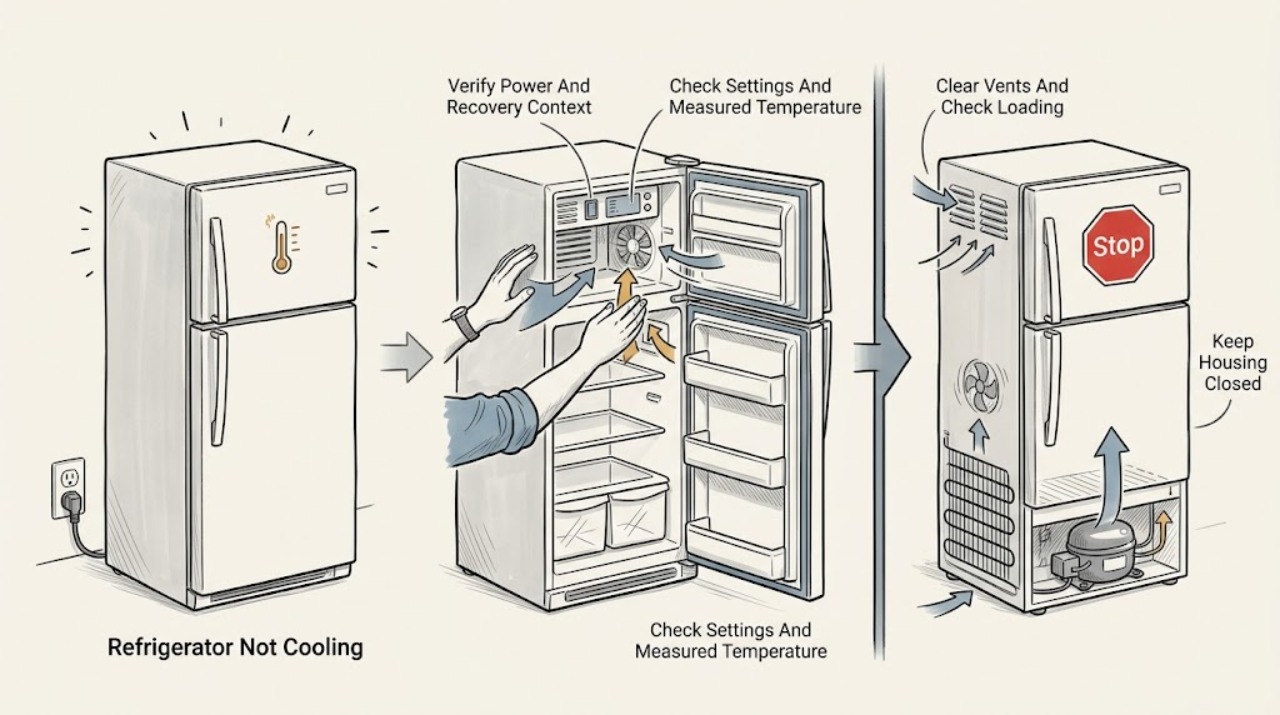
Work through in order
Diagnostic checks
Use only checks that match the exact appliance or system and its official guide.
-
Check 1
Check the interior light, display, control response, and any recent outage, move, installation, or large food load. Verify that the plug is fully seated and that the dedicated outlet or GFCI has not tripped, using only a dry, accessible location. Do not repeatedly cycle a breaker or use an extension cord to test the refrigerator.
Expected result: The display and light are dark; the display is lit but controls do not respond; the unit was recently installed or power was interrupted; or the appliance has normal power and response.
Next step: Restore only a tripped accessible outlet or documented control state, then use the exact manual and allow the model's recovery period. If power repeatedly trips, the cord is damaged, or the appliance remains dead, leave it disconnected and arrange service.
Stop if: Stop for smoke, burning odor, arcing, hot plug, damaged insulation, water near the outlet, or repeated breaker operation. Do not open electrical covers.
Why this matters
Why: No light or display makes a supply, outlet, GFCI, or control-state issue more likely than a sealed cooling failure. Recent installation, outage, or a large load can require a stabilization period. Normal power shifts the diagnosis toward settings, airflow, doors, frost, fans, or cooling hardware.
-
Check 2
Read the exact model's refrigerator and freezer settings and any high-temperature, Sabbath, vacation, Power Cool, Shopping, or other mode indication. Measure temperature with a suitable thermometer in a glass of water or another model-appropriate location, and record whether the freezer is cold, both compartments are warm, or only the refrigerator section is warm. Avoid changing several settings at once.
Expected result: A compartment is set warmer than intended, a special mode is active, the temperature is still outside the manual's range after the stabilization period, the freezer is cold but refrigerator is warm, or both sections are warm.
Next step: Apply only the exact model's documented setting and allow the stated recovery time. If the measured temperature remains abnormal, preserve the recorded values and continue with external airflow and seal checks before calling service.
Stop if: Do not infer a universal temperature from another Electrolux model, place a thermometer against an evaporator, or remove a sensor or panel.
Why this matters
Why: A setting or mode can explain a warm compartment without a hardware failure. A cold freezer with a warm refrigerator makes airflow, damper, fan, vent, door, or frost conditions more likely; both sections warm makes power, recovery, condenser, compressor, defrost, or sealed-system faults more likely.
-
Check 3
With doors open only briefly, look for food or containers directly against interior vents, a packed shelf blocking the return path, or items preventing a drawer or door from closing. Move only the visible obstruction while preserving safe food handling. Check whether airflow or a fan can be heard briefly after a door is closed and reopened, if the exact manual says the model has an accessible fan indication.
Expected result: Vents are blocked, the refrigerator is overloaded, the freezer is cold but the fresh-food compartment has little airflow, the fan is silent when the manual expects it, or the vents and airflow path are clear.
Next step: Restore clear space around vents and avoid overloading, then allow the temperature to recover. If airflow remains absent, frost blocks the path, or only one compartment stays warm, arrange service rather than removing covers.
Stop if: Do not insert tools into vents, touch a fan blade, chip frost, or remove an evaporator or rear panel.
Why this matters
Why: Electrolux says blocked vents prevent proper cooling, and its UK guidance links lack of air circulation or fan behavior with high temperature. A clear path with missing airflow makes an internal fan, damper, frost, or control issue more likely.
-
Check 4
Confirm the doors close without a food or shelf obstruction and inspect the visible gasket and hinge area for dirt, deformation, or damage. Use only a gentle paper-resistance check if appropriate for the exact model; wipe the gasket with a soft cloth and mild soapy water, then dry it. From outside the cabinet, check that vents and surrounding clearance match the installation guide; do not pull out a built-in unit.
Expected result: The door does not close squarely, the gasket has a gap or damage, the paper slips with little resistance, the cabinet ventilation is blocked, or the seal and clearance appear normal.
Next step: Remove only a visible obstruction and clean the gasket as documented. If the hinge, gasket, installation, or built-in alignment needs adjustment, arrange service; if those checks are normal, proceed to frost and service escalation.
Stop if: Do not adjust a loaded door, remove hinge hardware, cut or glue the gasket, move a heavy built-in refrigerator alone, or expose rear electrical or refrigerant components.
Why this matters
Why: A poor seal or inadequate ventilation lets warm air in or prevents heat rejection, making unstable or high temperatures more likely. A normal seal and external clearance shift the diagnosis toward frost, fan, control, or cooling-system faults.
-
Check 5
Record frost location and thickness, whether the compressor or fan runs, any high-temperature alarm, and how the measured temperature changes after the external checks and documented recovery period. Look only at accessible surfaces for frost or a blocked air path. If heavy frost is present, use the exact manual's defrost procedure or arrange service; do not scrape, puncture, or heat sealed components.
Expected result: A heavy frost pattern blocks airflow; the compressor runs but temperatures do not recover; the compressor and fan are silent; a high-temperature alarm persists; or there is no frost and no obvious external cause.
Next step: Follow only the model-specific manual for a safe defrost or recovery step. If warmth persists, frost returns, the alarm remains, the compressor/fan is abnormal, or no external cause is found, move perishables to safe cold storage and arrange qualified Electrolux service with the recorded data.
Stop if: Do not remove panels, puncture ice, use a heat gun or flame, handle refrigerant, test capacitors or wiring live, or keep a malfunctioning refrigerator running unattended.
Why this matters
Why: Frost from a poor seal, chute, temperature setting, or blocked airflow can restrict cooling, but persistent or recurrent frost may involve defrost or airflow hardware. A running compressor with no temperature recovery, or silence with power present, makes an internal cooling, fan, control, or sealed-system fault more likely.
Use your observations
Decision map
Find the observation that best matches what you see, then follow the next safe action.
-
PATH 01Safety boundary
What you see
The interior light and display are dark, or the display is lit but the appliance does not respond after an accessible outlet or documented control check.
Do this next
Leave the refrigerator safely disconnected for damaged wiring, repeated trips, odor, heat, or water near electricity and arrange service. Otherwise use the exact manual's power and control guidance once.
Why this path and its safety boundary
Why it matters: A power supply, GFCI, cord, control-state, or electrical fault is more likely than blocked airflow.
Safety stop: Do not open electrical covers, repeatedly reset a breaker, or use a damaged cord or extension lead.
-
PATH 02Safety boundary
What you see
The freezer is cold but the fresh-food section is warm, with blocked vents, little fan airflow, frost, heavy loading, or a door/seal issue.
Do this next
Clear only visible loading obstructions, correct the door seal if a simple clean restores it, and follow the model's defrost or airflow guidance. Persistent low airflow or recurring frost needs service.
Why this path and its safety boundary
Why it matters: Air distribution, damper, fan, frost, loading, or door sealing is more likely than a complete loss of cooling.
Safety stop: Do not remove evaporator covers, reach into a fan, chip ice, or alter a damper or sensor.
-
PATH 03Safety boundary
What you see
Both refrigerator and freezer remain warm after the documented stabilization period, with normal power and settings.
Do this next
Keep food in safe cold storage, record temperatures and operating sounds, and arrange qualified service. Do not infer a compressor or refrigerant diagnosis from sound alone.
Why this path and its safety boundary
Why it matters: A ventilation, condenser airflow, fan, compressor, defrost, control, or sealed-system fault is more likely than a single blocked shelf vent.
Safety stop: Do not remove the rear cover, clean energized components, handle refrigerant, or perform live tests.
-
PATH 04Safety boundary
What you see
Heavy frost, a door gasket gap, a chute that does not close, blocked vents, or inadequate external clearance accompanies the warm temperature.
Do this next
Correct only visible loading, gasket cleanliness, or documented setting issues and use the model's safe defrost instructions. Arrange service if frost is heavy, inaccessible, or returns.
Why this path and its safety boundary
Why it matters: Warm-air entry, blocked airflow, or a defrost/airflow restriction is more likely; frost can hide the original cause and may recur.
Safety stop: Do not scrape or puncture frost, apply flame or high heat, remove panels, or adjust hinges on a loaded door.
-
PATH 05Safety boundary
What you see
Power, settings, measured temperature, vents, doors, gasket, ventilation, and accessible frost checks are normal, but the refrigerator remains warm or alarms repeatedly.
Do this next
Leave the appliance operating only if it is electrically safe and not leaking or overheating, move perishables to safe cold storage, and arrange qualified Electrolux service with the model, temperatures, alarm, and observations.
Why this path and its safety boundary
Why it matters: An internal fan, sensor, damper, defrost component, control, compressor, or sealed-system fault is more likely; no single part is proven by this symptom.
Safety stop: Stop for burning odor, sparks, hot components, damaged wiring, repeated breaker operation, or refrigerant/oil evidence; do not attempt internal repair.
Helpful context
Understand the symptom
Separate no-power, warm-air, and no-cooling patterns
A dark display and no interior light point first to power or a control state. A lit display with a warm refrigerator but a cold freezer points toward airflow, damper, fan, frost, or loading conditions. Both compartments warm, especially after a move, outage, or large grocery load, can reflect recovery time or a cooling-system fault. Record the actual food or water temperature rather than relying only on the sound of the compressor.
Electrolux settings are model and region dependent
Electrolux U.S. and UK support pages express suggested temperatures in different units and describe different controls. Treat 37°F/0°F and about 4°C/-18°C as guidance from those pages, not a universal setting for every model. Use the rating-label model and its manual before changing modes such as Power Cool, Shopping, Sabbath, vacation, or a temperature dial.
Airflow and door sealing can mimic a cooling failure
Food packed against internal vents, a cabinet pushed too close to a wall, a door left open, a dirty or damaged gasket, or a hinge that prevents closure can all allow temperatures to rise. Electrolux also notes that frost can come from warm air entering through a poor seal or a chute that does not close. Correct only visible loading or sealing issues; do not dismantle a door or evaporator cover.
Persistent warmth after external checks needs service
If the refrigerator has power, settings and airflow are reasonable, doors seal, and the temperature still does not recover, the remaining possibilities include an internal fan, sensor, damper, defrost component, control, compressor, or sealed-system fault. The symptom does not identify a compatible part. Stop experimenting with panels, refrigerant, wiring, or live measurements and give the technician the model, temperatures, alarms, and observations.
Safety boundary
Stop conditions
- Stop for smoke, burning odor, sparks, a hot plug or component, damaged wiring, water near electrical parts, or repeated breaker operation; isolate power only from a safe, dry location.
- Move perishable food to safe cold storage when measured temperatures are unsafe or the refrigerator cannot maintain the model's documented range.
- Do not remove rear or freezer panels, touch fan blades, handle refrigerant, puncture evaporator tubing, or perform live electrical tests.
- Do not scrape frost with sharp tools, use a flame or high-temperature device, or force a door, hinge, damper, or gasket into alignment.
- Do not generalize Electrolux temperature settings, alarms, modes, fan checks, or recovery times from another model or region.
Only after diagnosis
Potential parts
- door gasket or hinge component
Consider only when the exact model is identified and qualified diagnosis confirms a damaged gasket or hinge that prevents a consistent seal after visible cleaning and obstruction checks.
Door hardware is model-specific and affects alignment and sealing; verify manufacturer fit information and use service for loaded-door or hinge work. - evaporator or condenser fan assembly
Consider only when qualified diagnosis confirms absent or abnormal airflow from a fan after vents, loading, and frost conditions are addressed.
Fan assemblies and connectors vary by model; do not reach into a fan or perform energized testing. - defrost or temperature-sensing component
Consider only when qualified diagnosis confirms recurring frost, a sensing fault, or a defrost failure that is not resolved by the model's safe external procedure.
Defrost and sensing parts are model-specific and safety-critical; do not remove freezer panels or infer fit from the symptom. - compressor or sealed-system component
Consider only after qualified diagnosis confirms that both compartments remain warm despite normal power, settings, airflow, doors, and defrost condition.
Compressor and sealed-system work requires qualified service and refrigerant handling; the symptom alone does not identify a replacement part.
When checks do not resolve it
Need a professional?
Arrange qualified service when the refrigerator remains warm after its model-specific stabilization period and safe checks of power, settings, vents, doors, gasket, ventilation, and frost; when the compressor or fan is abnormal; when a high-temperature alarm recurs; or when the freezer is cold but the fresh-food compartment remains warm with no visible airflow cause. Move perishables to safe cold storage. Stop immediately for smoke, burning odor, sparks, a hot plug, damaged wiring, water near electrical parts, repeated breaker operation, or refrigerant/oil evidence.
Safety scope: The user may check an accessible outlet and controls, record temperatures, clear visible loading or vent obstructions, clean a visible gasket with a soft cloth, and inspect external clearance. Fan, damper, defrost, sensor, compressor, refrigerant, wiring, panels, and live electrical work belong to qualified service.
Common questions
FAQ
Why is my Electrolux refrigerator warm but the freezer is cold?
That pattern makes airflow, blocked vents, a fan or damper, frost, loading, or a door-seal issue more likely than a complete loss of cooling. Check only visible loading, vents, door closure, gasket, and the exact model's documented fan or defrost guidance. Persistent low airflow or recurring frost needs service.
Is it normal for an Electrolux refrigerator compressor to run continuously?
Some Electrolux formats use variable-speed compressors that can run continuously at changing speeds. Confirm normal operation by measured temperature and airflow, not sound alone; if both sections remain warm or the compressor is unusually noisy, arrange service.
What temperature should an Electrolux refrigerator be set to?
Electrolux U.S. guidance lists 37°F for the refrigerator and 0°F for the freezer as suggested settings, while Electrolux UK guidance uses about 4°C and -18°C. Treat these as regional guidance and follow the exact model manual; allow the appliance to stabilize after a change or installation.
Can blocked vents or a door gasket make an Electrolux refrigerator stop cooling?
Yes. Electrolux identifies blocked vents, a poor door seal, prolonged door opening, and inadequate airflow as causes of unstable or high temperature. Clear only visible loading obstructions and clean the gasket gently; do not remove panels or adjust hinges yourself.
When should I stop troubleshooting an Electrolux refrigerator that is not cooling?
Stop for smoke, burning odor, sparks, a hot plug, damaged wiring, water near electrical parts, repeated breaker operation, or heavy inaccessible frost. Move perishable food to safe cold storage and arrange qualified service when the measured temperature remains abnormal after the exact model's safe external checks.
Read the exact guide
Official sources
- Refrigerators - Why does my refrigerator run most of the time? Is this normal?Electrolux · Supports distinguishing normal variable-speed compressor runtime from a temperature failure; it does not prove cooling from sound alone.
- Temperature in the fridge-freezer is too high, too warm, not cooling or not coldElectrolux UK · Supports temperature measurement, fan, loading, door, gasket, ventilation, ambient, and defrost observations; values and controls are region/model guidance.
- Refrigerators / Freezer - Frost Build UpElectrolux · Supports frost causes involving door seals, ice-chute flap, low settings, and blocked airflow; it does not diagnose a specific defrost component.
- Refrigerator Clean and Care GuideElectrolux · Supports gentle cleaning and drying of gaskets and caution around controls and electrical parts; exact cleaning instructions remain model-dependent.
- Refrigerators - Not CoolingElectrolux · Applies to all refrigerators in the article and supports checks of power, installation, settings, vents, door closure, and gasket; exact controls and recovery vary by model.
- My fridge freezer is not workingElectrolux UK · Supports checking plug, outlet, display/light/compressor response, control OFF state, and model manual; it does not identify a cooling-system part.
Community feedback
Share a repair observation
Share a plain-text repair observation. Accepted observations are published automatically; this page may take a moment to update.