
On this page
Start here
Quick answer
When an Electrolux washer-dryer leaves clothes damp, first confirm that the water tap is open and that the load is not larger than the drying capacity. Then check the selected drying program and care labels, clean the drain filter, and clean and fully dry the air filters if the model uses them. A heat-pump model may feel less hot and take longer than a conventional dryer, but the cycle should still complete according to its program. If the drum never warms, an error appears, the appliance stops after drying, or the basic checks do not improve results, stop using it and arrange authorised service rather than opening the cabinet.
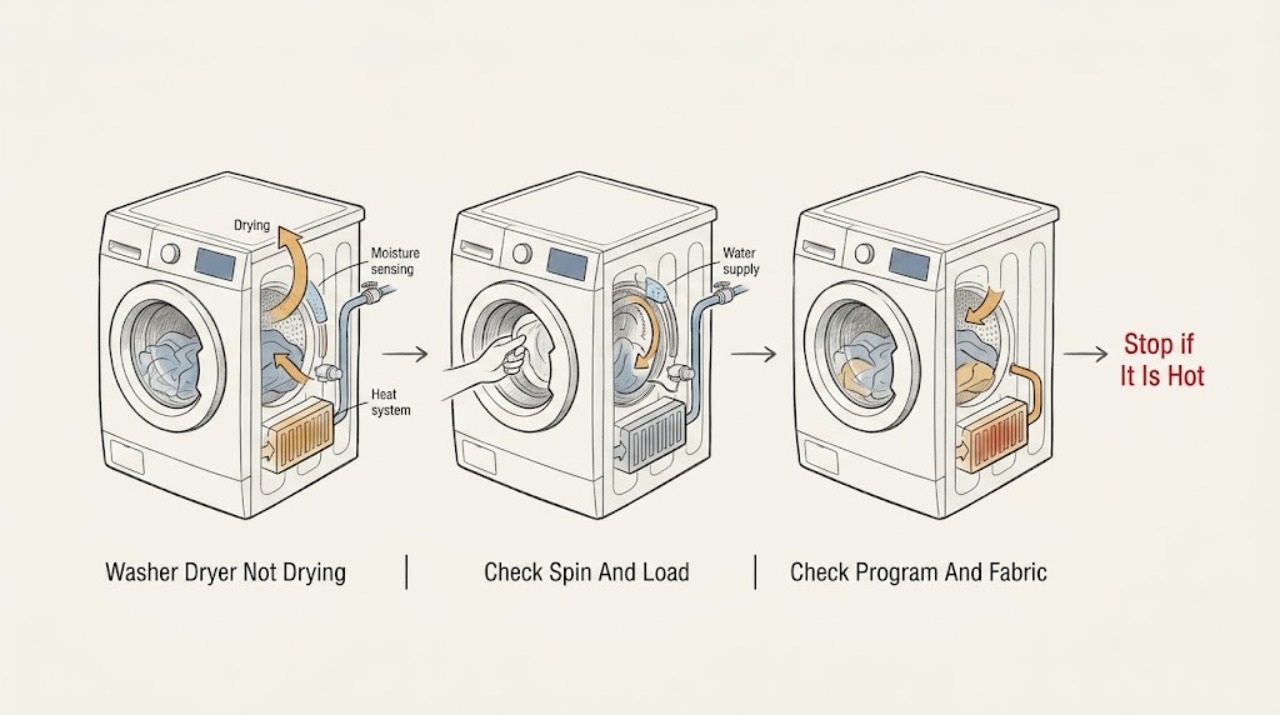
Work through in order
Diagnostic checks
Use only checks that match the exact appliance or system and its official guide.
-
Check 1
Confirm that the household water tap feeding the washer-dryer is open and that the inlet hose is not visibly kinked, without loosening the connection.
Expected result: The tap was closed or the hose was restricted, or water supply appears normal.
Next step: Correct only an obvious closed tap or external kink if safe, then retry the correct drying cycle. If supply is normal and drying still fails, continue to the load and filter checks; do not dismantle the inlet system.
Why this matters
Why: Electrolux states that the washer-dryer also needs water during the drying cycle. A restricted supply can prevent the drying process from working as intended even though drying uses heated air.
-
Check 2
Before drying, check whether the wash cycle spun the load properly and compare the amount of laundry with the drying capacity in the exact manual; remove excess items and untangle the remainder.
Expected result: The load was heavy, tightly tangled, or wetter than usual after washing, or the load size and spin result are normal.
Next step: Run a smaller, well-spun load using the appropriate drying program. If it remains damp, continue with program and filter checks rather than repeatedly extending an overloaded cycle.
Why this matters
Why: The drying capacity is smaller than the washing capacity, and excess water or restricted tumbling leaves less air circulation around the fabric. A normal load with a normal spin result makes capacity less likely as the main cause.
-
Check 3
Read the care symbols and select a drying program that matches the fabric, load size, and desired dryness; avoid assuming that a wash program or a short setting is a full drying cycle.
Expected result: The program was unsuitable, the load contains mixed thicknesses, or the cycle and fabric selection are appropriate.
Next step: Sort by fabric and thickness and run the manual-recommended program once. If the result is still damp, record the program and move to filter and drain checks; do not use a hotter setting that the garment label does not allow.
Why this matters
Why: Electrolux says drying programs and care symbols must match the load. Thick seams and mixed fabrics can need additional or separate drying, while a suitable program with damp results points toward airflow, drainage, sensing, or heat.
-
Check 4
If the exact model has primary or secondary drying air filters, remove and clean them only as the manual directs, then dry and refit them fully; do not operate the appliance with a missing or damaged filter.
Expected result: A filter is visibly clogged, the appliance displays a filter reminder, or the filters are clean, dry, correctly fitted, and undamaged.
Next step: Run a smaller compatible load after filter maintenance. If the reminder returns, airflow remains poor, or the filter is damaged, stop and arrange service rather than operating around the filter.
Why this matters
Why: Electrolux says clogged air filters restrict warm-air movement and extend drying. A clean and correctly fitted filter makes a blocked condenser, drain issue, sensor fault, or heating fault more likely if laundry remains damp.
-
Check 5
Inspect and clean the washer-dryer drain filter only at the user-accessible location and method specified in the manual, after disconnecting power and allowing any water to cool; prepare for residual water before opening the filter cover.
Expected result: The drain filter contains lint or debris, water remains in the drum, or the filter is clear and the machine drains normally.
Next step: Refit the filter securely and test one suitable load. If water remains, the filter cannot be secured, or the machine still does not dry, stop and request service; do not access the pump or internal hoses.
Why this matters
Why: Electrolux includes a clogged drain filter among causes of poor washer-dryer drying results. A clear filter with normal draining makes the drying air path, cycle selection, or a technical fault more likely.
-
Check 6
Observe the cycle without opening the cabinet: note whether the drum tumbles, whether the appliance completes the selected program, whether the inside becomes warm for the model type, and whether an error or filter message appears.
Expected result: The cycle completes with some warmth, the drum stays cold, the program ends immediately or stops, or an error appears.
Next step: If the machine stays cold, repeatedly stops, shows an error, or will not switch on after drying, discontinue use and contact an authorised service centre. Do not test heaters, sensors, or heat-pump components yourself.
Why this matters
Why: Some warmth and normal completion support a load, program, airflow, drainage, or moisture-sensing issue. A persistently cold drum, abrupt stop, repeated error, or failure to power on after drying indicates a technical fault requiring diagnosis.
-
Check 7
Compare the appliance's drying options, air-filter arrangement, and maximum drying load with the exact model manual rather than applying instructions from a separate tumble dryer or another washer-dryer.
Expected result: The appliance is a heat-pump washer-dryer, has model-specific filters or options, or the manual does not match the observed control panel.
Next step: Use the exact manual for the remaining user-care checks. If the model cannot be identified or the documented checks do not restore drying, stop troubleshooting and arrange professional service.
Why this matters
Why: Electrolux notes that programs, filters, sensors, and cleaning points vary by appliance type and model. A generic instruction can produce a poor result or damage the appliance or clothing.
Use your observations
Decision map
Find the observation that best matches what you see, then follow the next safe action.
-
PATH 01Next step
What you see
The washer-dryer completes a normal cycle but the whole load is damp.
Do this next
Run a smaller well-spun load with the correct fabric program after checking filters and drain. If it remains damp, call service.
Why this path and its safety boundary
Why it matters: Water supply, excess load, insufficient spin, unsuitable cycle, clogged filters, or drainage should be checked before assuming a failed heater.
-
PATH 02Next step
What you see
Light items dry but thick seams, towels, or mixed fabrics remain damp.
Do this next
Sort by fabric and thickness and use the matching manual-recommended program. Do not exceed the drying capacity.
Why this path and its safety boundary
Why it matters: Load composition, fabric thickness, and program choice may be limiting the result rather than a total loss of heat.
-
PATH 03Next step
What you see
A filter reminder appears or the air filter is clogged.
Do this next
Clean and fully dry the model-specific filter, refit it, and test a suitable load. Persistent warnings or a damaged filter require service.
Why this path and its safety boundary
Why it matters: Restricted airflow can extend drying or reduce the result.
-
PATH 04Next step
What you see
The drying program ends immediately, stops partway through, or the washer-dryer will not switch on afterward.
Do this next
Record the displayed code or behavior, stop using the appliance, and contact an authorised service centre. Do not bypass a sensor or thermal control.
Why this path and its safety boundary
Why it matters: A sensor or technical fault is more likely than a simple load-size issue, especially when the appliance will not power on after drying.
-
PATH 05Next step
What you see
The drum remains cold and clothes are still wet after a correctly loaded, suitable cycle.
Do this next
Stop using the machine and arrange qualified service. Do not open the cabinet or test internal heating components.
Why this path and its safety boundary
Why it matters: The heating or heat-pump system may not be operating, or airflow and condensation may be severely restricted.
-
PATH 06Next step
What you see
There is a burning smell, smoke, unusual heat, damaged wiring, repeated error, or water near electrical parts.
Do this next
Stop the cycle and isolate power only if safe. Keep the appliance unused until qualified service has assessed it.
Why this path and its safety boundary
Why it matters: This is a safety boundary, not a user drying adjustment.
Helpful context
Understand the symptom
Damp laundry does not always mean a failed heater
A washer-dryer can leave laundry damp because the drying load is too large, the clothes entered the cycle with too much water, the selected program does not match the fabric, or airflow and drainage are restricted. Heat-pump models also operate at lower temperatures and can take longer. Use the observations below to separate a setup or maintenance issue from a technical fault.
Stay within user maintenance
Use only the filters, door seal, controls, and other cleaning points identified by the exact user manual. Stop immediately for a burning smell, smoke, damaged cord, unusual heat, repeated error, or water near electrical parts. Do not remove panels, bypass a thermal protector, test live wiring, or work on the heater, heat-pump circuit, or refrigerant system.
Classify the drying failure
If the cycle completes but everything is uniformly damp, start with water, spin, load size, program, and filters. If thick items are damp inside while lighter items are dry, sort by fabric and thickness and verify that the program is suitable. If the cycle ends immediately, the machine does not heat, or an error is displayed, treat it as a service path after the safe checks.
Only after diagnosis
Potential parts
- air or lint filter
Consider only if the exact model's filter is damaged or cannot be cleaned and seated correctly.
Filter design and whether a model has one vary by washer-dryer type; confirm the rating-plate model before ordering. - drain filter or drain pump
Consider only after service confirms restricted drainage or a failed pump rather than a user-cleanable filter obstruction.
Drain components are model-specific and internal pump work is a technician repair. - condenser or heat-pump airflow component
Consider only when a technician confirms a blocked or failed condenser or heat-pump airflow component.
Only some washer-dryers use these components; exact model and drying-system type must be confirmed. - heating or moisture-sensing component
Consider only after qualified testing confirms a heating or sensing failure following the basic maintenance checks.
Internal electrical parts are model-specific and must not be bypassed or replaced as an unassisted user repair.
When checks do not resolve it
Need a professional?
Call an authorised service centre if the drum remains cold, the appliance stops or will not switch on after drying, an error returns, or the safe load, program, filter, and drain checks do not improve drying., Stop using the washer-dryer for burning smells, smoke, unusual heat, damaged cord or wiring, repeated electrical faults, or water near electrical components., Do not open the cabinet or attempt heater, heat-pump, refrigerant, sensor, pump, or live-wiring work; those require qualified diagnosis.
Common questions
FAQ
Why does my Electrolux washer-dryer wash but not dry?
Drying has its own water, load, airflow, drainage, program, and heating requirements. Confirm the water tap is open, use a load within the smaller drying capacity, select the correct fabric program, and check the model's air and drain filters before requesting service.
Why is a heat-pump washer-dryer not very hot?
Electrolux explains that heat-pump systems dry at lower temperatures and can take longer than older conventional systems. Judge the result against the selected cycle and load, not by expecting a very hot drum; persistent dampness after the safe checks still needs service.
Can an overloaded washer-dryer fail to dry?
Yes. The drying capacity is smaller than the washing capacity, and overloading reduces air circulation around the clothes. Remove excess laundry, spin it well, and use a program suited to the remaining fabric.
When should I stop troubleshooting and call service?
Call service for a persistently cold drum, repeated error, early stopping, failure to switch on after drying, burning smell, unusual heat, electrical damage, or damp results that remain after the documented load, program, filter, and drain checks.
Read the exact guide
Official sources
- Tumble dryer not drying, not drying properly, too long dryingElectrolux · Official Electrolux drying-performance guidance used for shared drying-system principles such as filters, load, program, heat-pump behavior, and service
- Drying cycle of washer dryer takes too long, too short or not drying at allElectrolux · Official Electrolux support article for a washer-dryer with damp laundry or poor drying results
- Washer - dryer does not switch on after a drying cycleElectrolux · Official Electrolux service-boundary article for a washer-dryer that will not switch on after drying
Community feedback
Share a repair observation
Share a plain-text repair observation. Accepted observations are published automatically; this page may take a moment to update.