
On this page
Start here
Quick answer
An Electrolux washer-dryer that is not filling should first be separated by phase: no water during washing, no water during drying, a long or weak fill, or water that enters and then drains away. Record the exact model, phase, display message, and whether the door locks. Check that hot and cold supplies are on, the hoses are connected to the matching inlets and are not kinked, the accessible inlet screens are not blocked, and the drain hose is not installed in a way that creates siphoning. Confirm the cycle was started and the door is closed, but do not open the cabinet or run live tests. If the symptom persists, the error returns, the unit leaks, the door will not lock, or water or electrical conditions are unsafe, stop and arrange qualified Electrolux appliance service.
Before you begin
Safety first
- This article covers ordinary-access observation, water-off screen inspection by model instructions, and visible hose or drain checks only. Do not open the cabinet, perform live tests, run diagnostics, bypass the door lock, or change internal parts.
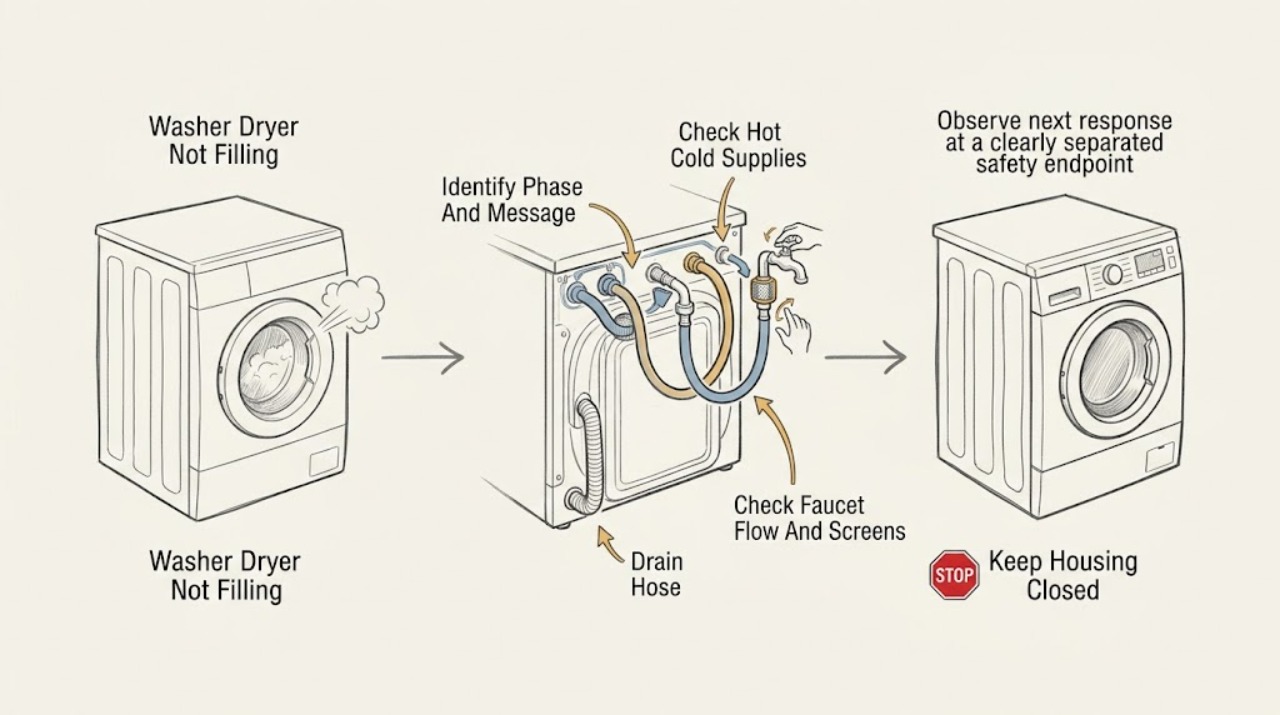
Work through in order
Diagnostic checks
Use only checks that match the exact appliance or system and its official guide.
-
Check 1
Record the full model number, selected cycle, whether the failure occurs during washing or drying, the exact display text or code, and whether the door locks; do not repeatedly cancel the cycle or open panels.
Expected result: There is no water in either phase, a long fill in the wash phase, a drying-phase fill warning, water that immediately leaves, or no readable message.
Next step: Photograph the display and model label, preserve the timing and phase, and use the matching Electrolux manual before attempting any reset.
Stop if: Stop for active leaking, smoke, burning smell, sparking, a hot plug, or a door that will not unlock or close normally.
Why this matters
Why: E11 and E12 are phase-specific on the applicable Electrolux front-load platform, so the same ‘not filling’ description can point to different water paths. A partial code or wrong manual cannot safely identify the failed valve, sensor, pump, or control.
-
Check 2
At the accessible wall connections, verify that the hot and cold water valves are open and that each hose is connected to the matching washer inlet without a kink, pinch, reversal, or visible leak; do not loosen a pressurized connection.
Expected result: A valve is closed, hoses are reversed or kinked, a connection drips, the unit was recently installed or moved, or both supplies look correct.
Next step: Open a normally operable valve and correct only an obvious hose-routing kink while the machine is idle. If a hose leaks, is damaged, or needs disassembly, stop and request service or installer review.
Stop if: Do not force valves, cross-thread fittings, over-tighten, move the connected appliance, or use an extension hose arrangement not approved for the model.
Why this matters
Why: Electrolux identifies turned-off supplies, reversed hot and cold lines, loose connections, and kinked hoses as installation or water-path causes of no or slow filling. A leak or recent move changes the task to installation or service review.
-
Check 3
Only with the water supply turned off and the appliance safely accessible, follow the model instructions to disconnect an inlet hose and observe whether the faucet supplies water and whether the washer-end inlet screen or connector filter is visibly obstructed; do not pry screens or use sharp tools.
Expected result: The faucet has weak or no flow, a screen is blocked, the hose is restricted, both flow and screens are normal, or a fitting will not release safely.
Next step: Clean or refit only the accessible screen or connector by the exact model procedure, restore water slowly, and check for leaks. Arrange service if flow is restricted, the screen is damaged, or the fitting is stuck.
Stop if: Do not work on a pressurized line, remove a screen from its seat, pour water near electrical parts, or continue after a leak appears.
Why this matters
Why: Electrolux directs owners to check faucet flow and water-inlet connector filters. Weak faucet flow points upstream; a blocked screen or hose restricts the fill path; normal flow and screens leave the model's valve, control, sensor, or wiring unresolved.
-
Check 4
If water enters but the drum does not retain it, inspect the visible drain hose routing and connection for a kink, an incorrect position, or a seal that could create siphoning; do not reach into standing water or alter the wall drain.
Expected result: Water immediately drains, the hose is kinked or positioned incorrectly, the drain opening is sealed, or water remains in the drum after filling.
Next step: Restore only the model-specific drain-hose arrangement with an air path and secure connection. If the standpipe, trap, or wall drain needs alteration, contact a qualified plumber or appliance technician.
Stop if: Do not seal the drain opening, force a hose into a pipe, move the machine while connected, or handle contaminated or standing water.
Why this matters
Why: Electrolux's fill-alarm flow checks drain-hose position to prevent a siphon before moving to internal fill components. A kink or blocked drain can cause a separate drain problem, while retained water makes immediate siphoning less likely but does not prove the inlet is healthy.
-
Check 5
Confirm that the intended program was selected and Start was pressed, the door is fully closed and recognized, and Delay Start or a normal pause is not holding the cycle; use only the exact model instructions for lock or delay controls.
Expected result: The door was ajar, a garment or seal obstruction is present, the control is paused or delayed, the door-lock indication is abnormal, or the cycle starts but still does not fill.
Next step: Clear only a loose visible obstruction, close the door normally, cancel a documented delay, and observe one cycle. If the lock or controls remain abnormal, arrange service.
Stop if: Do not force, tape, or bypass the door lock, enter an undocumented diagnostic mode, or open the control panel.
Why this matters
Why: Electrolux says an unclosed door, unpressed Start, Delay Start, or a normal pause can make a washer appear not to operate. A door that will not lock or a cycle that starts without filling points to a mechanical or water-path issue rather than a setting alone.
-
Check 6
After the safe supply, screen, drain, door, and start checks, record whether the washer-dryer remains dry, fills weakly, fills and drains, or fails only in the drying phase; leave it isolated from water or power when the condition is unsafe.
Expected result: The exact model still reports a fill error, no water arrives despite normal external supply, the drying-phase water path fails, or the unit leaks or trips power.
Next step: Arrange qualified Electrolux appliance service and provide the model, code, phase, hose and faucet observations, screen condition, drain routing, door status, and any installation history.
Stop if: Do not live-test a solenoid, access the control board, jumper the door lock, or replace an internal part from E11, E12, or a generic no-fill symptom alone.
Why this matters
Why: A persistent no-fill or phase-specific error may involve an inlet valve, condenser-water valve, pressure system, control, wiring, or drain installation. Electrolux's service documentation uses internal measurements and diagnostic phases, which are outside a safe ordinary-owner check.
Use your observations
Decision map
Find the observation that best matches what you see, then follow the next safe action.
-
PATH 01Safety boundary
What you see
The full model reports E11 or a comparable wash-phase long-fill or no-fill condition.
Do this next
Check matching hot and cold supplies, hose direction and kinks, faucet flow, inlet screens, and drain-hose position using the model instructions; arrange service if it persists.
Why this path and its safety boundary
Why it matters: The wash-phase water path is not reaching the expected level in the applicable Electrolux platform.
Safety stop: Do not infer a failed valve or sensor from E11 alone or perform live electrical tests.
-
PATH 02Safety boundary
What you see
The applicable washer-dryer reports E12 or a comparable fill problem at the beginning of the drying phase.
Do this next
Check the accessible tap and hose path, then use the exact model's service guidance; request qualified diagnosis if the drying-phase error repeats.
Why this path and its safety boundary
Why it matters: The drying-phase water or condenser circuit may not be reaching the expected condition; this is not necessarily the same as a wash-phase fill fault.
Safety stop: Do not enter the diagnostic cycle, measure a valve, access wiring, or replace a valve from E12 alone.
-
PATH 03Safety boundary
What you see
A hot or cold valve is off, hoses are reversed or kinked, faucet flow is weak, or an inlet screen is blocked.
Do this next
Restore the accessible supply or clean the screen only by the model procedure, then observe one cycle and check for leaks.
Why this path and its safety boundary
Why it matters: The external water path can explain the no or slow fill without proving an internal component failure.
Safety stop: Stop for a damaged hose, stuck valve, pressurized fitting, or any need to move the connected machine.
-
PATH 04Safety boundary
What you see
Water enters but immediately leaves, or the drain hose is positioned so it can create a siphon.
Do this next
Restore the model-specific drain arrangement and air path; use qualified plumbing help when the wall drain or standpipe needs work.
Why this path and its safety boundary
Why it matters: A drain installation issue can mimic a washer-dryer that will not fill.
Safety stop: Do not seal the drain opening, reach into standing water, or alter the plumbing as a user test.
-
PATH 05Safety boundary
What you see
The door is not recognized as closed, Start was not pressed, a delay or pause is active, or the controls do not accept the cycle.
Do this next
Clear a loose obstruction, close the door, cancel only a documented delay, and run one observation; arrange service for persistent lock or control behavior.
Why this path and its safety boundary
Why it matters: The program may not have reached its fill phase; a persistent lock or control fault needs service.
Safety stop: Do not bypass or force the door lock or control.
-
PATH 06Safety boundary
What you see
Supplies, hoses, screens, drain routing, door, and start state are normal, but no or weak water fill continues.
Do this next
Stop user troubleshooting and arrange qualified Electrolux appliance diagnosis with the phase, code, model, and observations.
Why this path and its safety boundary
Why it matters: An internal inlet valve, condenser valve, pressure system, control, wiring, or installation issue remains possible and cannot be identified safely from the symptom.
Safety stop: Do not open the cabinet, live-test, jumper the lock, or install an unverified internal part.
Helpful context
Understand the symptom
The phase and message change the diagnosis
A washer-dryer can need water in the wash phase and also in the drying phase on models that use a condenser-water circuit. Electrolux's published front-load guidance calls E11 a wash-phase fill problem, while its service documentation describes E12 as a drying-phase fill problem. Do not apply either code to every model without checking the full model and manual. Record whether no water arrives, water arrives slowly, or water enters and disappears.
Start with the outside water path
Electrolux's Laundry Water Supply Guide says hot and cold supplies must be on, hoses must be connected to the matching inlets, and kinked or reversed hoses can prevent proper filling. It also directs the owner to check faucet flow and inlet-connector filters. A recently installed or moved unit deserves installation review before an internal part is suspected.
A drain problem can imitate a fill problem
If the drum gains water but does not retain it, a drain hose positioned incorrectly can create a siphon. Electrolux's service flow for fill alarms checks that the drain circuit is correctly positioned and that the hose does not create a siphon before it moves to internal valves, wiring, or controls. Keep this check model-specific and do not alter a wall drain as a user experiment.
Safety boundary
Stop conditions
- Stop immediately for active leaking, water near electrical parts, smoke, burning smell, sparking, a hot plug, repeated breaker trips, or a damaged supply hose or cord.
- Do not open the cabinet or control board, perform live electrical measurements, test a solenoid, or enter a service diagnostic cycle.
- Do not force, tape, jumper, or bypass the washer-dryer door lock or any safety interlock.
- Do not work on a pressurized hose, pry out an inlet screen, move the connected machine, or alter a wall drain as a user test.
- Do not replace a valve, pressure sensor, pump, control, or wiring from E11, E12, or a generic no-fill symptom without exact model diagnosis.
Only after diagnosis
Potential parts
- washer-dryer inlet hose or connector screen
Consider this category only when the exact model's hose or connector screen is damaged, restricted beyond approved cleaning, or leaking after a qualified inspection.
Match the full model and connection arrangement; do not run without a screen or substitute a hose by appearance. - washer-dryer water inlet or condenser valve
Consider this category only when model-specific diagnosis confirms a wash-phase inlet or drying-phase condenser-water valve fault.
Confirm the exact model, phase, valve design, and repair procedure; do not live-test or replace from E11 or E12 alone. - washer-dryer door lock assembly
Consider this category only when the door remains correctly closed but a qualified diagnosis confirms the lock path prevents the cycle from reaching fill.
Match the exact model and preserve the safety interlock; never bypass or jumper it. - washer-dryer pressure sensor or control assembly
Consider this category only after safe water-path checks and qualified model-specific testing identify a pressure-sensing or control fault.
Confirm the exact model and required calibration or setup; do not install an internal part by symptom alone.
When checks do not resolve it
Need a professional?
Arrange qualified Electrolux appliance service when both water supplies, hose routing, accessible screens, drain installation, door closure, and cycle start are correct but the washer-dryer still does not fill or reports a phase-specific fill error. Request prompt service for a recurring leak, door-lock failure, abnormal electrical symptom, or a drying-phase water fault. For a recently installed or moved unit, have the installer verify the water and drain connections before internal parts are considered.
Safety scope: This article covers ordinary-access observation, water-off screen inspection by model instructions, and visible hose or drain checks only. Do not open the cabinet, perform live tests, run diagnostics, bypass the door lock, or change internal parts.
Common questions
FAQ
Why is my Electrolux washer-dryer not filling with water?
Check whether the problem occurs during washing or drying, then verify both hot and cold supplies, matching hoses without kinks, accessible inlet screens, drain routing, a closed door, and a started cycle. If the path is normal but the error or no-fill continues, arrange qualified service.
What does Electrolux washer-dryer error E11 mean?
On the applicable Electrolux front-load platform, E11 indicates difficulty filling during the washing phase. Check the hot and cold supply path and the exact model instructions; do not treat E11 alone as proof that a valve or control must be replaced.
What does E12 mean on an Electrolux washer-dryer?
Electrolux service documentation uses E12 for difficulty filling water during the drying phase on the applicable platform. Because models differ, confirm the full model and phase in its manual and arrange service if the warning repeats.
Can the drain hose make an Electrolux washer-dryer seem not to fill?
Yes. If water enters and immediately drains, incorrect drain-hose positioning can create a siphon. Check only the visible model-specific routing and preserve an air path; use qualified help if the wall drain or standpipe needs alteration.
Should I replace the inlet valve because my Electrolux washer-dryer will not fill?
Not from the symptom or code alone. First document the phase, model, supplies, hoses, screens, drain, door, and start state. A qualified technician should test the relevant wash or drying-phase water path and confirm the exact compatible part.
Read the exact guide
Official sources
- SERVICE MANUALElectrolux · Supports the combined washer-dryer distinction between wash-phase E11 and drying-phase E12, visible supply and drain checks, and escalation before internal diagnostic measurements.
- Laundry Water Supply GuideElectrolux · Supports ordinary checks of both water supplies, matching hose connections, kinks, faucet flow, inlet screens, and recent installation or movement.
- Laundry front loading washer displaying Error Code E11 long fill time.Electrolux · Supports the wash-phase branch where E11 or an equivalent long-fill symptom is shown; model applicability must be confirmed.
- Laundry front loading washer displaying Error Code E21 long pump out time.Electrolux · Supports the separate drain-path check when a fill symptom is actually water entering and failing to remain or a drain restriction is present.
- What should I do if my washer does not start?Electrolux · Supports the start-state branch where the cycle has not reached fill because Start, door closure, Delay Start, power, or water availability is unresolved.
Community feedback
Share a repair observation
Share a plain-text repair observation. Accepted observations are published automatically; this page may take a moment to update.