
On this page
Start here
Quick answer
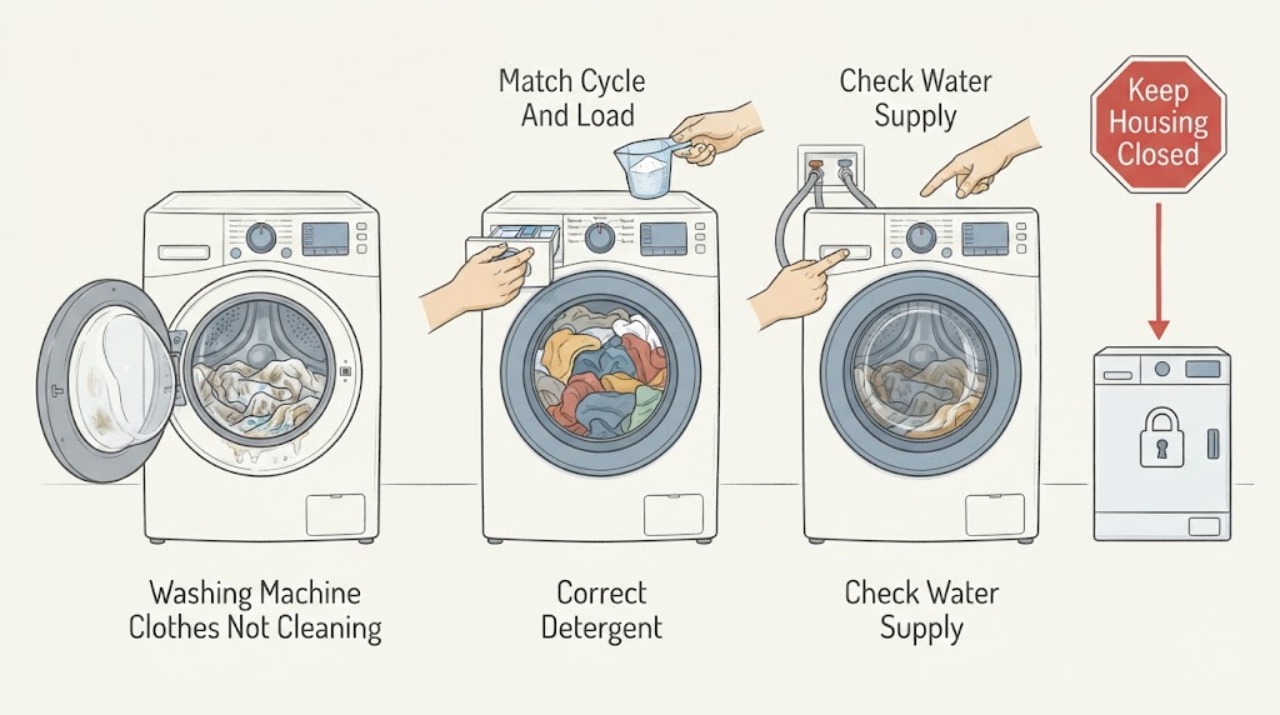
Start by separating a use issue from a machine fault. Make sure the cycle matches the soil level and load, the drum is not packed so tightly that clothes cannot move, and the detergent is high-efficiency detergent used in the correct compartment and amount. Electrolux says detergent packs belong directly in the drum, not the dispenser. Check that both hot and cold supplies are on, hoses are not kinked or reversed, inlet filters are not restricted, and household pressure is within the 30–120 psi guide. If a front-load washer shows SU dS or excessive suds, use HE detergent and reduce the amount. If the load, detergent, water supply and suds checks do not improve cleaning, stop guessing at an internal part and arrange model-matched service.
Work through in order
Diagnostic checks
Use only checks that match the exact appliance or system and its official guide.
-
Check 1
Record the selected cycle, load size, fabric/soil mix and whether clothes can move freely; compare the choice with the exact Electrolux model manual instead of using a rinse, quick or short cycle for a heavily soiled load.
Expected result: The cycle is a rinse/short program, the drum is tightly packed, or the cycle and load are appropriate for the soil and fabric.
Next step: Use the model-appropriate cycle and reduce or redistribute the load for one controlled comparison. If cleaning remains poor with a suitable cycle and load, continue to detergent and water checks.
Why this matters
Why: A short or unsuitable program and restricted movement can leave soil behind without proving a washer fault. The exact model determines its program behavior and capacity.
-
Check 2
Use HE detergent and the exact model's recommended amount and compartment; keep liquid or powder below the dispenser maximum, and place a detergent pack directly in the drum before adding laundry rather than in the dispenser.
Expected result: Non-HE or excessive detergent was used, the dispenser was overfilled, a pack was placed in the dispenser, or the correct HE detergent and placement were already used.
Next step: Correct the detergent type, amount or placement for the next controlled cycle. If the washer shows SU dS or continues to leave residue, follow the suds branch rather than adding more detergent.
Why this matters
Why: Electrolux says HE detergent reduces suds and supports cleaning, while incorrect pack placement can clog the detergent door and excess detergent can impair rinsing or cleaning.
-
Check 3
With the washer idle, verify both hot and cold faucets are on, the hoses are connected to the matching inlets, and the visible hoses are not kinked, pinched or leaking; check accessible inlet filters only with water controlled and power disconnected where the manual requires it.
Expected result: A faucet is off, hoses are reversed/kinked, a filter is restricted, pressure is outside 30–120 psi, or the visible supply is normal.
Next step: Correct only an accessible supply issue and check for leaks. Have a plumber verify pressure or repair a supply problem; if supply is normal and cleaning remains poor, continue with the service branch.
Why this matters
Why: Electrolux identifies water availability, hose routing, inlet filters and pressure as conditions that affect washer operation. Normal external supply does not prove that an internal fill component is healthy.
-
Check 4
If a front-load Electrolux washer displays SU dS, uses unusually many rinses or leaves heavy foam, use only HE detergent, reduce the amount and run the empty quick cycle described by Electrolux; do not add more detergent to compensate.
Expected result: Suds clear and the washer returns to normal rinsing, or SU dS/foam and poor cleaning persist.
Next step: Use the exact model guidance and stop adding detergent. If the alert or poor cleaning returns after the documented suds check, arrange service.
Why this matters
Why: Electrolux defines SU dS as oversudsing and says the washer may add rinses until suds clear. Persistent foam points to detergent or an unresolved washer condition, not automatically to a pump or control failure.
-
Check 5
After one controlled cycle with an appropriate load, HE detergent, normal water supply and no unresolved suds, compare the result and stop user diagnosis if clothes remain dirty, the washer leaks, overheats, smells electrical or fails to complete the cycle.
Expected result: Cleaning improves, or poor cleaning repeats with the documented conditions and/or a leak, electrical symptom, no-start condition or recurring alert appears.
Next step: Leave the washer off for a leak or electrical hazard and arrange Electrolux-authorized or qualified service. Provide the model, cycle, load, detergent, water observations and any code; do not open the cabinet or perform live tests.
Why this matters
Why: Improvement supports a use/supply cause; persistent failure or a hazard requires model-matched service. The available family-level sources do not identify an internal failed part.
Use your observations
Decision map
Find the observation that best matches what you see, then follow the next safe action.
-
PATH 01Next step
What you see
The washer used a rinse/short cycle for a heavily soiled load or the drum was packed so tightly that clothes could not move freely.
Do this next
Use the model-appropriate wash program and a smaller, balanced load, then reassess one controlled cycle.
Why this path and its safety boundary
Why it matters: The selected program or load is a supported explanation for poor cleaning and does not establish an appliance failure.
-
PATH 02Next step
What you see
The detergent is not HE, exceeds the dispenser limit, is placed in the wrong compartment, or a pack was put in the dispenser.
Do this next
Use fresh HE detergent at the model-recommended amount and place a pack directly in the drum as Electrolux directs; do not increase the dose to compensate.
Why this path and its safety boundary
Why it matters: Detergent type, amount or placement can reduce cleaning or create suds and dispenser problems.
-
PATH 03Next step
What you see
A faucet is off, hoses are reversed or kinked, an inlet filter is restricted, or pressure is outside the 30–120 psi guide.
Do this next
Correct the accessible supply issue and check for leaks; use a plumber for pressure or plumbing faults. If the external supply is normal but cleaning remains poor, arrange appliance service.
Why this path and its safety boundary
Why it matters: Water supply conditions can prevent the washer from operating and cleaning normally.
-
PATH 04Next step
What you see
SU dS or heavy foam persists after HE detergent, reduced amount and the documented empty quick cycle, or poor cleaning repeats under otherwise correct conditions.
Do this next
Stop changing components or detergent amounts experimentally and arrange Electrolux-authorized or qualified service, leaving the washer off for leaks or electrical concerns.
Why this path and its safety boundary
Why it matters: The supported user-level detergent and suds checks have not resolved the problem; the sources do not identify a specific internal part.
Helpful context
Understand the symptom
Poor cleaning is not automatically a failed part
Dirty clothes after a cycle can result from the selected program, an overloaded drum, detergent type or amount, low or misrouted water supply, or excess suds. The opened Electrolux pages support these user-level checks but do not establish that a pump, motor, heater, sensor or control board has failed.
Use the exact model manual for cycles
Electrolux washer families have different control layouts and cycle names. Select a program appropriate for the load and soil, but use the assigned model's manual for temperatures, options, capacity and any cleaning-cycle procedure. Do not substitute a front-load setting or top-load setting just because the brand is the same.
Watch for suds and water-supply symptoms
Excess detergent can create oversudsing and additional rinses, while restricted or reversed water hoses can keep the washer from operating properly. A visible supply or suds pattern is useful evidence, but it does not identify an internal component without model-specific diagnosis.
When checks do not resolve it
Need a professional?
Arrange service when clothes remain poorly cleaned after the cycle, load, HE detergent, water-supply and suds checks are correct., Stop using the washer for leaks, burning/electrical odor, overheating, damaged wiring, repeated alerts or a cycle that cannot complete safely., Do not open the cabinet, bypass the lid/door lock, test live wiring or order a pump, heater, sensor or board from the symptom alone.
Have this ready
- complete Electrolux model and serial information
- cycle, load size, fabric/soil type and measured cleaning result
- detergent type, amount and placement
- hot/cold supply, hose, filter and pressure observations
- any SU dS alert, leak, odor, no-start or incomplete-cycle symptom
Common questions
FAQ
Why are my clothes still dirty after an Electrolux wash?
Start with the cycle and load, then verify HE detergent and correct placement, water supply and any excessive suds. Electrolux's guidance supports these checks across washer families; persistent poor cleaning needs model-matched service rather than a guessed part.
Where should I put an Electrolux detergent pack?
Electrolux's detergent guide says to place the pack directly into the washer drum before adding laundry, rather than in the dispenser. Follow the exact model manual for any different product-specific instruction.
Can too much detergent cause poor cleaning?
Yes. Electrolux says to use HE detergent, and its SU dS guidance identifies oversudsing and extra rinses when too much detergent is used. Reduce the dose to the model's recommendation rather than adding more detergent.
Read the exact guide
Official sources
- Laundry Water Supply GuideElectrolux · Official Electrolux US washer water-supply guidance opened directly. Supports faucets, 30–120 psi, hose routing/kinks, inlet filters, flow and leak checks; it does not diagnose an internal valve.
- What should I do if my washer does not start?Electrolux · Official Electrolux US washer support page opened directly. Used for cycle/start, door/lid, water availability and qualified electrical-service boundaries, not as a poor-cleaning component diagnosis.
- Laundry Washers - Detergent GuideElectrolux · Official Electrolux US washer support opened directly. Supports HE detergent, dispenser limits, pack placement and additive compartments; exact model controls dosage and cycle details.
- Laundry front loading washer displaying Error Code SU dS too many sudsElectrolux · Official Electrolux US support page opened directly. Supports the SU dS oversuds branch, HE detergent, dose reduction and empty quick cycle; it is not a general internal repair procedure.
Community feedback
Share a repair observation
Share a plain-text repair observation. Accepted observations are published automatically; this page may take a moment to update.