
On this page
Start here
Quick answer
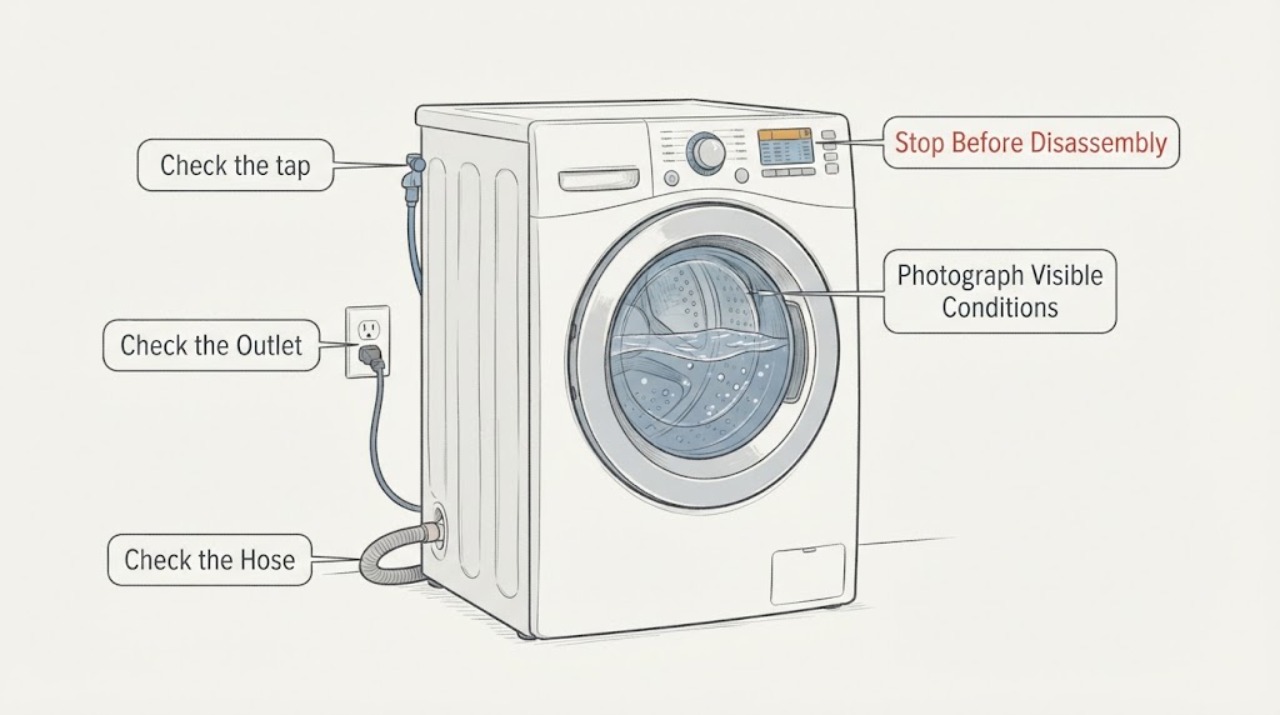
On an Electrolux EIFLS20QSW00, “Check the tap” does not automatically mean the wall supply is weak. The exact Owner's Guide lists no or slow fill, uninstalled or closed hot and cold hoses, inadequate pressure, kinked hoses, or blocked inlet screens; it also says that water entering while the tub does not fill can be caused by a drain standpipe that is too low and siphoning the water away. If water is actively entering and the drain pump is also running, or water continues when the controls are off, stop the cycle, close both water faucets, and isolate power only from a dry safe position. Do not replace a valve, pressure sensor, or control board from the message alone.
Work through in order
Diagnostic checks
Use only checks that match the exact appliance or system and its official guide.
-
Check 1
If water is entering continuously, the tub is rising unexpectedly, water is on the floor, or the drain pump is running while the fill valve is open, press Power or Cancel if the controls respond, close both hot and cold water faucets, and keep the floor and outlet area dry. Isolate power only from a dry, safe position.
Expected result: Water stops when the faucets are closed, continues despite the washer being off, or is already spreading near the appliance or electrical connection.
Next step: Leave the faucets closed and arrange qualified appliance service; use plumbing help for a blocked or overflowing household drain. If water continues with the faucets closed, document the exact timing and do not restart the washer.
Stop if: Do not touch a wet plug, cord, outlet, or cabinet, pull a plug through pooled water, keep resetting the washer, or reach into the tub while it moves.
Why this matters
Why: An uncontrolled water path is a flooding and electrical hazard. Whether the source is an inlet valve, pressure system, drain loop, or control cannot be decided safely while water is still moving.
-
Check 2
With the washer stopped and dry, confirm the complete model and serial information from the rating plate inside the door opening, then photograph the full “Check the tap” display. Record whether the message appears during initial filling, after tumbling, during rinse, or after a drain attempt.
Expected result: The label may read EIFLS20QSW00 or a related EIFLS20QS family code, and the message may be accompanied by a full tub, an empty tub, visible inlet flow, or a pump sound.
Next step: Use the matching EIFLS20QS/EIFLS20QSW documentation and keep the display photo for service. Do not substitute a newer Electrolux error-code list or assume that “Check the tap” names a valve.
Stop if: Do not remove panels, enter diagnostic mode, or disconnect hoses just to obtain another code.
Why this matters
Why: Electrolux's official support page provides separate manuals and installation documents for this discontinued family; the stage and model record are needed before treating a symptom message as a fill fault.
-
Check 3
From outside the washer and with water off, determine whether water entered the tub but was immediately leaving: look only at the visible drain hose route and standpipe height, and note whether the tub level ever rises. Do not pull a wet hose from the standpipe or move the machine.
Expected result: Water enters but the tub remains low or empty, especially while water can be heard or seen leaving through the drain; the guide identifies a standpipe below 24 inches as a siphoning path.
Next step: Have the drain installation corrected to the exact guide's minimum and maximum standpipe requirements, then recheck for leaks before one normal cycle. If the drain route is compliant but the loop returns, leave water off and request service.
Stop if: Do not pour drain chemicals, reach under the machine, disconnect a residual-water hose, or repeatedly run the cycle to prove siphoning.
Why this matters
Why: A fill-and-drain loop can produce a “Check the tap” or no-fill symptom even when inlet flow is present. This observation makes drain installation a higher-priority check than assuming an inlet valve or pressure sensor failed.
-
Check 4
Once the washer is safe and the water is controllable, inspect only the visible supply arrangement: both hot and cold faucets should be open as required, the hoses should be connected to the matching inlets without kinks or crushing, and the connections should show no leak. Check for normal flow at another faucet without loosening a pressurized washer hose.
Expected result: A closed faucet, reversed or kinked hose, weak household flow, a visible leak, or normal supply with repeated “Check the tap” are different outcomes.
Next step: Correct only an obvious safe faucet or hose-routing issue according to the guide. If supply is normal, the code returns, or a hose leaks, close the faucets and arrange qualified service rather than ordering a component.
Stop if: Do not loosen a pressurized fitting, probe an inlet valve, clean an inaccessible screen, or continue a leaking washer.
Why this matters
Why: The manual lists these external causes and inlet-screen obstruction as user-level possibilities, but normal visible supply does not prove the valve, pressure system, or control is defective.
-
Check 5
After any visible installation correction and with no safety hazard, run one ordinary owner-selected cycle while staying nearby. Record whether the tub gains and retains water, whether filling stops, whether the pump runs during filling, whether the message returns, and whether the washer completes the cycle without a leak.
Expected result: Normal fill followed by a completed cycle, repeated fill with simultaneous drain, “Check the tap” despite strong visible inlet flow, or a leak/overflow each points to a different service handoff.
Next step: Stop testing and give the technician the model, display photo, water-level pattern, pump timing, hose/standpipe arrangement, and checks performed if the message returns or water is not controlled.
Stop if: Do not run repeated cycles, use a hidden diagnostic mode, bypass a water or door safety, or continue for smoke, burning smell, sparks, severe vibration, flooding, or water near electricity.
Why this matters
Why: A single normal-cycle observation distinguishes a resolved installation condition from a persistent fill, level-sensing, drain, or control symptom, but it does not identify which internal part failed.
Use your observations
Decision map
Find the observation that best matches what you see, then follow the next safe action.
-
PATH 01Next step
What you see
Water enters but the tub never gains a normal level, the drain pump or drain flow is active at the same time, and the visible drain standpipe is below the manual's 24-inch minimum.
Do this next
Correct the drain installation to the exact guide, check for leaks with water controllable, and request service if the loop remains.
Why this path and its safety boundary
Why it matters: The exact guide identifies low drain placement and siphoning as a cause of water entering while the tub does not fill; the “Check the tap” message does not prove low inlet flow.
-
PATH 02Next step
What you see
The tub level rises while water continues entering, or water continues after the normal control is off and both faucets are open.
Do this next
Close both faucets, isolate power only from a dry safe position, do not restart, and arrange qualified appliance service.
Why this path and its safety boundary
Why it matters: This is uncontrolled filling or an overfill risk, not a normal low-flow check. The exact failed internal path is not identifiable from the message alone.
-
PATH 03Next step
What you see
The hoses, faucets, visible flow, and standpipe arrangement match the exact guide, but “Check the tap” returns and the cycle never finishes.
Do this next
Keep the washer off with water closed and provide the complete model, message timing, water level, pump behaviour, and installation record to Electrolux or qualified appliance service.
Why this path and its safety boundary
Why it matters: An internal fill, level, drain, wiring, or control diagnosis may be needed; the opened sources do not justify choosing a valve, pressure sensor, pump, or board.
-
PATH 04Next step
What you see
No water is entering, a faucet is closed, a hose is kinked or reversed, or household supply is visibly inadequate, and there is no leak.
Do this next
Correct only the safe visible supply condition, then make one normal-cycle observation. Escalate if the message returns or the connection leaks.
Why this path and its safety boundary
Why it matters: The manual's external fill causes remain plausible and can explain “Check the tap” without a component diagnosis.
Helpful context
Understand the symptom
The phrase “Check the tap” is a symptom label, not a part diagnosis. On this older compact front-load platform, the manual describes both inadequate filling and a siphoning pattern in which water enters but the tub does not fill. The safe sequence is therefore to stop uncontrolled water first, observe whether water is being removed, and only then compare the visible installation with the exact guide.
When checks do not resolve it
Need a professional?
Keep the water faucets closed and arrange Electrolux or qualified appliance service for uncontrolled filling, a recurring “Check the tap” after the visible supply and drain checks, a compliant drain route with a continuing fill-and-drain loop, a leak, or any need to inspect the valve, pressure system, pump, wiring, or control. Obtain urgent electrical or emergency help for smoke, sparks, burning smell, active flooding, water near electrical parts, or a repeated circuit trip.
Common questions
FAQ
Does “Check the tap” mean the water pressure is too low?
Not necessarily. The exact guide lists low or slow fill, but it also lists missing or closed hoses, kinks, inlet screens, and water leaving through a drain standpipe that is too low. Observe the tub level and drain behaviour before assuming a supply fault.
Why is water entering while the washer never fills?
On this model family, a drain standpipe below 24 inches can siphon water away while the inlet is open. If the drain installation is compliant, or the pump runs continuously, stop using the washer and arrange service rather than selecting a sensor or valve.
Read the exact guide
Official sources
- EIFLS20QS Front Load Washer Use & Care GuideElectrolux Major Appliances · Opened the official Electrolux Owner's Guide for EIFLS20QS*; the asterisk is the color-code family notation and the guide contains the exact “Check the tap” and siphoning troubleshooting entries.
- EIFLS20QSW Front Load Washer Product SpecificationsElectrolux Major Appliances · Opened official specification sheet; it identifies EIFLS20QSW as the white model and lists hot/cold inlets, a 24-inch minimum and 56.5-inch maximum standpipe, and related installation boundaries.
- Laundry Water Supply GuideElectrolux · Opened official Electrolux laundry water-supply guidance; it applies broadly to front-load washers and is used for external faucet, hose, pressure, leak, and filter boundaries, not internal part selection.
- Electrolux EIFLS20QSW00 Washer - “check tap” error, constant filling, never finishes loadReddit r/Appliances · Opened the exact Reddit post; it is used only as an exact symptom match for water entering while apparent drain activity continues and “Check the tap” returns, not as a verified repair or user instruction.
- EIFLS20QSW Model Support PageElectrolux Canada · Opened official Electrolux support page; it identifies the EIFLS20QSW compact front-load washer family, states it is no longer in production, and links the complete owner and installation documents.
Community feedback
Share a repair observation
Share a plain-text repair observation. Accepted observations are published automatically; this page may take a moment to update.