
On this page
Start here
Quick answer
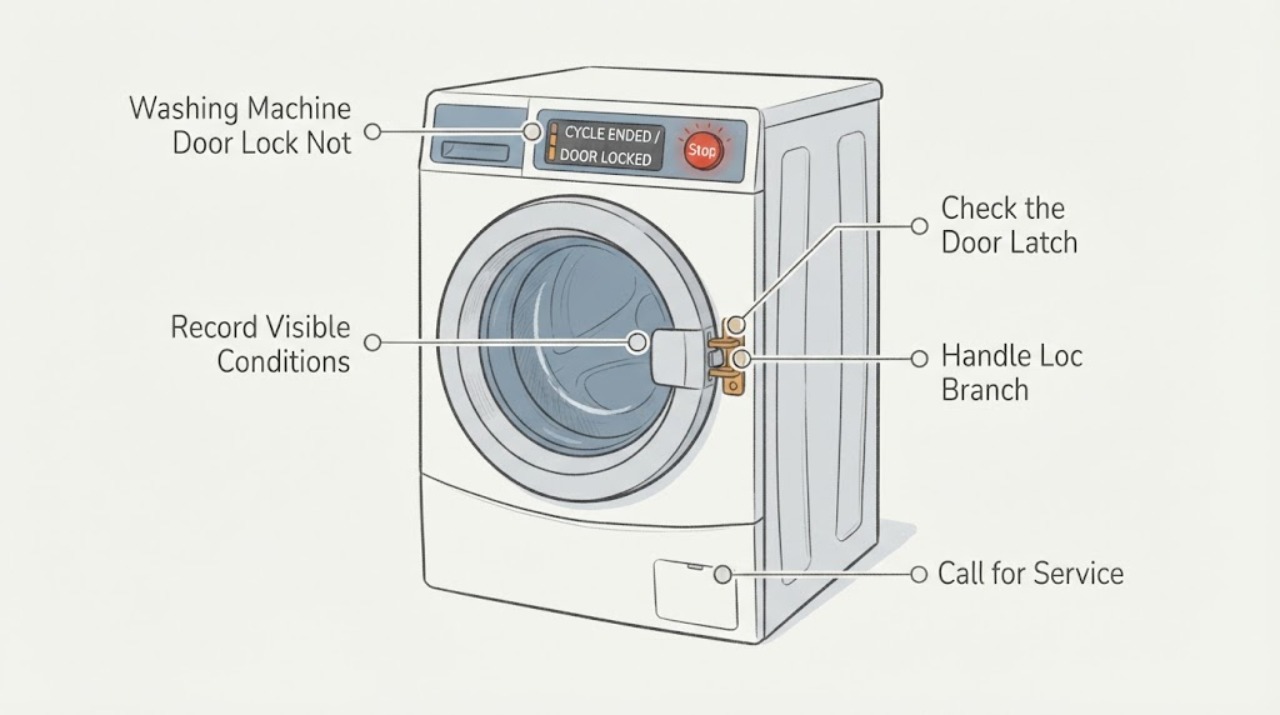
Do not pull, pry, or bypass the door lock. First record whether the drum is still moving, whether water is visible, and whether the display shows an exact message. If the display says LOC, use only the matching Electrolux manual's control-lock procedure. If it shows E42 or E41, use the corresponding conditional checks for a fully closed door, clothing or debris at the latch, and latch or striker engagement; those codes do not authorize a part replacement. If the cycle has ended but the lock remains engaged, or the code returns, identify the complete model and use its manual or qualified service. Do not use a generic emergency-release or random key sequence.
Work through in order
Diagnostic checks
Use only checks that match the exact appliance or system and its official guide.
-
Check 1
Without pulling the handle or repeatedly pressing controls, record whether the drum is moving, whether water is visible, whether the cycle is paused or complete, and every exact display code or message.
Expected result: The washer is still active or has water present; it shows LOC, E41, E42, another code, or no code.
Next step: Wait for the active cycle state to clear without forcing the door. Follow only the matching branch below for an exact LOC, E41, or E42; for another or unknown code, record it with the full model and use that model's manual.
Why this matters
Why: A running or water-filled cycle, a control lock, and a door-recognition code require different model-scoped paths; no code does not prove a failed lock.
-
Check 2
Only when the washer is stopped and the door can be inspected without resistance, look around the door opening for clothing or debris and confirm that the door is sitting fully closed against the latch; do not use a tool or force.
Expected result: A visible obstruction is removed safely, the door closes normally, or the latch/striker still does not engage or the door is damaged.
Next step: If the obstruction clears and the manual permits a normal retry, observe one normal cycle. If the latch will not engage, the door or striker is damaged, or the code returns, stop and arrange service.
Why this matters
Why: Electrolux lists a fully closed door, clothing or debris, the lock click, and latch/striker engagement as relevant external checks for E41/E42; failure here does not identify which internal part is defective.
-
Check 3
If the exact display reads LOC, open the owner manual for the complete model and locate its control-lock option; use only the documented unlock action for that control layout.
Expected result: The model manual confirms a control-lock state and the documented action clears LOC, or LOC remains or the model does not match.
Next step: Use the washer only as the matching manual allows after the lock clears. If LOC remains or the manual does not apply, stop and contact Electrolux service.
Why this matters
Why: Electrolux describes LOC as a control-lock condition on applicable front-loading washers, but the page does not establish one universal key sequence for every model.
-
Check 4
If the exact display reads E42, verify the door is fully closed, inspect the accessible opening for clothing or debris, and listen during a normal close for the documented lock click; do not dismantle or bypass the interlock.
Expected result: The door closes and engages normally after an obstruction is removed, or it still does not click, does not stay recognized, or E42 returns.
Next step: Use the exact model's owner guidance for any permitted next step. If recognition fails or E42 returns, keep the washer out of service and arrange qualified repair.
Why this matters
Why: Electrolux defines E42 as the door-lock device not being recognized, while the external checks cannot distinguish the latch, striker, interlock, wiring, or control cause.
-
Check 5
If the exact display reads E41, perform only the same external closed-door, obstruction, and latch/striker checks. If another code or no code is present, record the exact state and do not assign E41, E42, or LOC meaning to it.
Expected result: The door switch is recognized after an external correction, or the door remains locked, the code returns, or the display is different or blank.
Next step: For a returning E41 or an unexplained lock, use the full model to contact Electrolux service. Do not select a replacement switch or lock from a generic symptom.
Why this matters
Why: Electrolux describes E41 as the control believing the door switch is open; an unknown or absent code remains unresolved without the exact model and manual.
-
Check 6
Read and photograph the complete model and serial label without opening the cabinet, then document the display code, water or cycle state, door condition, and whether the symptom repeats.
Expected result: A complete model is available and matches the washer, or the label is missing, incomplete, or inconsistent with the control layout.
Next step: Provide the model, code, and observations to Electrolux or a qualified appliance technician. Keep the washer out of service if the lock remains engaged, the door is damaged, or the cycle cannot safely finish.
Why this matters
Why: Electrolux uses model information to locate the correct instructions; an unresolved lock after the model-scoped external checks cannot be narrowed to a specific component from the symptom alone.
Use your observations
Decision map
Find the observation that best matches what you see, then follow the next safe action.
-
PATH 01Next step
What you see
The drum is still moving, the cycle is paused, or water is visible and the door remains locked.
Do this next
Do not pull or pry the door. Wait for the documented cycle state to clear and use the exact model manual's drain or release procedure; arrange service if it cannot complete safely.
Why this path and its safety boundary
Why it matters: The washer has not reached a state where a forced door release is justified; the symptom does not identify a failed interlock.
-
PATH 02Next step
What you see
The display shows LOC and the complete model's manual confirms the control-lock option.
Do this next
Use only the matching manual's unlock action. If LOC remains or no matching procedure exists, stop and contact service.
Why this path and its safety boundary
Why it matters: The observed lock may be a model-specific control-lock state rather than proof of a damaged door lock.
-
PATH 03Next step
What you see
The exact display shows E42 and the door remains unrecognized after the external closed-door and obstruction checks.
Do this next
Keep the washer out of service and arrange qualified repair; do not bypass or dismantle the interlock.
Why this path and its safety boundary
Why it matters: Electrolux's E42 definition supports a door-lock recognition problem, but not a specific replacement part or internal cause.
-
PATH 04Next step
What you see
The exact display shows E41, another code, or no code, and the door still will not release after the model-authorized external check.
Do this next
Record the full model and display state and contact Electrolux service. Do not borrow a code meaning or install a lock, switch, or control based on the symptom.
Why this path and its safety boundary
Why it matters: E41 has a specific Electrolux definition only when displayed; another or absent code cannot be decoded from this generic symptom.
-
PATH 05Next step
What you see
The handle, door glass, striker, visible wiring, or lock area is damaged, or there is a burning smell, smoke, sparking, or water near electrical parts.
Do this next
Stop using the washer, isolate power and water only when it is safe to do so, and arrange qualified appliance or electrical help. Do not restore power for a test.
Why this path and its safety boundary
Why it matters: This is a safety and service boundary rather than a control-setting question.
Helpful context
Understand the symptom
Classify the locked state before touching the door
Watch the washer without repeatedly pressing Start or pulling the handle. Record whether the drum is still moving, whether water is visible through the door, whether the cycle is paused, and the exact text or code on the display. A door that is still in a cycle, a control lock, a latch-recognition code, and a lock that stays engaged after completion are different conditions; the symptom alone does not identify a failed lock assembly.
Use only the exact code branch shown on the display
Electrolux's E42 page applies to front-loading washers and describes a door-lock device that is not being recognized. Its E41 page describes the control believing the door switch is open. The LOC page describes a control-lock state. Do not transfer any of those meanings to an unlabelled display, a different model, or a code that merely looks similar.
Check the accessible door and latch area without forcing it
When the washer is stopped and the door can be inspected without pulling against the lock, check that no clothing or debris is caught at the opening and that the door sits fully closed against the latch. Electrolux's E41 and E42 guidance also calls for listening for the lock click and checking the externally visible latch or striker. Do not insert tools, pry the door, or remove the lock to make it release.
Confirm the exact washer model before a release sequence
Read the complete model from the rating label before trying a documented control-lock, drain, or release procedure. Electrolux says a front-load model number is along the door trim, while a top-load model number is along the rear of the tub opening under the lid. A family name or a similar control panel is not enough to select a key sequence.
Stop at the service boundary
If the lock stays engaged after the model-authorized checks, an exact E41 or E42 condition returns, the washer cannot complete or drain its cycle, or the handle, door glass, wiring, or lock area is damaged, keep the appliance out of service and arrange qualified Electrolux appliance service. Do not open the cabinet, probe the interlock, bypass the lock, or order a lock from the symptom alone.
When checks do not resolve it
Need a professional?
Arrange qualified Electrolux appliance service when the lock remains engaged after the exact model's permitted external checks, E41 or E42 returns, LOC will not clear using the matching manual, the door or striker is damaged, or any internal interlock, wiring, drain, or control diagnosis is needed.
Common questions
FAQ
Why is my Electrolux washer door still locked after the cycle?
First note whether the drum is still moving, water is visible, or the display shows LOC, E41, E42, another code, or nothing. Do not force the door. Use the full model's owner manual for the documented cycle, drain, or control-lock state; a persistent lock after the permitted external checks needs service.
What do E41 and E42 mean on an Electrolux front-load washer?
Only when the exact code is displayed, Electrolux describes E41 as the control believing the door switch is open and E42 as the door-lock device not being recognized. Check the documented closed-door, obstruction, and latch/striker observations, then arrange service if the condition remains or returns.
Can I use a generic emergency release or pry open the Electrolux washer door?
No. A generic release or forced entry can damage the door, leave water or an active cycle unresolved, and does not diagnose the cause. Identify the complete model and follow only its documented release or drain procedure; otherwise use qualified service.
Where is the Electrolux washer model number?
Electrolux says a front-load washer model number is along the door trim. For a top-load washer, it is along the back of the tub opening under the lid. Record the complete number before selecting a control-lock or door-release instruction.
Read the exact guide
Official sources
- Laundry front loading washer displaying Error Code E41 door is open.Electrolux · Official Electrolux support page for front-loading washers when the exact display reads E41; it supports external closed-door, obstruction, click, latch/striker and service checks.
- Laundry front loading washer displaying Error Code LOC control lock activator.Electrolux · Official Electrolux support page on an Electrolux-owned support host for front-loading washers when the exact display reads LOC; it supports a conditional control-lock interpretation and model-specific unlock path.
- What should I do if my washer does not start?Electrolux · Official Electrolux washer support page used only for distinguishing normal pause/door-state observations and directing unresolved operation problems to support; it is not used to decode an unknown door-lock code.
- Laundry Washers Noises GuideElectrolux · Official Electrolux laundry-washer guide used narrowly for the observation that clicking can accompany lock engagement/disengagement and that a washer may need to stop before the lid unlocks; it is not used to diagnose this generic lock symptom.
- Where can I find my model and serial number? | ElectroluxElectrolux · Official Electrolux support page used to locate the exact washer model needed for a matching lock, drain, control-lock or service procedure.
- Laundry front loading washer displaying Error Code E42 door lock device failure.Electrolux · Official Electrolux support page for front-loading washers when the exact display reads E42; it supports external door, obstruction, click, and latch/striker checks and service escalation, not a universal part diagnosis.
Community feedback
Share a repair observation
Share a plain-text repair observation. Accepted observations are published automatically; this page may take a moment to update.