
On this page
Start here
Quick answer
Treat a drain fault as a water-handling problem, not proof of a failed pump. First record the complete displayed code and whether water remains in the drum; Electrolux says different models can use different code variations. Disconnect power before handling standing water or an external filter, let hot water cool, and check only the accessible drain hose, household drain and model-approved filter. Electrolux's E20/E21 guidance applies across named front-load, top-load and washer-dryer families, but the filter can look different from model to model, so use the exact manual for its location and access. If the code or no-drain condition remains after those external checks, stop and arrange service rather than opening the pump or guessing a component.
Before you begin
Safety first
- Disconnect power before handling water or an external filter, let hot water cool, close the water supply when needed and keep water away from electrical connections. Do not force a hidden filter, remove panels, open the pump or perform live electrical tests.
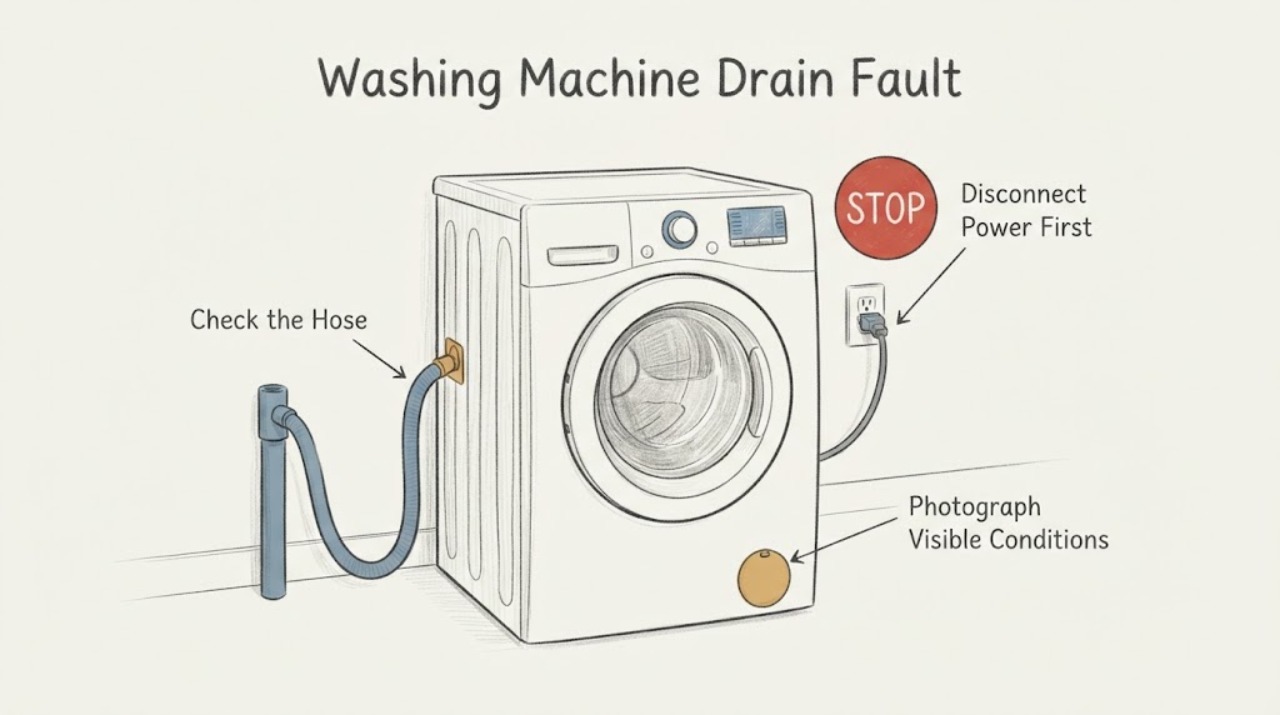
Work through in order
Diagnostic checks
Use only checks that match the exact appliance or system and its official guide.
-
Check 1
Photograph or write down the complete Electrolux code, beep/flash pattern, model number and whether water remains in the drum before disconnecting power.
Expected result: A complete code such as E20/E21/C2 is visible, or there is no code and only slow/no draining is present.
Next step: Use the exact model manual and matching Electrolux support article. If no code is present, continue with the external drain-path checks rather than applying a code-specific reset.
Why this matters
Why: Electrolux says different washing-machine models can use different code variations and instructs owners to note the full code before power is disconnected. A symptom alone does not establish a particular code or component.
-
Check 2
If water is in the drum or a filter must be handled, disconnect the washer from the mains, close the water tap when needed, let hot water cool and place a shallow bowl or tray where water may discharge.
Expected result: The washer is unplugged and the water is cool enough to handle, or water is hot, uncontrolled or spilling toward electrical connections.
Next step: Proceed only when the external area is safe and the model manual supports the next step. If water cannot be contained safely, keep the washer off and request service.
Why this matters
Why: Electrolux requires power disconnection before filter cleaning and warns to wait for hot water to cool. Water escaping toward electrical parts is a stop condition, not a pump test.
-
Check 3
Inspect the accessible drain hose behind the washer for kinks, twists, crushing or an incorrect connection; compare its insertion depth and drain height with the exact installation instructions.
Expected result: The hose is kinked/twisted, inserted too deeply, at the wrong height or connected to a restricted outlet, or the hose path is clear.
Next step: Correct only an accessible installation issue supported by the manual, secure the hose and check the household drain. If the path is clear or the fault returns, do not infer a failed pump.
Why this matters
Why: Electrolux's E20/E21 guidance says hose position, height and kinks can prevent drainage; its general values are no more than 10 cm into the drain and 60–100 cm above the machine base unless the manual specifies otherwise.
-
Check 4
Check whether the sink trap, standpipe or other household drain accepts water normally, and inspect the visible hose connection for blockage; also note excessive detergent foam without adding more detergent.
Expected result: The household drain backs up, draining into a suitable sink/bowl works, foam is present, or the external drain path is clear.
Next step: Clear only an accessible household blockage and follow the exact manual for foam cleanup. If the machine still will not drain, stop user testing and arrange service.
Why this matters
Why: Electrolux says an obstructed siphon/outlet, hose connection or excess foam can mimic a washer drain fault. A clear household drain does not prove that the internal pump or wiring is good.
-
Check 5
Only if the exact manual confirms an external drain-pump filter, use that model's access procedure after power is disconnected and water is cool; place a shallow container below it, remove only the stated filter, clear visible lint/objects and refit it fully.
Expected result: The manual confirms an external filter and it is accessible/blocked, or there is no model-approved filter access, the cover is jammed or water cannot be contained.
Next step: If the filter procedure is completed, follow the manual's drain test and inspect for leakage. If access is not confirmed or the fault persists, keep the washer off and call service; do not remove panels or open the pump housing.
Why this matters
Why: Electrolux says an external filter may be cleaned for E20-type problems, but the filter looks different from model to model and must be handled as described in the manual. A jammed/hidden access point does not identify a pump failure.
-
Check 6
Arrange authorised service if the complete code returns, the washer still will not drain after the model-approved external checks, there is a leak/burning smell, or the next step would require a hidden filter, pump, wiring or cabinet access.
Expected result: The fault persists, repeats immediately, or a safety/internal-repair condition is present.
Next step: Keep the washer unplugged as appropriate, provide the model, code, water level and checks already completed, and do not diagnose or replace the pump yourself.
Why this matters
Why: Electrolux identifies repeated codes, persistent no-drain behavior, leakage, burning smell and visible damage as reasons for professional diagnosis; its drain guide lists pump, internal blockage and electrical malfunction as service possibilities without confirming any one cause.
Use your observations
Decision map
Find the observation that best matches what you see, then follow the next safe action.
-
PATH 01Next step
What you see
The display actually shows E20/E21/E22/E23/E24 or C2, or the documented equivalent beep/flash pattern, and water remains or draining stops.
Do this next
Use the model-approved hose, external drain, foam and filter checks; book service if the code or no-drain condition returns.
Why this path and its safety boundary
Why it matters: The opened Electrolux support article treats these named states as a draining problem, while the code guide says the exact model still controls the applicable variation.
-
PATH 02Next step
What you see
No code is visible, but water remains in the drum or the washer stops before draining.
Do this next
Use only external hose/household-drain checks and the exact manual's filter procedure, then arrange service if no-drain persists.
Why this path and its safety boundary
Why it matters: Electrolux's drain guide lists blocked/dirty filter, kinked hose and pump issue as possibilities; without a code or model, the symptom does not identify the internal cause.
-
PATH 03Next step
What you see
A kinked hose, incorrect hose position, blocked sink/standpipe or excess foam is found and the washer otherwise responds normally.
Do this next
Correct the condition according to the exact manual, contain any water and run only the manual-approved drain check; stop and service if the fault repeats.
Why this path and its safety boundary
Why it matters: Electrolux identifies those external conditions as possible causes of poor drainage, so the observation supports correcting the accessible installation or household drain condition.
-
PATH 04Next step
What you see
The model does not confirm an external filter, the filter cover is jammed/hidden, water cannot be contained, or the fault remains after the approved checks.
Do this next
Leave the washer off and request authorised service; do not force the filter, remove cabinet panels or infer a pump failure from the symptom.
Why this path and its safety boundary
Why it matters: Electrolux states that filter appearance/access varies by model and that persistent no-drain faults may require diagnosis of a pump, internal blockage or electrical issue.
Helpful context
Understand the symptom
Record the exact code before treating it as an E20-type fault
The task has no model or displayed code. Electrolux says error-code variations differ by model and directs owners to note the complete code, then use the matching guide and manual. A drain symptom may accompany E20/E21/E22/E23/E24 or C2 on the opened Electrolux support page, but do not assign one of those codes unless it is actually shown.
Start with external water-path checks
Electrolux identifies a kinked or twisted drain hose, incorrect hose insertion/height, a blocked sink trap or outlet, excess foam and a blocked filter as possible drainage causes. Those checks can be made without diagnosing the pump. Hose dimensions and installation must follow the exact manual where it differs from the general support guidance.
Filter access is model-dependent
Only clean an external drain-pump filter when the exact Electrolux manual shows that your washer has one and explains its access. Disconnect mains power, let hot water cool, place a shallow container under the access point and prevent a spill. Electrolux explicitly says the filter can look different from model to model; a hidden or jammed filter is a service boundary rather than an invitation to remove panels.
When checks do not resolve it
Need a professional?
Call authorised Electrolux service if the complete fault code returns, the washer still will not drain after model-approved external checks, water cannot be contained safely, there is a leak/burning smell or the next step requires hidden filter, pump, wiring or cabinet access. Do not diagnose or replace a pump from the drain symptom alone.
Safety scope: Disconnect power before handling water or an external filter, let hot water cool, close the water supply when needed and keep water away from electrical connections. Do not force a hidden filter, remove panels, open the pump or perform live electrical tests.
Have this ready
- Provide the full model and serial, complete code/beep pattern, washer type, water level, hose position/height, household-drain result, whether an external filter is confirmed by the manual, and any leak, odor or burning-smell observations.
Common questions
FAQ
Does every Electrolux drain fault mean the pump failed?
No. Electrolux lists hose position, drain height, kinks, household-drain blockage, foam and filter blockage as possible causes. Its support guide lists pump or electrical issues only as possibilities requiring professional diagnosis when external checks do not resolve the problem.
Can I remove the drain filter on any Electrolux washer?
Only when the exact model manual confirms an external filter and gives the access method. Electrolux says the filter can look different from model to model. Disconnect power, let hot water cool and contain water before any permitted filter cleaning; do not force a hidden or jammed access point.
What if the code is not E20 or I do not see a code?
Record the complete code if one appears and use the matching model guide because Electrolux says code variations differ by model. If there is no code, use only external drain-path and model-approved filter checks; persistent no-drain behavior still needs service.
Read the exact guide
Official sources
- How to clean and maintain your Electrolux washing machine and extend its lifeElectrolux UK · Opened Electrolux official maintenance article. It applies only where the appliance is equipped with an external drain filter and explicitly routes model differences to the manual.
- Washing Machine Not Draining Water – Error Code E20 or E21Electrolux UK · Opened Electrolux official support article. It explicitly applies to front-load, top-load and washer-dryer families, but the exact manual controls model-specific installation and filter procedures.
- Washing Machine Not Draining? How to Drain It Quickly & Fix IssuesElectrolux UK · Opened Electrolux official drain guide for washing machines and washer-dryers. It is used for general external safety and service boundaries; exact model access and hose instructions remain controlling.
- Electrolux Washing Machine Displays an Error Code – causes and solutionsElectrolux UK · Opened Electrolux official error-code guidance for washing machines and washer-dryers. It supports recording the complete code and following the exact model guide; it does not make an unshown code applicable to this task.
Community feedback
Share a repair observation
Share a plain-text repair observation. Accepted observations are published automatically; this page may take a moment to update.