
On this page
Start here
Quick answer
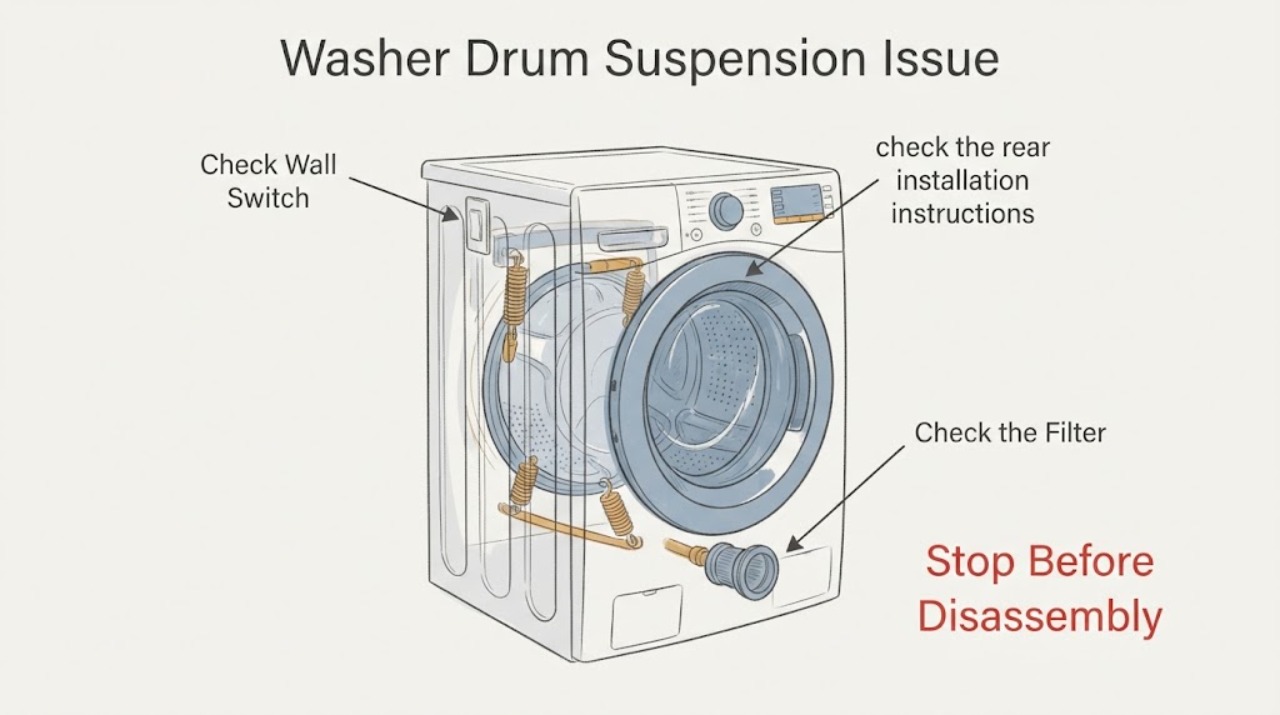
An Electrolux washer that bangs, shakes, or moves during spin does not automatically have a failed drum suspension. First stop the cycle if the machine is walking, leaking, or striking its cabinet; then, with power disconnected, check the installation, transit bolts, level and stable floor, load distribution, hoses, and accessible filter or drum area. If excessive vibration continues with a correctly installed machine and an empty drum, or unusual noise persists, keep it out of service and have an Electrolux technician inspect the suspension and other internal parts. Do not open the cabinet or pull on springs without the exact model procedure and proper safety controls.
Work through in order
Diagnostic checks
Use only checks that match the exact appliance or system and its official guide.
-
Check 1
Stop the washer if it is walking, striking the cabinet, leaking, or producing a new harsh noise. Switch it off and disconnect power before moving laundry or doing any maintenance; keep the washer upright and do not reach into a moving drum.
Expected result: The machine is stable and dry, or it is moving violently, leaking, striking the cabinet, or has another unsafe condition.
Next step: If the machine is unsafe or leaking, leave it disconnected, close the water supply if safe, and arrange service. Do not pull the washer out alone or open the cabinet.
Why this matters
Why: Severe movement can damage the appliance, hoses, floor, or nearby objects. Electrolux requires power isolation before maintenance and warns that suspension work has shock, pinch, and injury risks.
-
Check 2
If the problem began after installation or relocation, check the rear installation instructions for every transit bolt and confirm that the washer stands on a firm, level floor with all feet firmly in contact. Use a spirit level and adjust feet only as the installation instructions permit.
Expected result: Transit hardware remains installed, the washer rocks, a foot is not firmly planted, or the floor flexes; or the installation is stable and the bolts are removed.
Next step: Correct only the accessible installation condition using the exact model instructions. If the washer is already stable and the issue remains, continue with load and external checks instead of assuming the suspension is failed.
Why this matters
Why: Electrolux says transport bolts secure the drum and can prevent correct spin operation when left in place. An uneven or flexible installation can also cause imbalance and excessive vibration.
-
Check 3
With the drum stopped, redistribute laundry evenly and remove a single bulky item or excess load. Check that visible hoses are secured and that any user-accessible drain filter or drum opening is free of obvious loose objects, following the model manual.
Expected result: The shaking occurs only with an uneven or bulky load, or it remains with a normal load and no visible obstruction.
Next step: Run the next load only if the washer is stable and there is no leak or damage. If normal loading does not change the symptom, stop repeated testing and record the noise and cycle phase for service.
Why this matters
Why: Electrolux lists unbalanced or overloaded laundry, loose hoses, and foreign objects in the filter or drum as common sources of noise and vibration. A load-related result does not prove a suspension defect.
-
Check 4
After the external checks, compare the symptom only under a safe, model-permitted condition: note whether a correctly installed washer still shakes or makes unusual noise during an empty spin, and whether the drain filter is clean and water drains normally. Do not run a test if the machine is unstable, leaking, or striking the cabinet.
Expected result: The empty drum spins normally, or excessive vibration or unusual noise remains with an empty drum and normal drainage.
Next step: If the empty test is abnormal, keep the washer out of service and request Electrolux inspection. Do not order a suspension part or remove the lid based only on this symptom.
Why this matters
Why: Electrolux says an empty-drum result helps separate load imbalance from an appliance problem; persistent trouble after leveling and drainage checks may involve an internal component, but it does not identify a specific spring or damper.
-
Check 5
Record the complete model and serial number, when the vibration begins, whether the drum is empty or loaded, the floor and installation findings, any error code, and whether there is water or cabinet contact before booking service.
Expected result: The model is available, or the label cannot be read; the symptom is repeatable only in certain loads or persists across conditions.
Next step: Provide the details to Electrolux or an authorized technician. Keep the washer disconnected if movement is severe, a leak is present, or the source remains unclear.
Why this matters
Why: Electrolux's suspension repair guidance requires a compatible part and the product manual. The model and symptom pattern let service distinguish installation, load, drainage, and internal suspension possibilities.
Use your observations
Decision map
Find the observation that best matches what you see, then follow the next safe action.
-
PATH 01Next step
What you see
The washer was recently installed or moved, and transit bolts remain or the cabinet rocks on the floor.
Do this next
Correct the transit-bolt and leveling condition using the exact installation instructions, then reassess only if the washer is stable and dry.
Why this path and its safety boundary
Why it matters: Installation restraint or leveling is a stronger first explanation than a failed suspension part.
-
PATH 02Next step
What you see
Shaking appears only with one bulky item, an overloaded drum, or a load gathered on one side, and the empty or normally loaded machine is stable.
Do this next
Redistribute or reduce the load and follow the appliance's loading guidance. Book service if the same movement occurs with ordinary loads.
Why this path and its safety boundary
Why it matters: The observed pattern is consistent with load distribution rather than proof of suspension failure.
-
PATH 03Next step
What you see
The appliance is level, transit bolts are removed, the load and visible external checks are normal, but the empty drum still shakes, bangs, or fails to spin correctly.
Do this next
Keep the washer out of service and arrange an Electrolux or qualified technician inspection. Do not open the cabinet or choose a suspension component without exact model confirmation.
Why this path and its safety boundary
Why it matters: Electrolux treats persistent abnormal operation after these checks as a possible internal fault; the symptom cannot distinguish a spring, damper, motor, drainage, bearing, or control issue.
-
PATH 04Next step
What you see
The washer is leaking, has exposed damage, or would need to be tilted or opened to reach the suspected suspension.
Do this next
Disconnect power, turn off water if safe, keep the appliance upright, and arrange qualified service. Do not use a spring, damper, cable, or tool chosen without the exact model procedure.
Why this path and its safety boundary
Why it matters: The condition has crossed the safe external-check boundary. Electrolux requires power and water isolation, upright handling, compatible parts, and appropriate protective equipment for suspension work.
Helpful context
Understand the symptom
Shaking is a symptom, not proof of a failed suspension part
Electrolux applies its shaking guidance to front-load and top-load washing machines. The first checks are installation and operating conditions: transit bolts, level feet, a firm floor, load distribution, hoses, filters, and foreign objects. A drum suspension spring or damper may still need inspection when the problem persists, but the symptom alone does not identify which internal part is involved.
Use timing and load response to narrow the next safe step
Note whether the movement happens only with one large item or an overloaded load, only at high spin speed, or even with an empty drum. A recent installation makes transit bolts and leveling especially important. Continued movement or unusual noise after the external checks makes a service inspection more appropriate than repeated spin tests or a guessed spring or damper replacement.
Suspension work has a real injury and electrical boundary
Electrolux's suspension-spring instructions warn to disconnect mains power, turn off the water, empty the appliance, keep it upright, and use suitable safety equipment. They also require a compatible part and warn that nonprofessional repair can have safety consequences. Those instructions are not a universal invitation to open an unmodeled washer; use the exact user manual or an authorized technician for any internal suspension work.
When checks do not resolve it
Need a professional?
Arrange Electrolux or qualified appliance service if excessive vibration remains after transit-bolt, leveling, load, hose, filter, and visible-drum checks; the empty drum still shakes or makes unusual noise; the washer leaks or strikes the cabinet; an error code repeats; or internal suspension work would require opening, tilting, or supporting the drum. Do not bypass a safety device, run the machine with damaged suspension, or order a spring or damper without model-matched confirmation.
Common questions
FAQ
Does an Electrolux washer that shakes automatically need new suspension springs?
No. Electrolux first lists transit bolts, leveling, the floor, load distribution, hoses, filters, and foreign objects as common causes. Persistent movement with a stable installation and empty drum needs a technician to identify the internal fault before a part is selected.
Can I replace the Electrolux suspension spring myself?
Do not assume the generic repair page applies to your exact model. Electrolux's suspension guidance requires disconnecting power, turning off water, emptying and keeping the appliance upright, using compatible parts and protective equipment, and having the necessary know-how. Use the exact manual or qualified service.
Why does the washer shake only during spin?
Spin vibration can come from an unbalanced or overloaded load, an uneven floor or feet, transit bolts, loose hoses, or objects in the filter or drum. If those conditions are corrected but an empty drum still shakes or makes unusual noise, arrange an inspection.
Read the exact guide
Official sources
- Washing Machine Noisy or Shaking During Spin Cycle?Electrolux · Official Electrolux guidance applying to front-load and top-load washing machines. It supports external checks for transit bolts, level and stable flooring, laundry distribution, hoses, filters, drum objects, normal-operation noise, and escalation when excessive vibration persists.
- Washing machine - How to replace the suspension spring (1)Electrolux · Official Electrolux repair guidance for a washing-machine suspension spring. It is used only for the safety and service boundary: power and water isolation, upright handling, compatible parts, protective equipment, and the warning about nonprofessional repair. The internal replacement steps are not presented as a universal procedure for this model-unspecified task.
- Electrolux Washing Machine Does Not Spin – Causes and SolutionsElectrolux · Official Electrolux washing-machine and washer-dryer guidance used for transit-bolt, leveling, floor, load, filter, empty-drum, and persistent-fault distinctions. It does not identify a particular suspension part for an unmodeled washer.
Community feedback
Share a repair observation
Share a plain-text repair observation. Accepted observations are published automatically; this page may take a moment to update.