
On this page
Start here
Quick answer
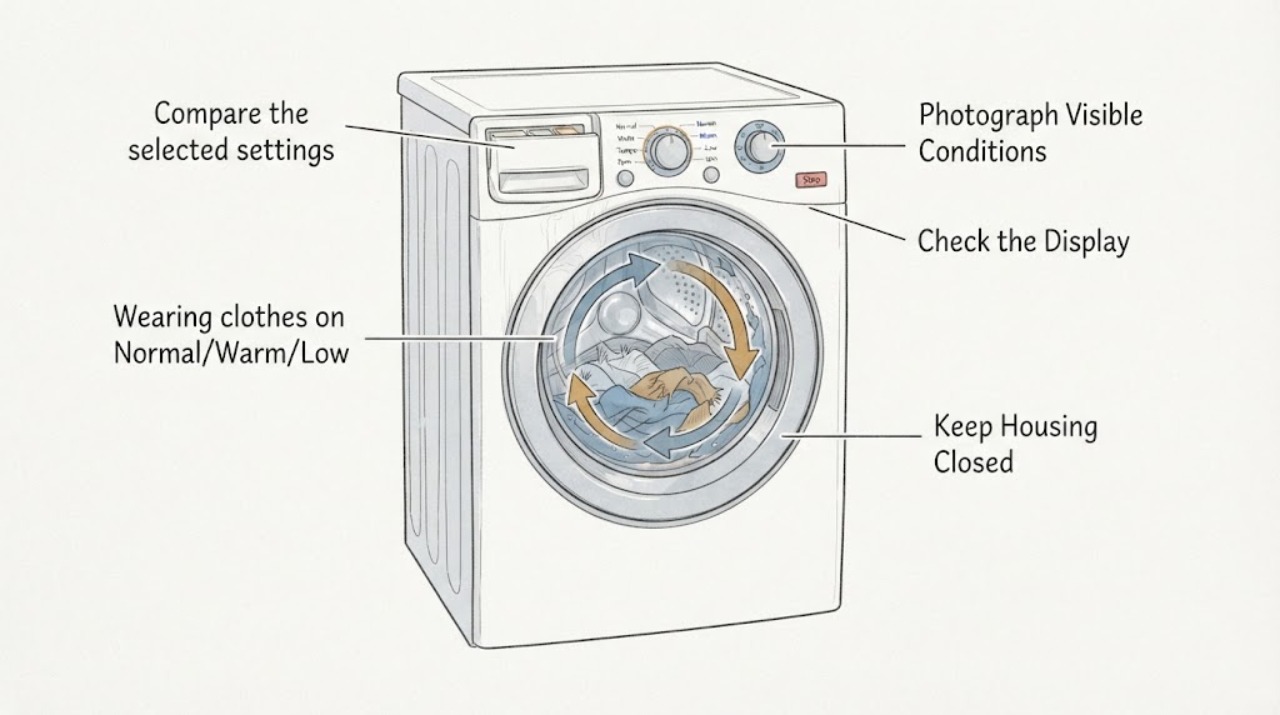
The Electrolux ELFW7437AW settings in this report do not by themselves prove a defective washer. Electrolux identifies this as a front-load washer, and its owner guide describes Normal as moderate agitation and moderate cleaning motion for normally soiled cotton, mixed loads, and bedding except comforters; Warm is for normally soiled white or colorfast cottons or blends, while Low spin mainly reduces wrinkling and is not a guarantee against wash abrasion. First photograph the wear pattern, check labels and garment condition, fasten zippers/hooks, turn items inside out, avoid overloading, and inspect the visible drum and gasket for a foreign object or rough spot. For fragile or pilling-prone items, use the model's Delicates or Hand Wash path, which the guide describes as shorter, gentler, cooler, and lower-spin. If holes, snags, or rough damage continue on correctly prepared, care-label-compatible loads, stop using valuable clothes and use Electrolux's exact-model service/warranty route with photos and the controlled settings; do not assume fabric softener or a lower spin setting can correct a mechanical defect.
Work through in order
Diagnostic checks
Use only checks that match the exact appliance or system and its official guide.
-
Check 1
Stop washing valuable or irreplaceable garments and photograph the damage before laundering again. Record whether the result is surface pilling, roughened fibers, a pulled thread, a localized snag, a hole, a torn seam, color change, or detergent/softener residue; note the fabric, care label, garment age, and exact cycle/settings.
Expected result: The damage is diffuse pilling on synthetic/permanent-press fabric, a localized snag or hole, a weak seam that was already stressed, color/heat change, or residue rather than fiber tearing.
Next step: Keep photos and the garment label, then choose the matching load-preparation and cycle branch. Do not use more fabric softener as a substitute for identifying a snag or hole.
Stop if: Stop using the washer for important clothing if new holes, cuts, repeated snags, sharp localized damage, or a visible mechanical defect appears.
Why this matters
Why: Different patterns point to different next checks. Electrolux treats pilling as abrasion that can be normal for some fabrics, while fasteners, pre-existing degradation, overloading, temperature, detergent, and direct softener can produce other visible results.
-
Check 2
Compare the selected settings with the garment care label and the load type. For ordinary colorfast cotton or blends that are normally soiled, Warm/Normal may fit the guide; for pilling-prone or delicate fabrics, select the model's Delicates or Hand Wash cycle when available, with the lower temperature and spin path assigned to it.
Expected result: The load contains delicate, synthetic, loosely woven, heat-sensitive, or label-restricted items but was run on Normal/Warm; or the load is care-label-compatible and the damage persists on a gentler cycle.
Next step: For a mismatch, stop using that setting for the affected fabric and follow the label. If correctly labeled items still show new physical damage on the gentler path, preserve the result for service rather than moving to still more settings changes.
Stop if: Do not wash a garment against its label, use higher heat to compensate for wear, or continue if the fabric is visibly catching or tearing in the drum.
Why this matters
Why: Normal is not the same as Delicates: Electrolux describes Normal with moderate agitation/cleaning, while Delicates uses shorter agitation, gentle cleaning motion, lower temperatures, and lower spin. Warm is not universally safe for every fiber or dye.
-
Check 3
Prepare the clothing before one controlled load: empty pockets, fasten zippers/hooks/buckles, turn items inside out, sort by fabric and color, separate exposed hardware or rough surfaces, and keep the load within capacity instead of packing the drum tightly.
Expected result: The same kind of damage stops after fasteners are secured, items are turned inside out, the load is reduced/sorted, or a pre-existing weak garment is removed; or the damage repeats on a small, correctly prepared load.
Next step: Use the changed preparation only for the matching clothing type and keep before/after photos. If the controlled load still produces a fresh snag or hole, stop testing with valuable items and request service.
Stop if: Do not reach into a moving drum, force a garment free, or continue when a fastener catches, a gasket is torn, or a sharp object is visible.
Why this matters
Why: Electrolux lists unfastened fasteners, overloading, incorrect sorting, and degradation of fabric as possible causes of holes, tears, snags, lint, and pilling. A repeat on a controlled load makes a washer-side drum/gasket or wash-action inspection more important.
-
Check 4
With the washer off and the drum stopped, inspect the visible stainless drum, door gasket, door striker area, and dispenser area for a coin, pin, broken fastener, rough edge, torn gasket, or residue. If the manual's empty-drum check is appropriate, run only the documented empty observation; do not dismantle the washer or probe behind the gasket.
Expected result: A foreign object or rough/damaged surface is visible, the gasket is torn or displaced, the empty drum is quiet and smooth, or the empty drum still produces scraping/catching noise.
Next step: Remove only a loose, accessible object when the appliance is safely off; do not scrape or reshape the drum/gasket. Request Electrolux service for a rough surface, torn gasket, hidden object, or continuing noise.
Stop if: Stop for a sharp edge, exposed metal, damaged gasket, scraping/grinding, water leak, or any need to remove a panel or moving part.
Why this matters
Why: A local rough point or object can create repeatable snags independently of Normal/Warm/Low settings. Electrolux says to stop and check the drum for foreign objects and call an authorized technician if noise continues after an empty cycle.
-
Check 5
Check the detergent and product path against the manual: use HE detergent at the recommended amount, do not pour liquid softener directly on fabric, and avoid overfilling the dispenser. Record whether the issue is physical fiber damage versus residue, stiffness, discoloration, or odor; do not change several products at once.
Expected result: There is residue, stiffness, discoloration, or odor without new tears/snags; or physical wear continues with correct HE dosage and no direct softener contact.
Next step: Correct only the product-use issue supported by the manual and recheck a compatible, low-value load. For continued physical damage, stop product experimentation and use the service/warranty branch.
Stop if: Do not mix laundry chemicals, pour concentrated products on clothing, or continue if a chemical burn, unusual odor, smoke, or skin/eye exposure occurs.
Why this matters
Why: Detergent, softener, water temperature, and soil level can explain residues or discoloration, but they do not explain a repeatable sharp snag or hole as well as a caught garment or drum-path issue.
-
Check 6
For a brand-new or recently purchased ELFW7437AW, assemble the model and serial numbers, receipt/delivery date, installation record, photos of the garment before and after washing, care labels, exact cycle/settings, load size, and results of the controlled checks before contacting Electrolux, the retailer, installer, or an authorized technician.
Expected result: Fresh damage repeats after correct care-label selection, preparation, product use, and visible drum/gasket checks; or a defect is visible even with an empty drum.
Next step: Stop using valuable clothing and request exact-model Electrolux/retailer service with the evidence. Ask the technician to inspect the drum, gasket, door area, wash action, and relevant installation/control behavior before authorizing a component.
Stop if: Keep the washer out of service for a sharp drum defect, damaged door/gasket, scraping or grinding, leak, smoke, burning/electrical odor, or exposed wiring.
Why this matters
Why: A new-unit pattern that survives controlled user checks is not resolved by calling the clothing delicate or assuming Normal was selected incorrectly. It supports a product-quality, installation, or mechanical inspection under the applicable service/warranty route.
Use your observations
Decision map
Find the observation that best matches what you see, then follow the next safe action.
-
PATH 01Next step
What you see
The result is mainly pilling on synthetic or permanent-press fabric, with no sharp snag, hole, rough drum point, or new damage on properly prepared cotton loads.
Do this next
Follow the garment label, turn pilling-prone items inside out, reduce abrasion with the appropriate Delicates or Hand Wash cycle, and avoid overloading. Do not call pilling alone proof of a failed washer.
Why this path and its safety boundary
Why it matters: Electrolux describes pilling as abrasion that can be normal for some fabrics. Normal/Warm can be appropriate for some cotton or colorfast blends but is not a delicate cycle for every textile.
-
PATH 02Next step
What you see
A zipper, hook, buckle, rough garment edge, overfilled load, pre-existing weak seam, or visible foreign object corresponds to the snag or tear, and the problem improves after preparation or removal.
Do this next
Keep the improved preparation for similar loads, photograph any pre-existing damage, and do not continue using a garment that catches until the cause is corrected.
Why this path and its safety boundary
Why it matters: The clothing/load path is more likely than an internal ELFW7437AW failure; Electrolux lists these conditions separately from fabric pilling.
-
PATH 03Next step
What you see
New holes, snags, or sharply localized abrasion repeat on a small, correctly prepared, care-label-compatible load after a visible empty-drum/gasket check finds no user-removable cause.
Do this next
Stop washing valuable clothing and use Electrolux/retailer warranty or authorized service with photos, garment labels, settings, and controlled-load results. Do not order a board, gasket, drum, or other part from symptoms alone.
Why this path and its safety boundary
Why it matters: A washer-side drum, gasket, door, wash-action, or other model-specific fault becomes more likely than an ordinary Normal/Warm setting explanation. The exact community report supports documenting this as a new-unit concern but does not diagnose a part.
-
PATH 04Next step
What you see
The issue is color change, residue, stiffness, or a heat-sensitive fabric result rather than a new tear or snag, and the load used Warm or a product outside the garment label.
Do this next
Follow the label and use the correct product amount and cycle; do not increase heat to compensate for wear. Escalate if physical damage remains after the product/settings issue is corrected.
Why this path and its safety boundary
Why it matters: Temperature, fiber/colorfastness, detergent amount, direct softener, and cycle selection are more likely than a mechanical catching fault. Electrolux says to select temperature according to fiber content, colorfastness, and soil level.
-
PATH 05Next step
What you see
The empty-drum check still produces scraping, grinding, or catching, or the gasket/door/drum has a sharp or damaged area.
Do this next
Stop using the washer and request authorized Electrolux service; do not reach behind the gasket, remove panels, or continue cycles to reproduce the damage.
Why this path and its safety boundary
Why it matters: A mechanical contact or foreign-object path can damage clothes regardless of temperature, soil level, or spin selection.
Helpful context
Understand the symptom
What Normal, Warm, and Low actually change
Electrolux's guide describes Normal as moderate agitation and moderate cleaning motion for normally soiled cotton, mixed loads, and bedding except comforters. Warm is intended for normally soiled white or colorfast cottons or blends, with the temperature selected according to fiber content, colorfastness, and soil level. Low spin is a final-spin choice: the guide says lower spin reduces wrinkling and can gently spin items intended to be line dried. It does not turn Normal into a delicate wash or prove that any visible abrasion is a control failure.
The useful boundary is the damage pattern
Pilling on synthetic or permanent-press fabrics can be normal abrasion, while a hole or snag beside a zipper, hook, buckle, pre-existing weak seam, or foreign object has a different meaning. The ELFW7437AW guide separately discusses fabric care labels, overloading, correct temperature and detergent, turning items inside out, and checking the drum when coins or safety pins may be present. A new washer that continues to produce fresh holes or snags on properly prepared loads deserves a model-specific inspection and warranty record; fabric softener alone cannot establish or disprove a mechanical defect.
When checks do not resolve it
Need a professional?
Have this ready
- Full model ELFW7437AW and serial number, receipt/delivery date, installation details, garment care labels, before/after photos, fabric and garment age, exact Normal/Warm/Normal-soil/Low-spin settings, load size, detergent and softener amounts, load-preparation steps, empty-drum/gasket observations, and whether the damage is pilling, residue, snagging, holes, or tears.
Common questions
FAQ
Is Normal/Warm/Normal soil/Low spin automatically too harsh for the ELFW7437AW?
No single setting proves that. Electrolux describes Normal as moderate agitation and cleaning for normally soiled cotton, mixed loads, and bedding except comforters; Warm is for normally soiled white or colorfast cottons/blends, and Low spin mainly reduces wrinkling. Delicates or Hand Wash use shorter, gentler motion and lower temperatures/spin for suitable fabrics.
Will lowering the spin speed stop clothes from wearing out?
Not necessarily. Electrolux says lower spin reduces wrinkling and can gently spin line-dry items, but wash agitation, fabric type, fasteners, load size, temperature, and the drum path can still cause pilling or snags. If fresh holes or sharp damage continue on a controlled load, use service rather than lowering spin repeatedly.
When should a new ELFW7437AW be treated as a warranty or quality issue?
After stopping valuable loads and documenting the garment label, exact settings, preparation, load size, detergent, photos, and a safe controlled result, repeated new holes, snags, or sharply localized abrasion with no visible user cause deserves Electrolux/retailer warranty or authorized-service review. The exact community report has no confirmed repair, so it does not establish a universal model defect.
What should I inspect inside the washer?
With the washer off and the drum stopped, inspect only the visible drum, door gasket, and door area for a loose coin, pin, fastener, rough edge, or torn gasket. Electrolux says to stop and check the drum for foreign objects and call an authorized technician if noise continues after an empty cycle. Do not remove panels or reach behind the gasket.
Read the exact guide
Official sources
- Brand new washer very hard on clothes - please give tips!Reddit r/Appliances · Exact Reddit post about the specified ELFW7437AW; used only for the reported user experience and lack of confirmed resolution, not as proof of a universal model defect.
- Front Load Perfect Steam™ Washer with LuxCare® Wash - 5.2 Cu.Ft. I.E.C ELFW7437AW Model Support PageElectrolux · Official Electrolux model-support page for ELFW7437AW; it identifies the exact appliance and links its Complete Owner's Guide, support, registration, service locator, and warranty resources.
- Front Load Perfect Steam™ Washer with LuxCare® Wash - 5.2 Cu.Ft. I.E.CElectrolux · Official Electrolux product page for ELFW7437AW; it confirms the front-load platform, LuxCare wash action, available Normal/Warm/Low settings, and model support information.
- EN User Manual | Washing MachineElectrolux · Official Electrolux owner guide reached through the exact ELFW7437AW support page; it covers the 700-series settings and troubleshooting topics used here. Follow the exact model support page if a control or option differs.
Community feedback
Share a repair observation
Share a plain-text repair observation. Accepted observations are published automatically; this page may take a moment to update.