
On this page
Start here
Quick answer
An Electrolux washer can make normal clicks, water-filling sounds, draining gurgles, pump hum, or a high-pitched spin sound, but persistent rattling, clanking, knocking, shaking, or metal-on-metal noise needs isolation before you keep running it. Stop the cycle safely, wait for the door or lid to unlock, and remove loose objects from the drum and clothing fasteners. If the noise remains with an empty cycle, check ordinary-access installation causes: shipping materials or bolts on a recent installation, a washer that is not level on a solid floor, an unsecured drain hose, or loose stacking hardware. Do not open the cabinet or replace a bearing, belt, pump, suspension part, or motor by guesswork. Stop for leaking water, smoke, burning smell, exposed wiring, a damaged drum or glass, violent movement, or a breaker that trips, and arrange qualified Electrolux service.
Before you begin
Safety first
- This article supports sound classification, stopping and unlocking normally, accessible load and installation checks, and a cautious empty-cycle split test only when safe. It does not authorize cabinet removal, live testing, internal disassembly, or part replacement.
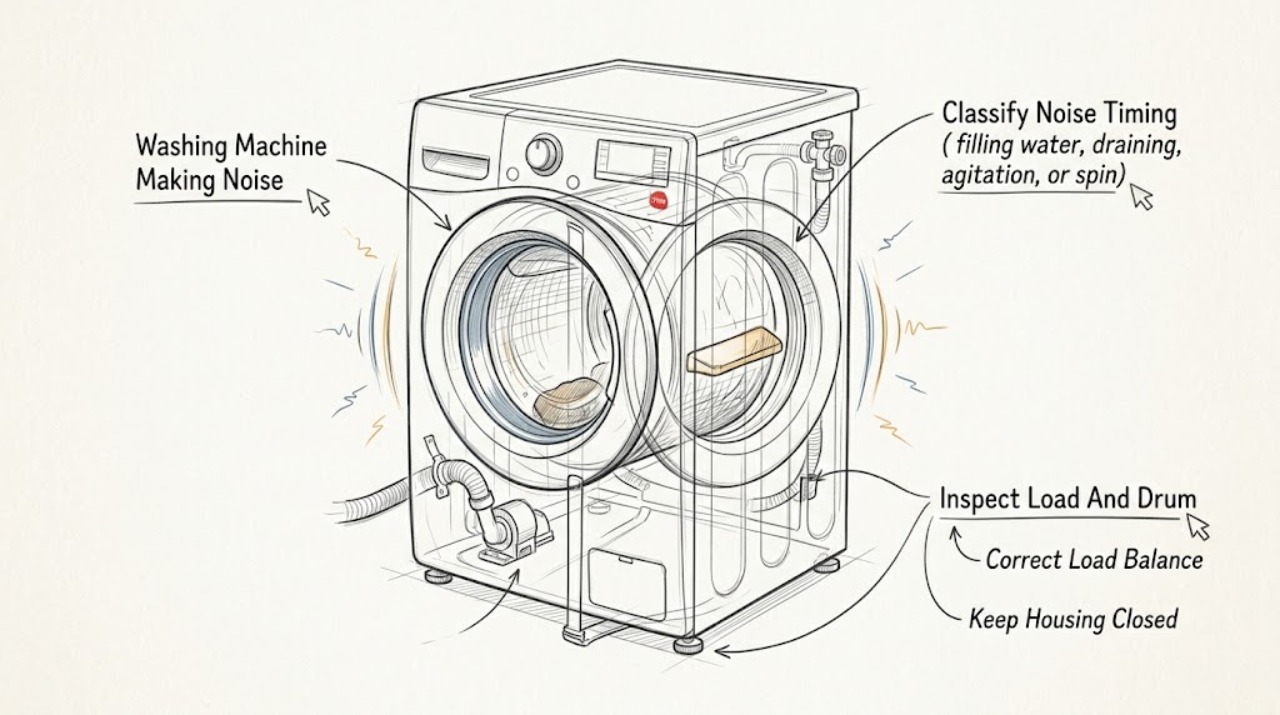
Work through in order
Diagnostic checks
Use only checks that match the exact appliance or system and its official guide.
-
Check 1
From outside the washer, note the exact sound and the cycle stage at which it occurs: door or lid lock, fill, tumble or agitation, drain, or spin; stop the washer normally if the sound is harsh or unsafe.
Expected result: Classify it as a brief click, water rush, gurgle, low pump hum, high-pitched spin sound, thump, rattle, clank, knock, scrape, grind, or violent bang, and record whether it is new or getting worse.
Next step: Proceed to the load and drum check for rattle, clank, or thump; proceed to installation checks for vibration or knocking; arrange service for scrape, grind, loud bang, or any hazard.
Stop if: Do not continue a cycle with smoke, burning smell, arcing, water leakage, a damaged door or drum, violent movement, or a breaker that trips.
Why this matters
Why: Brief clicks, fill/drain sounds, pump hum, and some spin noise can be normal on Electrolux washers. A repeated metallic or impact sound, or a noise present outside the expected stage, needs a physical and installation check rather than a normal-operation assumption.
-
Check 2
Stop the cycle using the normal control, wait until the door or lid unlocks, then check the drum and accessible door-seal area for coins or other loose objects; fasten buckles and other metal fasteners or turn garments inside out before the next test.
Expected result: Record whether a foreign object is present, whether the noise came only with metal fasteners or a particular garment, or whether the drum is clear and the noise occurred with ordinary laundry.
Next step: Remove only loose objects that are safely accessible, correct the clothing issue, and compare with an empty cycle; do not pry around the drum or seal.
Stop if: Do not reach into a moving drum, force a locked door or lid, use tools inside the tub, or continue if an object is trapped behind the drum or seal.
Why this matters
Why: Electrolux identifies foreign objects and clothing fasteners as possible causes of rattling or clanking. If the drum is clear or the sound is a scrape or grind, the noise is not explained by laundry alone.
-
Check 3
With the appliance stopped and unlocked, look for a tightly bundled or single heavy item and redistribute laundry evenly; do not add weight to a washer that is already moving violently or leaking.
Expected result: Note whether the washer was shaking or walking only at spin, whether laundry was concentrated on one side, and whether the tub settles when the load is redistributed.
Next step: Run the normal cycle only if the machine is stable and no hazard is present; if movement remains, move to the level and installation check instead of repeatedly rearranging laundry.
Stop if: Stop for violent movement, cabinet impact, a damaged floor or pedestal, a door or lid that shifts, water leakage, or any need to restrain the washer by hand.
Why this matters
Why: An off-balance load can create thumping, vibration, or shaking during spin. If the washer still shakes with a balanced load, the cause may be leveling, flooring, shipping restraints, stacking hardware, or an internal fault.
-
Check 4
If the unit is newly installed, moved, or shaking, inspect only ordinary-access installation points: shipping materials or bolts removed, washer resting on a solid floor, all feet firmly planted, and the unit level front-to-back and side-to-side.
Expected result: Record whether any transport material remains, a foot is off the floor, the washer rocks when safely nudged, the floor is soft or unstable, or the level and footing appear sound.
Next step: Follow the exact installation manual to correct an accessible foot or transport-restraint issue, or return a recently installed unit to the installer; contact service when the washer cannot be made stable without moving or opening it.
Stop if: Do not lift or tip a loaded washer, remove cabinet panels, work beneath an unsupported appliance, or run it while it rocks or strikes nearby surfaces.
Why this matters
Why: Electrolux identifies remaining shipping materials, an unlevel washer, unstable flooring, and improperly set feet as causes of vibration or noise. A sound installation with persistent noise points back to the load or appliance and should not be corrected by improvised shims or cabinet disassembly.
-
Check 5
From behind or beside the appliance only if access is safe, check whether the drain hose is slapping or rubbing the cabinet or wall and, for a stacked unit, whether the approved stacking kit, brackets, and feet appear secure; do not pull out an unstable appliance.
Expected result: Record whether the knocking follows pump-out or spin, whether the hose visibly contacts a surface, and whether the stacked dryer or washer shifts independently or has a loose bracket or pedestal.
Next step: Secure the hose only as the installation instructions allow; stop using a loose stack and arrange installer or qualified service inspection.
Stop if: Do not use an improvised tie, move a stacked appliance alone, work under a pedestal, or continue when the stack, hose connection, or water line is damaged or leaking.
Why this matters
Why: Electrolux links knocking to an unsecured drain hose and advises checking stacking hardware and feet. A hose or hardware correction may address the noise; a loose or shifting stack is a safety and installation issue, not a reason to tighten inaccessible parts while loaded.
-
Check 6
After the drum and installation checks, run an empty cycle or the model's approved empty test only when the washer is stable, closed, dry outside, and free of electrical or mechanical hazard; remain nearby and stop if the noise returns sharply.
Expected result: Record whether the noise disappears when empty, remains at the same cycle stage, changes with spin speed, or is accompanied by leaking, scraping, a hot smell, or unusual movement.
Next step: If the empty cycle is quiet, correct loading and monitor; if it is noisy, stop repeated testing and give the technician the sound recording, cycle stage, installation history, and checks already completed.
Stop if: Stop immediately for grinding, scraping, loud impact, violent shaking, smoke, burning smell, water leakage, exposed wiring, or a breaker trip.
Why this matters
Why: Noise that disappears points toward the load or loose laundry; noise that remains with an empty drum points toward installation or the washer itself. A change with speed or a new leak does not identify a specific part but justifies service.
Use your observations
Decision map
Find the observation that best matches what you see, then follow the next safe action.
-
PATH 01Safety boundary
What you see
The sound is a brief click, water rush, drain gurgle, low pump hum, or high-pitched spin sound and there is no abnormal movement, leak, or damage.
Do this next
Monitor the sound through the cycle and use the exact model manual if the character or timing changes.
Why this path and its safety boundary
Why it matters: Electrolux describes these as possible normal washer operating sounds.
Safety stop: Stop if the sound becomes metallic, impacts the cabinet, persists while empty, or is joined by a safety symptom.
-
PATH 02Safety boundary
What you see
Rattle or clank occurs with a particular load, metal fastener, or loose object and disappears when the item is removed or the washer is empty.
Do this next
Remove the object, fasten or turn garments inside out, and monitor a balanced load.
Why this path and its safety boundary
Why it matters: The laundry or accessible foreign object is the leading explanation rather than a confirmed washer-part failure.
Safety stop: Do not continue if an object is trapped behind the drum, the noise becomes scraping, or the drum or seal is damaged.
-
PATH 03Safety boundary
What you see
Thumping or shaking is concentrated in spin and improves after redistributing laundry, leveling the washer, removing transport restraints, or securing accessible installation points.
Do this next
Use the exact installation instructions, keep all feet firmly planted, and have an installer correct a recent installation when transport or stacking work is involved.
Why this path and its safety boundary
Why it matters: Load balance or installation stability plausibly caused the vibration.
Safety stop: Stop if the washer still walks, strikes the cabinet, rocks, leaks, or requires lifting, tipping, or cabinet access.
-
PATH 04Safety boundary
What you see
Rattling, clanking, scraping, grinding, or loud impact remains with an empty cycle after accessible load and installation checks.
Do this next
Stop repeated testing and arrange qualified Electrolux service with the sound timing, recording, model, installation history, and observations.
Why this path and its safety boundary
Why it matters: The noise is coming from the washer or unresolved installation rather than the laundry; the exact internal cause cannot be identified safely from sound alone.
Safety stop: Do not open the cabinet, spin the drum by force, probe wiring, or order a bearing, belt, pump, motor, or suspension part by guesswork.
-
PATH 05Safety boundary
What you see
Noise is accompanied by water leakage, smoke, burning smell, arcing, exposed wiring, damaged door or drum, violent movement, or a breaker that trips.
Do this next
Stop using the washer, isolate power only if safe and without touching damage, keep people away from the area, and arrange qualified appliance or electrical service.
Why this path and its safety boundary
Why it matters: The appliance presents a water, electrical, fire, or mechanical hazard; this is not a routine noise adjustment.
Safety stop: Do not restore a repeatedly tripping breaker, operate with damaged glass or wiring, reach into the machine, or attempt an internal repair.
Helpful context
Understand the symptom
First decide whether the sound is part of the cycle
Write down when the noise starts: filling, locking, tumbling or agitation, draining, or high-speed spin. Electrolux lists clicks from door locking or water valves, gurgling during draining, low hum from the drain pump, rushing water during fill, and a high-pitched spin sound as possible normal operating sounds. A short thump at the beginning of spin can also occur with a heavy load. A sound that is new, metallic, scraping, rapidly worsening, or present when the drum is empty deserves a different path.
Separate laundry and loose-object noise from washer noise
Stop the cycle using the normal control and wait for the door or lid to unlock. Check the drum and accessible seal area for coins or other loose objects, and fasten belt buckles and metal fasteners or turn garments inside out. Redistribute an obviously unbalanced load rather than adding more weight to a machine that is already shaking. Do not reach into a moving drum or force a locked door.
Check the installation before suspecting a failed part
If the washer was recently installed or moved, verify from ordinary access that all shipping materials and shipping bolts were removed, the appliance rests firmly on a solid level floor, and each foot is stable. For a stacked installation, the stacking kit, brackets, and feet must be secure. Secure a drain hose that is tapping the cabinet or wall. Do not remove panels to inspect suspension, drive, or wiring parts; those checks belong to a qualified technician.
Use an empty cycle as a controlled split test
After visible loose items are removed and the washer is safely closed, run an empty cycle only if there is no leak, electrical smell, damaged glass, or violent movement. If the sound disappears, inspect the previous load and fasteners. If it persists with no laundry, the source is in the appliance or installation rather than that load, and continued operation should be limited to what the manual and service guidance allow.
Escalate repeating or hazardous noise
Contact Electrolux or a qualified appliance technician when an empty cycle reproduces the noise, the washer walks or strikes the cabinet, a recently installed unit still has shipping or leveling concerns, or the sound is a repeated scrape, grind, loud bang, or metallic knock. Stop immediately for water leakage, smoke, burning smell, arcing, exposed wiring, a damaged drum or door glass, uncontrolled movement, or a breaker that trips.
Safety boundary
Stop conditions
- Do not reach into a moving drum, force a locked door or lid, or lift, tip, or move a loaded or stacked appliance alone.
- Stop for water leakage, smoke, burning smell, arcing, exposed or hot wiring, damaged door glass or drum, violent movement, cabinet impact, or a breaker that trips again.
- Do not open the cabinet, probe live terminals, spin internal parts by force, or replace a bearing, belt, pump, motor, suspension part, or control from the sound alone.
- Do not run a washer that rocks, walks, has remaining shipping restraints, or has loose stacking hardware until the installation is corrected by the manual, installer, or qualified service.
- Do not continue repeated empty-cycle tests when the noise is scraping, grinding, metallic, rapidly worsening, or accompanied by a leak or heat smell.
Only after diagnosis
Potential parts
- model-specific leveling foot or installation hardware
Consider this category only if the exact installation instructions or technician confirms a damaged or missing foot or related installation component is causing instability.
Confirm the complete Electrolux model and installation configuration; do not substitute a generic foot or use it to compensate for an unstable floor or loose stack. - model-specific drain hose support or hose assembly
Consider this category only if inspection confirms a damaged hose or support is striking a surface or leaking and the installation instructions call for replacement.
Verify the exact model, hose routing, connection, and water-safety requirements with Electrolux or a qualified technician before ordering. - model-specific drum suspension or drive component
Consider this category only after qualified diagnosis confirms an internal suspension or drive fault when noise persists with an empty drum and installation is sound.
Confirm exact model fit, revision, safety procedure, and technician diagnosis; do not select a bearing, belt, pump, motor, or suspension part from sound alone.
When checks do not resolve it
Need a professional?
Arrange Electrolux or qualified appliance service when the noise remains with an empty cycle, the washer still shakes after the load and accessible installation checks, a stacked installation is loose, shipping restraints or leveling cannot be safely corrected, or the sound is scraping, grinding, metallic, or rapidly worsening. Stop immediately and seek urgent qualified help for water leakage, smoke, burning smell, arcing, exposed wiring, damaged glass or drum, violent movement, or a repeat breaker trip.
Safety scope: This article supports sound classification, stopping and unlocking normally, accessible load and installation checks, and a cautious empty-cycle split test only when safe. It does not authorize cabinet removal, live testing, internal disassembly, or part replacement.
Common questions
FAQ
Which Electrolux washer sounds are normal?
Electrolux lists clicks from locking or valves, water rushing during fill, gurgling while draining, low pump hum, and high-pitched spin sounds as possible normal sounds. Timing and whether the washer remains stable matter; a new metallic or impact noise needs investigation.
Why is my Electrolux washer rattling or clanking?
Check for coins or other loose objects in the drum and metal buckles or fasteners on clothing. Stop safely, wait for the door or lid to unlock, remove only accessible objects, and use an empty cycle to see whether the sound follows the washer.
Why does the washer thump or shake during spin?
A heavy or unbalanced load can thump at spin start, while remaining shipping restraints, an unlevel washer, unstable flooring, loose feet, a drain hose, or stacking hardware can cause vibration. Correct only accessible installation issues under the exact manual; stop if the washer walks or strikes surfaces.
What does it mean if the noise remains when the drum is empty?
The sound is coming from the washer or unresolved installation rather than that load. Stop repeated testing and arrange qualified service with the model, sound timing, recording, and checks already completed. Do not guess at a belt, bearing, pump, motor, or suspension replacement.
When should I stop using a noisy Electrolux washer?
Stop for water leakage, smoke, burning smell, arcing, exposed wiring, damaged glass or drum, violent movement, cabinet impact, scraping or grinding, or a breaker that trips again. Use qualified appliance or electrical service for the hazard.
Read the exact guide
Official sources
- Delivery and Installation Guide - LaundryElectrolux · Official Electrolux installation guidance for top-load and front-load washers and stacked laundry; exact model installation instructions control.
- What should I do if my washer does not start?Electrolux · Official Electrolux washer support article; used here only for the ordinary-access level, lid/door, power, and qualified-service boundaries.
- Is it normal for my washer to make sounds or noises?Electrolux · Official Electrolux washer support guidance; use the exact appliance manual for model-specific operation.
- Laundry Washers Noises GuideElectrolux · Official Electrolux support article applying to laundry washers; exact model instructions control installation and service steps.
Community feedback
Share a repair observation
Share a plain-text repair observation. Accepted observations are published automatically; this page may take a moment to update.