
On this page
Start here
Quick answer
First identify whether your Fisher & Paykel dishwasher is a conventional full-size model or a DishDrawer, because the filter and drain path are different. A new-appliance smell may fade after a few wash programmes, but an established odor is more consistent with dirty filters, food left on dishes, a dirty interior, or water that is not draining. Stop the cycle, let hot water and spray parts cool, disconnect power and turn off the water before cleaning, then remove heavy food soil, clean only the filter and spray-arm parts your model manual identifies, and refit them fully. Run the model's documented empty or deep-clean cycle with a dishwasher cleaner only if the manual and product label allow it. If water remains, the drain hose or air gap is blocked, there is a leak, persistent foam, a fault alert, or the smell returns after correct cleaning, stop using the dishwasher and arrange Fisher & Paykel service.
Before you begin
Safety first
- The user may identify the model, stop a cycle, wait for cooling, disconnect power and turn off water, remove food, clean model-permitted filters, filter plates, spray arms, seals, and accessible residue, and inspect visible hose or air-gap conditions. Pump, drain disassembly, plumbing disconnection beyond the manual, wiring, heater, motor, controls, seals requiring disassembly, and live electrical work are for qualified personnel.
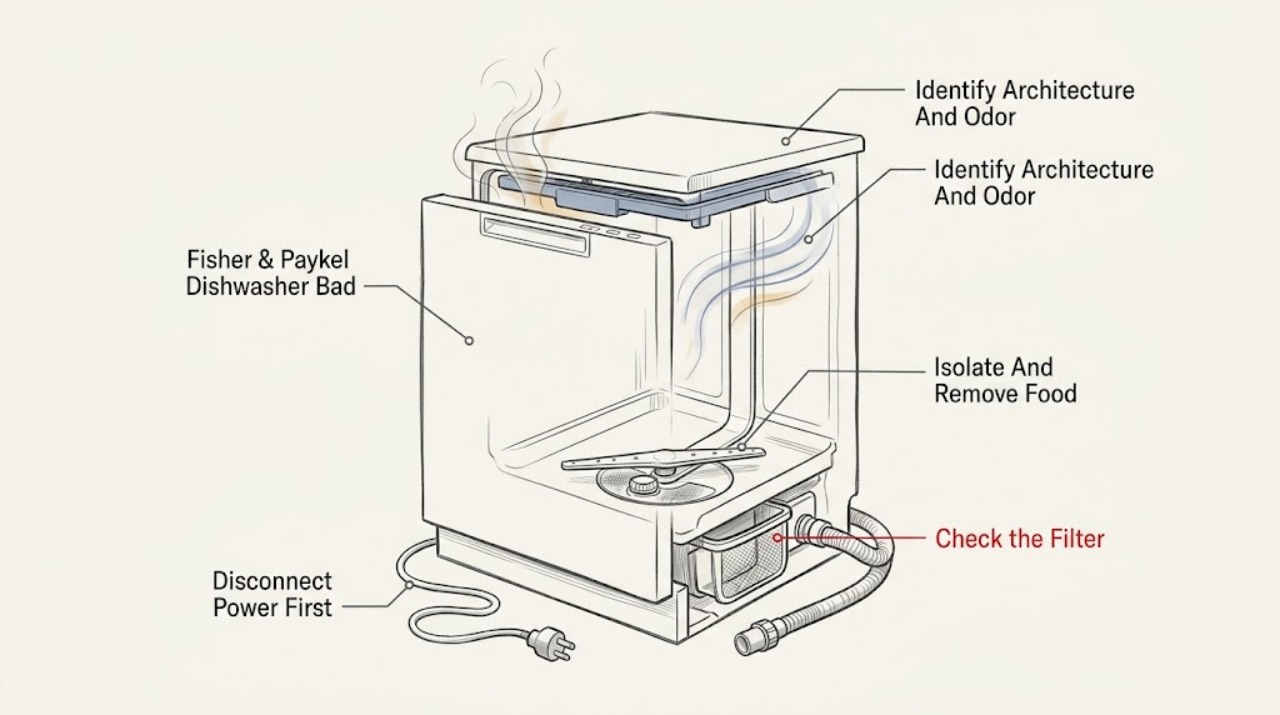
Work through in order
Diagnostic checks
Use only checks that match the exact appliance or system and its official guide.
-
Check 1
Record the exact model from its rating label and identify whether the dishwasher is a conventional full-size door-and-rack model or a DishDrawer. Note whether the odor is new-appliance odor, food or sour odor, stagnant-water odor, chemical or detergent odor, or a burning/electrical odor; also note any standing water, foam, leak, or fault indication.
Expected result: The machine is a full-size dishwasher or DishDrawer, and the smell is either limited to a new appliance or accompanied by residue, standing water, foam, leakage, abnormal heat, or an electrical smell.
Next step: Use the full-size branch only for a matching conventional layout and the DishDrawer branch only for a matching drawer layout. For a new-appliance smell without a hazard, follow the model's normal programme guidance; for residue or water, isolate the dishwasher before cleaning.
Stop if: Stop the cycle and disconnect power if there is smoke, a burning or electrical odor, abnormal heat, liquid near electrical components, a damaged cord or plug, or an active leak. Do not try to mask that condition with a cleaner.
Why this matters
Why: The filter and drain procedure depends on the architecture. A new-appliance smell may fade after several programmes on the cited full-size model, while residue or standing water makes cleaning or drainage more likely. Burning odor, smoke, liquid near electrical parts, or a leak is not a cleaning problem.
-
Check 2
Stop the programme and wait until the tub, water, and spray parts are no longer hot. Disconnect the dishwasher plug from the outlet and turn off the water supply before cleaning; remove dishes and rinse heavy food soil under running water. Wipe accessible residue from the tub, door seal, and door edge with a gentle cleaner only where the model guide permits.
Expected result: Food scraps or residue are present, the door seal is dirty, or the interior is visibly clean; the water is still hot or the appliance cannot be safely isolated.
Next step: Continue only when the machine is cool and isolated. Remove only loose, accessible residue; if the odor is new-appliance odor with no residue or hazard, run the documented normal programmes and reassess rather than applying chemicals.
Stop if: Do not reach into a running or recently hot dishwasher, open the door fully while spray parts may still be moving, use hand soap, laundry detergent, disinfectant, or unapproved chemicals, or continue when power or water cannot be safely isolated.
Why this matters
Why: Fisher & Paykel links odor to dirty dishes and a dirty interior and directs regular cleaning. The full-size safety instructions require power and water isolation before cleaning; hot water and a running spray arm create a scald or moving-part hazard.
-
Check 3
Clean the filter assembly only for the identified architecture. On a conventional full-size model matching the DW60DOX guide, remove the lower basket, twist the filter cylinder anticlockwise, lift the main plate, separate the coarse and micromesh filters, rinse all three, then reassemble and twist clockwise until the arrows align. On a DishDrawer matching the DD60 guide, twist the drain filter anticlockwise, separate its cap as shown, rinse the parts in hot water, and rotate the filter clockwise until the arrows align when refitting.
Expected result: The filter contains food or sludge, the assembly is clean, the filter will not unlock or refit as shown, or the layout does not match either cited guide.
Next step: Remove only loose residue, rinse the documented parts, and verify the filter is fully seated and flush or aligned as the exact guide shows. If the filter cannot be safely removed, is cracked, or is not the same design, stop and obtain the exact manual or service.
Stop if: Do not pry with sharp tools, reach into the pump opening, force a locking mechanism, operate without the filter assembly, or touch the filter while power is connected.
Why this matters
Why: A dirty filter is an official Fisher & Paykel cause of odor and can also contribute to retained water. A mismatch or resistance means the model-specific guide is different; forcing the filter can damage the seal or drain path.
-
Check 4
With power still disconnected, inspect the spray arm and, on a DishDrawer, the filter plate. For the full-size guide, rinse the lower and upper spray arms and refit the lower arm until it clicks and the upper locking nut is tight. For a matching DishDrawer, lift the spray arm as shown, rinse until all holes flow, lift the filter plate only after the drain filter is removed, clean its recess under hot water, and push it back into place.
Expected result: Food particles block spray holes or the filter-plate recess, the arm cannot rotate freely after refitting, or these accessible areas are clear.
Next step: Rinse only the documented removable parts, clear loose particles without damaging holes or edges, refit them exactly, and confirm free spray-arm movement by hand before restoring power. Move to a drain check if water or odor remains.
Stop if: Do not use a knife or wire to enlarge holes, handle a sharp filter-plate edge carelessly, force the arm or plate, remove fixed covers, or perform any inspection while powered.
Why this matters
Why: Blocked spray paths can leave residue in the tub and on dishes, while a filter-plate recess that is not clean or a spray arm that is not seated can reduce washing and drainage performance. A part that does not match the model guide may belong to another architecture.
-
Check 5
Look for water left after the cycle and inspect only the visible drain route permitted by the exact manual. On the cited full-size model, a blocked filter or bent or blocked drain hose is associated with retained water. On the cited DishDrawer guide, check for a blocked filter, bent drain hose, or blocked air gap; do not disconnect hoses or reach into the plumbing as a first-line repair. After the filter and spray parts are correctly refitted, run the model's documented empty or deep-clean cycle, using Fisher & Paykel Dishwasher Cleaner only when the model guide and label allow it.
Expected result: The tub drains normally, water remains, the hose or air gap is visibly bent or blocked, the dishwasher leaks or foams, or the odor improves after the cleaning cycle.
Next step: Correct only a visible kink or model-documented external blockage, then perform one supervised documented cleaning cycle. If water remains, a leak or foam returns, or the odor persists, keep the dishwasher isolated and arrange qualified service.
Stop if: Do not pour caustic drain opener into the dishwasher, dismantle the pump or drain assembly, disconnect plumbing without the exact installation procedure, run repeated cycles with standing water, or continue after a leak or flood indication.
Why this matters
Why: Normal drainage and an improved odor support residue or maintenance as the likely cause. Retained water makes a drain restriction or pump-side issue more likely; a leak or excess foam is a stop condition, not permission to keep cycling. The cleaner product is intended for the interior, filter, spray arms, and drain but does not prove a failed component.
Use your observations
Decision map
Find the observation that best matches what you see, then follow the next safe action.
-
PATH 01Next step
What you see
The appliance is new, there is no standing water, residue, leak, foam, smoke, or electrical odor, and the smell matches a temporary new-appliance odor.
Do this next
Run the exact model's normal programmes as directed and reassess. If the smell does not fade or changes to food, stagnant-water, chemical, or burning odor, use the corresponding branch instead.
Why this path and its safety boundary
Why it matters: The cited Fisher & Paykel full-size guide says a normal new-appliance smell should disappear after a few wash programmes; this does not establish that every Fisher & Paykel model uses the same programme or duration.
-
PATH 02Next step
What you see
The odor is food-like or sour, dishes or the tub have residue, or the matching filter contains food or sludge, with no leak or electrical hazard.
Do this next
Isolate power and water, remove heavy soil, clean the architecture-matched filter and spray paths, refit them, and run the documented empty or deep-clean cycle if permitted. Do not apply the full-size filter-cylinder procedure to a DishDrawer.
Why this path and its safety boundary
Why it matters: Dirty filters, heavy food soil, and dirty dishes standing for several days are official odor causes for the cited full-size model; the DishDrawer guide separately documents filter, plate, and spray-arm cleaning and a deep-clean cycle.
-
PATH 03Next step
What you see
Water remains after a completed cycle, the odor is stagnant, or a DishDrawer shows a drain-related alert, but there is no active leak.
Do this next
Clean the matching filter, check only visible external hose or air-gap conditions allowed by the model guide, and run one documented cycle. If water remains or a drain fault returns, stop and arrange service for the drain path or pump.
Why this path and its safety boundary
Why it matters: The cited full-size guide associates retained water with clogged filters or a bent or blocked drain hose. The DishDrawer guide adds a blocked air gap and documents drain-hose and pipe checks for its drain fault.
-
PATH 04Safety boundary
What you see
Water is leaking, foam is excessive, a flood or service indication appears, the odor is burning/electrical, or the appliance is unusually hot.
Do this next
Turn off the water and power, keep the dishwasher out of use, record the alert and model, and arrange Fisher & Paykel authorised service. Do not run a cleaning cycle to test it.
Why this path and its safety boundary
Why it matters: These signs can involve water, electrical, detergent, or internal component hazards. Fisher & Paykel's DishDrawer guide directs owners to turn off water and power for other leaks, and the full-size guide directs owners to disconnect and contact an authorised service centre when a fault cannot be solved.
Safety stop: Do not touch leaking water near electrics, open the pump or wiring area, keep restarting a flooding appliance, or attempt live electrical testing.
-
PATH 05Next step
What you see
The correct filter, filter plate, spray arm, visible drain path, and documented cleaning cycle have been completed, but the odor returns or water remains.
Do this next
Stop repeated cycles, keep the appliance isolated if water or a leak is present, and provide the technician with the exact model, architecture, odor pattern, water level, alerts, filter condition, and cleaning steps completed.
Why this path and its safety boundary
Why it matters: A recurring odor after safe user maintenance makes an inaccessible drain, seal, pump, hose, detergent-dispenser, or control-related problem more plausible, but the cited guides do not justify selecting a replacement part from odor alone.
Helpful context
Understand the symptom
Start with the odor pattern and dishwasher type
A smell that appeared immediately on a new appliance is a different case from a food, sour, or stagnant-water odor that developed after use. Before removing anything, note whether the tub is dry, whether water remains in the bottom, whether dishes have been left inside for days, and whether the machine is a conventional door-and-rack dishwasher or a DishDrawer. Fisher & Paykel documents different filter layouts for those families, and the exact model guide controls the procedure.
Clean the filter path that matches the architecture
For the full-size DW60DOX example, the filter cylinder unlocks by twisting anticlockwise, the main filter plate is lifted out, and the coarse and micromesh filters are separated and rinsed under running water before being reassembled and locked until the arrows align. For the cited DishDrawer DD60 family, the drain filter is twisted anticlockwise and lifted out, its cap is separated and rinsed in hot water, and the filter is rotated clockwise back into the holder. Do not force a part that does not match your model's guide.
Remove residue from spray and drain areas
Food particles can remain in a filter, filter-plate recess, or spray-arm holes and can be recirculated into the tub. With power isolated, inspect only accessible parts: rinse the applicable spray arm until water flows through its holes, wipe accessible residue, and refit the arm so it rotates freely. If water remains after a cycle, check only the visible, model-permitted drain hose and air-gap path; a blocked filter or bent or blocked hose can prevent drainage.
Use a documented cleaning cycle, then reassess
Remove heavy food from dishes under running water and avoid leaving dirty dishes in the closed appliance for several days. If the interior is dirty, the full-size guide permits running the dishwasher empty; the DishDrawer guide refers to a deep-clean cycle. Fisher & Paykel's Dishwasher Cleaner is described as cleaning the interior, filter, spray arms, and drain, but use it only when the exact model instructions and label permit it. A smell that persists after a correctly refitted filter, clear visible drain path, and documented cleaning cycle is a service symptom rather than a reason to add harsher chemicals or dismantle the pump.
Safety boundary
Stop conditions
- Stop and isolate power and water for smoke, burning or electrical odor, abnormal heat, a damaged cord or plug, liquid near electrical parts, an active leak, flood indication, or excessive foam.
- Before cleaning a conventional Fisher & Paykel dishwasher, disconnect the plug and turn off the water as directed by the guide; do not reach into hot water or a running spray arm.
- Use only dishwasher detergent and a model- and label-approved dishwasher cleaner. Do not use hand soap, laundry detergent, disinfectant, caustic drain opener, or improvised chemicals.
- Do not force, pry, drill, or sharpen filter, filter-plate, spray-arm, hose, pump, or drain parts; do not operate with the documented filter assembly missing or incorrectly seated.
- Arrange qualified Fisher & Paykel service for inaccessible drain or pump work, wiring, controls, heater, motor, active leaks, recurring fault alerts, or an odor that persists after the exact model's safe cleaning procedure.
When checks do not resolve it
Need a professional?
Arrange Fisher & Paykel authorised service when standing water or a drain fault remains after the exact model's filter and visible hose or air-gap checks, when a leak or flood/foam condition occurs, when a burning or electrical odor is present, or when the smell returns after the matching filter, spray-arm, filter-plate, and documented cleaning-cycle steps. Internal pump, drain, hose, heater, wiring, control, seal, and live electrical work are professional tasks.
Safety scope: The user may identify the model, stop a cycle, wait for cooling, disconnect power and turn off water, remove food, clean model-permitted filters, filter plates, spray arms, seals, and accessible residue, and inspect visible hose or air-gap conditions. Pump, drain disassembly, plumbing disconnection beyond the manual, wiring, heater, motor, controls, seals requiring disassembly, and live electrical work are for qualified personnel.
Common questions
FAQ
Why does my Fisher & Paykel dishwasher smell bad?
For the cited full-size Fisher & Paykel model, official guidance lists a temporary new-appliance smell, dirty filters, and dirty dishes standing for several days. A dirty DishDrawer filter, filter plate, spray arm, or retained water can also leave residue. Identify the architecture, isolate power and water, clean only the matching parts, and check drainage before considering service.
How do I clean a Fisher & Paykel dishwasher filter?
The answer depends on the model. The cited DW60DOX conventional guide uses a filter cylinder, main plate, coarse filter, and micromesh filter; the cited DD60 DishDrawer guide uses a drain filter with a cap plus a filter plate. Follow the exact guide, rinse the documented parts, and refit the locking arrows or seating features fully. Do not force a different layout.
Can standing water cause the dishwasher smell?
Yes, retained water can carry a stagnant odor and indicates a drainage issue. Official Fisher & Paykel guidance points to clogged filters and a bent or blocked drain hose on the cited full-size model; the DishDrawer guide also identifies a blocked air gap and provides drain-fault guidance. Clean the matching filter and inspect only visible, model-permitted external drainage conditions. Persistent water needs service.
Should I run dishwasher cleaner for a bad smell?
Only if the exact model guide and the cleaner label allow it. Fisher & Paykel describes its Dishwasher Cleaner as cleaning the interior, filter, spray arms, and drain, while the DishDrawer care guide refers to a deep-clean cycle. First remove food residue and correctly refit the filter and spray arm; a cleaner cannot safely substitute for a leak, blocked drain, or internal fault diagnosis.
When should I stop using a Fisher & Paykel dishwasher with a bad smell?
Stop and isolate power and water for a burning or electrical odor, smoke, abnormal heat, leak, flood indication, or excessive foam. Also arrange service when water remains or the odor returns after the exact model's filter, spray-arm, visible drain, and documented cleaning-cycle checks. Do not open the pump, wiring, heater, controls, or sealed drain system.
Read the exact guide
Official sources
- DishDrawer Dishwasher Care Guide — DD60DAX9, DD60DAW9, DD60SAW9, DD60SAX9Fisher & Paykel · Limited to the listed DishDrawer models and related architecture; filter, filter-plate, spray-arm, drain-hose, air-gap, deep-clean, foam, leak, and fault behavior can vary by model.
- Installation instructions and User guide — Dishwasher, DW60DOX modelsFisher & Paykel · Model-specific conventional full-size dishwasher guidance; filter-cylinder, spray-arm, odor, retained-water, detergent, and safety instructions must not be assumed for DishDrawer or other models.
- Dishwasher CleanerFisher & Paykel · Supports the product's stated cleaning scope for Fisher & Paykel dishwashers; the exact appliance guide and product label control compatibility, dosage, and cycle use.
Community feedback
Share a repair observation
Share a plain-text repair observation. Accepted observations are published automatically; this page may take a moment to update.