
On this page
Start here
Quick answer
Food or residue under a Fisher & Paykel DishDrawer filter plate is a user-cleaning issue only when the exact model manual supports removing that plate. Turn off power, let the drawer cool, and close the water supply if a leak is present. Identify the full model before choosing the locking method: the opened DD24/DD60/DD36/DD90 guide documents different plate and filter arrangements from the opened integrated DD60 guide. Clean the accessible plate, recess, filter and spray arm as that exact manual directs, then refit the O-ring, locking nut or ring, filter and spray arm so the plate is flat, locked and flush. Do not run the dishwasher with the plate or drain filter missing or loose. If the plate will not lock, moves, leaks, or buildup returns after correct cleaning, stop and arrange service rather than guessing a pump, seal or replacement part.
Before you begin
Safety first
- Disconnect power before filter work, let the drawer cool, close the water supply for a leak, do not run without the filter plate/drain filter/spray arm correctly fitted, and do not force the retainer or open internal covers.
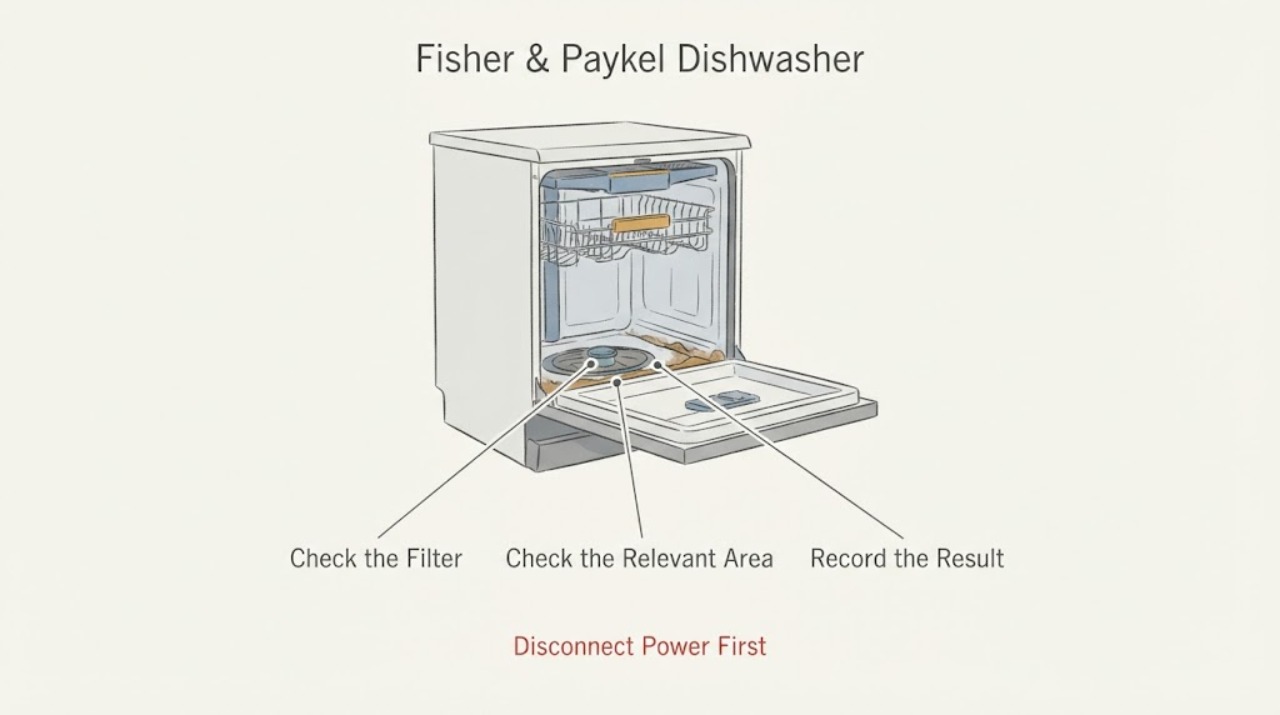
Work through in order
Diagnostic checks
Use only checks that match the exact appliance or system and its official guide.
-
Check 1
Stop the dishwasher, disconnect its electrical power before reaching into the drawer, and allow hot water and the plate to cool. If water is leaking, close the dishwasher water supply as a separate safety measure. Do not operate the drawer while the filter plate or drain filter is removed or loose.
Expected result: The drawer is hot, water is present outside the tub, or the filter plate/drain filter is already loose or missing.
Next step: Keep the appliance off until it is cool, dry externally and all model-approved filtration parts can be correctly refitted; use service if the source of a leak is not visible or the part will not seat.
Why this matters
Why: The opened DishDrawer guides require power to be off for filter work and require the filter plate, drain filter and spray arm to be correctly in place during use. A leak or a missing safety/filtration part is not a normal cleaning run.
-
Check 2
Read the full model number from the rating label or owner documentation before releasing the filter plate. Match the model to its Fisher & Paykel guide and identify whether it uses the older guide's outer-ring arrangement or the integrated DD60 guide's locking-nut arrangement.
Expected result: The model matches DD24, DD60, DD36 or DD90 coverage in the opened guide, matches one of the listed integrated DD60 models, or cannot be matched.
Next step: Follow only the exact matched guide. If the model cannot be matched, limit work to accessible filter cleaning and identification, and contact Fisher & Paykel or qualified service before forcing the plate.
Why this matters
Why: The sources show that filter-plate retention and access are not one universal Fisher & Paykel procedure. A family name alone does not prove that a ring, nut, O-ring or removal direction is compatible.
-
Check 3
Using the exact model guide, remove the drain filter, spray arm and filter plate only if that guide marks them owner-removable. Lift out visible food residue, wash the plate and filter in hot soapy water, rinse, and wipe the recess with a clean damp cloth; avoid sharp tools, aggressive scraping and internal pump access.
Expected result: Food or grease is present on the plate, drain filter or recess, or the accessible surfaces are already clean.
Next step: Reassemble using the exact guide and check that the plate sits flat. If debris is behind a non-removable cover or the cleaning result does not explain a leak or drainage problem, stop and arrange service.
Why this matters
Why: The opened guides identify filter plate and drain filter cleaning as the user-level response to food particles and buildup. Clean surfaces do not establish that a hidden pump, seal or drain component is faulty.
-
Check 4
Refit the O-ring and filter plate exactly as the matched manual shows, align the guide marks, tighten the outer ring or locking nut only to the documented position, and confirm the plate is flat, locked and cannot move. Refit the drain filter, spray arm and rack before restoring power.
Expected result: The plate locks and remains flush, or it rocks, moves, will not lock, or leaves the filter out of position.
Next step: Do not run the dishwasher if the plate moves, cannot be locked, the O-ring is damaged/missing, or the filter is not flush. Photograph the model and assembly and use qualified service rather than forcing the retainer or substituting a part.
Why this matters
Why: The opened DD24/DD60 guide requires aligned marks, an engaged ring/pin arrangement and a flush filter; the integrated DD60 guide requires the locking nut arrows to align. A loose plate can allow unsafe operation or renewed debris entry.
-
Check 5
After complete model-correct reassembly, record whether the buildup returns, dishes remain dirty, water remains in the tub, or a leak appears. Do not infer a failed pump, drain motor or seal from buildup alone, and do not open the base or remove internal covers.
Expected result: Buildup recurs despite correct cleaning, the plate cannot be secured, the appliance leaks, drainage remains abnormal, or the exact manual calls for service.
Next step: Keep the dishwasher off if it leaks or cannot retain the plate, and contact Fisher & Paykel or qualified appliance service with the full model, serial, symptom timing and photos of the filter assembly.
Why this matters
Why: The opened guides support cleaning and correct refitting, but they do not identify an internal component or a cross-model replacement part for this model-unspecified task. Persistent symptoms exceed the supported external maintenance boundary.
Use your observations
Decision map
Find the observation that best matches what you see, then follow the next safe action.
-
PATH 01Next step
What you see
The full model matches one of the opened Fisher & Paykel guide families and the filter plate can be released using that guide's documented retainer.
Do this next
Clean the plate, filter and recess, then complete the exact alignment and locking checks before use.
Why this path and its safety boundary
Why it matters: The issue is within the manufacturer-documented user cleaning boundary for that model family.
-
PATH 02Next step
What you see
The plate rocks, remains raised, the locking marks/nut do not align, or the drain filter is not flush after refitting.
Do this next
Leave the dishwasher off and arrange model-specific service.
Why this path and its safety boundary
Why it matters: The filtration assembly is not in the required operating position; the source does not support forcing the retainer or choosing an unverified part.
-
PATH 03Next step
What you see
The plate and filter are clean and correctly fitted, but food buildup or poor cleaning returns on later cycles.
Do this next
Record the full model and recurrence conditions, stop if drainage or leakage is present, and request qualified service.
Why this path and its safety boundary
Why it matters: Cleaning alone has not established the cause; the opened sources do not justify diagnosing a pump, drain path or seal without the exact model and further service evidence.
-
PATH 04Next step
What you see
Water leaks outside the drawer, the O-ring is damaged, a sharp or broken part is present, or the drawer cannot be safely closed after refit.
Do this next
Keep power off, close the water supply if needed, avoid touching broken glass or forcing parts, and arrange service.
Why this path and its safety boundary
Why it matters: The appliance is not ready for operation, and an external cleaning article cannot establish safe internal repair.
Helpful context
Understand the symptom
Confirm the DishDrawer family before removing the plate
Fisher & Paykel uses more than one DishDrawer filter-plate arrangement. The opened DD24/DD60/DD36/DD90 guide describes an outer ring and model-specific removal steps, while the opened integrated DD60 guide describes a locking nut for the listed integrated models. Because the task has no model number, use the article for the maintenance decision and identification boundary; use the exact owner guide for the actual release and refit motion.
Clean only the accessible filter area
With power disconnected and the drawer cool, remove only the filter, spray arm and filter plate that the exact guide identifies as owner-removable. The opened guides support hot soapy water, rinsing and wiping the plate recess; they do not support scraping into the pump, removing internal covers or selecting a universal replacement part. Take care around the sharp outer edge noted in the DD24/DD60 guide.
A correct refit is part of the repair
Before restoring power, verify the O-ring is seated, the plate is aligned and flat, the locking marks or nut are in the exact position shown by the manual, and the drain filter is flush. The plate must not move and the spray arm must be back in place. Fisher & Paykel warns that the dishwasher should be used only with the filter plate, drain filter and spray arm correctly fitted.
When checks do not resolve it
Need a professional?
Use Fisher & Paykel or qualified appliance service if the full model cannot be matched to the procedure, the plate or drain filter will not lock/seat flush, the O-ring or retainer is damaged, buildup recurs with drainage or dirty-dish symptoms, water leaks, or any next step would require internal access. Keep power off for leaks or an unsecured filtration assembly.
Safety scope: Disconnect power before filter work, let the drawer cool, close the water supply for a leak, do not run without the filter plate/drain filter/spray arm correctly fitted, and do not force the retainer or open internal covers.
Have this ready
- Provide the full model and serial, DishDrawer configuration, photos of the plate/retainer with power off, whether the plate is flat and locked, where water or buildup appears, and whether drainage or cleaning performance changed.
Common questions
FAQ
Can I use the DD24/DD60 outer-ring procedure on any Fisher & Paykel dishwasher?
No. The opened DD24/DD60/DD36/DD90 guide and the opened integrated DD60 guide show different retention arrangements. Read the full model and use only its matching owner guide; do not force a ring or locking nut that does not match.
Can I run the DishDrawer with the filter plate removed while I test it?
No. Fisher & Paykel says the filter plate, drain filter and spray arm must be correctly in place for use. Disconnect power during cleaning and complete the refit before operation.
Does buildup under the plate prove that the drain pump or another part has failed?
No. The opened manuals support cleaning the plate, recess and filter but do not diagnose an internal component from buildup alone. If buildup returns after correct model-specific cleaning, or drainage/leakage is abnormal, stop and arrange service.
Read the exact guide
Official sources
- 590199D DishDrawer P7 User GuideFisher & Paykel · Opened Fisher & Paykel official user guide for the named DD24/DD60/DD36/DD90 DishDrawer families. It supports the cleaning and refit claims only for those documented families; the task has no model, so it is not used to assert a universal ring or plate layout.
- Integrated DishDrawer User Guide: Cleaning the Filter PlateFisher & Paykel · Opened Fisher & Paykel official guide for the exact integrated DD60 model group named in the document. It supports the model-scoped cleaning and locking-nut branch only for those models, not for every Fisher & Paykel dishwasher.
Community feedback
Share a repair observation
Share a plain-text repair observation. Accepted observations are published automatically; this page may take a moment to update.